


28 Jul National SC-ST Hub Scheme Boosts Inclusive Growth & Industrial Participation
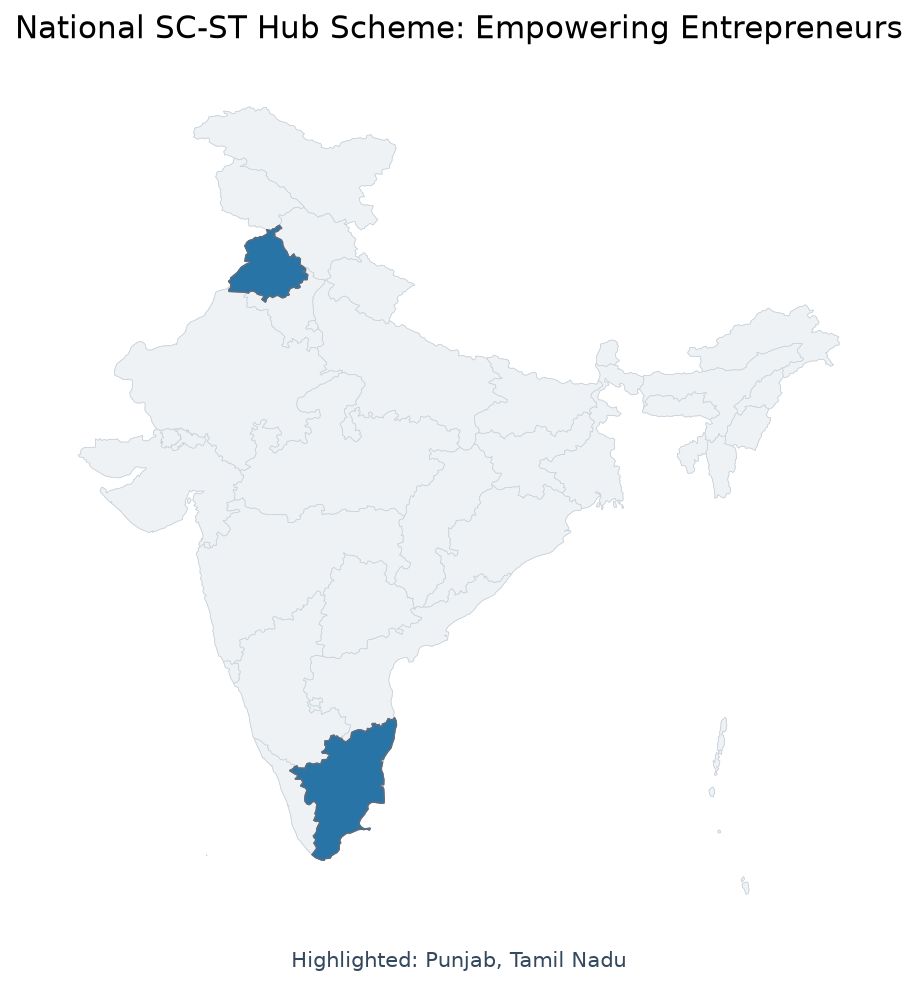
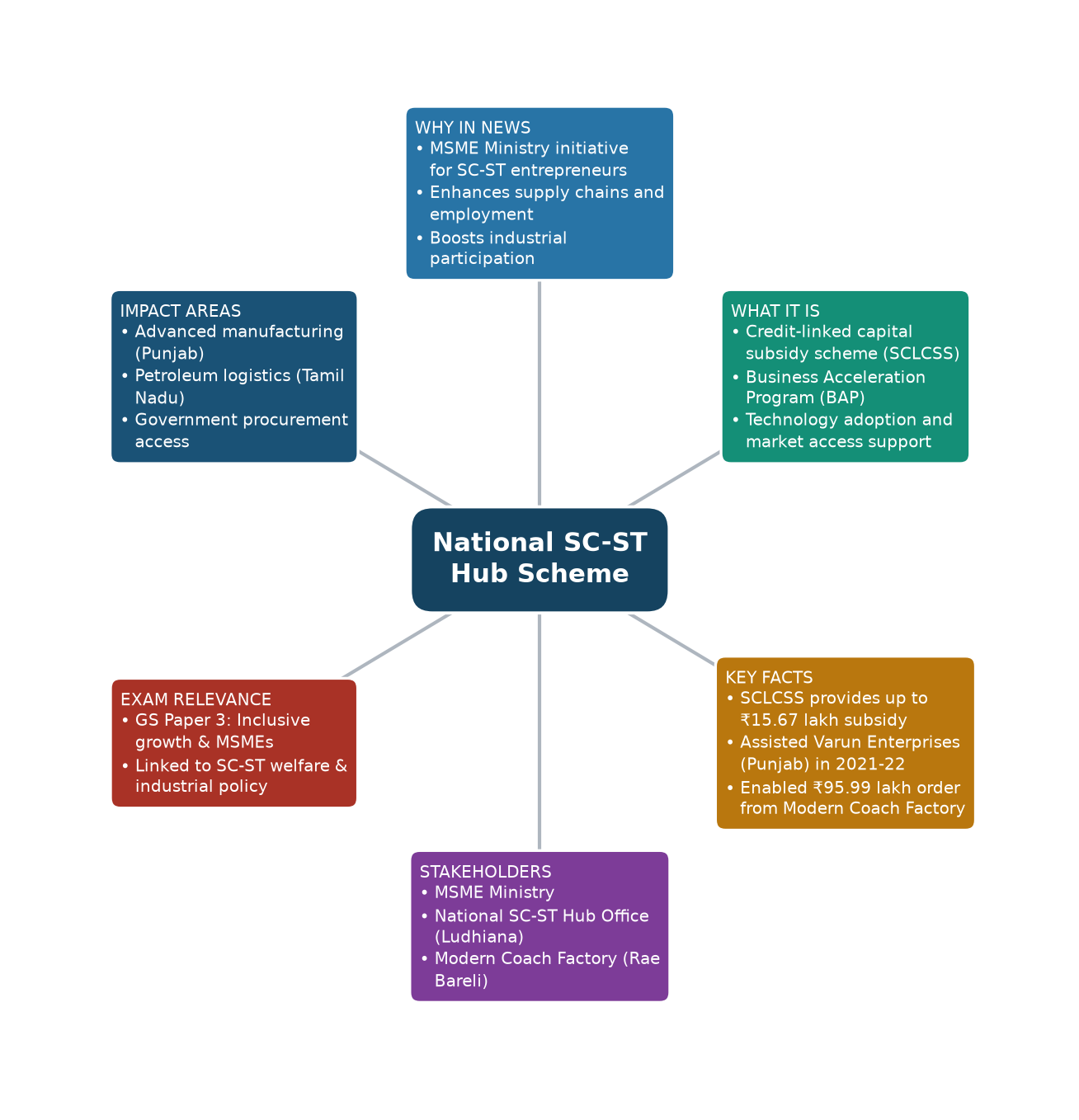
Map & concept mind-map: National SC-ST Hub Scheme: Empowering Entrepreneurs
Subject Relevance — Where This Topic Fits
- GS Paper II — Social Justice (Inclusion of Marginalised Sections) | GS Paper III — Indian Economy (MSMEs, Industrial Policy, Employment Generation) | GS Paper III — Government Schemes for Development and Welfare
- Prelims: National SC-ST Hub Scheme, MSME Ministry, Credit Linked Capital Subsidy Scheme (CLCSS), Business Acceleration Programme (BAP), Public Procurement Policy for SC/ST
- Essay: Inclusive growth as the cornerstone of India’s developmental paradigm, The role of entrepreneurship in bridging socio-economic divides
Quick Revision: The National SC-ST Hub Scheme (NSSH) empowers SC/ST entrepreneurs by providing technology adoption, market access, and public procurement participation, thereby bridging industrial participation gaps.
Why is this in the news?
The National SC-ST Hub Scheme (NSSH), operating under the Ministry of Micro, Small and Medium Enterprises (MSME), has been highlighted for its role in enhancing the participation of SC/ST entrepreneurs in India’s industrial ecosystem by improving supply chain reliability, employment generation, and fostering competitive capabilities through technology adoption, capacity building, and market access facilitation. The scheme’s impact is exemplified through case studies of enterprises such as Varun Enterprises (Punjab) and a petroleum logistics firm in Tamil Nadu, which leveraged financial and technical support to scale operations, achieve compliance, and secure institutional contracts.
Background
- The National SC-ST Hub Scheme was launched in 2016 as a central sector scheme under the MSME Ministry to address the underrepresentation of SC/ST entrepreneurs in India’s industrial and commercial landscape.
- The scheme aligns with constitutional provisions (Articles 15(4), 16(4), 46) and the Directive Principles of State Policy (Article 38, 39) that mandate affirmative action for socio-economically disadvantaged groups.
- India’s MSME sector contributes approximately 30% to GDP and 45% to exports, yet SC/ST entrepreneurs face systemic barriers including limited access to credit, technology, and institutional markets.
- The scheme operates alongside other MSME initiatives such as the Prime Minister’s Employment Generation Programme (PMEGP) and the Credit Guarantee Fund Scheme for Micro and Small Enterprises (CGS).
- The NSSH scheme is implemented through a network of 20 Hubs and 95 Spoke offices across India, coordinated by the MSME Ministry.
What is the National SC-ST Hub Scheme (NSSH)?
- A central sector scheme launched in 2016 under the Ministry of Micro, Small and Medium Enterprises (MSME) to promote entrepreneurship among Scheduled Caste (SC) and Scheduled Tribe (ST) communities.
- The scheme aims to enhance the competitiveness of SC/ST enterprises by providing technology adoption support, capacity-building interventions, and market access facilitation.
- It operates through two key financial instruments: the Special Credit Linked Capital Subsidy Scheme (SCLCSS) and the Business Acceleration Programme (BAP).
- The BAP offers mentorship, training, and handholding support to SC/ST entrepreneurs to address operational bottlenecks, regulatory compliance, and strategic growth challenges.
- The scheme facilitates participation in public procurement by providing certification, vendor development, and tendering support to SC/ST enterprises.
- NSSH Hubs and Spokes serve as nodal points for outreach, capacity-building, and implementation, ensuring grassroots-level engagement.
- The scheme’s performance is monitored through metrics such as number of enterprises supported, employment generated, and value of contracts secured from institutional buyers.
Key Features
| Feature | Significance |
|---|---|
| National SC-ST Hub Scheme (NSSH) | A centrally sponsored scheme under the Ministry of MSME aimed at enhancing the competitiveness of SC-ST entrepreneurs through technology adoption, capacity building, and market access. |
| Special Credit Linked Capital Subsidy Scheme (SCLCSS) | Provides financial assistance (up to 15% of the loan amount) for procurement of advanced machinery and technology to SC-ST enterprises. |
| Business Acceleration Program (BAP) | Facilitates skill development, mentorship, and market linkages for SC-ST entrepreneurs to accelerate business growth. |
| Public Procurement Policy for MSEs | Reserves 4% of annual procurement by central ministries/departments for MSEs owned by SC/ST entrepreneurs, enhancing market access. |
| Technology Upgradation | Adoption of advanced manufacturing equipment (e.g., CNC machines, fiber laser cutting systems) to improve efficiency, quality, and compliance. |
| Capacity Building | Training programs and workshops to address skill gaps, operational bottlenecks, and regulatory compliance among SC-ST entrepreneurs. |
Why it Matters
Economic Empowerment
- Enhances the participation of SC-ST entrepreneurs in India’s industrial ecosystem, fostering inclusive growth and reducing economic disparities.
- Promotes job creation through the expansion of SC-ST-led enterprises, particularly in manufacturing and logistics sectors.
- Strengthens supply chain reliability by integrating SC-ST enterprises into formal industrial networks, reducing dependency on informal sectors.
- Boosts GDP contribution from marginalized communities by enabling them to compete in high-value industrial segments.
Strategic Industrial Integration
- Facilitates the integration of SC-ST enterprises into government and institutional supply chains, including defense, railways, and petroleum logistics.
- Enhances India’s self-reliance in critical sectors by diversifying the supplier base to include underrepresented communities.
- Supports the ‘Make in India’ initiative by ensuring SC-ST entrepreneurs can meet the quality and compliance standards of large-scale public procurement.
Social Inclusion and Equity
- Addresses historical economic exclusion by providing targeted support to SC-ST entrepreneurs, aligning with constitutional provisions for social justice.
- Promotes intergenerational mobility by enabling SC-ST-led enterprises to scale and create employment opportunities for marginalized groups.
- Reduces the urban-rural divide by encouraging SC-ST entrepreneurs in rural and semi-urban areas to adopt modern technologies and expand market reach.
Technological and Operational Efficiency
- Encourages the adoption of Industry 4.0 technologies (e.g., automation, precision engineering) among SC-ST enterprises, improving global competitiveness.
- Reduces operational bottlenecks through capacity-building initiatives, enabling SC-ST entrepreneurs to meet stringent compliance and quality standards.
- Enhances supply chain resilience by integrating SC-ST enterprises into formal industrial networks, reducing vulnerabilities to disruptions.
Challenges
1. Access to Finance and Credit
- SC-ST entrepreneurs often face higher collateral requirements and risk aversion from financial institutions, limiting access to capital for technology upgradation.
- The SCLCSS, while beneficial, has limited coverage and may not address the full spectrum of financial needs for scaling operations.
UPSC Link: GS3: Financial Inclusion, MSMEs
2. Skill Gaps and Capacity Constraints
- Limited exposure to modern manufacturing techniques and regulatory frameworks among SC-ST entrepreneurs hinders their ability to compete in formal markets.
- Training programs under NSSH and BAP often lack scalability and fail to reach entrepreneurs in remote or underserved regions.
UPSC Link: GS2: Skill Development, Inclusive Growth
3. Market Access and Procurement Barriers
- Despite the 4% procurement reservation, SC-ST enterprises struggle to penetrate government supply chains due to bureaucratic hurdles and lack of awareness.
- Large institutional buyers often prefer established suppliers, creating entry barriers for new SC-ST-led enterprises.
UPSC Link: GS3: Public Procurement Policy
4. Technological Adoption and Compliance
- High initial costs of advanced machinery and technology deter SC-ST entrepreneurs from adopting modern practices, despite long-term benefits.
- Stringent regulatory and safety standards in sectors like petroleum logistics and defense manufacturing pose compliance challenges.
UPSC Link: GS3: Technology in MSMEs
5. Supply Chain Vulnerabilities
- SC-ST enterprises, particularly in logistics and manufacturing, face disruptions due to unreliable supplier networks and lack of integration into formal supply chains.
- Dependence on informal networks for raw material procurement increases operational risks and reduces competitiveness.
UPSC Link: GS3: Supply Chain Management
6. Regulatory and Bureaucratic Hurdles
- Complex compliance requirements and delayed approvals for licenses and certifications hinder the growth of SC-ST-led enterprises.
- Lack of dedicated grievance redressal mechanisms for SC-ST entrepreneurs exacerbates operational challenges.
UPSC Link: GS2: Governance and Ease of Doing Business
Challenges — UPSC Perspective
| Issue | Concern |
|---|---|
| Financial Inclusion | Limited access to credit and higher collateral requirements for SC-ST entrepreneurs. |
| Skill Development | Gaps in technical and managerial skills among SC-ST entrepreneurs. |
| Market Penetration | Barriers in accessing government and institutional procurement opportunities. |
| Technological Adoption | High costs and operational challenges in adopting advanced manufacturing technologies. |
| Compliance Burden | Stringent regulatory standards in sectors like petroleum and defense manufacturing. |
| Supply Chain Integration | Vulnerabilities due to reliance on informal networks and lack of formal integration. |
Government Initiatives — Must-Memorise for Prelims
- National SC-ST Hub Scheme (NSSH)
- Special Credit Linked Capital Subsidy Scheme (SCLCSS)
- Business Acceleration Program (BAP)
- Public Procurement Policy for Micro and Small Enterprises (MSEs) owned by SC/ST
Way Forward
- Strengthen the implementation of the 4% procurement reservation for SC/ST-led MSEs by streamlining bureaucratic processes and increasing awareness among government buyers.
- Expand the coverage of SCLCSS to include higher capital subsidies and reduce collateral requirements for SC-ST entrepreneurs.
- Scale up the Business Acceleration Program (BAP) with industry-specific mentorship and digital upskilling modules to address skill gaps.
- Enhance public-private partnerships to create dedicated incubation centers for SC-ST entrepreneurs in high-growth sectors like engineering and logistics.
- Introduce targeted subsidies for technology upgradation in rural and semi-urban areas to reduce the urban-rural divide.
- Establish a dedicated grievance redressal mechanism for SC-ST entrepreneurs to expedite compliance and procurement-related issues.
- Promote sector-specific clusters (e.g., engineering, petroleum logistics) where SC-ST enterprises can collaborate and share resources.
- Monitor and evaluate the impact of NSSH using real-time data analytics to identify bottlenecks and refine policy interventions.
UPSC Value Addition
Keywords for Mains Answer-Writing
National SC-ST Hub Scheme · MSME sector · inclusive entrepreneurship · credit-linked capital subsidy · public procurement · supply chain integration · capacity building · SC/ST empowerment · technological adoption in MSMEs · government procurement policy · industrial competitiveness · entrepreneurial ecosystem · sub-categorisation of OBCs · reservation in private sector · skill development for marginalised groups
Constitutional & Policy Linkages
- Article 15(4): Special provisions for advancement of socially and educationally backward classes.
- Article 16(4): Reservation in services and appointments for backward classes.
- Article 46: Promotion of educational and economic interests of Scheduled Castes and Scheduled Tribes.
- Seventh Schedule, List III (Concurrent List): Empowers the Centre and States to legislate on economic and social welfare measures for SC/ST.
Concept Flow
Historical Exclusion of SC/ST in Industrial Participation → Launch of NSSH and SCLCSS → Adoption of Modern Technology and Capacity Building → Integration into Formal Supply Chains → Enhanced Competitiveness and Market Access → Job Creation and Economic Empowerment → Sustainable Inclusive Growth
Prelims Practice Questions
Q1. The National SC-ST Hub Scheme is implemented under which Ministry of the Government of India?
- A. Ministry of Commerce and Industry
- B. Ministry of Micro, Small and Medium Enterprises
- C. Ministry of Social Justice and Empowerment
- D. Ministry of Skill Development and Entrepreneurship
Answer: B. Ministry of Micro, Small and Medium Enterprises — The National SC-ST Hub Scheme (NSSH) is implemented by the Ministry of Micro, Small and Medium Enterprises (MSME) to promote entrepreneurship among Scheduled Castes and Scheduled Tribes.
Q2. Which of the following is NOT a component of the National SC-ST Hub Scheme?
- A. Credit Linked Capital Subsidy Scheme (CLCSS)
- B. Business Acceleration Programme (BAP)
- C. Stand-Up India Scheme
- D. Procurement facilitation for SC/ST enterprises
Answer: C. Stand-Up India Scheme — The Stand-Up India Scheme is a separate initiative launched by the Government of India to promote entrepreneurship among women and SC/ST communities, not a component of the NSSH.
Q3. The National SC-ST Hub Scheme primarily aims to:
- A. Provide direct financial assistance to SC/ST individuals for personal consumption
- B. Enhance the competitiveness of SC/ST enterprises through technology adoption, capacity building, and market access
- C. Subsidise agricultural inputs for SC/ST farmers
- D. Promote large-scale industrial projects exclusively in tribal regions
Answer: B. Enhance the competitiveness of SC/ST enterprises through technology adoption, capacity building, and market access — The NSSH focuses on empowering SC/ST entrepreneurs by addressing operational bottlenecks, adopting modern technologies, and facilitating access to institutional markets.
Mains Practice Question
✍ Critically examine the role of the National SC-ST Hub Scheme in fostering inclusive industrial growth in India. How does the scheme address the challenges faced by SC/ST entrepreneurs in accessing credit, technology, and markets? Suggest measures to further strengthen the scheme’s impact.
Approach: Begin by outlining the objectives and components of the National SC-ST Hub Scheme, including its focus on credit-linked capital subsidy, capacity building, and procurement facilitation. Analyse how these components address the structural barriers faced by SC/ST entrepreneurs, such as limited access to finance, technological gaps, and market exclusion. Discuss the scheme’s impact through case studies like Varun Enterprises and Raj Thangavelu’s ventures. Critically evaluate the scheme’s limitations, such as scalability, administrative challenges, and the need for stronger public-private partnerships. Conclude by suggesting measures like expanding the scope of credit guarantees, integrating the scheme with other MSME initiatives, and leveraging digital platforms for better outreach and monitoring.
Source: PIB (Press Information Bureau)
Generated by AanyaAi for educational purpose.

- सुप्रीम कोर्ट ने चुनाव आयोग को दिल्ली में ‘यांत्रिक’ SIR नोटिस पर सावधानियां बरतने को कहा - September 22, 2026
- ‘स्वच्छता ही सेवा-2026’ अभियान: सरकारी विभागों में स्वच्छता क्रांति, जानिए मुख्य बिंदु - September 22, 2026
- DFPD Launches ‘Swachhata Hi Seva-2026’ Campaign for Clean India Mission - September 22, 2026

No Comments