


30 Jul National Smart Public Transport Mission: UPSC Exam Focus on Polity & Governance
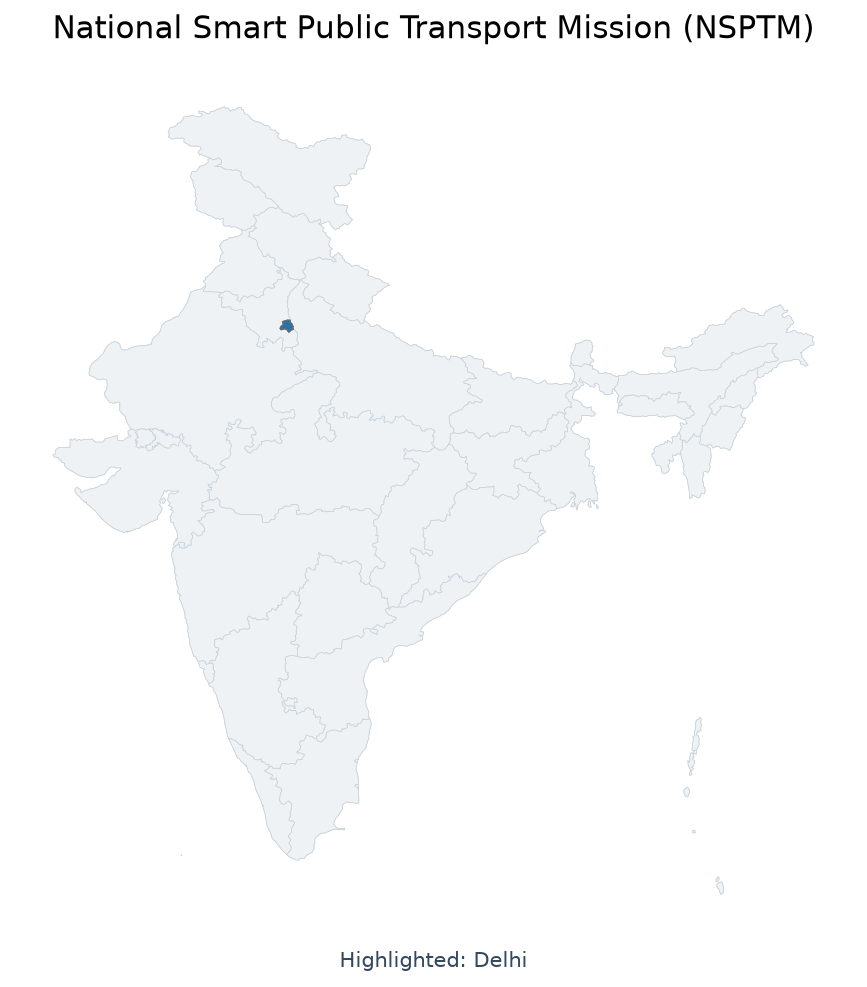
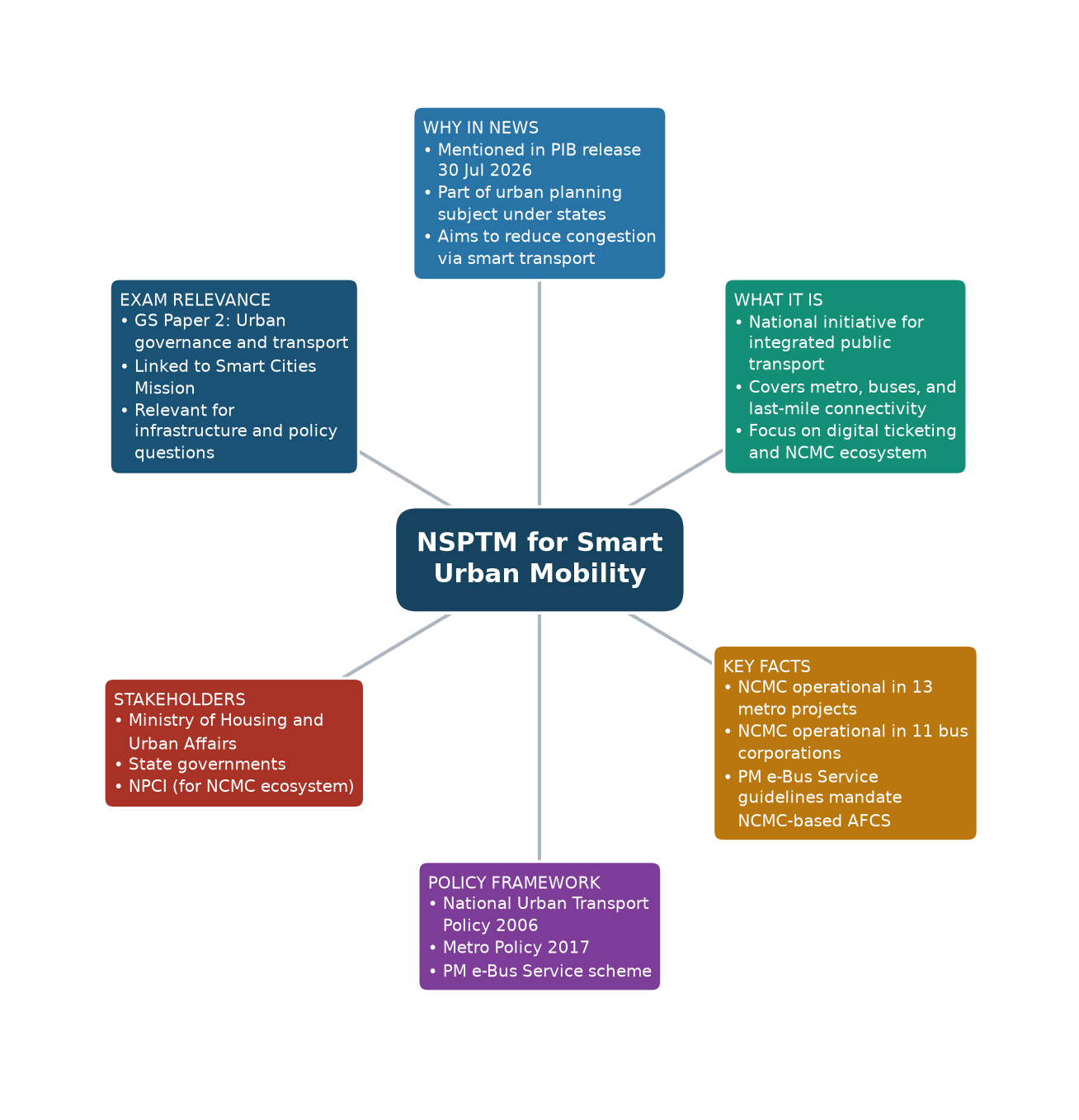
Map & concept mind-map: National Smart Public Transport Mission (NSPTM)
Subject Relevance — Where This Topic Fits
- GS Paper II — Governance, Constitution, Polity, Social Justice and International Relations (Urban Governance, Centre-State Relations) | GS Paper III — Infrastructure, Environment and Urban Development (Public Transport, Smart Cities, Digital Infrastructure)
- Prelims: National Urban Transport Policy 2006, Metro Policy 2017, National Common Mobility Card (NCMC), PM e-Bus Sewa, Last-mile connectivity, Integrated Mobility Plan, Automatic Fare Collection System (AFCS), qSPARC (Quick Specification for Payment Application of RuPay Chip)
- Essay: Urbanisation and Sustainable Development: Balancing Growth with Livability, Role of Technology in Governance: From Smart Cities to Smart Mobility
Quick Revision: The National Smart Public Transport Mission seeks to unify India’s urban mobility through digital interoperability (NCMC), last-mile connectivity, and electric bus deployment, bridging policy gaps between the Centre and states under the constitutional framework of urban governance.
Why is this in the news?
The Ministry of Housing and Urban Affairs (MoHUA) has highlighted the absence of a unified national framework for smart public transport systems in India, despite the existence of sectoral policies like the National Urban Transport Policy (2006) and Metro Policy (2017).
Background
- Urban planning and public transport are constitutionally assigned to state governments under the Seventh Schedule, with the Centre providing policy guidance and financial support through centrally sponsored schemes.
- The National Urban Transport Policy (2006) and Metro Policy (2017) were formulated to guide systematic planning and implementation of urban transport projects, including metros, across India.
- Despite these policies, India lacks a national-level integrated smart public transport strategy addressing digital ticketing, last-mile connectivity, and non-motorised transport.
- The National Common Mobility Card (NCMC) is a key initiative under the ‘One Nation, One Card’ vision, enabling seamless payments across metro, bus, and other transit systems using RuPay-based qSPARC technology.
- Central schemes like PM e-Bus Sewa and PM e-DRIVE provide financial support for deploying electric buses and enhancing last-mile connectivity, with a focus on digital fare collection systems.
What is the National Smart Public Transport Mission?
- The National Smart Public Transport Mission is a proposed framework to integrate digital technologies, interoperable ticketing, and last-mile connectivity solutions into India’s urban transport ecosystem, addressing the absence of a unified national strategy.
- The mission seeks to align with existing policies like the National Urban Transport Policy (2006) and Metro Policy (2017) while leveraging centrally sponsored schemes (e.g., PM e-Bus Sewa) to scale up electric bus deployment and smart infrastructure.
- The NCMC ecosystem, operational in 13 metro projects and 11 bus transport corporations, serves as a foundational tool for achieving interoperability and reducing transaction friction in urban mobility.
- Central financial assistance is provided under sub-schemes like ‘Urban Transport Planning and Capacity Building for Metro and Non-Metro Projects’ to support viable urban transport proposals submitted by states.
Key Features
| Feature | Significance |
|---|---|
| National Smart Public Transport Mission (NSPTM) | Proposes a unified framework for integrated urban mobility, digital ticketing, last-mile connectivity, and non-motorised transport across Indian cities, addressing fragmentation in public transport planning. |
| National Common Mobility Card (NCMC) | Enables interoperable digital ticketing across 13 metro systems and 11 bus operators, facilitating seamless travel and reducing reliance on cash transactions. |
| Automatic Fare Collection System (AFCS) | Mandated under PM e-Bus Sewa guidelines, this system automates ticketing for bus operations, enhancing efficiency and user convenience. |
| Integrated Mobility Plans (IMPs) | Includes Detailed Project Reports (DPRs), multi-modal integration plans, and capacity-building initiatives for urban local bodies (ULBs), ensuring holistic transport planning. |
| PM e-Bus Sewa & PM e-Drive | Central schemes providing financial assistance for e-bus deployment and electric vehicle (EV) infrastructure, prioritising clean and sustainable public transport solutions. |
Why it Matters
Urban Mobility & Infrastructure
- Addresses critical urban challenges such as congestion, pollution, and inefficient transport systems by promoting integrated and sustainable mobility solutions.
- Enhances last-mile connectivity, reducing dependence on private vehicles and improving accessibility for all citizens, including the elderly and differently-abled.
- Supports the development of non-motorised transport (NMT) infrastructure, aligning with global best practices for inclusive urban planning.
Digital Transformation
- Facilitates seamless digital ticketing through NCMC, reducing transaction costs and improving user experience across public transport modes.
- Promotes the adoption of smart technologies (e.g., AFCS, real-time tracking) to enhance operational efficiency and transparency in public transport systems.
- Encourages the integration of digital payment ecosystems, fostering financial inclusion and reducing cash-based transactions in urban transport.
Environmental Sustainability
- Promotes the deployment of e-buses under PM e-Bus Sewa, reducing carbon emissions and air pollution in urban areas.
- Supports the transition to electric mobility through PM e-Drive, aligning with India’s commitments under the Paris Agreement and national climate goals.
- Encourages the use of non-motorised transport, reducing vehicular congestion and improving urban air quality.
Policy & Governance
- Leverages existing policy frameworks such as the National Urban Transport Policy (2006) and Metro Policy (2017) to ensure systematic planning and implementation of transport projects.
- Empowers state governments to propose and execute transport projects, ensuring local ownership and context-specific solutions.
- Promotes multi-stakeholder collaboration between central ministries, state governments, ULBs, and private operators for cohesive urban transport governance.
Challenges
1. Fragmented Urban Transport Planning
- Lack of a unified national framework for integrated public transport, leading to disjointed infrastructure and services across cities.
- Inconsistent implementation of mobility solutions due to varying capacities and priorities among state governments and ULBs.
UPSC Link: GS-III: Urbanisation
2. Financial Constraints & Resource Allocation
- Limited central financial assistance for transport projects, particularly in smaller cities and tier-II/III urban centres.
- High capital expenditure for e-bus deployment and metro infrastructure, requiring innovative financing models such as public-private partnerships (PPPs).
UPSC Link: GS-III: Infrastructure Financing
3. Technological Adoption & Interoperability
- Slow adoption of digital ticketing systems (e.g., NCMC) across all transport modes, leading to fragmented user experiences.
- Interoperability challenges between different transport operators and payment systems, hindering seamless travel across cities.
UPSC Link: GS-III: Science & Technology
4. Last-Mile Connectivity & NMT Integration
- Inadequate planning for last-mile connectivity, particularly in peri-urban and informal settlements, leading to poor accessibility.
- Limited investment in non-motorised transport (NMT) infrastructure such as cycle lanes and pedestrian pathways, despite their proven benefits.
UPSC Link: GS-III: Urban Development
5. Regulatory & Institutional Bottlenecks
- Complex regulatory frameworks and bureaucratic delays in project approvals and clearances for transport infrastructure.
- Weak enforcement of urban transport policies and guidelines, leading to ad-hoc project implementations and cost overruns.
UPSC Link: GS-II: Governance
6. Public Awareness & Behavioural Change
- Low public awareness and trust in public transport systems, particularly among middle-class commuters accustomed to private vehicles.
- Resistance to behavioural change, including reluctance to adopt digital payment methods and preference for personal vehicles.
UPSC Link: GS-IV: Ethics & Human Values
Challenges — UPSC Perspective
| Issue | Concern |
|---|---|
| Inconsistent State-Level Implementation | Variations in state capacities and priorities lead to uneven progress in transport projects, undermining national goals. |
| High Capital Costs for E-Bus Deployment | Capital-intensive nature of e-buses and charging infrastructure poses financial challenges for state governments. |
| Digital Divide in Payment Systems | Limited digital literacy and access to smartphones among marginalised communities hinder adoption of NCMC and AFCS. |
| Land Acquisition & R-o-W Challenges | Delays in land acquisition and right-of-way (R-o-W) clearances for metro and bus corridors disrupt project timelines. |
| Lack of Standardised Data Systems | Absence of unified data platforms for transport planning and monitoring complicates evidence-based policymaking. |
| Climate Change & Extreme Weather Risks | Increased frequency of extreme weather events (e.g., floods, heatwaves) threatens the resilience of urban transport infrastructure. |
Government Initiatives — Must-Memorise for Prelims
- National Urban Transport Policy (2006)
- Metro Policy (2017)
- National Common Mobility Card (NCMC) ecosystem
Way Forward
- Establish a dedicated National Smart Public Transport Mission Secretariat to coordinate state-level implementations and monitor progress.
- Develop a unified National Urban Mobility Data Platform to standardise data collection, analysis, and decision-making across cities.
- Expand central financial assistance for e-bus deployment and last-mile connectivity projects in tier-II and tier-III cities.
- Launch nationwide awareness campaigns to promote digital ticketing (NCMC) and behavioural change towards public transport.
- Strengthen inter-state coordination mechanisms to harmonise transport policies, standards, and interoperability frameworks.
- Encourage state governments to adopt Integrated Mobility Plans (IMPs) with mandatory inclusion of NMT and last-mile connectivity components.
- Facilitate public-private partnerships (PPPs) for financing and operating e-bus fleets and charging infrastructure.
- Conduct regular capacity-building programmes for ULBs and transport officials on smart mobility technologies and governance.
UPSC Value Addition
Keywords for Mains Answer-Writing
National Smart Public Transport Mission · Urban Transport Policy 2006 · Metro Policy 2017 · National Common Mobility Card (NCMC) · Integrated Public Transport · Digital Ticketing · Last-Mile Connectivity · Non-Motorised Transport (NMT) · PM e-Bus Sewa · Urban Local Bodies (ULBs) · Public-Private Partnership (PPP) in Urban Transport · Traffic Congestion Mitigation · Interoperable Mobility Solutions · National Urban Transport Policy (NUTP) · State Subject under 7th Schedule
Concept Flow
Urbanisation & Rising Congestion → Need for Integrated Public Transport → Formulation of National Smart Public Transport Mission (NSPTM) → NSPTM → Promotion of Digital Ticketing (NCMC) & AFCS → Enhanced User Experience & Reduced Cash Transactions → Digital Transformation → Adoption of E-Buses (PM e-Bus Sewa) → Lower Emissions & Improved Air Quality → Integrated Mobility Plans (IMPs) → Last-Mile Connectivity & NMT Infrastructure → Inclusive Urban Accessibility → Central Financial Assistance → State-Level Implementation → Local Ownership & Context-Specific Solutions
Prelims Practice Questions
Q1. Consider the following statements regarding the National Common Mobility Card (NCMC): 1. It is based on the ‘One Nation, One Card’ vision. 2. It enables seamless operation across metro, regional rapid transit systems (RRTS), and bus operators. 3. It is developed by the Reserve Bank of India (RBI). 4. It is operational in 13 metro projects and 11 bus transport corporations. How many of the above statements are correct?
- Only one
- Only two
- Only three
- All four
Answer: All four — Statements 1, 2, and 4 are correct. Statement 3 is incorrect as NCMC is developed by the National Payments Corporation of India (NPCI), not RBI.
Q2. Assertion (A): The responsibility for planning, initiating, and developing public transport projects, including metro projects, lies with the state governments under the 7th Schedule of the Constitution. Reason (R): Urban planning is a state subject as per the Constitution of India.
- Both A and R are true, and R is the correct explanation of A
- Both A and R are true, but R is NOT the correct explanation of A
- A is true, but R is false
- A is false, but R is true
Answer: Both A and R are true, but R is NOT the correct explanation of A — Both the assertion and reason are true, and the reason correctly explains the assertion. Urban planning and public transport are state subjects under the 7th Schedule of the Constitution.
Q3. Match the following policies with their respective years of formulation: Column I (Policy) | Column II (Year)
1. National Urban Transport Policy | A. 2017
2. Metro Policy | B. 2006
3. National Smart Public Transport Mission | C. 2026
4. PM e-Bus Sewa Guidelines | D. 2023
- 1-B, 2-A, 3-C, 4-D
- 1-A, 2-B, 3-C, 4-D
- 1-B, 2-A, 3-D, 4-C
- 1-A, 2-B, 3-D, 4-C
Answer: 1-B, 2-A, 3-C, 4-D — 1-B (National Urban Transport Policy, 2006), 2-A (Metro Policy, 2017), 3-C (National Smart Public Transport Mission, 2026), 4-D (PM e-Bus Sewa Guidelines, 2023).
Mains Practice Question
✍ Critically examine the role of the National Common Mobility Card (NCMC) in achieving integrated public transport in India. Also, discuss the challenges in its widespread adoption and suggest measures to enhance its effectiveness. (15 Marks)
Approach: MODEL-ANSWER SKELETON:
1. Introduction (2 marks): Define NCMC, its vision (‘One Nation, One Card’), and its objective of seamless interoperability across metro, RRTS, and bus systems.
2. Role of NCMC (5 marks):
– Facilitates integrated ticketing and reduces transaction costs.
– Promotes digital ticketing and reduces reliance on private vehicles.
– Aligns with National Urban Transport Policy (2006) and Metro Policy (2017).
– Supports last-mile connectivity and non-motorised transport integration.
– Enables data-driven urban mobility planning and congestion mitigation.
3. Challenges (5 marks):
– Limited coverage: Operational in only 13 metro projects and 11 bus corporations.
– Technological barriers: Requires robust digital infrastructure and interoperability standards.
– Awareness and adoption: Low public awareness and resistance to change from traditional ticketing.
– Financial constraints: High initial investment for states and ULBs.
– Regulatory hurdles: Need for harmonised policies across states and union territories.
4. Measures to Enhance Effectiveness (3 marks):
– Expand coverage to all metro and bus systems under PM e-Bus Sewa.
– Strengthen digital infrastructure and cybersecurity measures.
– Launch mass awareness campaigns and incentives for adoption.
– Provide central financial assistance for state-level implementation.
– Encourage public-private partnerships for technology upgradation and maintenance.
Source: PIB (Press Information Bureau)
Generated by AanyaAi for educational purpose.

- हिमाचल में डिजिटल भुगतान क्रांति: बिलासपुर अव्वल, महिलाओं की भागीदारी 93% तक पहुंची - September 23, 2026
- Himachal Pradesh Leads in Digital Payments: Bilaspur Tops, Women’s Role Rises - September 23, 2026
- केरल लोक सेवा आयोग ने उच्च न्यायालय में दायर किया मामला, सदस्यों के खिलाफ मामला रद्द करने की मांग - September 23, 2026

No Comments