


21 Jul National Vayoshri Yojana: 9.23 lakh elders get assistive devices under PMBJP
Subject Relevance — Where This Topic Fits
- GS Paper II — Governance, Social Justice and Welfare | GS Paper III — Development, Inclusion and Technology
- Prelims: National Vayoshri Yojana, Elderline (14567), Atal Vayo Abhyuday Yojana, Senior Care Ageing Growth Engine (SAGE), Silver Economy
- Essay: Demographic Dividend and Silver Economy: Challenges and Opportunities, Social Justice and Inclusive Development: Ensuring Dignity for the Elderly
Quick Revision: The National Vayoshri Yojana is a flagship scheme under the Atal Vayo Abhyuday Yojana that provides assistive devices to elderly citizens from economically weaker sections to enhance their independence and dignity.
Why is this in the news?
The recent PIB release highlights the distribution of assistive devices to over 9.23 lakh senior citizens under the National Vayoshri Yojana, alongside the operationalisation of Elderline (14567) across 32 States and Union Territories and the expansion of institutional care through 734 old-age homes under the Atal Vayo Abhyuday Yojana. This underscores the government’s commitment to enhancing accessibility, dignity, and social security for the elderly, particularly those from economically weaker sections.
Background
- India’s elderly population (60 years and above) is projected to reach 340 million by 2050, constituting 20% of the total population, necessitating robust welfare mechanisms.
- The National Policy on Older Persons (1999) and Maintenance and Welfare of Parents and Senior Citizens Act (2007) provide the legal framework for elderly care in India.
- The Atal Vayo Abhyuday Yojana (AVYAY), launched in 2021, is a comprehensive scheme aimed at ensuring the welfare, dignity, and social security of senior citizens through integrated programmes.
- The Senior Care Ageing Growth Engine (SAGE) initiative, launched in August 2022, promotes innovation in elderly care by supporting startups developing products and services for the ageing demographic.
- The ‘Silver Economy’ refers to economic activities driven by the needs and purchasing power of the elderly population, encompassing healthcare, assistive devices, and financial services.
- Elderline (14567), a toll-free helpline, was operationalised in 2021 to provide information, emotional support, and grievance redressal to senior citizens across the country.
What is the National Vayoshri Yojana?
- A centrally sponsored scheme under the Department of Social Justice and Empowerment, Ministry of Social Justice and Empowerment.
- Aims to provide physical aids and assisted-living devices to senior citizens belonging to Below Poverty Line (BPL) households or those with a monthly income up to ₹15,000.
- Devices distributed include hearing aids, wheelchairs, walkers, crutches, spectacles, and other assistive tools to mitigate age-related disabilities.
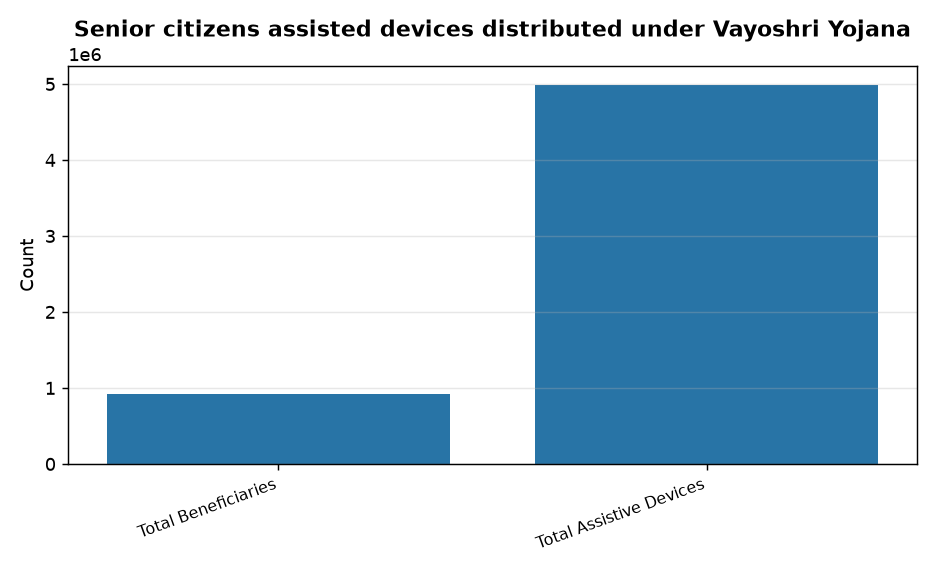
- Since its inception, the scheme has benefitted over 9.23 lakh senior citizens by distributing more than 49.81 lakh assistive devices.
- The scheme aligns with the broader objectives of the Atal Vayo Abhyuday Yojana, which integrates institutional care, technological innovation, and social inclusion for the elderly.
Key Features
| Feature | Significance |
|---|---|
| National Vayoshri Yojana (NVY) | Provides assistive devices (e.g., hearing aids, wheelchairs, spectacles) to elderly citizens below the poverty line or with monthly income ≤ ₹15,000, enhancing their functional independence and dignity. |
| Elderline (14567) | A pan-India toll-free helpline operational in 32 states/UTs, offering 24/7 (8 AM–8 PM) support including emotional counselling, rescue assistance, and grievance redressal for senior citizens. |
| Atal Vayo Abhyuday Yojana (AVYAY) | A comprehensive framework under the Ministry of Social Justice and Empowerment to promote welfare, social security, and dignified living for senior citizens through integrated programmes. |
| Senior Care Ageing Growth Engine (SAGE) | A government initiative to support startups developing innovative products/services for elderly care, with ₹9.05 crore disbursed to 10 selected ventures since 2022. |
| Integrated Programme for Senior Citizens | Provides grant-in-aid for the operation and maintenance of 734 old-age homes, ensuring institutional care for elderly individuals, particularly those requiring assistance. |
Why it Matters
Demographic Imperative
- India’s elderly population (60+) is projected to reach 340 million by 2050, necessitating robust welfare mechanisms to address their socio-economic vulnerabilities.
- The NVY’s focus on assistive devices directly addresses age-related disabilities, reducing dependency and improving quality of life for marginalised seniors.
Social Justice and Inclusion
- The schemes under AVYAY embody constitutional principles of equality (Article 14) and protection of vulnerable groups (Article 41), ensuring no senior citizen is left behind due to economic or physical barriers.
- Elderline’s 24/7 availability ensures equitable access to support, irrespective of geographical or socio-economic disparities.
Economic and Productive Ageing
- The SAGE initiative fosters the ‘silver economy’ by incentivizing startups to innovate in elderly care, aligning with India’s demographic dividend and promoting sustainable economic growth.
- Assistive devices distributed under NVY enable elderly individuals to remain economically active, contributing to household income and reducing caregiver burden.
Institutional Care Framework
- The 734 old-age homes supported under the integrated programme provide a safety net for elderly individuals without familial support, ensuring dignity and healthcare access.
- Institutional care complements community-based support, creating a multi-layered eldercare ecosystem.
Challenges
1. Limited Coverage and Awareness
- Despite NVY’s reach, many elderly in rural and remote areas remain unaware of the scheme or lack access to assistive devices due to logistical constraints.
- Elderline’s 8 AM–8 PM operation excludes night-time emergencies, leaving a critical gap in urgent support.
UPSC Link: GS-II: Social Justice
2. Financial and Resource Constraints
- The NVY’s budgetary allocation may be insufficient to meet the demand for assistive devices, given the scale of India’s ageing population.
- SAGE’s ₹9.05 crore disbursement to 10 startups highlights limited scalability, with many innovative solutions remaining unfunded.
UPSC Link: GS-III: Economic Development
3. Technological and Infrastructure Gaps
- The ‘silver economy’ remains underdeveloped, with a lack of indigenous manufacturing of high-quality assistive devices, leading to import dependency.
- Digital divide in rural areas hinders access to Elderline and online services, exacerbating exclusion for elderly populations.
UPSC Link: GS-III: Science & Tech
4. Social Stigma and Cultural Barriers
- Traditional family structures often discourage institutional care, making elderly individuals reluctant to utilise old-age homes despite their benefits.
- Ageism and lack of intergenerational support systems reduce the uptake of welfare schemes among seniors.
UPSC Link: GS-I: Society
5. Policy Fragmentation
- The absence of a dedicated ‘National Silver Policy’ (as clarified in the PIB release) leaves a policy vacuum, leading to disjointed implementation across states.
- Overlapping schemes (e.g., NVY, SAGE, integrated programme) require better convergence to avoid duplication and inefficiencies.
UPSC Link: GS-II: Governance
Challenges — UPSC Perspective
| Issue | Concern |
|---|---|
| Awareness Gaps | Low penetration of NVY and Elderline in rural/remote areas due to limited outreach and digital illiteracy among elderly. |
| Financial Sustainability | Dependence on central funds for NVY and old-age homes may strain state budgets, risking discontinuation of services. |
| Quality and Affordability | High cost of assistive devices and lack of standardisation in products supplied under NVY. |
| Institutional Readiness | Inadequate infrastructure in many old-age homes, including medical facilities and trained staff, compromising care quality. |
| Inter-State Disparities | Variations in implementation of AVYAY schemes across states due to differential resource allocation and administrative capacity. |
| Monitoring and Evaluation | Lack of real-time data on the utilisation and impact of NVY’s assistive devices, hindering evidence-based policymaking. |
Government Initiatives — Must-Memorise for Prelims
- National Vayoshri Yojana (NVY)
- Atal Vayo Abhyuday Yojana (AVYAY)
- Senior Care Ageing Growth Engine (SAGE)
- Integrated Programme for Senior Citizens
Way Forward
- Expand Elderline’s operational hours to 24/7, including night-time emergency support, to address urgent needs of elderly citizens.
- Launch targeted awareness campaigns in regional languages, leveraging ASHA workers and local NGOs to bridge the rural-urban divide.
- Increase budgetary allocation for NVY and SAGE, with a focus on indigenous manufacturing of assistive devices to reduce costs and import dependency.
- Develop a National Silver Policy to provide a unified framework for elderly welfare, addressing gaps in institutional care, financial security, and technology adoption.
- Strengthen convergence between NVY, SAGE, and old-age home programmes to eliminate duplication and ensure holistic coverage.
- Establish a real-time monitoring system for NVY’s assistive device distribution, using Aadhaar-linked beneficiary tracking for transparency.
- Promote public-private partnerships (PPPs) to scale up SAGE’s impact, incentivising private investment in elderly care innovations.
- Integrate elderly care modules into existing healthcare schemes (e.g., Ayushman Bharat) to ensure seamless access to medical and non-medical support.
UPSC Value Addition
Keywords for Mains Answer-Writing
National Vayoshri Yojana · Senior Citizens Welfare · Assistive Devices for Elderly · Atal Vayo Abhyuday Yojana · Elderline Helpline 14567 · Integrated Programme for Senior Citizens · Senior Care Aging Growth Engine (SAGE) · Silver Economy · Institutional Care for Elderly · Social Justice and Empowerment Ministry · Geriatric Healthcare · Universal Accessibility · Poverty Alleviation for Elderly · Demographic Dividend Utilisation
Concept Flow
Demographic transition → Rise in elderly population → Increased demand for assistive devices and care services → Launch of NVY and AVYAY schemes → Distribution of 49.81 lakh assistive devices to 9.23 lakh seniors (2026 data) → Enhanced functional independence and dignity for beneficiaries → Strengthening of the ‘silver economy’ through SAGE initiative → Feedback loop to inform policy adjustments and future welfare programmes.
Prelims Practice Questions
Q1. Which of the following initiatives is NOT a component of the Atal Vayo Abhyuday Yojana (AVYAY)?
- A. National Vayoshri Yojana
- B. Elderline Helpline 14567
- C. Ayushman Bharat Health Insurance Scheme
- D. Senior Care Aging Growth Engine (SAGE)
Answer: C. Ayushman Bharat Health Insurance Scheme — Ayushman Bharat Health Insurance Scheme is a separate initiative under the Ayushman Bharat Mission, not a component of AVYAY. The other three are directly linked to the Atal Vayo Abhyuday Yojana.
Q2. The Elderline Helpline (14567) provides which of the following services to senior citizens?
- A. Only medical emergency response
- B. Information, emotional support, rescue, and grievance redressal
- C. Exclusively pension-related queries
- D. Legal advice on property disputes
Answer: B. Information, emotional support, rescue, and grievance redressal — The Elderline Helpline (14567) is designed to offer comprehensive support, including information, emotional support, rescue, and grievance redressal, ensuring timely assistance to elderly citizens.
Q3. Under the National Vayoshri Yojana, assistive devices are distributed to senior citizens primarily to:
- A. Enhance their digital literacy
- B. Enable independent and dignified living
- C. Provide entertainment facilities
- D. Promote agricultural productivity
Answer: B. Enable independent and dignified living — The National Vayoshri Yojana aims to distribute assistive devices to elderly individuals suffering from age-related disabilities to facilitate independent and dignified living.
Mains Practice Question
✍ Critically examine the role of the Atal Vayo Abhyuday Yojana (AVYAY) in addressing the challenges faced by India’s ageing population. How does the integration of schemes like the National Vayoshri Yojana, Elderline Helpline, and Senior Care Aging Growth Engine (SAGE) contribute to a holistic welfare framework for senior citizens?
Approach: The answer must assess the multidimensional approach of AVYAY, highlighting its objectives of social security, dignity, and empowerment for the elderly. Discuss the National Vayoshri Yojana’s role in providing assistive devices, the Elderline Helpline’s function in crisis management and support, and the SAGE initiative’s focus on innovation and silver economy. Critically evaluate the effectiveness of these measures in ensuring inclusive growth, accessibility, and quality of life for senior citizens, while addressing gaps such as regional disparities, funding constraints, and implementation challenges.
Source: PIB (Press Information Bureau)
Generated by AanyaAi for educational purpose.

- यूपीएससी तैयारी: आरबीआई द्वारा 91, 182 और 364 दिनों के ट्रेजरी बिलों की नीलामी - September 19, 2026
- RBI to Auction ₹24,000 Crore T-Bills: Key Dates & Process for UPSC Aspirants - September 19, 2026
- संयुक्त राष्ट्र महासभा अध्यक्ष का Rohingya संकट से सीख: विश्वास और AI पर बल - September 19, 2026

No Comments