


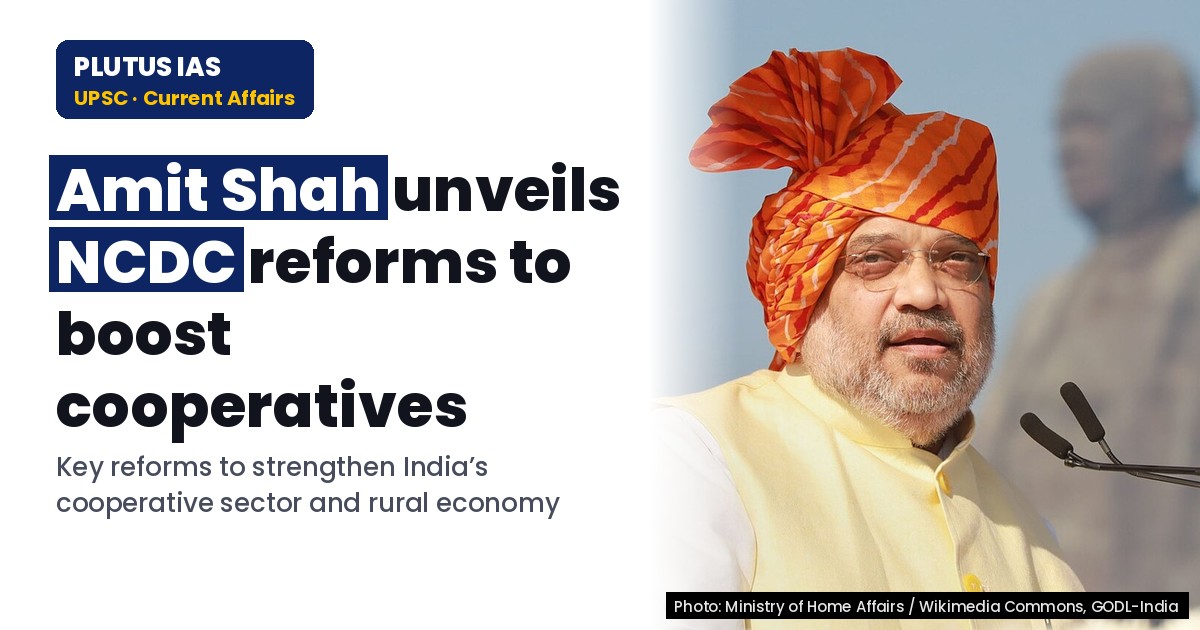
29 Oct NCDC’s 93rd Meeting: Key Policy Reforms for Cooperative Sector
✎ The National Cooperative Development Corporation (NCDC), established under the NCDC Act, 1962, is the apex developmental and financing institution for cooperatives in India, operating under the Ministry of Cooperation.
Subject Relevance — Where This Topic Fits
- GS Paper II — Constitutional, Statutory, Regulatory and Various Quasi-judicial Bodies | GS Paper III — Indian Economy and Issues Relating to Planning, Mobilisation of Resources, Growth, Development and Employment
- Prelims: National Cooperative Development Corporation (NCDC), Multistate Cooperative Societies Act, 2002, Union Minister of Cooperation, Cooperative Principles, Credit Cooperatives, Agro-based Cooperatives
- Essay: Role of cooperatives in inclusive economic growth and rural development in India, Institutional governance and autonomy in public sector undertakings
Quick Revision: The National Cooperative Development Corporation (NCDC), established under the NCDC Act, 1962, is the apex developmental and financing institution for cooperatives in India, operating under the Ministry of Cooperation.
Why is this in the news?
The 93rd meeting of the General Council of the National Cooperative Development Corporation (NCDC), chaired by the Union Home Minister and Minister of Cooperation, was held in New Delhi. This meeting assumes significance in the context of the government’s renewed emphasis on strengthening the cooperative sector as a vehicle for socio-economic transformation, particularly in rural and agricultural domains, and aligns with the broader policy framework of ‘Sahkar se Samriddhi’ (Prosperity through Cooperation).
Background
- The NCDC was established under the National Cooperative Development Corporation Act, 1962, as a statutory corporation under the Ministry of Cooperation, Government of India.
- It functions as the apex financing and developmental institution for cooperatives in India, providing financial and technical support to cooperative societies across sectors such as agriculture, dairy, fisheries, handloom, and rural industries.
- The NCDC operates under the administrative control of the Ministry of Cooperation, which was created in July 2021 to promote and strengthen the cooperative movement in India.
- Cooperatives in India are governed by the Constitution (97th Amendment) Act, 2011, which inserted Article 43B in the Directive Principles of State Policy, mandating the promotion of cooperative societies.
- The Multistate Cooperative Societies Act, 2002, regulates cooperatives operating in more than one state, while state-specific cooperative laws govern intra-state cooperatives.
- The NCDC’s governance structure includes a General Council, Executive Committee, and Managing Director, with the Union Minister of Cooperation serving as the ex-officio Chairman of the General Council.
What is the National Cooperative Development Corporation (NCDC)?
- The NCDC is a statutory body established to promote and develop cooperatives in India through financial assistance, capacity building, and policy advocacy.
- Its mandate includes extending medium- and long-term financial assistance to cooperative societies, state cooperative banks, and other financial institutions engaged in cooperative activities.
- The corporation provides support for the establishment, expansion, and modernization of cooperatives, with a focus on sectors such as agriculture, horticulture, dairy, fisheries, handloom, and sericulture.
- NCDC also plays a pivotal role in the implementation of centrally sponsored schemes such as the ‘Formation and Promotion of 10,000 FPOs (Farmer Producer Organisations)’ and the ‘Cooperative Development Programme’.
- It undertakes research and studies to identify gaps and opportunities in the cooperative sector, and disseminates best practices through training and workshops for cooperative leaders and members.
- The corporation operates through a network of regional and state offices, ensuring grassroots-level implementation of its developmental initiatives.
- NCDC’s financial resources are derived from budgetary allocations, borrowings from financial institutions, and the issuance of bonds and debentures.
- The institution adheres to the principles of cooperative governance, including democratic control, voluntary membership, and equitable distribution of benefits among members.
Key Features
| Feature | Significance |
|---|---|
| Chairmanship by Union Home Minister and Minister of Cooperation | Ensures high-level political oversight and inter-ministerial coordination for cooperative sector reforms and development. |
| 93rd Meeting of NCDC General Council | Provides a platform for reviewing progress, approving financial allocations, and strategizing future interventions in the cooperative sector. |
| Focus on cooperative governance | Reinforces the institutional framework for democratic decision-making within cooperatives, aligning with constitutional provisions under Article 43B. |
| Discussion on financial resources and capacity-building | Highlights the need for targeted funding and skill development to enhance the viability and competitiveness of cooperatives. |
Why it Matters
Economic
- The NCDC is a statutory body under the Ministry of Cooperation, tasked with promoting cooperative enterprises as instruments of economic democracy and rural development.
- Strengthening cooperatives can enhance agricultural productivity, reduce input costs, and improve market access for small producers, contributing to inclusive growth.
- The meeting underscores the government’s commitment to leveraging the cooperative model for achieving Sustainable Development Goals (SDGs), particularly SDG 1 (No Poverty) and SDG 8 (Decent Work and Economic Growth).
Institutional
- The NCDC functions as a financing and developmental agency, providing credit, grants, and technical assistance to cooperatives across sectors such as agriculture, dairy, and handloom.
- The General Council, chaired by the Union Minister, includes representatives from state governments, cooperative institutions, and experts, ensuring multi-stakeholder participation.
- The meeting serves as a mechanism for accountability, transparency, and performance review of NCDC’s initiatives and funded projects.
Policy and Governance
- The deliberations likely included discussions on the implementation of the National Cooperative Policy 2023, which aims to modernize the cooperative sector through digitalization, governance reforms, and financial sustainability.
- The meeting may have addressed the integration of cooperatives with other government schemes, such as PM-KISAN, PM-FME, and the Atal Innovation Mission, to create synergies and avoid duplication.
- Strengthening the cooperative ecosystem aligns with the broader goal of promoting ‘Sahakar se Samriddhi’ (Prosperity through Cooperation), a vision articulated in the Union Budget 2023-24.
Challenges
1. Limited Financial Autonomy of Cooperatives
- Many cooperatives face challenges in accessing adequate credit due to stringent lending norms, lack of collateral, and high interest rates from formal financial institutions.
- Dependence on government funding often leads to delays in disbursement and bureaucratic hurdles, affecting the operational efficiency of cooperatives.
UPSC Link: Cooperative Societies Act, 1912
2. Governance and Management Deficiencies
- Cooperatives frequently suffer from poor governance, including lack of transparency, mismanagement, and dominance by vested interests, which erodes member trust.
- Inadequate training and capacity-building for cooperative leaders and members hinder effective decision-making and strategic planning.
UPSC Link: 97th Constitutional Amendment Act, 2011
3. Competition from Private Sector
- Cooperatives often struggle to compete with private enterprises due to limited economies of scale, outdated technology, and lack of market linkages.
- The rise of e-commerce and corporate agribusiness models has intensified competition, particularly in the dairy, handloom, and food processing sectors.
UPSC Link: Competition Act, 2002
4. Regulatory and Legal Hurdles
- The multiplicity of laws governing cooperatives—both at the central and state levels—creates confusion and compliance burdens, particularly for multi-state cooperatives.
- Delays in dispute resolution and legal proceedings deter investment and operational stability in the cooperative sector.
UPSC Link: Concurrent List, Seventh Schedule
5. Technology Adoption and Digital Divide
- Low adoption of digital tools and platforms limits the ability of cooperatives to integrate with supply chains, access markets, and improve service delivery.
- Rural cooperatives, in particular, face challenges in bridging the digital divide due to inadequate infrastructure and low digital literacy.
UPSC Link: Digital India Mission
Challenges — UPSC Perspective
| Issue | Concern |
|---|---|
| Access to Credit | High collateral requirements and risk-averse lending practices by banks deter cooperatives from accessing formal credit. |
| Governance Failures | Instances of mismanagement, fraud, and lack of member participation undermine cooperative credibility. |
| Market Competition | Cooperatives struggle to match the efficiency, pricing, and marketing strategies of private enterprises. |
| Regulatory Complexity | Overlapping jurisdictions between central and state laws create compliance challenges for multi-state cooperatives. |
| Technology Integration | Limited digital infrastructure and skills hinder the adoption of modern business practices in cooperatives. |
Way Forward
- Enhance the financial autonomy of cooperatives by simplifying credit access mechanisms, including the establishment of a dedicated cooperative bank or credit guarantee fund.
- Strengthen governance frameworks through mandatory training programs for cooperative leaders, digital record-keeping, and third-party audits to ensure transparency.
- Promote technology adoption by integrating cooperatives with e-NAM (National Agriculture Market), PM-KISAN, and other digital platforms to improve market access and efficiency.
- Streamline regulatory compliance by harmonizing cooperative laws across states and simplifying registration and reporting processes for multi-state cooperatives.
- Foster public-private partnerships to leverage corporate expertise in supply chain management, marketing, and technology while preserving the cooperative ethos.
- Expand NCDC’s role in capacity-building by collaborating with institutions like the Indian Institute of Cooperative Management (IICM) and state cooperative training centers.
- Encourage the formation of federations and apex bodies to aggregate resources, share best practices, and negotiate better terms with suppliers and buyers.
- Monitor and evaluate the impact of cooperative interventions through periodic audits and performance reviews to ensure accountability and continuous improvement.
UPSC Value Addition
Keywords for Mains Answer-Writing
National Cooperative Development Corporation · Ministry of Cooperation · Cooperative Sector Reforms · Cooperative Principles · Cooperative Federalism · Agricultural Cooperatives · Cooperative Credit Societies Act, 1904 · Multi-State Cooperative Societies Act, 2002 · Cooperative Governance · Sustainable Development Goals · Doubling Farmers’ Income · Cooperative Movement in India
Constitutional & Policy Linkages
- Article 43B: Promotion of cooperative societies as a means of securing economic democracy (Part IV – Directive Principles of State Policy).
- 97th Constitutional Amendment Act, 2011: Inserted Article 43B and Part IXB to provide constitutional status to cooperatives and strengthen their governance.
Concept Flow
Cooperative societies as instruments of economic democracy (Article 43B) → Establishment of NCDC under the Ministry of Cooperation → 93rd General Council meeting for policy review and financial allocations → Challenges in governance, credit access, and technology adoption → Way forward: governance reforms, digital integration, and regulatory simplification.
Prelims Practice Questions
Q1. Consider the following statements regarding the National Cooperative Development Corporation (NCDC):
1. It is a statutory body established under the National Cooperative Development Corporation Act, 1962.
2. It functions under the administrative control of the Ministry of Cooperation, Government of India.
3. Its primary mandate is to promote and develop cooperative societies in the fields of agriculture, industry, housing, and other sectors.
4. It provides financial assistance only to state cooperative banks and not to individual cooperatives.
How many of the above statements are correct?
- Only one
- Only two
- Only three
- All four
Answer: Only three — Statements 1, 2, and 3 are correct. Statement 4 is incorrect as NCDC provides financial assistance to a wide range of cooperative societies, including individual cooperatives, not just state cooperative banks.
Q2. Assertion (A): The Ministry of Cooperation was established in 2021 to provide a separate administrative framework for the cooperative sector in India.
Reason (R): The cooperative sector in India has historically been governed under the Ministry of Agriculture and Farmers’ Welfare, leading to fragmented policy implementation.
In the context of the above two statements, which one of the following is correct?
- Both A and R are true, and R is the correct explanation of A.
- Both A and R are true, but R is not the correct explanation of A.
- A is true but R is false.
- A is false but R is true.
Answer: Both A and R are true, and R is the correct explanation of A. — Both Assertion (A) and Reason (R) are true, and Reason (R) correctly explains Assertion (A). The establishment of the Ministry of Cooperation in 2021 was aimed at consolidating and strengthening the cooperative sector’s governance.
Mains Practice Question
✍ The cooperative sector in India has been identified as a critical instrument for achieving the goal of ‘Doubling Farmers’ Income’ and promoting sustainable agricultural development. In this context, critically examine the role of the National Cooperative Development Corporation (NCDC) in strengthening cooperative governance and financial sustainability. Also, discuss the challenges faced by cooperatives in India and suggest measures to enhance their effectiveness. (15 Marks)
Approach: Introduction: Define cooperatives and their significance in India’s socio-economic framework, citing constitutional provisions (Directive Principles of State Policy, Article 43) and policy initiatives (National Cooperative Policy 2023). Role of NCDC: Elaborate on NCDC’s statutory mandate (NCDC Act, 1962), financial instruments (loans, grants, subsidies), and key schemes (e.g., Cooperative Development Programme, Agri-Infrastructure Fund). Highlight its role in promoting multi-state cooperatives and technology adoption. Cooperative Governance: Discuss governance challenges (dual control by state/central governments, lack of professional management, weak auditing mechanisms) and NCDC’s initiatives (capacity-building, training programs, digital platforms). Challenges: Enumerate structural issues (fragmented policies, lack of convergence with other schemes like PM-KISAN, credit constraints, political interference) and operational hurdles (low member participation, outdated bye-laws). Suggestions: Propose reforms (strengthening the Multi-State Cooperative Societies Act, 2002; integrating cooperatives with e-NAM; promoting FPOs; enhancing transparency via blockchain-based audits). Conclusion: Balance the potential of cooperatives as vehicles for inclusive growth against the need for systemic reforms, citing examples of successful models (e.g., Amul, IFFCO).
Source: PIB (Press Information Bureau)
Generated by AanyaAi for educational purpose.
Related guides on our sites
- Best PSIR optional coaching for upsc
- Best economics optional coaching for upsc
- Best PSIR optional teacher for upsc
- Best teacher of PSIR optional for upsc

- OBC Creamy Layer: SC Ruling & CSE Impact - November 7, 2026
- दिल्ली प्रदूषण निगरानी में खामियां: GRAP-III के बीच कई स्टेशन निष्क्रिय - November 7, 2026
- Himalayan Glacier Melt & Climate Change: UPSC Analysis - November 7, 2026

No Comments