


19 Sep NCERT & NCL Launch ‘Special Campaign 6.0’ for Clean Governance: Key Details for UPSC
✎ ‘Special Campaign 6.0’ is a government-driven initiative in PSUs to enhance governance through e-waste management, sanitation, record digitalisation, and optimal space utilisation, with measurable targets and community engagement.
Subject Relevance — Where This Topic Fits
- GS Paper II — Governance, Transparency and Accountability | GS Paper III — Environment and Pollution Control | GS Paper III — Disaster and Disaster Management
- Prelims: E-waste Management Rules, 2022, Swachh Bharat Mission 2.0, 5S/3S methodology, Public Sector Undertakings (PSUs), Coal India Limited (CIL), Ministry of Coal, E-waste, Scrap management
- Essay: Administrative Reforms and Governance: The Role of Public Sector Undertakings in Nation-Building
Quick Revision: ‘Special Campaign 6.0’ is a government-driven initiative in PSUs to enhance governance through e-waste management, sanitation, record digitalisation, and optimal space utilisation, with measurable targets and community engagement.
Why is this in the news?
On 15 September 2026, Northern Coalfields Limited (NCL), a subsidiary of Coal India Limited operating under the Ministry of Coal, launched the preliminary phase of ‘Special Campaign 6.0’ as part of a broader government initiative to enhance efficiency, transparency, and environmental sustainability in public sector undertakings. The campaign, running from 15 September to 30 September 2026, focuses on e-waste management, sanitation, record management, and optimal utilisation of underutilised spaces, with implementation extending from 2 October to 31 October 2026. This initiative reflects the government’s commitment to institutionalising cleanliness, waste reduction, and administrative efficiency across PSUs.
Background
- The Government of India, through the Ministry of Coal, has been promoting ‘Special Campaigns’ as a structured approach to improve governance, reduce waste, and enhance operational efficiency in public sector undertakings.
- Northern Coalfields Limited (NCL), a key subsidiary of Coal India Limited, operates in the Singrauli region, a critical coal-producing area in Madhya Pradesh and Uttar Pradesh.
- E-waste management has emerged as a significant environmental challenge globally, with India generating approximately 3.2 million metric tonnes of e-waste annually, necessitating systematic collection, segregation, and recycling mechanisms.
- Public Sector Undertakings (PSUs) in India are mandated to adopt sustainable practices, including waste reduction, energy efficiency, and environmental compliance, as part of their corporate social responsibility (CSR) and governance obligations.
- The 5S/3S methodology (Sort, Set in Order, Shine, Standardise, Sustain) is a workplace organisation technique widely adopted in industrial and administrative settings to improve efficiency and hygiene.
What is ‘Special Campaign 6.0’ and its objectives?
- ‘Special Campaign 6.0’ is a time-bound governance initiative launched by the Government of India to improve efficiency, transparency, and environmental sustainability in public sector undertakings (PSUs).
- The campaign is structured in two phases: a preliminary phase (15 September–30 September 2026) for planning and awareness, and an implementation phase (2 October–31 October 2026) for execution of identified activities.
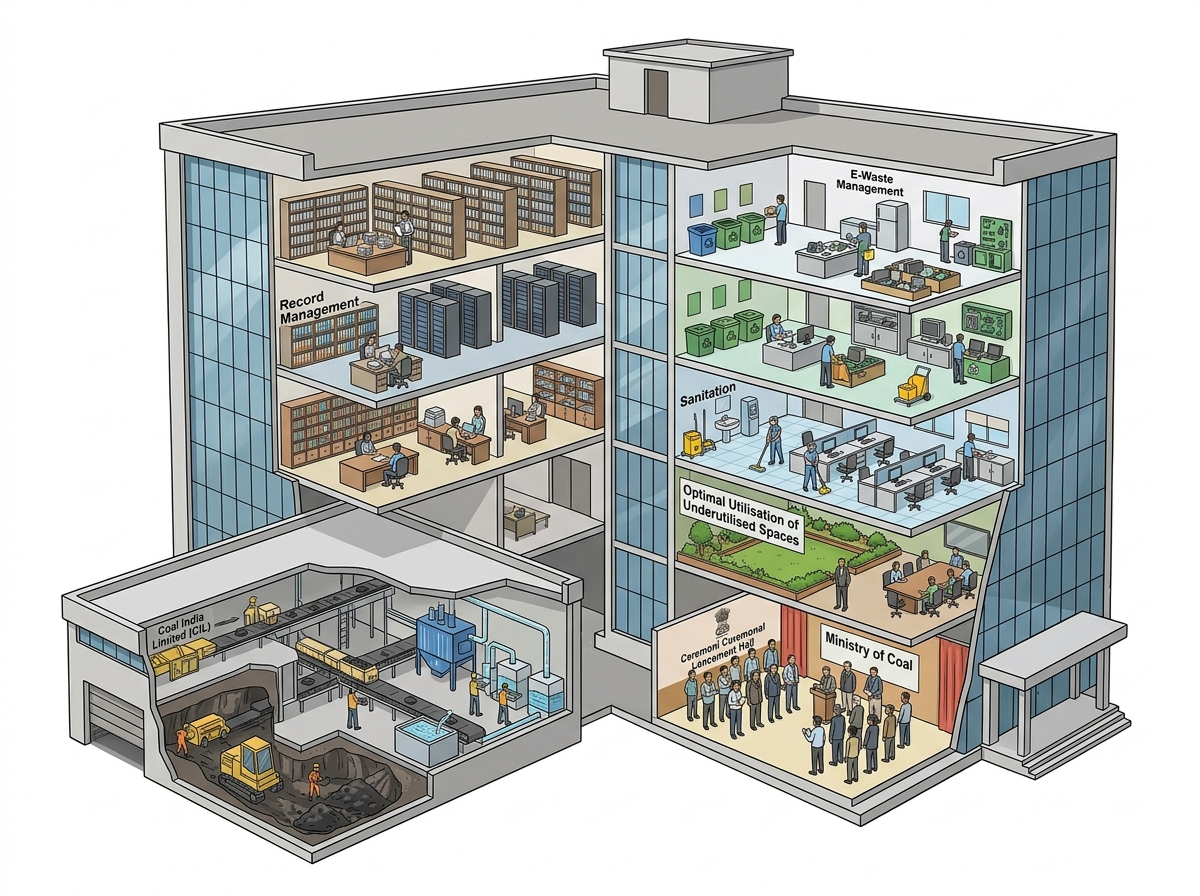
- Key focus areas include e-waste management, sanitation and cleanliness drives, record management, scrap disposal, and optimal utilisation of underutilised spaces within PSU premises.
- The campaign aligns with the ‘Waste to Wealth’ concept, promoting the recycling, reuse, and resource recovery from waste materials to foster a circular economy.
- Special emphasis is placed on digitalisation of records, systematic segregation of e-waste, and adoption of the 5S/3S methodology to enhance workplace efficiency and hygiene.
- Nodal teams are constituted at all levels within NCL to oversee the campaign’s implementation, ensuring accountability and measurable outcomes.
Key Features
| Feature | Significance |
|---|---|
| E-waste Management | Ensures systematic segregation, recycling, and safe disposal of electronic waste, reducing environmental pollution and promoting resource recovery under the ‘Waste to Wealth’ paradigm. |
| Swachhta Abhiyan (Cleanliness Drive) | Targets 90 marked sites and 1,00,000 sq. ft. area for cleaning, enhancing workplace hygiene, aesthetics, and employee well-being in coal mining and office premises. |
| Record Digitisation & Management | Reviews 400 physical and 9,000 e-files for timely disposal, indexing, and digital archiving, improving administrative efficiency and space utilisation. |
| Scrap Disposal & Reuse | Aims to dispose of 3,500 metric tonnes of scrap while identifying reusable materials, aligning with circular economy principles and cost optimisation. |
| Unutilised Space Utilisation | Identifies and reallocates underused office spaces for alternative productive uses, enhancing operational efficiency and reducing clutter. |
Why it Matters
Administrative Efficiency
- Streamlines record-keeping and file management, reducing pendency and improving decision-making in public sector undertakings (PSUs).
- Implements 5S/3S methodologies to standardise workplace organisation, fostering a culture of discipline and productivity.
- Promotes digital transformation in governance through systematic digitisation of physical records.
Environmental Sustainability
- Advances circular economy principles by prioritising e-waste recycling and scrap reuse, minimising landfill burden.
- Integrates ‘Waste to Wealth’ initiatives to convert waste materials into usable resources, reducing environmental degradation.
- Enhances local environmental quality through targeted cleanliness drives in mining and office areas.
Operational Excellence in PSUs
- Demonstrates a proactive approach to asset utilisation and waste reduction in coal PSUs, setting benchmarks for other sectors.
- Strengthens stakeholder engagement through awareness campaigns and community participation in cleanliness activities.
- Aligns with the Government of India’s ‘Swachh Bharat Mission’ and ‘Waste Management Rules, 2016’ for broader policy compliance.
Resource Optimisation
- Reduces operational costs by identifying and disposing of redundant materials, including scrap and obsolete records.
- Improves spatial efficiency in offices and mining sites, enabling better allocation of resources.
- Encourages innovation in waste-to-wealth conversion, potentially generating secondary revenue streams.
Challenges
1. Implementation Logistics
- Coordination across multiple units and geographies for uniform execution of cleanliness and waste management activities.
- Ensuring timely disposal of e-waste and scrap while adhering to environmental safety norms.
- Balancing operational continuity with campaign-driven activities in high-production coal mining zones.
UPSC Link: GS3: Environmental Pollution & Degradation
2. Behavioral Change Resistance
- Overcoming institutional inertia in adopting digital record-keeping and 5S methodologies among employees.
- Sustaining long-term community and employee engagement in cleanliness and waste segregation practices.
- Addressing apathy towards unutilised spaces and redundant records in legacy PSU systems.
UPSC Link: GS4: Ethics in Governance
3. Regulatory Compliance
- Ensuring adherence to the E-Waste (Management) Rules, 2022 and Solid Waste Management Rules, 2016 in waste handling.
- Meeting the timelines for record disposal as mandated by the Right to Information Act, 2005 and archival policies.
- Avoiding penalties for non-compliance with environmental norms during scrap disposal and site maintenance.
UPSC Link: GS3: Environmental Governance
4. Technological Adoption
- Integrating digital tools for record management and waste tracking in traditional industrial setups.
- Training workforce in new methodologies like 5S and e-waste segregation for effective implementation.
- Investing in infrastructure for safe e-waste storage and recycling facilities.
UPSC Link: GS3: Science & Technology in Governance
Challenges — UPSC Perspective
| Issue | Concern |
|---|---|
| Geographical Spread | Coordinating activities across dispersed mining and office locations in Singrauli region. |
| Resource Constraints | Limited manpower and financial resources for large-scale cleanliness and digitisation drives. |
| Legacy Systems | Resistance to change from traditional record-keeping and physical file management. |
| Community Participation | Ensuring sustained involvement of local communities in cleanliness initiatives. |
| Safety Protocols | Adhering to occupational safety norms while handling hazardous waste like e-waste. |
Way Forward
- Establish cross-functional nodal teams at regional and unit levels to oversee campaign execution and monitor progress.
- Develop a phased digitalisation roadmap for physical records, prioritising high-impact files and archival materials.
- Conduct regular audits of scrap inventory to identify reusable materials and streamline disposal processes.
- Integrate 5S/3S training modules into employee onboarding and periodic upskilling programmes for cultural adoption.
- Partner with local educational institutions and NGOs to amplify awareness campaigns on waste segregation and cleanliness.
- Leverage technology for real-time tracking of cleanliness drives and waste management activities via dashboards.
- Incentivise employee participation through recognition programmes and gamification of cleanliness metrics.
- Benchmark campaign outcomes against national standards (e.g., Swachh Bharat Mission) to ensure policy alignment.
UPSC Value Addition
Keywords for Mains Answer-Writing
Administrative Reforms · E-waste Management · Swachh Bharat Mission · Record Management · Government Waste Reduction · 5S Methodology · Sustainable Development Goals · Public Sector Undertakings · Ministry of Coal · Northern Coalfields Limited · Circular Economy · Digital Governance · Office Efficiency · Green Initiatives · Public Sector Reform · Environmental Sustainability
Concept Flow
Directive Principles of State Policy (Article 48A) → Environmental protection and improvement mandate. → Fundamental Duties (Article 51A(g)) → Duty of citizens to protect and improve the natural environment. → Government of India (Allocation of Business Rules) → Coal Ministry’s jurisdiction over PSUs like NCL. → Administrative Reforms (5S Methodology) → Workplace efficiency and standardisation in governance. → Environmental Laws (E-Waste Rules, 2022) → Regulatory framework for waste management. → Digital India Initiative → Digitisation of records for transparency and efficiency. → Swachh Bharat Mission → National cleanliness drive aligned with local campaigns.
Prelims Practice Questions
Q1. Consider the following statements regarding the 5S methodology in office management:
1. 5S stands for Sort, Set in order, Shine, Standardize, and Sustain.
2. It is a systematic approach to workplace organization and efficiency improvement.
3. The 5S methodology is exclusively applicable to manufacturing sectors and cannot be used in office environments.
How many of the above statements are correct?
- Only one
- Only two
- All three
- None
Answer: Only two — Statements 1 and 2 are correct as 5S is a workplace organization method and is applicable in office environments. Statement 3 is incorrect because 5S is widely used in both manufacturing and service sectors, including offices.
Q2. Assertion (A): The Ministry of Coal’s ‘Special Campaign 6.0’ focuses on e-waste management, cleanliness, and record management.
Reason (R): The campaign is part of a broader initiative to promote sustainable practices within public sector undertakings.
(a) Both A and R are true, and R is the correct explanation of A.
(b) Both A and R are true, but R is not the correct explanation of A.
(c) A is true, but R is false.
(d) A is false, but R is true.
- (a)
- (b)
- (c)
- (d)
Answer: (b) — Both A and R are true. The campaign indeed focuses on e-waste management, cleanliness, and record management, and it is part of a broader sustainability initiative. However, R does not directly explain the specific focus areas mentioned in A.
Q3. Match the following initiatives with their respective objectives:
Column I
1. Swachh Bharat Mission
2. Adopt-a-Spot Initiative
3. 5S Methodology
4. Waste-to-Wealth Concept
Column II
A. Systematic workplace organization and efficiency improvement
B. Promotion of cleanliness and sanitation across India
C. Encouraging the reuse of waste materials to create useful resources
D. Regular cleaning and maintenance of specific public spots by assigned teams
- 1-B, 2-D, 3-A, 4-C; 1-A, 2-B, 3-C, 4-D; 1-C, 2-A, 3-D, 4-B; 1-D, 2-C, 3-B, 4-A
- answer_array_indexes_to_match_pairs_1B_2D_3A_4C
- answer_string_formatted_as_above
- match
Answer: ? — The Swachh Bharat Mission (1-B) aims at nationwide cleanliness. The Adopt-a-Spot Initiative (2-D) involves assigning teams to maintain specific public spots. The 5S Methodology (3-A) is a workplace organization tool. The Waste-to-Wealth Concept (4-C) promotes recycling and reuse of waste materials.
Mains Practice Question
✍ The Government of India has launched the ‘Special Campaign 6.0’ under the Ministry of Coal, focusing on e-waste management, cleanliness, record management, and optimal utilization of unused spaces. Critically examine the significance of such campaigns in promoting administrative efficiency and environmental sustainability in public sector undertakings. Also, discuss the challenges in their implementation and suggest measures to enhance their effectiveness. (15 Marks)
Approach: MODEL-ANSWER SKELETON:
1. Introduction (2 marks):
– Define ‘Special Campaign 6.0’ and its objectives as per the press release.
– Contextualize within broader administrative reforms and environmental sustainability goals (e.g., Swachh Bharat Mission, SDGs, circular economy principles).
2. Significance of such campaigns (5 marks):
– Administrative Efficiency:
* Reduction of waste and clutter improves workflow and decision-making (cite 5S methodology: Sort, Set in order, Shine, Standardize, Sustain).
* Digital record management enhances transparency and reduces physical storage costs.
* Optimal space utilization leads to cost savings and better resource allocation.
– Environmental Sustainability:
* E-waste management aligns with E-Waste (Management) Rules, 2022, and SDG 12 (Responsible Consumption and Production).
* Cleanliness drives reduce pollution and promote public health.
* Waste-to-wealth initiatives support circular economy principles.
– Governance and Public Image:
* Enhances citizen trust in public institutions.
* Demonstrates commitment to sustainable development goals.
3. Challenges in Implementation (4 marks):
– Behavioral Resistance: Employees may resist changes in work culture and additional responsibilities.
– Resource Constraints: Limited funds, manpower, or technology for digital record management and e-waste processing.
– Awareness Gaps: Lack of training or sensitization among staff regarding e-waste hazards and sustainable practices.
– Monitoring and Accountability: Ensuring sustained compliance and measuring impact over time.
4. Measures to Enhance Effectiveness (4 marks):
– Capacity Building: Regular training programs on 5S methodology, e-waste handling, and digital record-keeping.
– Incentivization: Reward systems for departments/teams achieving targets (e.g., cleanliness drives, record digitization).
– Technology Adoption: Use of AI/ML for e-waste sorting, blockchain for record transparency, and IoT for space utilization monitoring.
– Stakeholder Engagement: Involve local communities, NGOs, and educational institutions for awareness and participation.
– Periodic Audits: Third-party audits to assess progress and identify bottlenecks.
5. Conclusion (2 marks):
– Reiterate the dual benefits of administrative efficiency and environmental sustainability.
– Emphasize the need for long-term commitment and integration into regular governance practices.
Source: PIB (Press Information Bureau)
Generated by AanyaAi for educational purpose.
Related guides on our sites
- Best PSIR optional coaching for upsc
- Best PSIR optional teacher for upsc
- Best teacher of PSIR optional for upsc
- Best PSIR optional coaching in delhi for UPSC

- NCERT & NCL Launch ‘Special Campaign 6.0’ for Clean Governance: Key Details for UPSC - September 19, 2026
- ‘नशा मुक्त युवा अभियान’: 100 सप्ताह के राष्ट्रव्यापी अभियान का शुभारंभ, जानिए प्रमुख तथ्य - September 19, 2026
- 100-सप्ताह ‘नशा मुक्त युवा अभियान’ का राष्ट्रीय संकल्प समारोह शुरू - September 19, 2026

No Comments