


05 Aug NCERT & UPSC Focus: NCSS Portal’s 10.05 Crore Job Milestone Explained
✎ The National Career Service (NCS) portal is a Digital Public Infrastructure initiative under the Ministry of Labour and Employment, providing AI-driven, multilingual, and integrated career services to bridge the gap between job…
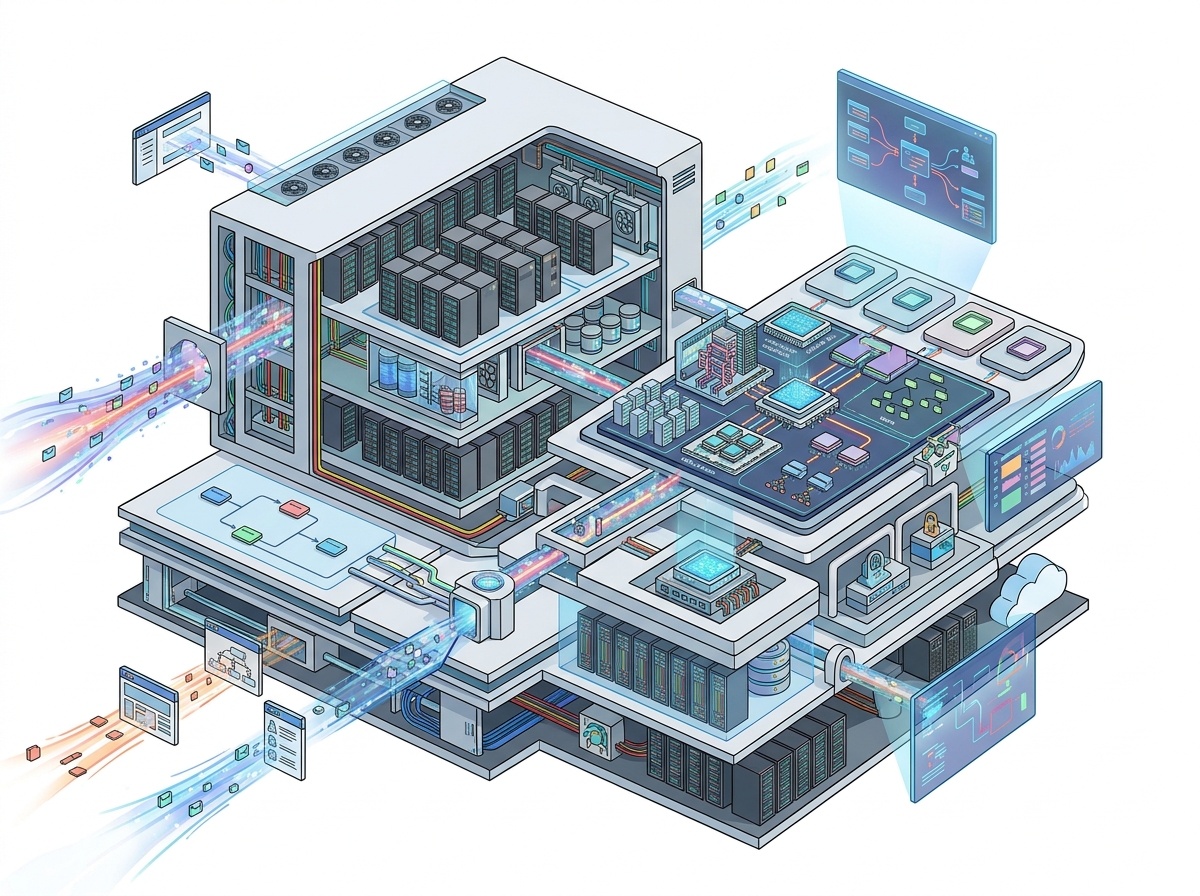 Job Seeker PortalEmployer PortalAI Job MatchingCloud Infrastructure
Subject Relevance — Where This Topic Fits
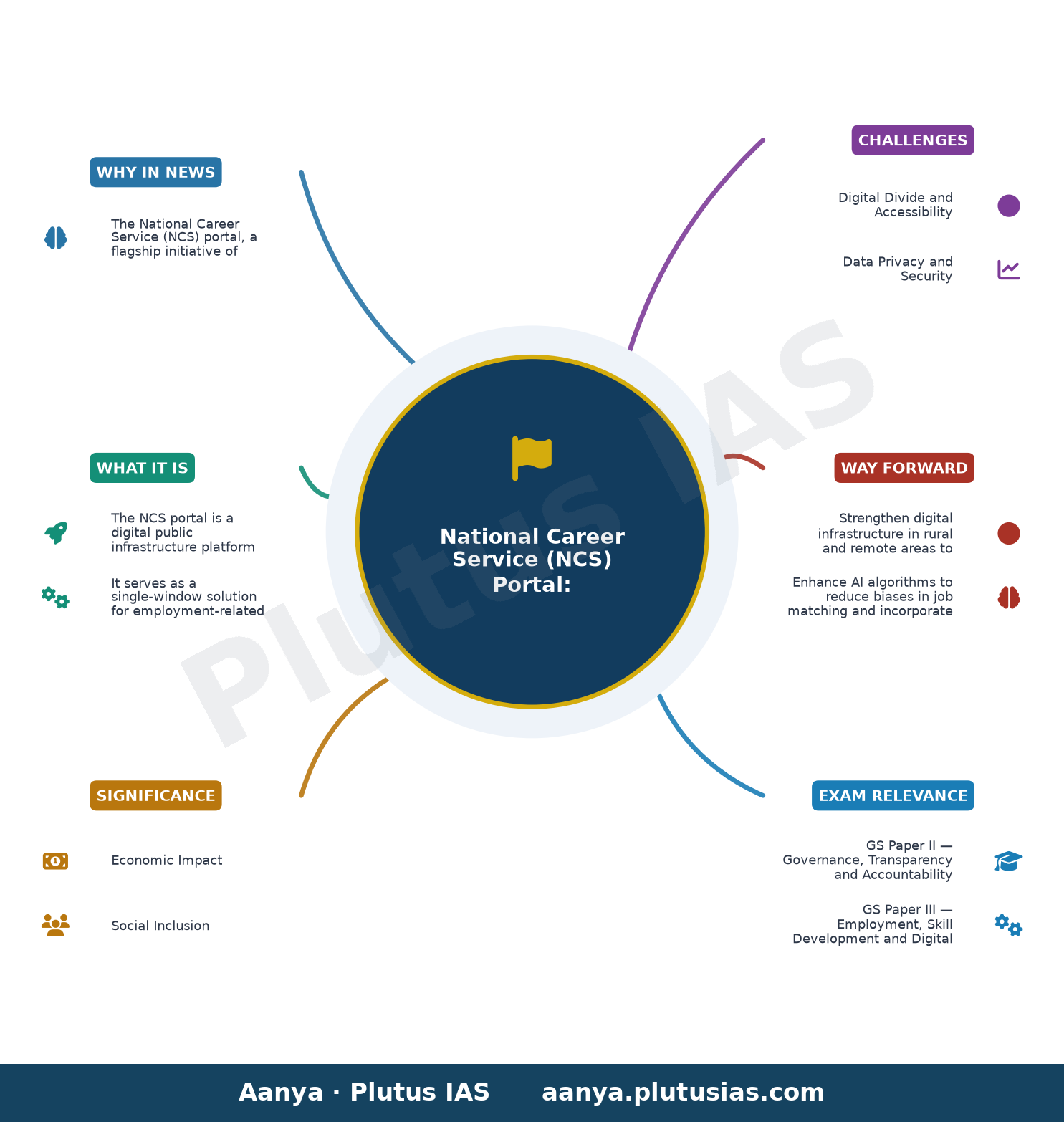
- GS Paper II — Governance, Transparency and Accountability | GS Paper III — Employment, Skill Development and Digital Public Infrastructure | GS Paper IV — Role of Technology in Governance
- Prelims: National Career Service (NCS), Digital Public Infrastructure (DPI), Skill India Mission, Public-Private Partnership (PPP) in employment, AI-driven job matching, E-Shram Portal, Skill India Digital Hub, Employment Exchange Transformation
- Essay: The Role of Digital Public Infrastructure in Bridging India’s Employment Divide, Public-Private Partnerships as Catalysts for Inclusive Growth
Quick Revision: The National Career Service (NCS) portal is a Digital Public Infrastructure initiative under the Ministry of Labour and Employment, providing AI-driven, multilingual, and integrated career services to bridge the gap between job seekers and employers in India.
Why is this in the news?
The National Career Service (NCS) portal, a flagship initiative of the Ministry of Labour and Employment under the Government of India, has achieved significant milestones in digital employment facilitation, registering over 6.64 crore job seekers and aggregating more than 10.05 crore vacancies since its inception. As of 15 July 2026, the portal hosts 17.68 lakh active vacancies and 2.89 crore active job seekers, reflecting its growing adoption and operational efficiency. The portal’s integration with advanced technologies such as AI-driven job matching, multilingual support via ‘Bhashini’, and cloud-based applications underscores its evolution into a robust digital public infrastructure for employment and skill development.
Background
- The National Career Service (NCS) portal was launched as a digital platform under the Ministry of Labour and Employment to address the challenges of unemployment and underemployment in India by providing a single-window solution for career services.
- The NCS portal is an evolution of the erstwhile National Employment Service (NES), which was transformed to align with the dynamic needs of the labour market and the digital economy.
- The portal operates under the broader framework of the Skill India Mission, aiming to bridge the gap between job seekers and employers through skill development, career counselling, and employment facilitation.
- The NCS portal is part of India’s broader strategy to leverage Digital Public Infrastructure (DPI) for inclusive growth, aligning with the G20’s emphasis on DPI for social welfare and economic development.
- The portal’s architecture is designed to integrate with other government portals such as E-Shram, Skill India Digital Hub, and DigiLocker, as well as with private sector platforms to enhance its reach and functionality.
What is the National Career Service (NCS) Portal?
- The NCS portal is a digital public infrastructure platform (www.ncs.gov.in) launched by the Ministry of Labour and Employment to provide comprehensive career services to job seekers and employers across India.
- It serves as a single-window solution for employment-related services, including job matching, career counselling, skill development courses, vocational guidance, and access to online/offline job fairs.
- The portal facilitates the registration of job seekers and employers, enabling seamless interaction between the two through a structured and transparent process.
- NCS leverages advanced technologies such as Artificial Intelligence (AI) for intelligent job matching, skill gap analysis, and personalised employment recommendations, enhancing the efficiency of the job search process.
- The portal supports multilingual functionality through ‘Bhashini’, ensuring accessibility for job seekers and employers across linguistic regions in India.
- NCS is integrated with other government portals such as E-Shram, Skill India Digital Hub, DigiLocker, EPFO, ESIC, and MHRD, as well as with private sector platforms like Apna, Swiggy, Zomato, Amazon, and TCS, to expand its reach and functionality.
- The portal hosts a repository of active vacancies (17.68 lakh as of 15 July 2026) and registered job seekers (2.89 crore as of 15 July 2026), providing real-time data on employment opportunities and labour market trends.
- NCS also facilitates the organisation of job fairs, both online and offline, to connect job seekers with potential employers, particularly in sectors facing skill shortages or high demand.
- The portal’s architecture is cloud-based and open, allowing for continuous upgrades and integration with emerging technologies to meet evolving labour market needs.
- NCS aligns with the broader objectives of the Skill India Mission by offering skill development courses and vocational training programs, thereby enhancing the employability of job seekers.
Key Features
| Feature | Significance |
|---|---|
| Single-window digital platform (www.ncs.gov.in) | Provides a unified interface for career services, integrating government and private sector job opportunities, job fairs, and skill development programs. |
| AI-powered job matching and skill gap analysis | Enhances precision in employment matching by leveraging artificial intelligence to align job seekers’ profiles with employer requirements. |
| Public-Private Partnerships (PPP) via 40+ MoUs | Expands reach and functionality through collaborations with entities like Swiggy, Zomato, Amazon, and TCS, facilitating broader job market access. |
| Integration with government portals (e.g., eShram, Skill India Digital Hub, EPFO) | Ensures seamless data sharing and service delivery across multiple government initiatives, reducing duplication and improving efficiency. |
| Mobile application with multilingual support (via Bhashini) | Increases accessibility for diverse linguistic groups, particularly in rural and semi-urban areas, ensuring inclusive participation. |
| Model Career Centres (MCC) in transformed employment exchanges | Establishes physical hubs for offline career services, including job fairs, employer engagement, and counseling, complementing the digital platform. |
Why it Matters
Economic Impact
- Reduces structural unemployment by improving job market efficiency through real-time matching of supply (job seekers) and demand (employers).
- Enhances formal sector employment by facilitating compliance with labor regulations via integration with portals like EPFO and ESIC.
- Supports gig economy growth by partnering with platforms like Swiggy and Zomato, creating structured pathways for informal sector workers.
Social Inclusion
- Bridges urban-rural divides by providing multilingual and mobile-accessible services, particularly for marginalized communities.
- Promotes gender inclusion through targeted career counseling and skill development programs for women and transgender individuals.
- Facilitates upward mobility for low-skilled workers by offering vocational training and upskilling opportunities aligned with industry needs.
Governance and Digital Public Infrastructure
- Demonstrates the efficacy of Digital India initiatives by creating a scalable, cloud-based employment ecosystem.
- Reduces administrative burden on government agencies by automating job matching and verification processes.
- Serves as a model for other welfare schemes by integrating real-time data analytics for evidence-based policymaking.
Skill Development and Employment Generation
- Aligns with the Skill India Mission by providing a direct link between skill acquisition and employment opportunities.
- Enables employers to identify skill gaps in the workforce, guiding future training and education policies.
- Supports the Atmanirbhar Bharat initiative by fostering self-employment and entrepreneurship through career guidance.
Challenges
1. Digital Divide and Accessibility
- Limited internet penetration in rural and remote areas may exclude a significant portion of the workforce from accessing the platform.
- Low digital literacy among certain demographic groups, particularly older workers and those in informal sectors, poses a barrier to effective usage.
UPSC Link: GS3: Digital Divide
2. Data Privacy and Security
- Risk of misuse of sensitive personal and employment data, necessitating robust cybersecurity measures and compliance with data protection laws.
- Lack of standardized data-sharing protocols across government and private entities may lead to inconsistencies or breaches.
UPSC Link: GS3: Data Governance
3. Quality of Job Listings
- Potential for low-quality or fraudulent job postings, which could erode trust in the platform among job seekers.
- Inadequate verification mechanisms for employer credentials may lead to exploitation of job seekers.
UPSC Link: GS3: Employment Challenges
4. Sustainability and Funding
- Long-term financial viability of the platform depends on continuous government and private sector investment.
- Over-reliance on PPP models may lead to commercialization, potentially sidelining public welfare objectives.
UPSC Link: GS3: Resource Mobilization
5. Cultural and Linguistic Barriers
- Multilingual support, while expanding, may still fall short in covering all regional languages, limiting inclusivity.
- Cultural biases in job matching algorithms could inadvertently favor certain demographics over others.
UPSC Link: GS2: Social Justice
Challenges — UPSC Perspective
| Issue | Concern |
|---|---|
| Digital Literacy | Low awareness and skills among users, particularly in rural areas, hinder effective platform utilization. |
| Data Privacy | Risk of unauthorized access or misuse of personal data, requiring stringent safeguards. |
| Fraudulent Listings | Potential for scams or misleading job postings, undermining user trust. |
| Infrastructure Gaps | Uneven internet connectivity and device availability limit platform accessibility. |
| Algorithmic Bias | AI-driven job matching may inadvertently perpetuate existing employment disparities. |
| Sustainability | Dependence on government funding and private partnerships raises questions about long-term viability. |
Government Initiatives — Must-Memorise for Prelims
- National Career Service (NCS) Portal
- Skill India Mission
- eShram Portal
- Skill India Digital Hub
Way Forward
- Strengthen digital infrastructure in rural and remote areas to ensure equitable access to the NCS platform.
- Enhance AI algorithms to reduce biases in job matching and incorporate real-time feedback from users for continuous improvement.
- Expand partnerships with state governments and local bodies to establish more Model Career Centres (MCCs) in underserved regions.
- Implement stricter verification protocols for employer postings to eliminate fraudulent job listings and protect job seekers.
- Launch targeted digital literacy campaigns in collaboration with NGOs and educational institutions to improve user adoption.
- Develop a feedback mechanism for job seekers and employers to report issues and suggest improvements, ensuring iterative enhancements.
- Integrate NCS with other welfare schemes like PMKVY and PM-SYM to create a seamless ecosystem for skill development and employment.
- Conduct periodic audits of data privacy and security measures to comply with evolving regulations and maintain user trust.
UPSC Value Addition
Keywords for Mains Answer-Writing
National Career Service (NCS) Portal · Digital Employment Exchange · Public-Private Partnership in Employment · Model Career Centres (MCC) · Skill Development and Employment · AI-driven Job Matching · Employment Exchange Transformation · NCS Portal Integration with Government Schemes · National Employment Service · Career Counselling and Guidance
Concept Flow
Rising unemployment and skill mismatches → Government launches National Career Service (NCS) portal to bridge the gap. → Digital platform aggregates job vacancies and skill development programs → Integrates with government portals (eShram, Skill India) for data sharing. → Public-Private Partnerships (PPP) expand platform reach → AI-driven job matching improves efficiency. → Model Career Centres (MCCs) complement digital services → Offline support enhances inclusivity. → Continuous technological upgrades (Bhashini, cloud-based systems) → Ensures scalability and accessibility. → User adoption and trust grow → Employment rates improve, reducing structural unemployment.
Prelims Practice Questions
Q1. Consider the following statements regarding the National Career Service (NCS) Portal:
1. The NCS Portal is a digital platform launched by the Ministry of Labour and Employment to provide career-related services.
2. It offers services such as online and offline job fairs, career counselling, and skill development courses.
3. The portal has been integrated with platforms like Udemy, eShram, and Skill India Digital Hub.
4. The NCS Portal uses AI exclusively for conducting job fairs and does not assist in job matching.
How many of the above statements are correct?
- Only one
- Only two
- Only three
- All
Answer: Only three — Statements 1, 2, and 3 are correct as they align with the official description of the NCS Portal. Statement 4 is incorrect because the NCS Portal uses AI for multiple functions including intelligent job matching and skill gap analysis, not exclusively for job fairs.
Q2. Assertion (A): The National Career Service (NCS) Portal is designed to facilitate seamless integration between job seekers and employers through a cloud-based, open-architecture platform.
Reason (R): The portal aims to provide a single-window solution for career-related services, including employment matching, career counselling, and skill development.
In the context of the above two statements, which one of the following is correct?
- Both A and R are true, and R is the correct explanation of A
- Both A and R are true, but R is not the correct explanation of A
- A is true, but R is false
- A is false, but R is true
Answer: Both A and R are true, and R is the correct explanation of A — Both Assertion (A) and Reason (R) are true, and Reason (R) correctly explains Assertion (A). The NCS Portal’s cloud-based, open-architecture design is intended to provide a single-window solution for career services, including employment matching and counselling.
Q3. Match the following initiatives with their respective objectives as per the National Career Service (NCS) Portal:
Column I (Initiative)
A. Model Career Centres (MCC)
B. AI-driven Job Matching
C. Public-Private Partnerships (PPP)
D. Integration with Government Schemes
Column II (Objective)
1. Transform employment exchanges into centres providing career services
2. Enhance job seeker-employer matching using artificial intelligence
3. Collaborate with private entities to expand employment opportunities
4. Link with schemes like eShram and Skill India Digital Hub
Select the correct match:
- A-1, B-2, C-3, D-4
- A-2, B-1, C-4, D-3
- A-3, B-4, C-1, D-2
- A-4, B-3, C-2, D-1
Answer: A-1, B-2, C-3, D-4 — The correct matches are: A-1 (Model Career Centres aim to transform employment exchanges), B-2 (AI-driven Job Matching enhances job seeker-employer matching), C-3 (Public-Private Partnerships collaborate with private entities), and D-4 (Integration with Government Schemes links with initiatives like eShram and Skill India Digital Hub).
Mains Practice Question
✍ Critically examine the role of the National Career Service (NCS) Portal in addressing India’s employment challenges. How far has it succeeded in bridging the gap between job seekers and employers through technological integration and public-private partnerships? (15 Marks)
Approach: MODEL-ANSWER SKELETON:
1. **Introduction (2 Marks)**
– Brief background of the NCS Portal: launched under the Ministry of Labour and Employment to transform the National Employment Service into a digital, single-window platform.
– Key objectives: registration of job seekers, collection of vacancies, career counselling, and skill development.
2. **Technological Integration and AI-Driven Solutions (4 Marks)**
– Cloud-based, open-architecture platform enabling scalability and accessibility.
– AI-driven features: intelligent job matching, skill gap analysis, AI interview coaching, and multilingual support (e.g., Bhashini).
– Integration with government portals (e.g., eShram, Skill India Digital Hub, EPFO) and recruitment bodies (UPSC, SSC, RRB).
– Mobile application for user-friendly access and robust verification mechanisms.
3. **Public-Private Partnerships (PPP) and Collaborations (4 Marks)**
– Over 40 MoUs signed with private entities (e.g., Swiggy, Zomato, Amazon, TCS) to expand job opportunities and skill development programs.
– Role of PPP in organising job fairs (online/offline) and providing career counselling services.
– Impact: Enhanced reach and diversity of employment opportunities beyond traditional sectors.
4. **Challenges and Limitations (3 Marks)**
– Digital divide: Limited internet access in rural and remote areas affecting participation.
– Skill mismatch: Persistent gap between industry demands and available skills despite skill development programs.
– Data privacy and security concerns in AI-driven platforms.
– Low awareness among job seekers and employers about portal functionalities.
5. **Conclusion and Way Forward (2 Marks)**
– NCS Portal as a significant step toward formalising the informal sector and improving employment matching.
– Recommendations: Strengthen last-mile connectivity (e.g., Common Service Centres), expand vocational training aligned with industry needs, and enhance awareness campaigns.
– Future potential: Leveraging AI and big data for predictive employment analytics and personalised career guidance.
Source: PIB (Press Information Bureau)
Generated by AanyaAi for educational purpose.

- राज्यसभा में राम मंदिर दान घोटाले पर विपक्ष का हंगामा, पुलिस कार्रवाई - August 5, 2026
- Ram Temple Donation Scam: Opposition Protests in Rajya Sabha - August 5, 2026
- एनसीएस पोर्टल: 10 करोड़ से अधिक रिक्तियां, 6.64 करोड़ पंजीकरण, जानिए पूरा विश्लेषण - August 5, 2026

No Comments