


18 Sep NCR Air Pollution: UP-Centre Joint Plan for 8 Key Districts in Focus
✎ The National Clean Air Programme (NCAP) targets a 20-30% reduction in PM2.5/PM10 levels by 2024 in 132 non-attainment cities, with the Commission for Air Quality Management (CAQM) serving as the statutory body for coordinating…
Subject Relevance — Where This Topic Fits
- GS Paper III — Environment and Disaster Management | GS Paper II — Federalism and Centre-State Relations
- Prelims: National Clean Air Programme (NCAP), Commission for Air Quality Management (CAQM), Online Continuous Emission Monitoring Systems (OCEMS), Solid Waste Management Rules 2016, Construction and Demolition Waste Management Rules 2016, National Green Tribunal (NGT), Bharat Stage Emission Standards (BSES), National Electric Mobility Mission Plan (NEMMP)
- Essay: Environmental governance and federalism: Balancing development and sustainability in India, The role of technology in mitigating urban air pollution: A case study of the NCR
Quick Revision: The National Clean Air Programme (NCAP) targets a 20-30% reduction in PM2.5/PM10 levels by 2024 in 132 non-attainment cities, with the Commission for Air Quality Management (CAQM) serving as the statutory body for coordinating multi-state air pollution mitigation in the NCR.
Why is this in the news?
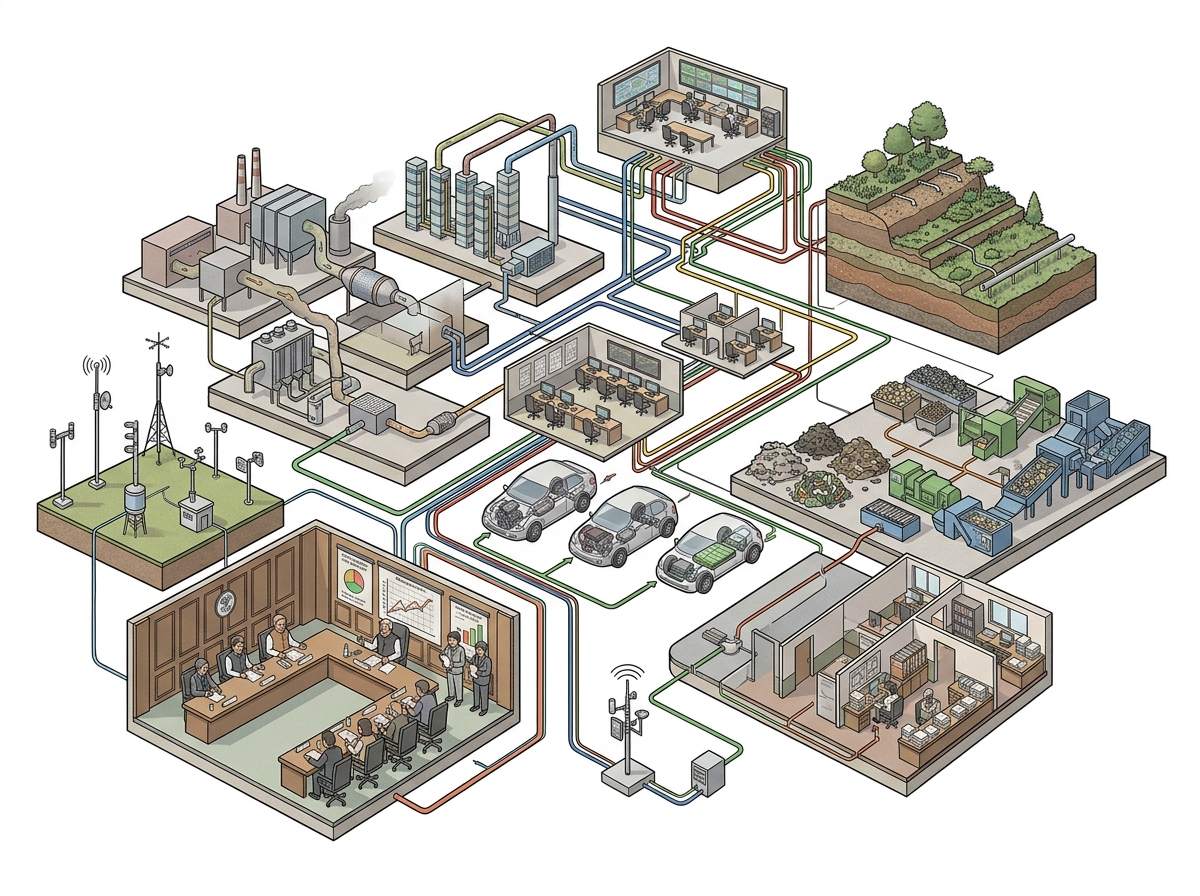
The meeting between the Chief Minister of Uttar Pradesh and the Union Environment Minister underscores the Centre-State coordination required to operationalise the National Clean Air Programme (NCAP) in the eight NCR-linked districts of Uttar Pradesh. This initiative is part of a broader, multi-state strategy to address air pollution in the National Capital Region (NCR), focusing on vehicular emissions, industrial pollution, dust management, and solid waste. The deliberations highlight the institutional mechanisms—such as the Commission for Air Quality Management (CAQM) and the National Green Tribunal (NGT)—that enforce compliance with environmental regulations, as well as the technological interventions like Online Continuous Emission Monitoring Systems (OCEMS) and Electric Vehicle (EV) policies to mitigate pollution sources.
Background
- The National Capital Region (NCR) is a contiguous urban agglomeration spanning parts of Delhi, Haryana, Rajasthan, Uttar Pradesh, and Punjab, recognised as a single air-shed due to shared meteorological and pollution dynamics.
- Air pollution in the NCR is a multi-source problem, with vehicular emissions, industrial activities, construction dust, and agricultural stubble burning contributing significantly to ambient particulate matter (PM2.5 and PM10) levels.
- The Commission for Air Quality Management (CAQM) was established in 2021 under the Commission for Air Quality Management in National Capital Region and Adjoining Areas Act, 2021, to replace the erstwhile Environment Pollution (Prevention and Control) Authority (EPCA) and provide a statutory framework for air quality management.
- The Solid Waste Management Rules, 2016, and Construction and Demolition Waste Management Rules, 2016, mandate segregation, processing, and disposal of waste to minimise fugitive dust emissions and environmental degradation.
- The Bharat Stage Emission Standards (BS-VI) and the National Electric Mobility Mission Plan (NEMMP) are key regulatory and policy instruments aimed at reducing vehicular emissions and promoting clean mobility solutions.
What is the NCR Air Pollution Action Plan?
- A coordinated governance framework aimed at reducing air pollution in the National Capital Region (NCR) through multi-sectoral interventions, including vehicular emissions control, industrial regulation, dust management, and waste management.
- The plan is operationalised under the National Clean Air Programme (NCAP), which sets time-bound targets for reducing particulate matter (PM2.5 and PM10) concentrations in 132 non-attainment cities, including those in the NCR.
- The Commission for Air Quality Management (CAQM) serves as the apex statutory body for implementing the action plan, coordinating between the Centre, state governments, and local authorities to ensure compliance with environmental standards.
- Key interventions include the deployment of Online Continuous Emission Monitoring Systems (OCEMS) in industries to track real-time emissions, enforcement of Bharat Stage Emission Standards (BS-VI) for vehicles, and promotion of electric mobility through the National Electric Mobility Mission Plan (NEMMP).
- Dust pollution mitigation measures encompass mechanised cleaning of roads and public spaces, regulation of construction and demolition activities, and enforcement of the Construction and Demolition Waste Management Rules, 2016.
- Waste management strategies focus on the implementation of the Solid Waste Management Rules, 2016, including segregation at source, decentralised processing, and scientific disposal to reduce fugitive dust and emissions.
- The action plan also includes agricultural stubble management initiatives, such as the promotion of Happy Seeders and other mechanised solutions, in coordination with state agriculture departments to prevent open burning.
- Stakeholder consultations with government departments, industry representatives, and civil society are integral to the plan’s implementation, ensuring localised solutions and community participation.
Key Features
| Feature | Significance |
|---|---|
| Coordinated NCR-NCR-linked UP districts action plan | Institutes a multi-state governance framework for air quality management, aligning UP with NCR’s pollution control priorities. |
| Focus on vehicular emissions | Targets old vehicles, enforces mandatory pollution certificates, accelerates EV adoption, and regulates aggregator-based transport to curb transport sector pollution. |
| Industrial pollution control with OCEMS | Mandates real-time monitoring of industrial emissions via Online Continuous Emission Monitoring Systems (OCEMS) and air pollution control devices to ensure compliance. |
| Mechanised and deep cleaning for dust control | Deploys mechanised street sweepers and deep cleaning protocols to reduce particulate matter from construction, demolition, and road dust. |
| Solid Waste and C&D Waste Management Rules implementation | Strengthens enforcement of waste segregation, collection, and processing under statutory rules to prevent open burning and landfill emissions. |
Why it Matters
Environmental Governance
- Demonstrates inter-state coordination under the National Capital Region (NCR) framework, integrating UP’s NCR-linked districts into a regional air quality management strategy.
- Enhances compliance through real-time monitoring (OCEMS) and statutory enforcement of waste management rules, reducing regulatory arbitrage.
- Aligns state actions with national ambient air quality standards (NAAQS) and the National Clean Air Programme (NCAP) targets.
Public Health Impact
- Directly addresses the health burden of particulate matter (PM2.5/PM10) and nitrogen oxides (NOx) in densely populated NCR-linked districts of UP, reducing respiratory and cardiovascular diseases.
- Mitigates the health impacts of open waste burning and construction dust, which are significant contributors to air pollution in urban areas.
Sustainable Urban Mobility
- Promotes transition to electric vehicles (EVs) and public transport electrification, reducing tailpipe emissions from the transport sector.
- Regulates aggregator-based transport and enforces pollution certificates, ensuring only compliant vehicles operate in the region.
Institutional Capacity Building
- Strengthens the role of the Commission for Air Quality Management (CAQM) in smaller cities through nodal officer appointments and multi-stakeholder consultations.
- Enhances inter-departmental coordination between environment, transport, industry, and urban local bodies for integrated pollution control.
Challenges
1. Fragmented Regulatory Enforcement
- Inconsistent implementation of pollution control norms across districts due to overlapping jurisdictions between state agencies and local bodies.
- Lack of uniform standards for waste management and construction activities leads to regulatory gaps and enforcement challenges.
UPSC Link: Environmental governance and federalism
2. Technological and Infrastructure Gaps
- Incomplete coverage of industries under OCEMS, particularly in MSMEs, delaying real-time monitoring and compliance.
- Inadequate mechanised cleaning infrastructure in smaller towns and peri-urban areas, limiting dust control effectiveness.
UPSC Link: Urban infrastructure and pollution control
3. Stubble Burning and Agricultural Residue Management
- Delayed or inadequate coordination with agriculture departments for stubble management, leading to seasonal spikes in biomass burning emissions.
- Limited adoption of in-situ management techniques (e.g., happy seeders) due to cost and awareness barriers among farmers.
UPSC Link: Agricultural practices and air quality
4. Public Participation and Behavioural Change
- Low awareness among citizens about vehicular pollution norms, waste segregation, and dust control measures, reducing community compliance.
- Resistance to behavioural changes such as reducing private vehicle use or adopting cleaner fuels due to convenience and cost considerations.
UPSC Link: Environmental awareness and public policy
5. Economic Disincentives for Compliance
- High capital costs for retrofitting industries with air pollution control devices and transitioning to EVs, deterring SMEs and transport operators.
- Lack of financial incentives or subsidies for MSMEs to adopt cleaner technologies, exacerbating compliance gaps.
UPSC Link: Environmental economics and regulation
Challenges — UPSC Perspective
| Issue | Concern |
|---|---|
| Incomplete OCEMS coverage | Delays in real-time monitoring and enforcement for industries not yet equipped with emission monitoring systems. |
| Waste management enforcement gaps | Open burning and improper segregation of solid and construction waste continue due to weak on-ground implementation. |
| Stubble burning in adjoining states | Seasonal agricultural residue burning in Punjab, Haryana, and western UP contributes to transboundary air pollution. |
| Urban transport congestion | High vehicular density and reliance on older, polluting vehicles in NCR-linked districts exacerbate emission levels. |
| Limited public transport electrification | Slow adoption of electric buses and lack of last-mile connectivity reduce the impact of EV policies. |
| Seasonal pollution spikes | Diwali firecrackers, post-monsoon crop residue burning, and winter inversion conditions worsen air quality despite year-round efforts. |
Government Initiatives — Must-Memorise for Prelims
- Commission for Air Quality Management (CAQM) in NCR and Adjoining Areas Act, 2021
- Solid Waste Management Rules, 2016
- Construction and Demolition Waste Management Rules, 2016
- FAME India Scheme Phase II (for EV adoption)
- National Electric Mobility Mission Plan (NEMMP) 2020
- Swachh Bharat Mission – Urban (SBM-U) 2.0 (for waste management)
Way Forward
- Constitute district-level task forces with representatives from environment, transport, industry, and urban local bodies for real-time monitoring and enforcement of pollution norms.
- Expand OCEMS coverage to 100% of industries in NCR-linked districts through phased retrofitting and financial assistance schemes for MSMEs.
- Accelerate the deployment of electric buses and charging infrastructure in key NCR-linked cities, prioritising high-traffic corridors.
- Enforce stricter penalties for open waste burning and illegal construction activities, with regular surveillance using satellite imagery and drones.
- Launch public awareness campaigns on vehicular pollution norms, waste segregation, and dust control measures, leveraging school and community networks.
- Strengthen coordination with agriculture departments for in-situ stubble management, including subsidies for happy seeders and bio-decomposers.
- Develop a graded response action plan (GRAP) for seasonal pollution spikes, with pre-emptive measures for Diwali, post-monsoon, and winter periods.
- Establish a transparent grievance redressal mechanism for citizens to report pollution violations, with time-bound resolution protocols.
UPSC Value Addition
Keywords for Mains Answer-Writing
National Capital Region (NCR) air pollution · Commission for Air Quality Management (CAQM) · National Green Tribunal (NGT) · Environment Protection Act, 1986 · Online Continuous Emission Monitoring Systems (OCEMS) · Solid Waste Management Rules, 2016 · Construction and Demolition Waste Management Rules, 2016 · National Electric Vehicle Policy · stubble management · inter-state coordination for air quality · mechanised dust cleaning · pollution control measures in Uttar Pradesh · Air (Prevention and Control of Pollution) Act, 1981 · stubble burning · vehicle emission norms · industrial pollution control
Constitutional & Policy Linkages
- Article 21 (Right to Life and Personal Liberty) – Implies state obligation to protect citizens from environmental hazards.
- Article 48A (Directive Principles of State Policy) – Mandates state to protect and improve the environment and safeguard forests and wildlife.
- Article 51A(g) (Fundamental Duties) – Obliges citizens to protect and improve the natural environment.
Concept Flow
Urbanisation and industrialisation → Increase in vehicular traffic, construction activity, and industrial emissions → Rise in ambient air pollution levels in NCR-linked districts → High pollution levels → Adverse health impacts (respiratory diseases, cardiovascular disorders) → Increased public health burden and economic costs → Non-compliance with environmental norms → Weak enforcement of waste management and emission standards → Persistent pollution sources → Regulatory gaps → Fragmented governance between state and local bodies → Ineffective implementation of pollution control measures → Policy interventions (NCAP, CAQM, EV policies) → Coordination between Centre and states → Implementation of OCEMS, waste management rules, and dust control measures → Enhanced monitoring and enforcement → Reduction in industrial and vehicular emissions → Improvement in ambient air quality → Public awareness and behavioural change → Increased compliance with pollution norms → Sustainable reduction in pollution levels
Prelims Practice Questions
Q1. Consider the following statements regarding the Commission for Air Quality Management (CAQM):
1. It is a statutory body established under the Commission for Air Quality Management in National Capital Region and Adjoining Areas Act, 2021.
2. The CAQM has the power to impose penalties for violation of air pollution norms in the NCR.
3. The CAQM is mandated to coordinate with state governments for air quality management but does not have any executive powers.
How many of the above statements are correct?
- Only one
- Only two
- Only three
- None
Answer: Only two — Statement 1 is correct as the CAQM was established under the 2021 Act. Statement 2 is correct as the CAQM has enforcement powers including imposition of penalties. Statement 3 is incorrect as the CAQM has executive powers to issue directions and coordinate implementation.
Q2. Assertion (A): The Solid Waste Management Rules, 2016 mandate segregation of waste at source in urban areas.
Reason (R): The rules require local bodies to ensure 100% segregation of waste at the household level by 2026.
In the context of the above two statements, which one of the following is correct?
- Both A and R are true, and R is the correct explanation of A
- Both A and R are true, but R is NOT the correct explanation of A
- A is true, but R is false
- A is false, but R is true
Answer: A is true, but R is false — A is correct as the Solid Waste Management Rules, 2016 mandate segregation of waste at source. However, R is incorrect as the rules do not specify a 100% segregation target by 2026; the target is progressive and varies by urban local body.
Q3. Match the following pairs related to air pollution control measures in India:
Column I (Measure/Policy) Column II (Description)
A. National Electric Vehicle Policy 1. Mandates installation of air pollution control devices in industries
B. Online Continuous Emission Monitoring Systems (OCEMS) 2. Aims to promote electric mobility and reduce vehicular emissions
C. Air (Prevention and Control of Pollution) Act, 1981 3. Requires industries to install real-time emission monitoring systems
D. Construction and Demolition Waste Management Rules, 2016 4. Regulates dust and debris from construction activities
Select the correct match:
- A-2, B-3, C-1, D-4
- A-1, B-2, C-3, D-4
- A-3, B-1, C-2, D-4
- A-4, B-3, C-2, D-1
Answer: A-2, B-3, C-1, D-4 — A matches with 2 (National Electric Vehicle Policy promotes electric mobility). B matches with 3 (OCEMS requires real-time monitoring). C matches with 1 (the 1981 Act mandates air pollution control devices). D matches with 4 (the 2016 rules regulate construction and demolition waste).
Mains Practice Question
✍ The National Capital Region (NCR) faces severe air pollution challenges due to vehicular emissions, industrial activities, and dust from construction and waste management. Critically examine the institutional and legal framework governing air pollution control in the NCR, with particular reference to the role of the Commission for Air Quality Management (CAQM), the Air (Prevention and Control of Pollution) Act, 1981, and recent policy initiatives such as the National Electric Vehicle Policy. Also, assess the effectiveness of inter-state coordination in addressing the transboundary nature of air pollution in the region. (15 Marks)
Approach: MODEL-ANSWER SKELETON:
1. **Institutional Framework:**
– Role of CAQM: Statutory body under the Commission for Air Quality Management in National Capital Region and Adjoining Areas Act, 2021; powers to issue directions, coordinate with states, and impose penalties.
– Legal basis: CAQM derives authority from the 2021 Act and the Air (Prevention and Control of Pollution) Act, 1981.
– Other institutions: National Green Tribunal (NGT) for adjudication, State Pollution Control Boards (SPCBs) for enforcement.
2. **Policy Initiatives:**
– National Electric Vehicle Policy: Aims to reduce vehicular emissions by promoting electric mobility, including deployment of electric buses and incentives for EV adoption.
– Online Continuous Emission Monitoring Systems (OCEMS): Mandates real-time monitoring of industrial emissions to ensure compliance with pollution norms.
– Solid Waste Management Rules, 2016 and Construction and Demolition Waste Management Rules, 2016: Target source segregation, waste processing, and dust control.
3. **Inter-state Coordination:**
– Challenges: Air pollution in the NCR is transboundary, requiring coordination among Uttar Pradesh, Haryana, Rajasthan, Punjab, and Delhi.
– Mechanisms: CAQM facilitates coordination; meetings between state chief ministers and Union Environment Minister; stubble management initiatives in Punjab and Haryana.
– Effectiveness: Limited success due to varying state capacities, political constraints, and enforcement gaps; need for stronger institutional mechanisms.
4. **Critical Analysis:**
– Strengths: CAQM provides a unified framework; OCEMS enhances transparency; EV policy aligns with global trends.
– Weaknesses: Enforcement remains weak; inter-state coordination is ad hoc; lack of uniform standards across states.
– Way forward: Strengthen CAQM’s powers, harmonise state-level policies, invest in public transport, and promote sustainable urban planning.
Source: The Indian Express
Generated by AanyaAi for educational purpose.
Related guides on our sites
- Best geography optional coaching
- Best geography optional coaching
- Best geography optional teacher
- Best geography optional teacher

- NCR Air Pollution: UP-Centre Joint Plan for 8 Key Districts in Focus - September 18, 2026
- कर्नाटक का डेटा सेंटर नीति: 2031 तक 1 गीगावाट IT लोड का लक्ष्य - September 18, 2026
- Karnataka’s Sustainable Data Centre Policy 2026–2031: Key Features & UPSC Relevance - September 18, 2026

No Comments