


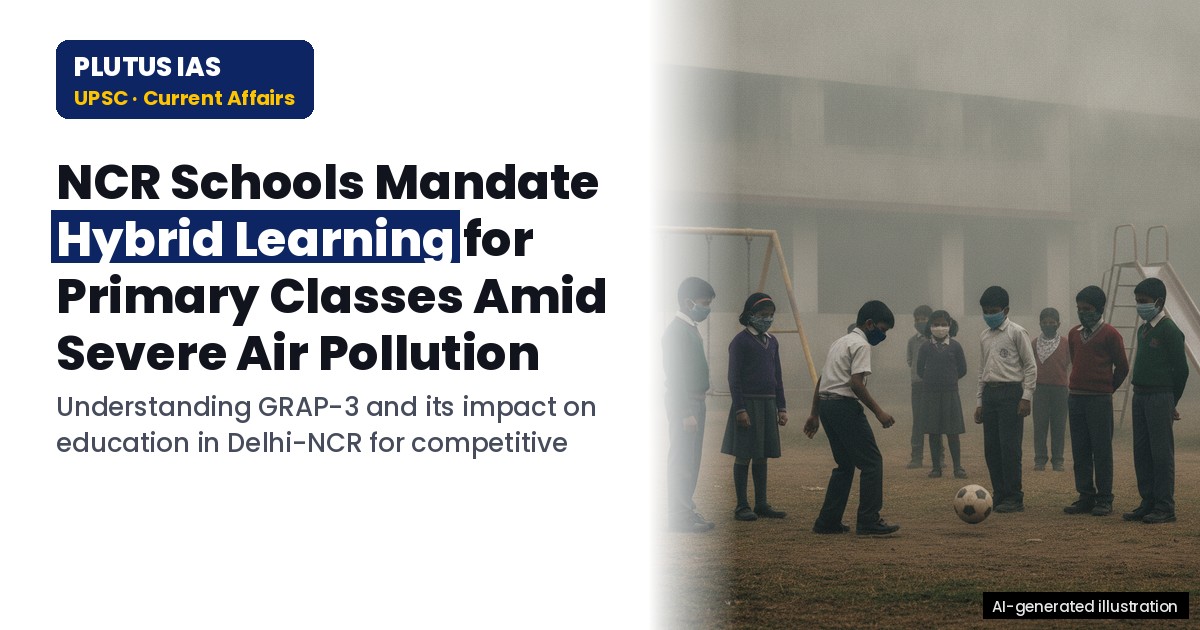
13 Nov NCR Pollution: Hybrid Learning for Primary Classes
✎ The Graded Response Action Plan (GRAP) is a critical framework for implementing emergency measures to combat air pollution in the Delhi-NCR region, with Stage III mandating stringent actions, including hybrid learning for young…
Subject Relevance — Where This Topic Fits
- GS Paper I — Urbanisation, Social Empowerment | GS Paper II — Government Policies and Interventions, Issues Relating to Development and Management of Social Sector/Services relating to Education, Health | GS Paper III — Environmental Pollution and Degradation, Environmental Impact Assessment, Disaster Management
- Prelims: Air Quality Index (AQI), Graded Response Action Plan (GRAP), National Capital Region (NCR), Hybrid learning, Smog, Particulate Matter (PM2.5, PM10)
- Essay: The environmental crisis and its impact on public health and education., Sustainable urban development and the challenges of air pollution.
Quick Revision: The Graded Response Action Plan (GRAP) is a critical framework for implementing emergency measures to combat air pollution in the Delhi-NCR region, with Stage III mandating stringent actions, including hybrid learning for young students, when air quality deteriorates to ‘severe’ levels.
Why is this in the news?
Authorities in the National Capital Region (NCR), including Noida, Ghaziabad, Gurugram, and Faridabad, have mandated a ‘hybrid mode’ of learning for students up to Class 5 in response to deteriorating air quality, particularly following the Diwali festival. This directive, issued by district basic education officers, necessitates schools to offer both online and offline learning options, aligning with the implementation of Stage III of the Graded Response Action Plan (GRAP) to mitigate the adverse effects of severe air pollution on children’s health and education.
Background
- Air pollution in the National Capital Region (NCR) is a recurring environmental challenge, particularly during the post-monsoon and winter months, exacerbated by factors such as stubble burning, vehicular emissions, industrial pollution, and meteorological conditions.
- The Air Quality Index (AQI) is a tool for communicating air quality status to the public, indicating how clean or polluted the air currently is, and what associated health effects might be a concern.
- The Graded Response Action Plan (GRAP) is a set of emergency measures implemented to combat air pollution in Delhi-NCR, categorized into four stages based on the severity of air quality.
- Stage III of GRAP is activated when the AQI crosses the ‘severe’ category (401-450), triggering stricter measures to prevent further deterioration of air quality.
- The ‘hybrid learning’ model combines traditional in-person classroom instruction with online educational activities, offering flexibility and continuity of education during disruptive events such as severe air pollution.
- The decision to implement hybrid learning underscores the government’s proactive approach to safeguard public health, especially that of vulnerable populations like young children, from the detrimental impacts of hazardous air quality.
What is the Graded Response Action Plan (GRAP)?
- The Graded Response Action Plan (GRAP) is a set of emergency measures implemented in the Delhi-NCR region to combat air pollution.
- It was formulated by the Environment Pollution (Prevention and Control) Authority (EPCA) and notified by the Ministry of Environment, Forest and Climate Change (MoEFCC) in 2017.
- GRAP operates on a ‘severe’ to ‘moderate’ scale, with four distinct stages of intervention, each triggered by specific Air Quality Index (AQI) thresholds.
- The plan aims to prevent the further deterioration of air quality and ensure timely implementation of pollution control measures.
- Measures under GRAP include restrictions on construction activities, industrial operations, vehicular movement, and the burning of biomass.
- Stage III of GRAP is activated when the AQI reaches the ‘severe’ category (401-450), necessitating more stringent actions such as a ban on non-essential construction and demolition work, and restrictions on certain industrial activities.
- The implementation of GRAP is overseen by the Commission for Air Quality Management (CAQM) in NCR and adjoining areas, which coordinates efforts among various government agencies.
- The current directive for hybrid learning in schools falls under the purview of GRAP Stage III, highlighting the gravity of the prevailing air pollution levels and the need for protective measures for children.
Key Features
| Feature | Significance |
|---|---|
| Hybrid Learning Mandate | Schools up to Class 5 in Delhi-NCR are directed to offer both online and offline learning options. |
| Scope of Application | This directive applies to all government, aided, and private schools within the specified regions of Delhi-NCR. |
| Student Choice | Students are provided the flexibility to choose between attending physical classes or participating in online sessions. |
| Trigger for Implementation | The measure is a direct response to deteriorating air quality, specifically the implementation of GRAP Stage III restrictions. |
| Enforcement Authority | Orders have been issued by District Basic Education Officers, with strict instructions for compliance by school principals and management. |
| Preventive Measure | The decision is framed as a precautionary step to safeguard children’s health amidst adverse meteorological conditions and anticipated worsening air quality. |
Why it Matters
Public Health
- Mitigation of exposure to hazardous air pollutants for young children, who are particularly vulnerable to respiratory and developmental issues.
- Reduction of health burden on healthcare systems by proactively addressing the health impacts of severe air pollution.
Education Sector
- Ensuring continuity of education during environmental crises, preventing significant learning loss.
- Promoting adaptability and resilience within the educational framework by integrating technology for remote learning.
Environmental Governance
- Demonstrates a proactive governmental response to environmental emergencies, utilizing established frameworks like GRAP.
- Highlights the inter-sectoral impact of environmental degradation, necessitating coordinated policy responses across various domains.
Social Equity
- Addresses concerns regarding equitable access to education, as online options can bridge gaps for students unable to attend physically due to health or logistical reasons.
- Raises awareness among the populace about the severity of air pollution and the need for collective action.
Challenges
1. Digital Divide and Access
- Unequal access to reliable internet connectivity and digital devices among students, particularly in economically disadvantaged households.
- Varying levels of digital literacy among students, parents, and educators, impacting the effectiveness of online learning.
UPSC Link: Social Justice; Education
2. Learning Effectiveness and Engagement
- Challenges in maintaining student engagement and attention in an online environment, especially for younger children.
- Difficulties in providing individualized attention and addressing diverse learning needs in a hybrid setup.
UPSC Link: Human Resource Development; Education
3. Infrastructure and Resource Allocation
- Requirement for robust digital infrastructure and technical support within schools to facilitate seamless hybrid learning.
- Financial implications for schools and families in acquiring necessary technology and ensuring uninterrupted power supply.
UPSC Link: Government Policies and Interventions
4. Socio-Emotional Well-being
- Potential negative impacts on children’s social development and mental health due to reduced physical interaction with peers and teachers.
- Increased screen time concerns and its implications for physical health, including vision and posture.
UPSC Link: Social Sector/Services; Health
5. Curriculum Adaptation and Assessment
- Need for adapting teaching methodologies and curriculum content to suit both online and offline modalities.
- Challenges in standardizing assessment methods and ensuring fair evaluation across different learning environments.
UPSC Link: Education; Governance
Challenges — UPSC Perspective
| Issue | Concern |
|---|---|
| Air Quality Index (AQI) Fluctuation | Unpredictable and rapid changes in air quality necessitate agile policy responses, potentially disrupting educational continuity. |
| Parental Choice vs. Mandate | Balancing parental preferences for physical schooling with public health mandates during environmental emergencies. |
| Teacher Training and Preparedness | Ensuring educators are adequately trained and equipped to deliver effective instruction across hybrid platforms. |
| Monitoring and Compliance | Effective enforcement of directives across a large number of diverse educational institutions, including private entities. |
| Long-term Educational Planning | Integrating hybrid learning as a sustainable model rather than a temporary fix, requiring strategic planning and investment. |
Government Initiatives — Must-Memorise for Prelims
- Graded Response Action Plan (GRAP)
Way Forward
- Invest in robust digital infrastructure and provide subsidized access to devices and internet connectivity for underprivileged students.
- Develop standardized, flexible hybrid learning modules and provide comprehensive training to educators on effective online pedagogy.
- Establish clear guidelines and support systems for schools to ensure equitable access and quality education for all students in a hybrid model.
- Implement regular monitoring and evaluation mechanisms for the effectiveness of hybrid learning, incorporating feedback from students, parents, and teachers.
- Formulate long-term strategies for integrating environmental health considerations into educational planning, including curriculum on air pollution awareness.
- Strengthen inter-agency coordination for effective implementation of GRAP, ensuring timely and consistent communication with educational institutions.
- Promote public awareness campaigns on air pollution mitigation and the importance of collective action to improve environmental health.
UPSC Value Addition
Keywords for Mains Answer-Writing
Air Pollution · National Capital Region (NCR) · Graded Response Action Plan (GRAP) · Environmental Governance · Public Health · Education Policy · Hybrid Learning · Sustainable Development · Environmental Protection Act, 1986 · Commission for Air Quality Management (CAQM)
Constitutional & Policy Linkages
- Article 21A: Right to Education
- Article 48A: Protection and Improvement of Environment
Concept Flow
Deteriorating Air Quality (AQI) → Activation of GRAP Stage III → Government Directive for Hybrid Learning → Schools Implement Online/Offline Options → Children’s Health Protection & Educational Continuity
Prelims Practice Questions
Q1. Consider the following statements regarding the Graded Response Action Plan (GRAP):
1. GRAP is a set of emergency measures implemented to tackle air pollution in the National Capital Region (NCR).
2. It is enforced by the Central Pollution Control Board (CPCB) under the Environment Protection Act, 1986.
3. The measures under GRAP are implemented based on the Air Quality Index (AQI) categories.
How many of the above statements are correct?
- Only one
- Only two
- All three
- None
Answer: All three — Statement 1 is correct: GRAP is indeed an emergency action plan for air pollution in the NCR. Statement 2 is incorrect: GRAP is enforced by the Commission for Air Quality Management (CAQM), not directly by CPCB, though CPCB plays a crucial role. Statement 3 is correct: The severity of GRAP measures is directly linked to the Air Quality Index (AQI) levels.
Q2. Which of the following bodies is primarily responsible for implementing the Graded Response Action Plan (GRAP) in the National Capital Region (NCR)?
- Ministry of Environment, Forest and Climate Change (MoEFCC)
- Central Pollution Control Board (CPCB)
- National Green Tribunal (NGT)
- Commission for Air Quality Management (CAQM)
Answer: Commission for Air Quality Management (CAQM) — The Commission for Air Quality Management (CAQM) in NCR and Adjoining Areas is the statutory body responsible for coordinating and implementing GRAP measures to combat air pollution.
Mains Practice Question
✍ The implementation of the Graded Response Action Plan (GRAP) has become a recurring feature in addressing air pollution in the National Capital Region (NCR). Critically examine the effectiveness of GRAP in mitigating air pollution and discuss the broader challenges in ensuring sustainable air quality in the region. (15 Marks)
Approach: INTRODUCTION: Briefly define GRAP and its purpose in the context of NCR’s air pollution.
BODY 1 – EFFECTIVENESS OF GRAP:
* POSITIVE IMPACTS: Discuss how GRAP provides a structured framework, triggers emergency measures (e.g., construction bans, odd-even schemes, school closures), raises public awareness, and has led to some short-term improvements in air quality during severe episodes.
* LIMITATIONS/CRITICISMS: Analyse the challenges such as reactive rather than proactive approach, temporary nature of relief, economic disruption, enforcement issues, lack of sustained behavioural change, and insufficient focus on root causes (e.g., vehicular emissions, industrial pollution, stubble burning, dust).
BODY 2 – BROADER CHALLENGES FOR SUSTAINABLE AIR QUALITY:
* INTER-STATE COORDINATION: Mention the complexity of managing pollution sources across multiple states (Delhi, Haryana, Uttar Pradesh, Rajasthan).
* SOURCE DIVERSIFICATION: Discuss the varied sources of pollution (industrial, vehicular, domestic, agricultural stubble burning, construction dust) and the difficulty in addressing all simultaneously.
* TECHNOLOGICAL SOLUTIONS: Highlight the need for cleaner technologies, public transport infrastructure, and waste management.
* PUBLIC PARTICIPATION & BEHAVIOURAL CHANGE: Emphasise the role of citizens and industries in adopting sustainable practices.
* INSTITUTIONAL CAPACITY: Address issues related to monitoring, enforcement, and policy implementation by various agencies.
CONCLUSION: Summarise the need for a comprehensive, long-term, and multi-sectoral strategy that moves beyond emergency responses to address the structural causes of air pollution for sustainable air quality improvement in the NCR.
Source: indiatv.in
Uttar Pradesh PCS (UPPSC) — State PCS Practice
Prelims: Considering the recent directive for schools up to Class 5 in Noida and Ghaziabad to operate in hybrid mode due to rising pollution, which of the following statements is/are correct regarding the administrative measures taken in Uttar Pradesh to combat air pollution?
1. The Uttar Pradesh Pollution Control Board (UPPCB) is the primary state authority responsible for implementing environmental protection laws and regulations.
2. The National Green Tribunal (NGT) has no jurisdiction over environmental matters within Uttar Pradesh as it is a state subject.
3. The ‘Graded Response Action Plan’ (GRAP) is a set of emergency measures implemented in the National Capital Region (NCR), including parts of Uttar Pradesh, to tackle severe air pollution levels.
Select the correct option:
- A. 1 only
- B. 1 and 3 only
- C. 2 and 3 only
- D. 1, 2 and 3
Answer: B. 1 and 3 only — Statement 1 is correct as UPPCB is the key state body. Statement 3 is correct as GRAP is implemented in NCR, including UP districts like Noida and Ghaziabad. Statement 2 is incorrect as NGT has jurisdiction over environmental matters across India, including Uttar Pradesh.
Mains: Discuss the socio-economic implications for families and the education sector in Noida and Ghaziabad when schools are mandated to operate in a hybrid mode due to escalating air pollution. What administrative and infrastructural challenges does the Uttar Pradesh government face in ensuring effective implementation of such directives while maintaining educational continuity and public health standards in these rapidly urbanizing districts?
Generated by AanyaAi for educational purpose.
Related guides on our sites
- Current affairs for upsc 2026
- How to prepare for GS paper 1 for UPSC CSE mains exam
- Best schools in India
- Best UPSC coaching for IFOS exam

- NAMASTE Scheme: Enhancing Sanitation Workers’ Livelihoods & Safety - November 14, 2026
- एमएसएमई का विशेष अभियान 6.0: स्वच्छता और लंबित मामलों का निपटारा - November 14, 2026
- Sea Vigil-26: Coastal Defence Drills Off Visakhapatnam - November 14, 2026

No Comments