


09 May NCRB released its flagship Crime report 2024
This article covers “Daily Current Affairs”
SYLLABUS MAPPING : GS Paper 1,2,3 : Society, Social Issues, Governance, Internal Security.
FOR PRELIMS : NCRB , ADSI 2024 , Crimes Against Vulnerable Groups
FOR MAINS : “The 17.9% surge in cybercrime in 2024 — crossing one lakh registered cases for the first time — is not merely a law enforcement challenge but a structural threat to India’s digital economy and citizen safety.” Examine the nature and drivers of cybercrime in India, institutional mechanisms to combat it, and the policy gaps that need urgent attention. (15 M)

Why in News?
The National Crime Records Bureau (NCRB) released its flagship Crime in India 2024 report and the companion Accidental Deaths & Suicides in India (ADSI) 2024 report in May 2026. The report holds special significance as it covers the first full year of enforcement under India’s new criminal laws — the Bharatiya Nyaya Sanhita (BNS), Bharatiya Nagarik Suraksha Sanhita (BNSS), and Bharatiya Sakshya Adhiniyam (BSA) — replacing the colonial-era IPC, CrPC, and Indian Evidence Act. While headline cognisable crime figures dropped by 6%, a closer reading reveals deepening structural vulnerabilities: cybercrime crossed the one-lakh mark for the first time, crimes against senior citizens surged, drug overdose deaths jumped 50%, and juvenile offences rose 11.2%.
What is the NCRB?
Mandate and History
The National Crime Records Bureau is India’s premier statistical organisation under the Ministry of Home Affairs, set up in 1986 based on the recommendations of the National Police Commission (1977) and the Task Force (1985). Its core mandate is to collect, compile, and analyse crime data as defined under criminal laws — first under the Indian Penal Code and now under the Bharatiya Nyaya Sanhita — across all 36 states and Union Territories of India.
Crime data flows from police stations into State Crime Records Bureaus (SCRBs) and then to the NCRB through the Crime and Criminal Tracking Networks & Systems (CCTNS). The bureau follows the Principal Offence Rule: when a single FIR lists multiple charges, only the most serious offence is counted — a methodology that can understate composite violent crimes.
Key Publications
Overall Crime Picture — The 2024 Paradox
The headline number — 58.85 lakh cognisable crimes, a 6% drop from 2023 — appears reassuring. However, forensic criminologists and policy experts caution against treating this as a straightforward improvement in public safety. Several structural factors can artificially suppress registered crime numbers:
- The IPC-to-BNS transition in 2024 altered how offences are classified and registered, creating transitional data noise
- Systemic underreporting persists — especially for crimes against women in rural areas, where social stigma and lack of access to police stations suppress FIR registration
- The Principal Offence Rule means composite violent crimes (e.g., rape + murder) are counted only once, understating severity
- NCRB data captures registered crimes, not the actual incidence — victimisation surveys like NFHS-5 show far higher actual rates of violence against women
Crimes Against Vulnerable Groups — Category-by-Category
| Category | 2024 Data | Change from 2023 | Key Driver / Observation |
|---|---|---|---|
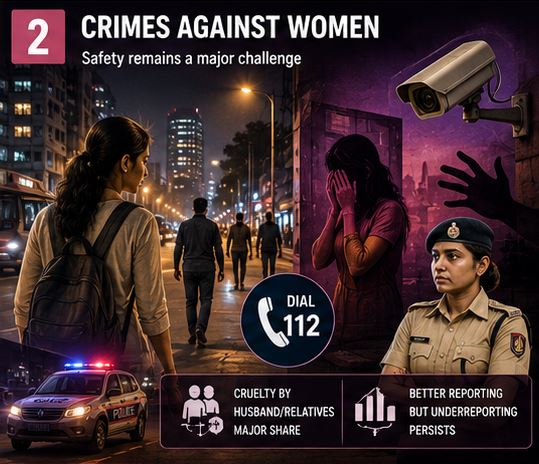
| Crimes Against Women | ~4.41 lakh cases; crime rate 64.6 per lakh women | ↓ 1.5% | Cruelty by husband/relatives constituted nearly 42% of all cases; new BNS category introduced |
| Crimes Against Children | ~1.87 lakh cases | ↑ 5.9% | Kidnapping (40%) and POCSO sexual offences (36.9%) formed the largest share |
| Crimes Against Senior Citizens | Significant rise in registered offences | ↑ 16.9% | Theft, cheating, and financial fraud dominated; Delhi recorded highest metro figures |
| Crimes Against SCs | Decline in registered cases | ↓ 3.6% | Reduction may reflect underreporting rather than an actual decline in caste discrimination |
| Crimes Against STs | Sharp fall in registered cases | ↓ 23.1% | Considered a possible statistical anomaly; requires deeper investigation |
| Murder Cases | National murder rate: 1.9 per lakh; Delhi: 504 cases | ↓ 2.4% | Delhi recorded a high charge-sheeting rate of 90.8% |
| Economic Offences | 2.14 lakh+ cases | ↑ 4.6% | Rise driven mainly by digital fraud, cheating, and cyber-enabled financial crimes |
| Missing Persons | 5.2 lakh+ persons reported missing | ↑ 7.3% | Girls constituted 76.8% of missing children; recovery rates remained relatively high |
Cybercrime — The Most Alarming Finding
The 17.9% surge in cybercrime — crossing 1 lakh registered cases for the first time in India’s history — is the most alarming data point in the 2024 report. Cybercrime is aggregated from the National Cyber Crime Reporting Portal (cybercrime.gov.in) and remains the only standardised national dataset in this domain.

- Financial fraud accounts for the majority of all cybercrime FIRs — UPI fraud, OTP phishing, and fake investment schemes are the top methods
- Karnataka, Telangana and Maharashtra top state-wise cybercrime counts because they host metropolitan commercial hubs where online fraud thrives
- The challenge for investigators lies in tracing financial trails across UPI ecosystems, cryptocurrency wallets, mule accounts, and foreign-hosted servers
- The 15.4% decline in kidnapping FIRs alongside a 7.8% rise in missing children reports is a statistical paradox — some abduction cases may be reclassified under BNS provisions

ADSI 2024 — Suicides and Accidental Deaths
Suicide Statistics
The companion Accidental Deaths & Suicides in India (ADSI) 2024 report reveals a marginal improvement in the national suicide rate — dropping from 12.3 to 12.2 per lakh population — but the absolute numbers remain deeply concerning and reflect systemic socio-economic distress across the country.
Farmer Suicides
The agriculture sector accounted for 10,546 suicides in 2024, reflecting economic insecurity, crop failure, mounting debt burdens, and inadequate rural support systems. These figures underline the urgent need for reforms in agricultural credit, crop insurance, and rural mental health services.
Drug Overdose Deaths — A 50% Jump
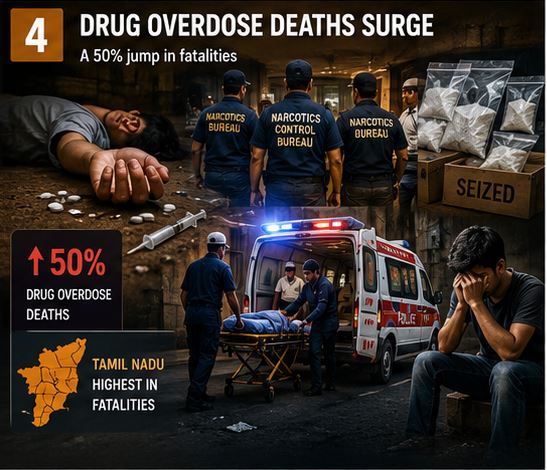
One of the most stark findings of the ADSI 2024 report is the 50% jump in drug overdose deaths compared to the previous year. Tamil Nadu recorded the highest number of drug overdose fatalities in the country. This sharp rise reflects both increasing substance availability and gaps in de-addiction infrastructure at the district level.
Metropolitan Crime — Delhi’s Persistent Challenge
Among India’s 19 Metro Cities, Delhi recorded the highest number of crimes against women, crimes against senior citizens, and cases involving foreigners in 2024 — a pattern that has repeated year after year. The city’s murder charge-sheeting rate of 90.8% reflects effective investigative follow-through, but absolute crime volumes remain disproportionately high relative to other metros.
Juvenile Crime — Rising Delinquency
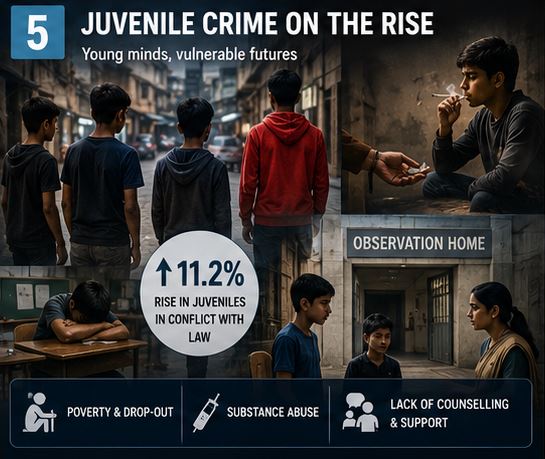
The 11.2% rise in juveniles in conflict with law is one of the more underreported but significant findings of the 2024 report. This trend reflects broader socio-economic pressures on adolescents — including poverty, school dropout, substance exposure, and inadequate child protection infrastructure. The Juvenile Justice (Care and Protection of Children) Act, 2015 and the JJ Model Rules need periodic review in light of these rising numbers.
Limitations of NCRB Data — Critical Analysis
- NCRB measuresregistered crimes— not actual crime. The “dark figure of crime” (unreported offences) remains invisible
- NFHS-5 found that nearly1 in 3 married women (29.3%) have experienced spousal violence— vastly exceeding NCRB’s domestic cruelty case count
- ThePrincipal Offence Ruleunderstates composite violent crimes by counting only the most serious offence in a multi-charge FIR
- A statistical decline in SC/ST atrocity cases does not mean reduced discrimination — it may reflect rural underreporting and fear of social retaliation
- State-wise rankings attract political attention but need rate-based (not absolute) comparison adjusted for population
Prelims Question
Q. With reference to the NCRB Crime in India 2024 Report, consider the following statements:
1. Overall cognisable crimes in India declined by 6% in 2024 compared to 2023.
2. Cybercrime in India exceeded the one-lakh mark for the first time in 2024, recording a 17.9% rise.
3. Crimes against women increased significantly in 2024, with Cruelty by Husband forming the smallest share of cases.
4. The 2024 report is the first to record crimes under the Bharatiya Nyaya Sanhita (BNS), replacing the IPC.
Which of the statements given above are correct?
a) 1, 2 and 3 only
b) 1, 2 and 4 only
c) 2, 3 and 4 only
d) 1, 2, 3 and 4
Answer & explanation
Correct Answer: (b) 1, 2 and 4 only
Statement 1 is CORRECT. India recorded 58.85 lakh cognisable crimes in 2024, a 6% decline from 62.41 lakh in 2023. The crime rate per lakh population fell from 448.3 to 418.9.
Statement 2 is CORRECT. Cybercrime rose 17.9% in 2024, crossing the one-lakh mark for the first time — a historic threshold. Financial fraud through UPI, OTP phishing and fake investment schemes drives the bulk of cases.
Statement 3 is INCORRECT. The statement is doubly wrong. Crimes against women actually declined marginally by 1.5%. And Cruelty by Husband/Relatives forms the largest share (~42%) of all registered crimes against women — not the smallest.
Statement 4 is CORRECT. 2024 was the first full year of enforcement under the new BNS, BNSS and BSA, which replaced the IPC, CrPC and Indian Evidence Act on July 1, 2024. The NCRB is currently mapping legacy IPC heads to BNS sections.
Mains Questions
“The NCRB Crime in India 2024 report presents a statistical paradox — a 6% decline in overall cognisable crime alongside an explosion in cybercrime, crimes against the elderly, and drug overdose deaths.” Critically analyse the key findings of the report, discuss the methodological limitations of NCRB data, and examine what these numbers reveal about the state of law enforcement and governance in India.

- India’s Youth Unemployment and Education Crisis - August 5, 2026
- India’s Sports Infrastructure and the 2036 Olympics Ambition - August 5, 2026
- Critical Minerals: The Foundation of Strategic Power - August 4, 2026

No Comments