


24 Sep NCST Reviews Constitutional Safeguards for Karnataka’s Scheduled Tribes
✎ The National Commission for Scheduled Tribes (NCST) is a constitutional body mandated to monitor the implementation of safeguards and welfare schemes for Scheduled Tribes, including constitutional protections, reservations, and…
Subject Relevance — Where This Topic Fits
- GS Paper II — Constitutional and Non-Constitutional Bodies (Statutory, Regulatory and various Quasi-judicial Bodies) | GS Paper II — Welfare Schemes for Vulnerable Sections of the population by the Centre and States and the Performance of these Schemes | GS Paper III — Land Reforms and Issues Relating to Tribal Communities | GS Paper III — Government Policies and Interventions for Development in various sectors and Issues arising out of their Design and Implementation
- Prelims: Scheduled Tribes (STs) Constitutional Safeguards, National Commission for Scheduled Tribes (NCST), Forest Rights Act (FRA), 2006, Scheduled Tribes and Other Traditional Forest Dwellers (Recognition of Forest Rights) Act, 2006, Backlog Vacancies in Public Employment, Primitive Vulnerable Tribal Groups (PVTGs), Koraga and Jenu Kuruba Communities, Reservation Policy for STs in Education and Public Employment, Tribal Sub-Plan (TSP) and Tribal Component Funds
- Essay: The Role of Constitutional Bodies in Ensuring Social Justice: A Case Study of the National Commission for Scheduled Tribes, Tribal Development in India: Balancing Constitutional Safeguards with Inclusive Growth
Quick Revision: The National Commission for Scheduled Tribes (NCST) is a constitutional body mandated to monitor the implementation of safeguards and welfare schemes for Scheduled Tribes, including constitutional protections, reservations, and the Forest Rights Act, 2006.
Why is this in the news?
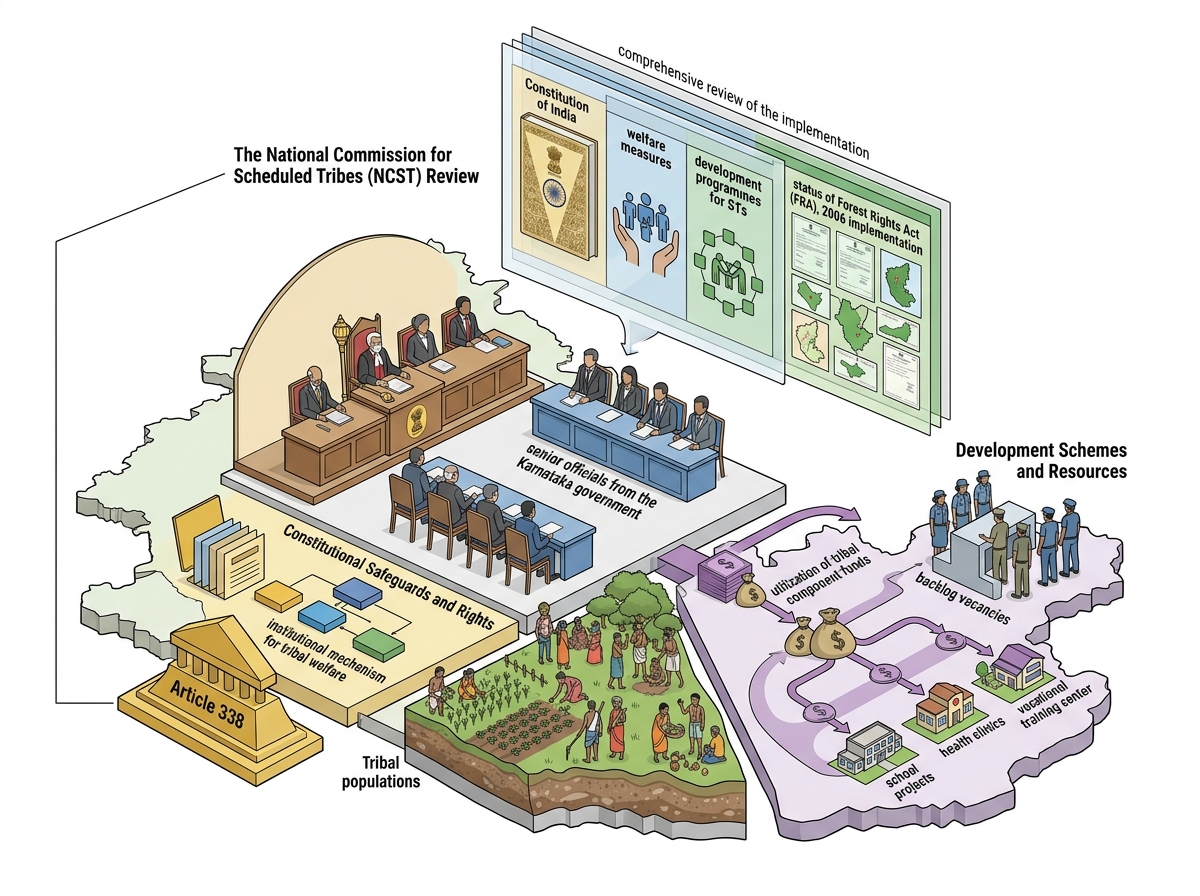
The National Commission for Scheduled Tribes (NCST) conducted a comprehensive review of the implementation of constitutional safeguards, welfare measures, and development programmes for Scheduled Tribes (STs) in Karnataka on 24 September 2026. The review meeting, chaired by the NCST Chairperson, included participation from senior officials of the Karnataka government and assessed the status of Forest Rights Act (FRA), 2006 implementation, backlog vacancies, utilisation of tribal component funds, and institutional mechanisms for tribal welfare. The meeting underscored the need for effective monitoring and timely redressal of grievances to ensure substantive and equitable outcomes for ST communities in the state.
Background
- The Constitution of India, under Article 338 provides for the National Commission for Scheduled Castes (NCSC) and under Article 338A, provides for the National Commission for Scheduled Tribes (NCST) to monitor the implementation of constitutional safeguards and welfare schemes for marginalised communities.
- The Scheduled Tribes (STs) are notified under Article 342 of the Constitution and are entitled to constitutional protections, reservations in education and public employment, and development programmes.
- The Forest Rights Act (FRA), 2006, recognises the rights of forest-dwelling tribal communities over forest land and resources, aiming to address historical injustices and ensure sustainable livelihoods.
- Karnataka hosts a significant tribal population, including Primitive Vulnerable Tribal Groups (PVTGs) such as the Koraga and Jenu Kuruba communities, who face socio-economic and infrastructural challenges.
- The NCST, through structured questionnaires, field visits, and grievance redressal mechanisms, periodically reviews the implementation of constitutional safeguards and development programmes for STs across states.
- The review meeting in Karnataka follows a structured process of data collection, field observations, and stakeholder consultations to assess the ground-level implementation of policies and schemes.
What is the National Commission for Scheduled Tribes (NCST) and its Role in Tribal Welfare?
- The National Commission for Scheduled Tribes (NCST) is a constitutional body established under Article 338A of the Constitution to monitor the implementation of constitutional safeguards and welfare schemes for Scheduled Tribes (STs).
- The NCST is mandated to investigate and monitor all matters relating to the constitutional safeguards provided for STs, including their social, economic, and educational development.
- The Commission conducts periodic reviews, field visits, and consultations with state governments, tribal communities, and civil society organisations to assess the effectiveness of policies and programmes.
- The NCST submits reports to the President of India on the status of implementation of constitutional safeguards and may recommend measures for the socio-economic upliftment of STs.
- The Commission plays a pivotal role in addressing grievances of ST communities, including issues related to land rights, forest rights, and access to basic services.
- The NCST also reviews the utilisation of funds allocated under the Scheduled Tribe Component to ensure targeted and equitable development.
- The Commission has the power to summon witnesses, examine documents, and conduct investigations into matters referred to it, ensuring accountability and transparency in governance.
- The NCST’s recommendations are advisory in nature but carry significant weight in shaping policies and programmes for tribal welfare.
Key Features
| Feature | Significance |
|---|---|
| Constitutional safeguards review | Ensures adherence to Articles 15(4), 16(4), 29, 342, and 342A, protecting ST rights in education, employment, and cultural preservation. |
| Forest Rights Act, 2006 implementation | Critical for securing individual and community forest rights, addressing historical injustices in tribal land alienation. |
| Backlog vacancy filling mechanism | Addresses systemic underrepresentation in public employment through targeted recruitment and reservation compliance. |
| PVTG-focused development | Targets marginalized tribal groups like Koraga and Jenu Kuruba, ensuring inclusive socio-economic upliftment. |
| Institutional monitoring framework | Proposes a dedicated Karnataka ST Commission for continuous oversight of welfare schemes and grievance redressal. |
Why it Matters
Constitutional and Legal
- Reinforces the constitutional mandate under the Fifth and Sixth Schedules for tribal welfare and autonomy in scheduled areas.
- Examines compliance with the Scheduled Castes and Scheduled Tribes (Prevention of Atrocities) Act, 1989, and the Protection of Civil Rights Act, 1955.
- Evaluates the implementation of the Panchayats (Extension to Scheduled Areas) Act, 1996 (PESA) in tribal-dominated districts of Karnataka.
Administrative and Governance
- Assesses the efficacy of the Tribal Sub-Plan (TSP) and the Special Central Assistance (SCA) in addressing development deficits in tribal regions.
- Highlights the role of district-level tribal advisory councils in decentralized planning and monitoring.
- Evaluates the coordination between the Tribal Cooperative Marketing Development Federation (TRIFED) and state agencies for tribal livelihood enhancement.
Socio-Economic
- Examines the impact of the National Rural Livelihood Mission (NRLM) and the Van Mitra Scheme on tribal income generation and food security.
- Analyzes the effectiveness of the Integrated Tribal Development Programme (ITDP) in bridging gaps in education, health, and infrastructure.
- Reviews the implementation of the National Education Policy (NEP) 2020 provisions for tribal children, including residential schools and Eklavya Model Residential Schools (EMRS).
Environmental and Cultural
- Scrutinizes the alignment of tribal land rights with the National Forest Policy, 1988, and the Wildlife Protection Act, 1972.
- Evaluates the preservation of tribal languages and cultural practices under the Sixth Schedule and the National Culture Fund schemes.
Challenges
1. Forest Rights Act (FRA) 2006 Implementation Gaps
- High rejection rates of forest rights claims under FRA, 2006, due to procedural delays, lack of awareness, and conflicting land records.
- Inadequate capacity of forest and revenue departments in processing claims, leading to pendency and denial of rights.
- Absence of a grievance redressal mechanism at the district level for FRA-related disputes.
UPSC Link: Forest Rights Act, 2006
2. Underrepresentation in Public Employment
- Persistent gaps in filling reserved vacancies for STs in government services, particularly in technical and administrative cadres.
- Lack of robust data on ST representation in higher echelons of bureaucracy, including All India Services.
- Inadequate sensitization of selection committees on reservation policies and merit-based inclusion.
UPSC Link: Article 16(4)
3. Marginalization of Particularly Vulnerable Tribal Groups (PVTGs)
- Koraga and Jenu Kuruba communities face extreme socio-economic deprivation, with limited access to healthcare, education, and livelihood opportunities.
- Historical neglect in policy design, leading to low participation in mainstream development programs.
- Absence of targeted interventions for PVTGs in state and central welfare schemes.
UPSC Link: Dhebar Commission Report
4. Land Alienation and Displacement
- Continued encroachment on tribal lands for infrastructure projects, mining, and industrialization without adequate compensation or rehabilitation.
- Weak enforcement of the Scheduled Tribes and Other Traditional Forest Dwellers (Recognition of Forest Rights) Act, 2006, in land acquisition cases.
- Lack of convergence between land records and forest rights documentation, exacerbating disputes.
UPSC Link: Article 342A
5. Institutional Weaknesses in Monitoring
- Fragmented governance structure with limited inter-departmental coordination for tribal welfare schemes.
- Inadequate financial devolution to tribal sub-plans, leading to suboptimal resource allocation.
- Absence of a dedicated state-level monitoring body for tribal development, as proposed in the review.
UPSC Link: Fifth Schedule
Challenges — UPSC Perspective
| Issue | Concern |
|---|---|
| FRA 2006 claim rejections | Procedural bottlenecks and lack of awareness among tribal communities. |
| Backlog vacancies in services | Systemic delays in recruitment and inadequate sensitization of selection committees. |
| PVTG development deficits | Extreme poverty, malnutrition, and lack of access to basic services among Koraga and Jenu Kuruba. |
| Land alienation and displacement | Encroachment by infrastructure projects without proper compensation or rehabilitation. |
| Institutional coordination gaps | Fragmented governance leading to poor implementation of tribal welfare schemes. |
| Data gaps in ST representation | Lack of disaggregated data on ST representation in higher education and bureaucracy. |
Government Initiatives — Must-Memorise for Prelims
- Forest Rights Act, 2006
Way Forward
- Establish a dedicated Karnataka State Scheduled Tribes Commission to monitor constitutional safeguards and welfare schemes continuously.
- Streamline the Forest Rights Act, 2006, claim processing mechanism with dedicated grievance redressal cells at the district level.
- Ensure 100% filling of reserved vacancies for STs in government services through targeted recruitment drives and capacity-building programs.
- Launch a special development package for PVTGs like Koraga and Jenu Kuruba, focusing on healthcare, nutrition, and livelihood diversification.
- Strengthen inter-departmental coordination under the Tribal Sub-Plan (TSP) with clear financial devolution and outcome-based monitoring.
- Conduct periodic socio-economic surveys of tribal communities to identify gaps and tailor interventions accordingly.
- Sensitize forest and revenue officials on FRA, 2006, and PESA provisions to reduce procedural delays and improve claim acceptance rates.
- Promote convergence between tribal welfare schemes and flagship programs like Ayushman Bharat and Poshan Abhiyaan for holistic development.
UPSC Value Addition
Keywords for Mains Answer-Writing
National Commission for Scheduled Tribes (NCST) · Scheduled Tribes (STs) in Karnataka · Constitutional safeguards for STs · Forest Rights Act, 2006 · Scheduled Tribes and Other Traditional Forest Dwellers (Recognition of Forest Rights) Act, 2006 · Special provisions for Particularly Vulnerable Tribal Groups (PVTGs) · Reservation and backlog vacancies for STs · Institutional mechanisms for tribal welfare · Land and forest rights of tribals · Tribal development schemes in Karnataka
Constitutional & Policy Linkages
- Article 15(4) – Special provisions for advancement of socially and educationally backward classes.
- Article 16(4) – Reservation in public employment for backward classes.
- Article 342 – Specification of Scheduled Tribes.
Concept Flow
Constitutional recognition of ST rights (Articles 15, 16, 29, 342, 342A) → → Enactment of protective legislations (FRA 2006, PESA 1996, SC/ST Act 1989) → → Implementation gaps (procedural delays, land alienation, underrepresentation) → → Institutional review by NCST (structured questionnaires, field observations, grievance redressal) → → Policy correctives (dedicated state commission, PVTG-focused packages, vacancy filling mechanisms) → → Outcome: Equitable socio-economic development and preservation of tribal rights.
Prelims Practice Questions
Q1. Consider the following statements regarding the National Commission for Scheduled Tribes (NCST):
1. The NCST is a constitutional body established under Article 338-A of the Constitution of India.
2. The NCST is headed by a Chairperson who is appointed by the President of India.
3. The NCST has the power to investigate and monitor matters relating to the constitutional safeguards for Scheduled Tribes.
4. The NCST can only make recommendations to the Central Government and has no executive powers.
How many of the above statements are correct?
- Only one
- Only two
- Only three
- All four
Answer: Only three — Statements 1, 2, and 3 are correct. Statement 4 is incorrect as the NCST can also monitor the implementation of safeguards and has investigative powers. The NCST is a constitutional body under Article 338-A, headed by a Chairperson appointed by the President, and is empowered to investigate and monitor matters related to STs.
Q2. Assertion (A): The Forest Rights Act, 2006, recognises the rights of forest-dwelling Scheduled Tribes and other traditional forest dwellers to forest land and resources.
Reason (R): The Act aims to redress historical injustices and provide a framework for the conservation of forests while ensuring livelihood security for forest-dependent communities.
In the context of the above two statements, which one of the following is correct?
- Both A and R are true, and R is the correct explanation of A
- Both A and R are true, but R is not the correct explanation of A
- A is true, but R is false
- A is false, but R is true
Answer: Both A and R are true, and R is the correct explanation of A — Both Assertion (A) and Reason (R) are true. The Forest Rights Act, 2006, indeed recognises the rights of forest-dwelling STs and other traditional forest dwellers to forest land and resources. The Act also aims to redress historical injustices and balance conservation with livelihood security, making R the correct explanation of A.
Q3. Match the following Scheduled Tribes in Karnataka with their respective categories as recognised by the Government of India:
Column I (Tribe) | Column II (Category)
——————————-|———————
A. Koraga | 1. Particularly Vulnerable Tribal Group (PVTG)
B. Jenu Kuruba | 2. Scheduled Tribe (ST)
C. Lambani | 3. Denotified Tribe (DNT)
D. Hakki Pikki | 4. Nomadic Tribe (NT)
Select the correct match using the codes below:
- A-1, B-2, C-4, D-3
- A-2, B-1, C-3, D-4
- A-1, B-2, C-3, D-4
- A-2, B-1, C-4, D-3
Answer: A-1, B-2, C-4, D-3 — The correct matches are: Koraga (PVTG), Jenu Kuruba (ST), Lambani (Nomadic Tribe), and Hakki Pikki (Denotified Tribe). The Koraga and Jenu Kuruba are recognised as Particularly Vulnerable Tribal Groups (PVTGs) and Scheduled Tribes (STs) respectively, while Lambani is classified as a Nomadic Tribe and Hakki Pikki as a Denotified Tribe.
Mains Practice Question
✍ The National Commission for Scheduled Tribes (NCST) recently conducted a comprehensive review of the implementation of constitutional safeguards and development schemes for Scheduled Tribes (STs) in Karnataka. In this context, critically examine the efficacy of the constitutional and statutory provisions for the protection and welfare of STs in India. Also, assess the challenges in the effective implementation of the Forest Rights Act, 2006, and suggest measures to address them. (15 Marks)
Approach: MODEL-ANSWER SKELETON:
1. **Constitutional and Statutory Safeguards for STs**:
– Article 338-A (Constitutional status of NCST) and Article 342 (Specification of STs).
– Provisions for reservation in education (Article 15(4), 16(4)), public employment (Article 335), and political representation (Article 330, 332).
– The Scheduled Castes and Scheduled Tribes (Prevention of Atrocities) Act, 1989, and Rules, 1995.
– The Provisions of the Panchayats (Extension to the Scheduled Areas) Act, 1996 (PESA), and its relevance to tribal self-governance.
2. **Efficacy and Gaps**:
– **Achievements**: Expansion of reservation, establishment of NCST, and implementation of welfare schemes (e.g., Eklavya Model Residential Schools, Van Mitra Yojana).
– **Gaps**: Underrepresentation in higher education and public services, delays in land rights recognition, and inadequate institutional mechanisms for grievance redressal.
– **Data**: High backlog vacancies in government services for STs and low literacy rates among certain tribal communities.
3. **Forest Rights Act, 2006 (FRA)**:
– **Provisions**: Recognition of individual and community forest rights (Sections 3, 4), and the role of Gram Sabhas in decision-making (Section 6).
– **Challenges**: High rejection rates of claims, procedural delays, lack of awareness among tribals, and conflicts with forest conservation policies.
– **Judicial Pronouncements**: Landmark judgments such as *T.N. Godavarman Thirumulpad v. Union of India* (1997) and *Chellan v. State of Kerala* (2021) on FRA implementation.
4. **Measures to Address Challenges**:
– **Legal**: Strengthening the FRA by simplifying claim processes, reducing bureaucratic hurdles, and ensuring timely redressal of rejections.
– **Institutional**: Enhancing the capacity of Gram Sabhas and tribal cooperatives, and establishing dedicated tribal courts for land disputes.
– **Socio-economic**: Focused development of Particularly Vulnerable Tribal Groups (PVTGs) through targeted schemes (e.g., housing, healthcare, and livelihood support).
– **Monitoring**: Regular reviews by NCST and state commissions, and leveraging technology for real-time monitoring of scheme implementation.
5. **Conclusion**: While constitutional and statutory provisions provide a robust framework, their effective implementation requires political will, institutional capacity, and community participation. The FRA, despite its potential, faces systemic challenges that necessitate urgent reforms to ensure justice for forest-dwelling communities.
Source: PIB (Press Information Bureau)
Karnataka PCS (KPSC) — State PCS Practice
Prelims: Which of the following constitutional provisions specifically empowers the State of Karnataka to make laws for the advancement of Scheduled Tribes (STs) in the state?
- Article 164 (1) of the Constitution of India
- Article 244 (1) read with the Fifth Schedule
- Article 342 (1) of the Constitution of India
- Article 371 (J) of the Constitution of India
Answer: Article 244 (1) read with the Fifth Schedule — Article 244(1) read with the Fifth Schedule empowers the Governor of a state to make regulations for the peace and good governance of Scheduled Areas, including provisions for the advancement of Scheduled Tribes.
Mains: Critically evaluate the implementation of constitutional safeguards and development schemes for Scheduled Tribes in Karnataka. Suggest measures to enhance their effectiveness in addressing socio-economic disparities.
Generated by AanyaAi for educational purpose.
Related guides on our sites
- Anthropology VS PSIR
- Best PSIR optional coaching
- Best PSIR optional coaching online
- Best PSIR optional teacher

- NCST Reviews Constitutional Safeguards for Karnataka’s Scheduled Tribes - September 24, 2026
- झारखंड हाईकोर्ट ने खुली जेलों पर सख्त रुख, सरकार से 3 नवंबर तक रिपोर्ट मांगी - September 24, 2026
- झारखंड हाईकोर्ट ने खुली जेलों पर उठाए सवाल, सरकार से मांगी रिपोर्ट - September 24, 2026

No Comments