


25 Sep Nepal PM’s UN Appeal: Himalayan Tsunami Exposes Climate Injustice Crisis
✎ Climate justice demands equitable climate action, where vulnerable nations like Nepal, despite minimal emissions, receive adequate, grant-based finance and technology for adaptation, particularly in high-risk regions like the…
Subject Relevance — Where This Topic Fits
- GS Paper II — International Relations (Global Governance, Climate Diplomacy, South-South Cooperation) | GS Paper III — Environment and Disaster Management (Climate Change Impacts, Disaster Risk Reduction, Himalayan Ecology)
- Prelims: Himalayan Tsunami, Glacial Lake Outburst Flood (GLOF), Loss and Damage Fund, Permafrost degradation, South-South cooperation, UNFCCC, Climate justice, Disaster Risk Reduction (DRR), Early Warning Systems
- Essay: Climate justice as a moral imperative in global governance, The intersection of climate vulnerability and geopolitical inequality
Quick Revision: Climate justice demands equitable climate action, where vulnerable nations like Nepal, despite minimal emissions, receive adequate, grant-based finance and technology for adaptation, particularly in high-risk regions like the Himalayas.
Why is this in the news?
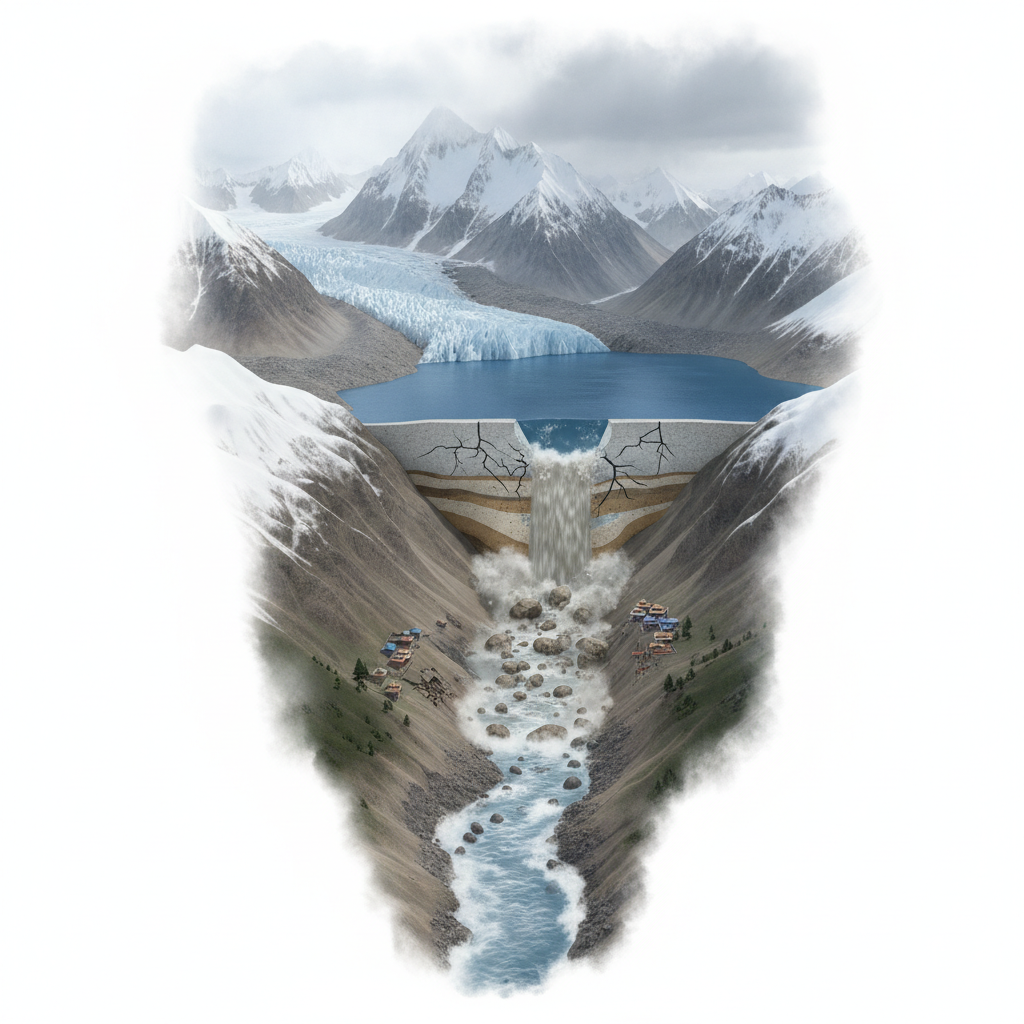
Nepal’s Prime Minister Balendra Shah highlighted the catastrophic impacts of climate-induced disasters in the Himalayas at the 81st session of the UN General Assembly, terming the Bhotekoshi-Trishuli floods a ‘Himalayan Tsunami’ that killed over 1,400 people and displaced thousands. The address underscored the disproportionate burden borne by vulnerable nations like Nepal, which contribute minimally to global emissions yet face severe climate-related risks, thereby bringing the issue of climate justice to the forefront of international climate diplomacy.
Background
- The Himalayas, often referred to as the ‘Third Pole,’ hold the largest volume of ice outside the polar regions and are highly sensitive to climate change, acting as a critical regulator of regional hydrology and climate systems.
- Glacial Lake Outburst Floods (GLOFs) are a growing threat in the Himalayas due to accelerated glacial melt, which increases the volume of glacial lakes and their instability, leading to sudden, catastrophic floods.
- Nepal, a landlocked least developed country (LDC), contributes less than 0.1% to global greenhouse gas emissions but faces disproportionate climate impacts, including floods, landslides, and avalanches, which have escalated in frequency and intensity over the past two decades.
- The international climate finance architecture, including the Loss and Damage Fund established at COP27, remains underfunded and inaccessible to many vulnerable nations, exacerbating their climate vulnerability.
- The Himalayan region spans multiple countries, including Nepal, India, and China, necessitating transboundary cooperation for effective climate adaptation, disaster risk reduction, and early warning systems.
- Nepal’s democratic transition and youth-led political movements reflect a broader global shift towards accountability and climate-conscious governance, aligning national priorities with international climate justice frameworks.
What is Climate Justice in the Context of Himalayan Disasters?
- Climate justice is a framework that recognises the disproportionate impacts of climate change on vulnerable nations and communities, particularly those least responsible for historical emissions, and advocates for equitable solutions that address both mitigation and adaptation needs.
- The Himalayas are experiencing rapid environmental degradation due to global warming, including permafrost thaw, glacial retreat, and increased frequency of extreme weather events, which destabilise mountain ecosystems and increase disaster risks.
- Glacial Lake Outburst Floods (GLOFs) are a direct consequence of glacial melt, where unstable lakes breach their natural dams, releasing millions of cubic meters of water in a short span, causing catastrophic downstream flooding, as seen in the Bhotekoshi-Trishuli disaster.
- The Loss and Damage Fund, established under the UNFCCC, aims to provide financial assistance to vulnerable countries for climate-induced losses and damages, but its implementation remains slow and insufficient to meet the scale of need.
- Transboundary cooperation is essential for Himalayan disaster resilience, as glacial melt and floods do not respect national boundaries; mechanisms like the proposed Himalayan Climate Resilience Mechanism can facilitate data sharing, early warning systems, and coordinated disaster response.
- Climate justice demands that high-emission nations and industries bear the cost of adaptation and mitigation in vulnerable regions, aligning with the principle of ‘polluter pays’ and ensuring that climate finance is grant-based rather than debt-creating.
- The international logistics disparity highlighted by Nepal—where weapons and military equipment move rapidly across borders while food and essential supplies face delays—reflects deeper structural inequalities in global governance and supply chains.
- Multilateralism remains a critical tool for small and vulnerable nations to amplify their voices, as demonstrated by Nepal’s call for a UN that prioritises the representation and agency of small states in climate decision-making.
Key Features
| Feature | Significance |
|---|---|
| Bhotekoshi-Trishuli disaster | Demonstrated the catastrophic impact of glacial lake outburst floods (GLOFs) in the Himalayas, highlighting the vulnerability of mountain ecosystems and downstream communities. |
| Himalayan Climate Resilience Mechanism | Proposed trilateral initiative (Nepal-India-China) to enhance climate resilience through satellite data sharing, glacial lake monitoring, early-warning systems, and cross-border disaster coordination. |
| Loss and Damage Fund | Critiqued as inadequate for addressing climate-induced losses in vulnerable nations like Nepal, which bear disproportionate impacts despite minimal historical emissions. |
| Climate Justice | Emphasised the ethical and legal principle that nations most affected by climate change—often the least responsible—deserve equitable support and reparative action from global stakeholders. |
| Multilateralism and Small States | Reaffirmed Nepal’s commitment to multilateral institutions, stressing the need for inclusive decision-making where small, poor nations have meaningful participation in climate governance. |
Why it Matters
Environmental Governance
- Exposed systemic gaps in global climate adaptation frameworks, particularly for high-risk regions like the Himalayas, where ecological fragility intersects with geopolitical complexities.
- Highlighted the transboundary nature of climate-induced disasters, necessitating coordinated regional responses rather than isolated national measures.
- Underscored the urgency of integrating indigenous knowledge and localised early-warning systems into broader climate resilience strategies.
Economic Implications
- Quantified the economic burden on climate-vulnerable nations: Nepal’s GDP loss (10%) from the disaster illustrates the disproportionate financial strain on low-emission countries.
- Demonstrated the compounding effects of climate disasters on debt cycles, as nations resort to borrowing for reconstruction, exacerbating fiscal vulnerabilities.
- Drew attention to the inequitable distribution of climate financing, where grant-based support remains insufficient compared to the scale of losses.
Geopolitical Dynamics
- Proposed the Himalayan Climate Resilience Mechanism as a model for regional cooperation, leveraging shared ecological risks to foster diplomatic collaboration.
- Illustrated the geostrategic importance of the Himalayas as a climate hotspot, necessitating joint monitoring and mitigation efforts among India, China, and Nepal.
- Highlighted the role of small states in global governance, advocating for their inclusion in climate decision-making processes to ensure equitable outcomes.
Social and Demographic Factors
- Emphasised the generational shift in Nepal’s political landscape, linking youth-led demands for accountability to broader climate justice movements.
- Demonstrated the disproportionate impact of climate disasters on marginalised communities, including indigenous populations and rural livelihoods dependent on fragile ecosystems.
- Revealed the logistical disparities in global supply chains, contrasting the efficiency of arms trade with the inefficiency in delivering essential goods like food and fuel to climate-affected regions.
Challenges
1. Inadequate Climate Financing Mechanisms
- The Loss and Damage Fund, Global Environment Facility, and other mechanisms are criticised as insufficient to address the scale of losses in vulnerable nations like Nepal.
- Climate financing remains heavily skewed towards mitigation rather than adaptation, leaving nations ill-prepared for immediate disaster response and long-term resilience building.
- Grant-based support is limited, forcing climate-vulnerable countries to rely on debt financing, which exacerbates fiscal instability.
UPSC Link: GS3: Climate Change and International Agreements
2. Transboundary Climate Risks
- Glacial lake outburst floods (GLOFs) and other climate-induced disasters do not respect national borders, necessitating coordinated regional responses.
- Existing frameworks for cross-border disaster management are fragmented, with no unified mechanism for monitoring, early warning, or coordinated relief efforts.
- Geopolitical tensions (e.g., between India and China) can hinder the implementation of joint initiatives like the proposed Himalayan Climate Resilience Mechanism.
UPSC Link: GS2: Regional Cooperation and Disaster Management
3. Ecological Fragility and Permafrost Degradation
- Melting permafrost in the Himalayas destabilises mountain slopes, increasing the frequency and intensity of avalanches, landslides, and floods.
- The Himalayas are warming at a rate significantly faster than the global average, exacerbating glacial retreat and the formation of unstable glacial lakes.
- Ecosystem degradation in the Himalayas threatens biodiversity hotspots and the livelihoods of millions dependent on mountain resources.
UPSC Link: GS3: Environmental Conservation and Climate Change
4. Logistical Inequities in Global Supply Chains
- The disparity between the efficiency of arms trade logistics and the inefficiency in delivering essential goods (food, fuel, fertiliser) to climate-affected regions highlights systemic inequities.
- Climate-vulnerable nations face compounded challenges due to disrupted supply chains, which are often exacerbated by conflicts and geopolitical decisions beyond their control.
- The lack of resilient logistics for food and fuel undermines the ability of nations to respond effectively to climate-induced disasters.
UPSC Link: GS2: International Trade and Logistics
5. Political and Institutional Fragmentation
- The failure of international climate governance to protect vulnerable nations reflects broader institutional weaknesses in multilateralism, particularly in addressing equity and justice.
- Small states often lack the political capital to influence global climate policies, despite bearing disproportionate impacts of climate change.
- The proposed Himalayan Climate Resilience Mechanism faces challenges in implementation due to differing national priorities and geopolitical rivalries.
UPSC Link: GS2: International Organisations and Global Governance
Challenges — UPSC Perspective
| Issue | Concern |
|---|---|
| Inadequate Climate Financing | Limited grant-based support forces climate-vulnerable nations to rely on debt, exacerbating fiscal instability. |
| Transboundary Disaster Risks | Absence of a unified regional mechanism for monitoring and responding to GLOFs and other climate-induced disasters. |
| Permafrost Degradation | Accelerated melting destabilises Himalayan ecosystems, increasing the frequency of catastrophic floods and landslides. |
| Logistical Inequities | Global supply chains prioritise arms trade over essential goods, leaving climate-affected regions underserved. |
| Institutional Fragmentation | Multilateral climate governance lacks mechanisms to ensure equitable participation and outcomes for small, vulnerable states. |
| Geopolitical Tensions | Regional cooperation initiatives may stall due to competing national interests and historical rivalries. |
Way Forward
- Establish a dedicated Himalayan Climate Resilience Fund with contributions from high-emission nations to address immediate and long-term adaptation needs in vulnerable regions.
- Develop a trilateral (Nepal-India-China) early-warning system for glacial lake outburst floods (GLOFs), integrating satellite data, AI-driven risk modelling, and community-based monitoring.
- Reform global climate financing mechanisms to prioritise grant-based support for adaptation, particularly for least developed countries (LDCs) and small island developing states (SIDS).
- Strengthen regional disaster management frameworks by harmonising national policies, sharing best practices, and conducting joint drills for cross-border climate-induced emergencies.
- Enhance the Loss and Damage Fund’s operational capacity by simplifying access procedures and increasing pledges from developed nations to match the scale of losses.
- Promote research and development in climate-resilient infrastructure, focusing on high-risk regions like the Himalayas, with a focus on indigenous knowledge and localised solutions.
- Advocate for the inclusion of climate justice principles in international climate agreements, ensuring that vulnerable nations have a formal role in decision-making processes.
- Invest in capacity-building programmes for small states to participate effectively in global climate governance, including training in negotiation, policy design, and financial management.
UPSC Value Addition
Keywords for Mains Answer-Writing
Climate justice · Loss and Damage Fund · Glacial lake outburst floods (GLOFs) · Himalayan ecosystem · Cross-border disaster management · Climate financing mechanisms · Permafrost degradation · Early warning systems · Multilateralism in climate governance · South-South cooperation · Disaster risk reduction · Paris Agreement obligations · Climate-induced displacement · Himalayan Climate Resilience Mechanism · Global North-South equity in climate action
Concept Flow
Himalayan ecosystem destabilisation due to climate change → Accelerated glacial retreat and permafrost degradation → Formation and collapse of unstable glacial lakes → Catastrophic glacial lake outburst floods (GLOFs) → Transboundary flooding and landslides → Disproportionate impact on downstream communities and infrastructure → Economic losses, displacement, and debt cycles → International calls for climate justice and equitable financing → Proposal for regional resilience mechanisms → Challenges in implementation due to geopolitical and institutional fragmentation → Need for systemic reforms in global climate governance.
Prelims Practice Questions
Q1. Consider the following statements regarding Glacial Lake Outburst Floods (GLOFs):
1. GLOFs are sudden releases of water from glacial lakes due to the failure of natural dams.
2. The Bhotekoshi-Trishuli disaster in Nepal is an example of a GLOF event.
3. GLOFs are primarily caused by anthropogenic greenhouse gas emissions alone.
4. Early warning systems can mitigate the impact of GLOFs by providing timely alerts.
How many of the above statements are correct?
- Only one
- Only two
- Only three
- All
Answer: All — Statements 1, 2, and 4 are correct. Statement 3 is incorrect because GLOFs can also be triggered by natural factors such as seismic activity or changes in permafrost stability, though climate change exacerbates their frequency and intensity.
Q2. Assertion (A): The Loss and Damage Fund established under the UNFCCC is designed to compensate vulnerable countries for irreversible climate impacts.
Reason (R): The Fund operates on a grant-based mechanism to support adaptation and resilience-building in developing nations.
Options:
A. Both A and R are true, and R is the correct explanation of A.
B. Both A and R are true, but R is NOT the correct explanation of A.
C. A is true, but R is false.
D. A is false, but R is true.
Answer: ? — Both A and R are true. The Loss and Damage Fund aims to address irreversible climate impacts in vulnerable countries, and it operates through grant-based financing mechanisms to support adaptation and resilience-building efforts.
Q3. Match the following climate financing mechanisms with their primary objectives:
Column I (Mechanism)
A. Loss and Damage Fund
B. Global Environment Facility (GEF)
C. Green Climate Fund (GCF)
D. Adaptation Fund
Column II (Objective)
1. Provides grants for adaptation projects in developing countries
2. Supports projects to reduce greenhouse gas emissions
3. Addresses irreversible climate impacts in vulnerable countries
4. Funds projects to enhance climate resilience and adaptation
Select the correct match from the options below:
- A-3, B-2, C-4, D-1
- A-1, B-3, C-2, D-4
- A-4, B-1, C-3, D-2
- A-2, B-4, C-1, D-3
Answer: A-3, B-2, C-4, D-1 — The correct match is: A-3 (Loss and Damage Fund addresses irreversible climate impacts), B-2 (GEF supports emission reduction projects), C-4 (GCF enhances climate resilience), and D-1 (Adaptation Fund provides grants for adaptation projects).
Mains Practice Question
✍ Critically examine the concept of ‘climate justice’ in the context of Himalayan glacial lake outburst floods (GLOFs). In your answer, address the following dimensions: (i) the principle of common but differentiated responsibilities (CBDR) under the UNFCCC, (ii) the adequacy of existing climate financing mechanisms, and (iii) the role of multilateralism in addressing transboundary climate disasters. (15 Marks)
Approach: MODEL-ANSWER SKELETON:
1. **Definition and Core Tenets of Climate Justice**:
– Define climate justice as the equitable distribution of climate change impacts and responsibilities, emphasizing the disproportionate burden on vulnerable nations (e.g., Nepal, Small Island States).
– Reference the principle of Common But Differentiated Responsibilities (CBDR) under Article 3(1) of the UNFCCC and the Paris Agreement, highlighting the historical responsibility of developed nations.
2. **Himalayan GLOFs as a Case Study**:
– Explain the mechanism of GLOFs (e.g., destabilization of permafrost, glacial retreat) and their transboundary nature, as seen in the Bhotekoshi-Trishuli disaster.
– Cite data on Nepal’s negligible GHG emissions (0.1%) versus its disproportionate exposure to climate-induced disasters.
3. **Adequacy of Climate Financing Mechanisms**:
– Evaluate the Loss and Damage Fund, Global Environment Facility (GEF), and Green Climate Fund (GCF) in terms of their operationalization, funding gaps, and grant-based vs. loan-based financing.
– Reference the PM’s critique of these mechanisms as ‘grossly inadequate’ and the demand for simplified, grant-based access.
4. **Role of Multilateralism**:
– Discuss the proposed Himalayan Climate Resilience Mechanism (led by Nepal, India, China) as an example of South-South and triangular cooperation.
– Highlight the tension between multilateralism and geopolitical fragmentation, citing the contrast between ‘flawless logistics for war’ and ‘broken logistics for food’ (PM Shah’s statement).
5. **Way Forward**:
– Propose institutional reforms: strengthening early-warning systems, real-time satellite data sharing, and harmonized cross-border disaster protocols.
– Emphasize the need for a rights-based approach to climate financing, ensuring predictability and accessibility for vulnerable nations.
Source: news.un.org
Generated by AanyaAi for educational purpose.
Related guides on our sites
- Current affairs for upsc 2026
- How to prepare for GS paper 1 for UPSC CSE mains exam
- Best UPSC coaching for IFOS exam
- Best geography optional coaching

- PM Modi Praises Youth-Led Nasha Mukt Yuva Abhiyan Momentum - September 27, 2026
- राजनाथ सिंह का बड़ा बयान: भारत किसी की ज़मीन कब्ज़ा नहीं करेगा, लेकिन सुरक्षा पर होगा कठोर - September 27, 2026
- Exercise Tarang Shakti 2026: India’s Mega Multi-Nation Air Power Showcase - September 27, 2026

No Comments