


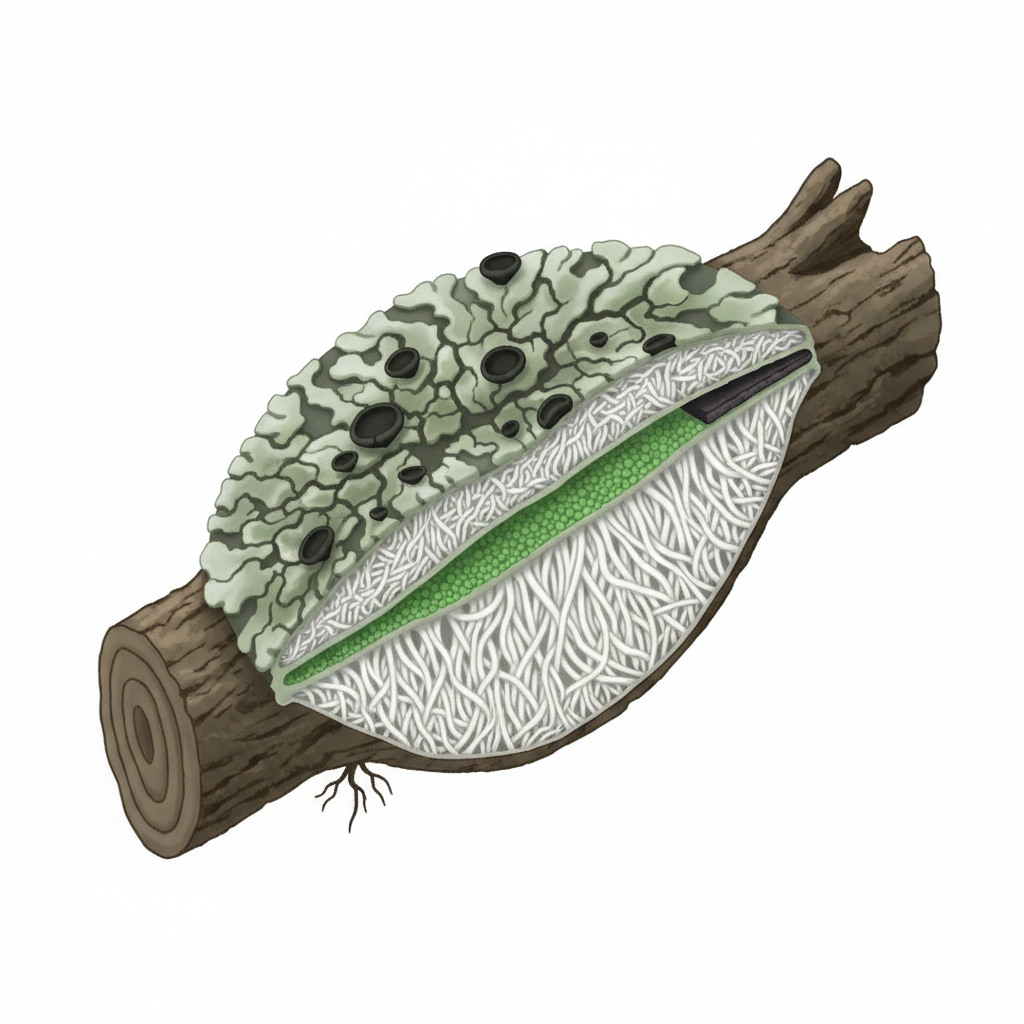
08 Sep New Lichen Species Buellia maharajensis Discovered in Kerala’s Mathikettan Shola
✎ Lichens are symbiotic organisms critical for ecosystem health and serve as bioindicators; their discovery in protected areas like Mathikettan Shola National Park highlights the importance of undisturbed habitats in biodiversity…
Subject Relevance — Where This Topic Fits
- GS Paper III — Environment and Biodiversity | GS Paper III — Science and Technology
- Prelims: Lichen, Saxicolous lichen, Buellia maharajensis, Mathikettan Shola National Park, Biodiversity hotspot, Western Ghats, Keralam, Protected Area Network, CSIR-NBRI, Kerala Forest Research Institute
- Essay: Biodiversity conservation: Balancing scientific discovery and ecological preservation, The role of protected areas in sustaining fragile ecosystems and undiscovered biodiversity
Quick Revision: Lichens are symbiotic organisms critical for ecosystem health and serve as bioindicators; their discovery in protected areas like Mathikettan Shola National Park highlights the importance of undisturbed habitats in biodiversity conservation.
Why is this in the news?
The discovery of a new lichen species, *Buellia maharajensis*, in Mathikettan Shola National Park, Keralam, underscores the ecological significance of protected areas in the Western Ghats. This finding, the fourth of its kind in the park, highlights the region’s role as a biodiversity hotspot and the importance of undisturbed habitats in preserving cryptic biodiversity. The study, published in *Taiwania*, also reflects the contributions of Indian institutions to global taxonomic research.
Background
- Mathikettan Shola National Park is a notified protected area in Idukki district, Keralam, covering 12.82 square kilometres and declared a national park on 21 November 2003.
- The Western Ghats, a UNESCO World Heritage Site, is recognised as one of the eight hottest biodiversity hotspots globally, harbouring over 5,000 species of flowering plants, 139 mammal species, 508 bird species, and numerous cryptogamic organisms including lichens.
- Lichens are symbiotic associations between fungi and photosynthetic partners (algae or cyanobacteria) that play critical roles in ecosystem processes such as nutrient cycling, soil formation, and bioindication of air quality.
- The discovery aligns with India’s commitments under the Convention on Biological Diversity (CBD) and the National Biodiversity Action Plan, which emphasise the documentation and conservation of lesser-known taxa.
- Taxonomic research in India has historically contributed significantly to global biodiversity knowledge, with institutions like CSIR-NBRI and KFRI playing pivotal roles in documenting India’s flora and fauna.
- Protected areas in India, governed by the Wildlife (Protection) Act, 1972, serve as refugia for species that thrive in undisturbed ecosystems.
What are Lichens and Why Does Their Discovery Matter?
- Lichens are composite organisms formed by a symbiotic relationship between a fungus (mycobiont) and a photosynthetic partner, which may be green algae (phycobiont) or cyanobacteria (cyanobiont).
- They exhibit diverse growth forms, including crustose (crust-like), foliose (leaf-like), fruticose (shrub-like), and squamulose (scale-like), with *Buellia maharajensis* classified as a saxicolous (rock-inhabiting) crustose lichen.
- Lichens are highly sensitive to environmental changes, making them valuable bioindicators for air pollution, climate change, and habitat disturbance.
- The genus *Buellia* comprises over 400 species globally, many of which are adapted to extreme environments such as high-altitude rock surfaces.
- Undisturbed forest ecosystems, particularly in the Western Ghats, provide ideal conditions for lichen diversity due to stable microclimates, high humidity, and minimal anthropogenic interference.
- Taxonomic discoveries like *Buellia maharajensis* enhance India’s biodiversity inventories, aiding conservation planning and policy formulation under frameworks such as the National Biodiversity Mission.
- The naming of *Buellia maharajensis* in honour of Maharaja’s College, Ernakulam, reflects the institution’s long-standing contributions to botanical research and taxonomy.
- Collaborative research involving national and international institutions, such as CSIR-NBRI, KFRI, and Maharaja’s College, exemplifies India’s growing capacity in biodiversity science.
Key Features
| Feature | Significance |
|---|---|
| Discovery of Buellia maharajensis | Expands taxonomic knowledge of lichens in India, particularly saxicolous species, and contributes to global biodiversity databases. |
| Saxicolous habitat preference | Indicates specialised ecological niche adaptation, highlighting the importance of rock-surface ecosystems in high-elevation shola forests. |
| Elevation record (1,351 m) | Demonstrates lichen diversity in montane ecosystems, which are critical for climate-sensitive species and microhabitat studies. |
| Protected area status of Mathikettan Shola | Undisturbed habitat facilitates lichen colonisation and growth, underscoring the role of conservation in biodiversity preservation. |
| Institutional collaboration | Showcases interdisciplinary research involving state, national, and international institutions, enhancing scientific rigour and peer validation. |
Why it Matters
Ecological
- Reinforces the ecological value of shola forests as biodiversity hotspots, particularly for cryptogamic flora such as lichens.
- Highlights the role of undisturbed montane ecosystems in supporting specialised and endemic species.
- Contributes to baseline data for climate change impact assessments, as lichens are sensitive bioindicators of environmental quality.
Scientific
- Adds to the taxonomic inventory of Indian lichens, a group historically under-documented compared to vascular plants.
- Demonstrates the utility of field surveys and systematic taxonomy in discovering cryptic biodiversity.
- Enhances understanding of saxicolous lichen ecology, including substrate specificity and altitudinal distribution.
Conservation
- Underscores the effectiveness of protected area networks in conserving microhabitats essential for non-vascular plants.
- Provides evidence for the need to integrate cryptogamic flora into biodiversity conservation strategies.
- Supports the argument for expanding lichen-focused monitoring in India’s Western Ghats, a UNESCO World Heritage Site.
Institutional
- Showcases the role of academic institutions (e.g., Maharaja’s College) in fostering long-term biodiversity research and taxonomy.
- Illustrates the importance of multi-institutional collaborations in biodiversity discovery and validation.
- Highlights the contribution of state agencies (KSCSTE–KFRI) in supporting field-based ecological research.
Challenges
1. Limited Taxonomic Expertise
- India faces a shortage of trained lichenologists, leading to underrepresentation in global biodiversity databases.
- Capacity-building in taxonomy and cryptogamic botany is essential to sustain discovery-based research.
UPSC Link: GS Paper 3: Conservation, Environmental Pollution and Degradation
2. Habitat Fragmentation in Western Ghats
- Despite protected area status, shola forests face pressures from anthropogenic activities, including tourism and invasive species.
- Climate change-induced shifts in temperature and precipitation may alter lichen distribution patterns.
UPSC Link: GS Paper 3: Environmental Impact Assessment
3. Data Gaps in Cryptogamic Flora
- Systematic documentation of lichens remains incomplete, with many species likely yet to be described.
- Integration of traditional ecological knowledge with modern taxonomy can enrich biodiversity inventories.
UPSC Link: GS Paper 3: Biodiversity and Conservation
4. Funding and Research Prioritisation
- Biodiversity research often receives limited funding compared to applied sciences, delaying taxonomic studies.
- Long-term monitoring programmes are needed to assess population trends of newly discovered species.
UPSC Link: GS Paper 3: Science and Technology – Developments and their Applications
Challenges — UPSC Perspective
| Issue | Concern |
|---|---|
| Taxonomic expertise deficit | Delays in species discovery, description, and validation due to lack of specialists. |
| Habitat degradation | Threats to lichen populations from deforestation, invasive species, and climate change. |
| Inadequate baseline data | Limited historical records hinder trend analysis and conservation planning. |
| Interdisciplinary gaps | Poor integration between taxonomy, ecology, and policy frameworks. |
| Resource constraints | Limited funding for field surveys, equipment, and publication of findings. |
Way Forward
- Strengthen lichen taxonomy programmes in academic institutions through dedicated funding and fellowships.
- Integrate lichen monitoring into existing biodiversity conservation frameworks, such as the National Mission on Biodiversity and Human Well-being.
- Promote collaborative research between state forest departments, universities, and national institutions (e.g., CSIR-NBRI, KFRI).
- Develop citizen science initiatives to document lichen diversity in protected areas and community forests.
- Enhance digital repositories of lichen specimens and taxonomic data for global accessibility and peer review.
- Include lichen-focused modules in environmental education curricula to raise awareness among students and policymakers.
- Conduct long-term ecological studies to assess the impact of climate change on lichen populations in montane ecosystems.
UPSC Value Addition
Keywords for Mains Answer-Writing
Lichen biodiversity · Protected areas and conservation · Western Ghats ecology · Taxonomy and species discovery · Mathikettan Shola National Park · Saxicolous lichens · Biodiversity hotspots · Kerala Forest Research Institute (KFRI) · CSIR-National Botanical Research Institute (NBRI) · Conservation of cryptogams · Biodiversity surveys and documentation · Endemism in Western Ghats
Concept Flow
Discovery of saxicolous lichen species → Recognition of undisturbed montane habitats as biodiversity reservoirs → Documentation of ecological niche specificity → Integration into conservation strategies → Policy support for protected area management → Long-term ecological monitoring for climate resilience.
Prelims Practice Questions
Q1. Consider the following statements regarding lichens:
1. Lichens are composite organisms formed from a symbiotic relationship between a fungus and a photosynthetic partner.
2. Saxicolous lichens grow exclusively on soil substrates.
3. Lichens are typically indicators of undisturbed forest ecosystems.
4. The newly discovered species Buellia maharajensis belongs to the genus Buellia.
How many of the above statements are correct?
- Only one
- Only two
- Only three
- All
Answer: All — Statements 1, 3, and 4 are correct. Statement 2 is incorrect as saxicolous lichens grow on rock surfaces, not soil.
Q2. Assertion (A): Mathikettan Shola National Park in Kerala is recognised as a lichen hub.
Reason (R): The park’s protected status has significantly contributed to the expansion of lichen growth due to undisturbed habitats.
Options:
A. Both A and R are true, and R is the correct explanation of A.
B. Both A and R are true, but R is not the correct explanation of A.
C. A is true, but R is false.
D. A is false, but R is true.
Answer: ? — Both A and R are true, and R correctly explains A. The protected status of the park has preserved undisturbed habitats, facilitating lichen diversity.
Q3. Which of the following institutions was NOT involved in the discovery of the new lichen species Buellia maharajensis in Mathikettan Shola National Park?
A. Maharaja’s College, Ernakulam
B. Kerala Forest Research Institute (KFRI)
C. Indian Council of Agricultural Research (ICAR)
D. CSIR–National Botanical Research Institute (NBRI)
- A
- B
- C
- D
Answer: C — The Indian Council of Agricultural Research (ICAR) was not involved in the discovery. The institutions involved were Maharaja’s College, KFRI, and NBRI.
Mains Practice Question
✍ Critically examine the significance of protected areas like Mathikettan Shola National Park in conserving cryptogamic biodiversity such as lichens. Substantiate your answer with reference to the role of undisturbed habitats and the broader ecological functions of lichens. (15 Marks)
Approach: MODEL-ANSWER SKELETON:
1. **Introduction (2 Marks)**: Define cryptogams and lichens; highlight their ecological roles (e.g., bioindicators, soil formation, nutrient cycling). Mention the Western Ghats as a biodiversity hotspot.
2. **Protected Areas and Conservation (4 Marks)**:
– Explain the legal framework: Wildlife Protection Act, 1972 (Schedule I species), and the role of national parks (e.g., Mathikettan Shola declared in 2003).
– Discuss how protected areas provide undisturbed habitats essential for lichen growth (reference to the study’s findings on Buellia maharajensis).
– Cite examples of lichen diversity in other protected areas (e.g., Silent Valley, Agasthyamala Biosphere Reserve).
3. **Ecological Functions of Lichens (4 Marks)**:
– Primary colonisers: role in soil formation and succession.
– Bioindicators: sensitivity to air pollution and climate change.
– Symbiotic relationships: nitrogen fixation and nutrient cycling.
– Cultural and economic significance (e.g., traditional uses, pharmaceutical applications).
4. **Challenges and Threats (3 Marks)**:
– Habitat fragmentation and climate change impacts on lichen distribution.
– Need for systematic biodiversity surveys (reference to the discovery of 250 lichen species in Mathikettan Shola).
– Role of institutions (e.g., KFRI, NBRI) in taxonomy and conservation research.
5. **Conclusion (2 Marks)**: Emphasise the importance of integrating cryptogamic conservation into broader biodiversity and climate action frameworks. Highlight the need for continued research and policy support.
Source: The Hindu
Generated by AanyaAi for educational purpose.
Related guides on our sites
- How to prepare for GS paper 1 for UPSC CSE mains exam
- Best UPSC coaching for IFOS exam
- Best geography optional coaching
- Best geography optional coaching

- New Lichen Species Buellia maharajensis Discovered in Kerala’s Mathikettan Shola - September 8, 2026
- UPSC Civil Services (Main) Examination 2026 — Physics Optional Paper I: Questions with Model Answers | Plutus IAS - September 8, 2026
- UPSC Civil Services (Main) Examination 2026 — Law Optional Paper II: Questions with Model Answers | Plutus IAS - September 8, 2026

No Comments