


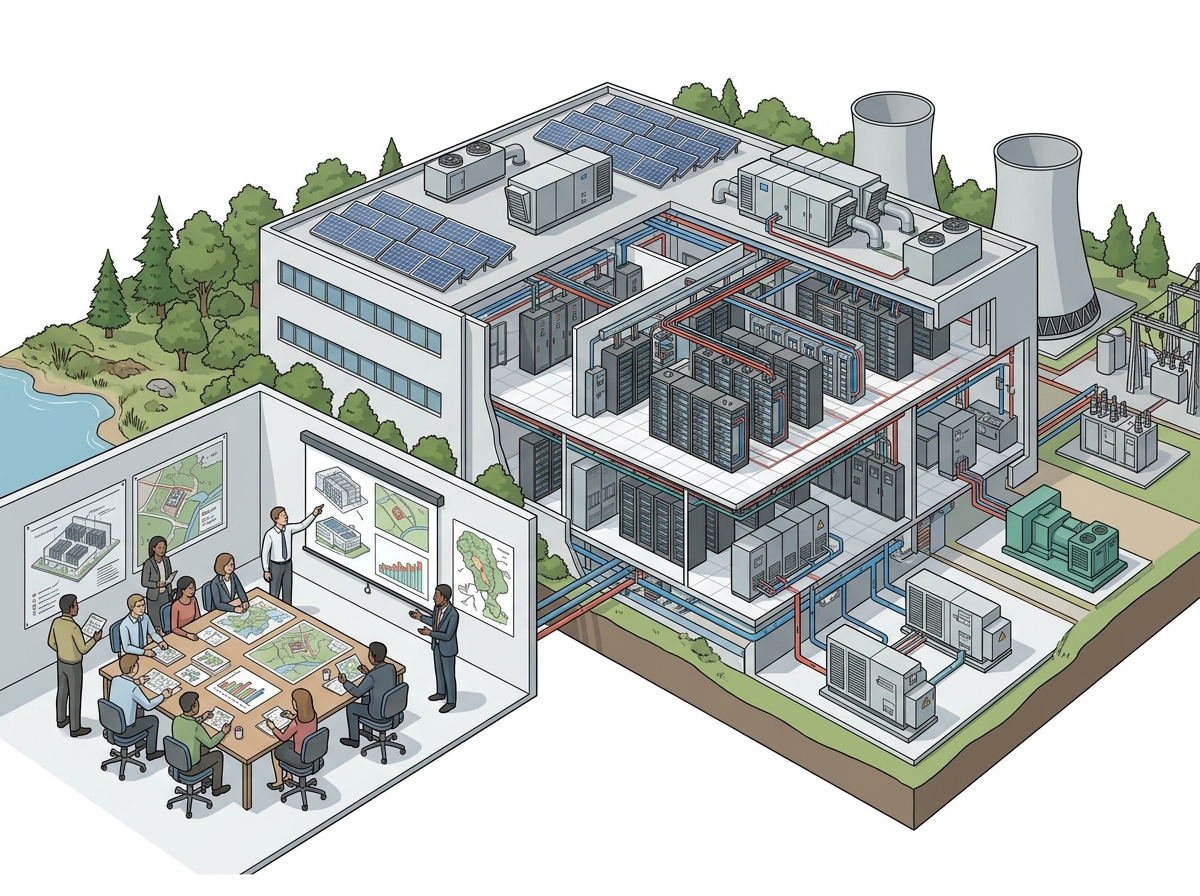
08 Aug NGO Flags Environmental Risks of AI Data Centres in Andhra Pradesh
✎ Hyperscale AI data centres, while pivotal for India’s digital transformation, pose severe environmental risks—high energy and water consumption, land degradation, and carbon emissions—necessitating stringent EIA compliance…
Subject Relevance — Where This Topic Fits
- GS Paper III — Environment and Ecology | GS Paper III — Science and Technology | GS Paper III — Disaster Management | GS Paper II — Governance, Constitution, and Polity
- Prelims: Data centre, Hyperscale data centres, Environmental Impact Assessment (EIA), Greenhouse Gas Emissions, Water footprint, Land use change, Public Consultation, Constitutional provisions on environment, Legislative Assembly debates
- Essay: The ethical dimensions of technological advancement: Balancing innovation with environmental sustainability, Governance challenges in the digital age: Transparency, accountability, and public participation
Quick Revision: Hyperscale AI data centres, while pivotal for India’s digital transformation, pose severe environmental risks—high energy and water consumption, land degradation, and carbon emissions—necessitating stringent EIA compliance, transparent governance, and alignment with constitutional and international sustainability commitments.
Why is this in the news?
The deliberations organised by the NGO Green Visakha in Visakhapatnam underscore the rising concerns regarding the environmental, social, and legal ramifications of proposed hyperscale AI data centres in India. The session highlighted the need for rigorous environmental impact assessments, transparent governance, and public participation in decision-making processes, particularly in light of the absence of legislative debate on relevant Government Orders. This issue is critical as India positions itself as a global hub for digital infrastructure, necessitating a balance between technological progress and ecological sustainability.
Background
- India’s digital economy is projected to contribute 20% to the national GDP by 2026, driving demand for hyperscale data centres to support AI, cloud computing, and other emerging technologies.
- Hyperscale data centres, defined as facilities with a minimum capacity of 5,000 servers and scalable to meet exponential data processing needs, are energy-intensive, consuming up to 100 times more electricity than traditional data centres.
- The environmental footprint of data centres includes significant greenhouse gas emissions (primarily from electricity consumption), water usage for cooling (up to 1.5 litres per kWh), and land degradation due to construction.
- The Information Technology (Intermediary Guidelines and Digital Media Ethics Code) Rules, 2021, and the draft Digital Personal Data Protection Bill, 2023, have raised questions about the regulatory oversight of such infrastructure projects.
- The Constitution of India, under Article 21 (Right to Life and Personal Liberty) and Article 48A (Duty of the State to protect and improve the environment), imposes obligations on the state to ensure sustainable development.
- The Environmental Impact Assessment (EIA) Notification, 2006, mandates public consultations for projects exceeding certain thresholds, though exemptions and post-facto clearances have been a subject of contention.
What are Hyperscale AI Data Centres?
- Hyperscale data centres are large-scale facilities designed to support the computational demands of artificial intelligence (AI), machine learning (ML), and cloud services, typically operated by tech giants such as Google, Microsoft, and Meta.
- These centres house thousands of servers, storage systems, and networking equipment, requiring massive energy inputs for operation and cooling, often exceeding 100 MW of power capacity.
- The AI-driven workloads, including training of large language models, are particularly energy-intensive, with some estimates suggesting that training a single AI model can emit as much carbon dioxide as five cars over their lifetimes.
- Cooling systems, which account for up to 40% of a data centre’s energy consumption, rely heavily on water-intensive methods such as evaporative cooling or direct water usage, exacerbating water scarcity in regions like Visakhapatnam.
- The construction and operation of hyperscale data centres lead to land use changes, including deforestation, soil degradation, and disruption of local ecosystems, particularly in biodiversity-rich coastal and forest areas.
- The rapid expansion of data centres has raised concerns about their alignment with India’s Nationally Determined Contributions (NDCs) under the Paris Agreement, which aim for a 45% reduction in emissions intensity by 2030.
- The integration of renewable energy sources, such as solar and wind, into data centre operations is a critical but often underutilised strategy to mitigate their environmental impact, though grid reliability and storage challenges persist.
- The socio-economic implications include displacement of local communities, disruption of livelihoods dependent on agriculture or fishing, and potential conflicts over resource allocation, particularly in water-stressed regions.
Key Features
| Feature | Significance |
|---|---|
| Hyperscale AI Data Centres | High-density computing infrastructure requiring substantial land, water, and electricity, with significant environmental footprints. |
| Environmental Impact Assessment (EIA) | Mandatory regulatory process to evaluate and mitigate ecological consequences of industrial projects, including data centres. |
| Public Consultation | Constitutional requirement under EIA Notification, 2006, ensuring democratic participation in decision-making for projects affecting communities. |
| Constitutional and Legal Compliance | Adherence to Articles 21 (Right to Life), 48A (Protection and improvement of environment), and 51A(g) (Duty to protect environment) of the Indian Constitution. |
| Biodiversity Loss | Risk of habitat fragmentation and ecosystem degradation due to land acquisition and resource-intensive operations of data centres. |
Why it Matters
Environmental
- Data centres consume vast amounts of electricity, often derived from fossil fuels, exacerbating carbon emissions and climate change.
- High water usage for cooling systems threatens local water security, particularly in water-stressed regions like Andhra Pradesh.
- Land degradation and biodiversity loss due to large-scale infrastructure projects, including deforestation and soil erosion.
Economic
- Potential for job creation in construction, maintenance, and ancillary services, but with risks of displacing traditional livelihoods.
- Foreign direct investment (FDI) inflows if data centres are established by multinational corporations, boosting local economies.
- Long-term economic dependency on high-energy, high-water infrastructure may strain public resources and subsidies.
Social and Legal
- Public consultations ensure democratic accountability but may face challenges due to information asymmetry and corporate influence.
- Legal scrutiny of Government Orders (GOs) is essential to prevent bypassing legislative debates and public accountability.
- Human rights concerns arise from potential displacement of local communities and denial of access to natural resources.
Technological and Strategic
- AI data centres represent India’s push towards digital sovereignty and technological self-reliance in the AI and computing sectors.
- Strategic importance of data localisation and secure data storage for national security and economic competitiveness.
- Opportunity to adopt green computing practices, such as renewable energy-powered data centres, to align with global sustainability goals.
Challenges
1. Environmental Degradation
- Unregulated land and water usage may lead to irreversible ecological damage, particularly in coastal and biodiversity-rich regions.
- High carbon footprint from energy-intensive cooling systems contradicts India’s climate commitments under the Paris Agreement.
- Lack of stringent enforcement of environmental norms exacerbates risks of non-compliance by project proponents.
UPSC Link: GS-III: Environmental Impact Assessment
2. Regulatory and Governance Gaps
- Absence of specific national guidelines for hyperscale AI data centres, leading to ad-hoc approvals and regulatory arbitrage.
- Inadequate public consultations and lack of transparency in Government Orders (GOs) undermine democratic processes.
- Overlapping jurisdictions between central and state authorities create confusion in enforcement and accountability.
UPSC Link: GS-II: Governance and Constitutional Framework
3. Social and Ethical Concerns
- Risk of displacement of marginalised communities without adequate compensation or rehabilitation mechanisms.
- Potential for digital divide exacerbation if data centres are concentrated in urban areas, leaving rural populations underserved.
- Ethical dilemmas regarding data privacy and surveillance risks associated with AI infrastructure.
UPSC Link: GS-IV: Ethics, Integrity, and Aptitude
4. Economic and Fiscal Strain
- Subsidies for high-energy data centres may divert public funds from critical social sectors like healthcare and education.
- Long-term economic dependency on foreign tech giants could undermine domestic innovation and industrial growth.
- Opportunity cost of investing in sustainable alternatives, such as distributed computing or low-energy AI models.
UPSC Link: GS-III: Indian Economy and Resource Allocation
5. Technological and Security Risks
- Dependence on foreign hardware and software for AI infrastructure raises concerns about data sovereignty and cybersecurity.
- Vulnerability to cyberattacks and data breaches due to centralised data storage in hyperscale facilities.
- Lack of indigenous AI capabilities may limit India’s strategic autonomy in critical technology sectors.
UPSC Link: GS-III: Science and Technology
Challenges — UPSC Perspective
| Issue | Concern |
|---|---|
| Land Acquisition | Displacement of local communities and loss of agricultural or forest land. |
| Water Consumption | Strain on local water resources, particularly in drought-prone regions. |
| Energy Demand | Increased reliance on fossil fuels, contradicting renewable energy targets. |
| Biodiversity Loss | Habitat fragmentation and ecosystem disruption due to large-scale infrastructure. |
| Regulatory Arbitrage | Lack of specific guidelines for AI data centres leading to non-compliance. |
| Public Participation | Inadequate consultations and transparency in decision-making processes. |
Way Forward
- Enact specific national guidelines for hyperscale AI data centres, incorporating environmental, social, and legal safeguards.
- Mandate renewable energy sourcing for data centres, with incentives for green computing practices.
- Strengthen Environmental Impact Assessment (EIA) processes, ensuring rigorous public consultations and third-party audits.
- Establish a multi-stakeholder task force comprising government, industry, academia, and civil society to oversee sustainable AI infrastructure development.
- Promote decentralised and low-energy AI models to reduce reliance on hyperscale data centres.
- Enhance data localisation laws to ensure sovereignty and security, while balancing innovation and privacy.
- Invest in capacity-building for local communities to participate meaningfully in consultations and decision-making.
- Conduct regular environmental audits and publish compliance reports to ensure transparency and accountability.
UPSC Value Addition
Keywords for Mains Answer-Writing
AI data centres · environmental impact assessment · hyperscale data infrastructure · sustainable development · constitutional environmental justice · public consultation · legislative oversight · natural resource governance · climate change mitigation · digital infrastructure policy · social and environmental justice · transparency in governance
Constitutional & Policy Linkages
- Article 21: Right to Life and Personal Liberty (environmental protection as part of life).
- Article 48A: Directive Principle of State Policy (protection and improvement of environment).
- Article 51A(g): Fundamental Duty (protect and improve natural environment).
Concept Flow
Rapid expansion of AI → Increased demand for hyperscale data centres → High land, water, and energy consumption → Environmental degradation and resource strain. → Proposed data centres in Andhra Pradesh → Public consultations and legal scrutiny → Concerns over transparency and constitutional compliance → Risk of bypassing legislative debates. → Environmental Impact Assessment (EIA) process → Identification of ecological risks → Mitigation measures and public participation → Approval or rejection of projects. → Regulatory gaps → Ad-hoc Government Orders (GOs) → Lack of democratic accountability → Potential constitutional violations (Articles 21, 48A, 51A(g)). → Economic incentives for data centres → Job creation and FDI inflows → Long-term fiscal strain and resource dependency. → Technological dependence on foreign AI infrastructure → Data sovereignty and cybersecurity risks → Strategic autonomy concerns. → Way forward: Sustainable AI policies → Green computing adoption → Strengthened EIA and public consultations → Balanced economic and environmental outcomes.
Prelims Practice Questions
Q1. Consider the following statements regarding the environmental implications of hyperscale AI data centres:
1. They require substantial water for cooling systems.
2. Their energy consumption is primarily from renewable sources.
3. They can lead to biodiversity loss due to land-use changes.
4. They are exempt from environmental impact assessments under Indian law.
How many of the above statements are correct?
- Only one
- Only two
- Only three
- All
Answer: Only three — Statements 1 and 3 are correct as hyperscale data centres consume vast amounts of water for cooling and can disrupt local ecosystems. Statement 2 is incorrect because their energy consumption is often from non-renewable sources. Statement 4 is incorrect as such projects require environmental impact assessments under Indian law.
Q2. Assertion (A): The Constitution of India, under Article 21, guarantees the right to a clean environment.
Reason (R): The Supreme Court of India has interpreted Article 21 to include the right to live in a pollution-free environment, as seen in the case of Subhash Kumar v. State of Bihar.
Options:
A. Both A and R are true, and R is the correct explanation of A.
B. Both A and R are true, but R is not the correct explanation of A.
C. A is true, but R is false.
D. A is false, but R is true.
Answer: ? — Both Assertion (A) and Reason (R) are correct, and R correctly explains A. Article 21 has been interpreted by the Supreme Court to include the right to a clean environment, as established in Subhash Kumar v. State of Bihar (1991).
Q3. Match the following environmental governance frameworks with their respective legal provisions:
Column I (Framework)
1. Environmental Impact Assessment
2. Public Consultation
3. Sustainable Development
4. Precautionary Principle
Column II (Legal Provision)
A. National Green Tribunal Act, 2010
B. Environment (Protection) Act, 1986
C. Rio Declaration on Environment and Development, 1992
D. Constitution of India, Article 21
Options:
A. 1-A, 2-B, 3-C, 4-D
B. 1-B, 2-D, 3-C, 4-A
C. 1-B, 2-A, 3-C, 4-D
D. 1-A, 2-D, 3-B, 4-C
Answer: ? — 1-B: Environmental Impact Assessment is governed by the Environment (Protection) Act, 1986. 2-A: Public Consultation is mandated under the National Green Tribunal Act, 2010. 3-C: Sustainable Development is enshrined in the Rio Declaration, 1992. 4-D: The Precautionary Principle is interpreted under Article 21 of the Constitution, as part of the right to life.
Mains Practice Question
✍ The establishment of hyperscale AI data centres raises significant environmental, social, and legal concerns. Critically examine the constitutional and statutory framework governing their environmental impact, with particular reference to the principles of environmental justice and public participation. Also, analyse the role of legislative oversight in ensuring sustainable development. (15 Marks)
Approach: MODEL-ANSWER SKELETON:
1. **Introduction (2 marks)**
– Define hyperscale AI data centres and their environmental footprint (energy, water, land use, e-waste).
– State the constitutional basis: Article 21 (right to life and clean environment), Article 48A (Directive Principle of State Policy on environmental protection), and Article 51A(g) (fundamental duty to protect the environment).
2. **Legal Framework for Environmental Impact (4 marks)**
– **Environment (Protection) Act, 1986**: Mandates Environmental Impact Assessments (EIAs) for large projects.
– **National Green Tribunal Act, 2010**: Provides a specialised forum for environmental disputes and enforcement.
– **Forest Conservation Act, 1980**: Regulates land-use changes in forest areas.
– **Water (Prevention and Control of Pollution) Act, 1974** and **Air (Prevention and Control of Pollution) Act, 1981**: Regulate resource use and emissions.
3. **Principles of Environmental Justice (4 marks)**
– **Intergenerational equity**: Balancing current developmental needs with future environmental costs.
– **Precautionary Principle**: As interpreted in the case of *Vellore Citizens Welfare Forum v. Union of India* (1996).
– **Polluter Pays Principle**: Ensuring accountability for environmental damage.
– **Public Trust Doctrine**: The state holds natural resources in trust for the people (e.g., *M.C. Mehta v. Union of India*).
4. **Public Participation and Transparency (3 marks)**
– **EIA Notification, 2006**: Mandates public consultations for projects like hyperscale data centres.
– **Right to Information Act, 2005**: Ensures access to environmental data and decision-making processes.
– **Judicial precedents**: Cases like *Indian Council for Enviro-Legal Action v. Union of India* (1996) reinforce public participation.
5. **Role of Legislative Oversight (2 marks)**
– Need for parliamentary debates on Government Orders (GOs) related to such projects, as highlighted in the news.
– Role of Parliamentary Committees (e.g., Standing Committee on Environment) in scrutinising environmental policies.
– Challenges: Lack of specialised expertise in legislatures, lobbying by corporate interests.
6. **Conclusion (2 marks)**
– Synthesis: Balancing technological advancement with environmental sustainability requires robust legal frameworks, public participation, and legislative vigilance.
– Way forward: Strengthening EIA processes, ensuring transparency, and integrating climate change mitigation into policy.
Source: The Hindu
Generated by AanyaAi for educational purpose.

- एआई से वैश्विक खतरा: मानवता के लिए गंभीर चुनौती और समाधान - October 2, 2026
- Maharashtra’s ₹10,520 Cr BharatNet Revamp: Key for UPSC & State PCS - October 2, 2026
- गुजरात सरकार द्वारा मालधारियों के स्थानांतरण की घोषणा, जानिए पूरा विवरण - October 2, 2026

No Comments