


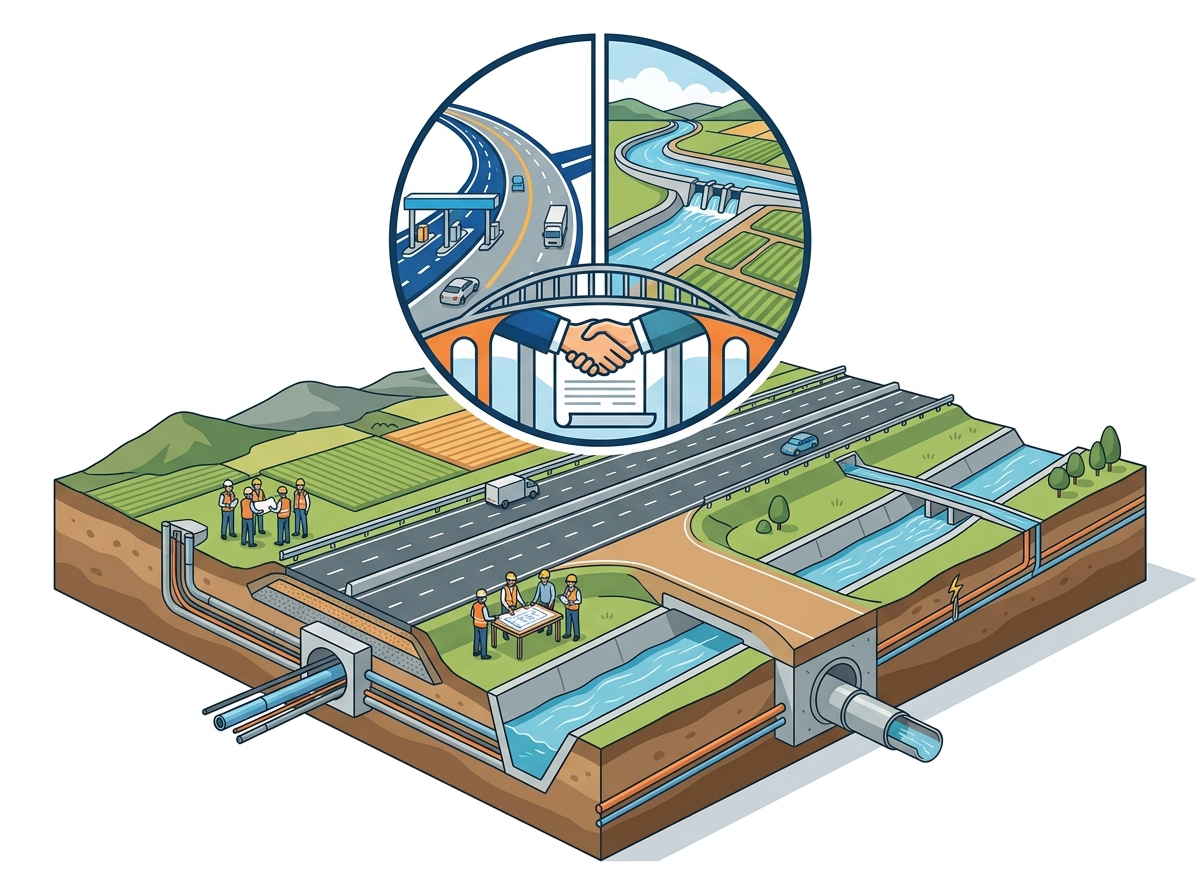
23 Sep NHAI-SSNL MoU to Fast-Track Gujarat Infrastructure Projects
✎ NHAI-SSNL MoU in Gujarat aims to streamline infrastructure project approvals by enhancing inter-agency coordination, reducing procedural delays, and optimising costs through mutual fee waivers and standardised processes.
Subject Relevance — Where This Topic Fits
- GS Paper II — Governance, Transparency and Accountability | GS Paper III — Infrastructure: Energy, Roads, Irrigation
- Prelims: National Highways Authority of India (NHAI), Sardar Sarovar Narmada Nigam Limited (SSNL), Inter-agency coordination, Infrastructure approvals, Public-private partnership (PPP), Project execution timelines, Cost optimisation in infrastructure
- Essay: The role of inter-agency coordination in accelerating India’s infrastructure development, Balancing speed and sustainability in public infrastructure projects
Quick Revision: NHAI-SSNL MoU in Gujarat aims to streamline infrastructure project approvals by enhancing inter-agency coordination, reducing procedural delays, and optimising costs through mutual fee waivers and standardised processes.
Why is this in the news?
On 22 September 2026, the National Highways Authority of India (NHAI) and the Sardar Sarovar Narmada Nigam Limited (SSNL) signed a Memorandum of Understanding (MoU) in Gandhinagar to streamline the approval process for national highways, irrigation infrastructure, and utility crossings in Gujarat. The agreement aims to reduce procedural delays, optimise project costs, and enhance inter-departmental coordination, thereby accelerating infrastructure development in the state.
Background
- The National Highways Authority of India (NHAI) is a statutory body under the Ministry of Road Transport and Highways, responsible for the development, maintenance, and management of national highways in India.
- The Sardar Sarovar Narmada Nigam Limited (SSNL) is a state-owned enterprise in Gujarat, tasked with the implementation and management of the Sardar Sarovar Project, including irrigation, drinking water supply, and hydroelectric power generation.
- Gujarat, a leading state in infrastructure development, faces challenges in the timely approval and execution of cross-sectoral projects due to overlapping jurisdictions and regulatory requirements.
- The MoU aligns with the Government of India’s emphasis on ‘Ease of Doing Business’ and ‘Infrastructure Development’ as key drivers of economic growth.
- Utility crossings (such as national highways, canals, and pipelines) often face delays due to multiple approvals, fee structures, and inter-agency conflicts, necessitating coordinated governance mechanisms.
What is the NHAI-SSNL MoU and its significance?
- The MoU is a formal agreement between NHAI and SSNL to establish a coordinated framework for the approval and execution of infrastructure projects in Gujarat, including national highways, irrigation canals, and utility crossings.
- The primary objective is to enhance inter-agency coordination, reduce procedural bottlenecks, and expedite project approvals to ensure timely and cost-effective implementation.
- The MoU includes provisions for mutual waiver of fees, charges, and taxes on crossings of national highways, canals, and pipelines, thereby reducing the financial burden on infrastructure projects.
- It mandates the rapid exchange of project-related information, adoption of standardised engineering practices, and clearly defined roles and responsibilities for the construction and maintenance of crossings.
- The agreement aims to improve project planning, ensure adherence to high-quality standards, and enhance operational efficiency in infrastructure development.
- By streamlining approvals, the MoU seeks to reduce project execution timelines, optimise public expenditure, and accelerate economic growth through improved connectivity and infrastructure resilience.
- The collaboration reflects NHAI’s commitment to developing world-class infrastructure and aligns with Gujarat’s vision for integrated infrastructure planning and development.
- The MoU also underscores the importance of inter-departmental synergy in achieving sustainable infrastructure outcomes.
Key Features
| Feature | Significance |
|---|---|
| Inter-agency Memorandum of Understanding (MoU) between NHAI and SSNL | Establishes a structured framework for coordinated planning and execution of infrastructure projects in Gujarat, reducing bureaucratic silos. |
| Mutual waiver of fees, charges, and taxes for highway, canal, and pipeline crossings | Lowers project costs, eliminates procedural bottlenecks, and optimises public expenditure, enhancing financial viability of infrastructure projects. |
| Standardised engineering practices and clear delineation of roles for construction and maintenance | Ensures uniformity in project execution, improves quality control, and minimises disputes over responsibilities. |
| Rapid information exchange protocols between NHAI and SSNL | Facilitates timely decision-making, reduces delays in approvals, and enhances project monitoring. |
| Time-bound approval processes for crossings | Accelerates project timelines, reduces implementation delays, and improves overall efficiency in infrastructure development. |
Why it Matters
Economic Development
- Enhances connectivity through integrated highway and irrigation infrastructure, fostering regional economic integration.
- Reduces project costs via fee waivers, enabling higher investment in infrastructure development.
- Accelerates project execution, shortening gestation periods and improving return on investment for public funds.
- Supports agricultural productivity by improving irrigation network efficiency and reliability.
Institutional Efficiency
- Promotes inter-departmental coordination, reducing duplication of efforts and administrative friction.
- Establishes clear accountability and standardised procedures, minimising disputes and delays.
- Encourages data-driven planning through structured information exchange between agencies.
- Demonstrates the efficacy of collaborative governance models in infrastructure delivery.
Public Resource Optimisation
- Ensures optimal utilisation of public funds by reducing unnecessary expenditures on procedural hurdles.
- Enhances transparency in project execution, reducing leakages and inefficiencies.
- Facilitates long-term cost savings through standardised engineering practices and reduced maintenance disputes.
Challenges
1. Inter-agency Coordination Gaps
- Historical silos between road and irrigation departments may persist despite formal agreements.
- Differing operational priorities between NHAI (transport focus) and SSNL (irrigation focus) could lead to misalignment in project objectives.
UPSC Link: GS2: Intergovernmental relations
2. Regulatory and Compliance Burdens
- Complexity of overlapping environmental, land acquisition, and safety regulations may still cause delays.
- Need for synchronised compliance across multiple statutory bodies (e.g., MoEFCC, state agencies).
UPSC Link: GS3: Infrastructure governance
3. Financial Sustainability of Fee Waivers
- Long-term impact on revenue streams for NHAI and SSNL requires careful fiscal planning.
- Risk of reduced financial autonomy for agencies if fee waivers become permanent without compensatory mechanisms.
UPSC Link: GS3: Public finance
4. Technical and Engineering Challenges
- Integration of highway crossings with irrigation canals and pipelines demands precise engineering solutions.
- Potential conflicts in land use and right-of-way acquisition between competing infrastructure needs.
UPSC Link: GS3: Infrastructure development
5. Monitoring and Accountability Mechanisms
- Ensuring adherence to MoU terms and preventing ad-hoc deviations requires robust oversight.
- Need for independent audits to assess compliance and outcomes.
UPSC Link: GS4: Ethics in governance
Challenges — UPSC Perspective
| Issue | Concern |
|---|---|
| Silos in departmental functioning | Persistent bureaucratic barriers despite formal agreements. |
| Regulatory overlaps | Conflicting compliance requirements across multiple agencies. |
| Financial viability of fee waivers | Potential long-term revenue impact on NHAI and SSNL. |
| Engineering integration complexities | Technical challenges in harmonising diverse infrastructure systems. |
| Monitoring and evaluation gaps | Risk of non-compliance without independent oversight mechanisms. |
| Land acquisition conflicts | Competing claims on right-of-way between highways and irrigation projects. |
Way Forward
- Constitute a joint task force comprising NHAI, SSNL, and state agencies to oversee MoU implementation and resolve inter-agency disputes.
- Develop a standardised digital dashboard for real-time monitoring of project progress and compliance with MoU terms.
- Undertake capacity-building initiatives for officials to align operational priorities and enhance inter-departmental coordination.
- Conduct periodic independent audits to assess adherence to MoU provisions and identify areas for improvement.
- Establish a grievance redressal mechanism for stakeholders to report delays or deviations in project execution.
- Integrate environmental and social impact assessments into the planning phase to pre-empt regulatory bottlenecks.
- Explore public-private partnership models to supplement public funding and accelerate project delivery.
- Document best practices from this MoU for replication in other states facing similar infrastructure coordination challenges.
UPSC Value Addition
Keywords for Mains Answer-Writing
National Highways Authority of India (NHAI) · Sardar Sarovar Narmada Nigam Limited (SSNNL) · Infrastructure development · Inter-departmental coordination · Project approval processes · Public-Private Partnership (PPP) · Ease of Doing Business · Multi-modal infrastructure · Gujarat infrastructure projects · Expeditious clearances · Cross-sectoral convergence · Standardised engineering practices
Concept Flow
Inter-agency coordination gaps in infrastructure planning → Formal MoU between NHAI and SSNL → Mutual waiver of fees and standardised processes → Accelerated approvals and reduced costs → Enhanced project execution efficiency → Improved regional connectivity and economic development → Long-term public resource optimisation
Prelims Practice Questions
Q1. Consider the following statements regarding the Memorandum of Understanding (MoU) signed between NHAI and SSNNL in Gujarat:
1. The MoU aims to streamline the approval process for national highway and irrigation infrastructure projects in Gujarat.
2. The MoU includes provisions for mutual waiver of fees, charges, and taxes for crossings of national highways, canals, and pipelines.
3. The MoU mandates the adoption of standardised engineering practices for all infrastructure projects in Gujarat.
How many of the above statements are correct?
- Only one
- Only two
- All three
- None
Answer: All three — Statements 1 and 2 are explicitly mentioned in the MoU. Statement 3 is implied but not explicitly stated as a mandate; it is part of the broader objective to enhance project execution.
Q2. Assertion (A): The MoU between NHAI and SSNNL is expected to reduce project costs by waiving cross-sectoral fees and charges.
Reason (R): The waiver of fees and charges is a key provision of the MoU aimed at optimising public expenditure and accelerating infrastructure development.
- Both A and R are true, and R is the correct explanation of A
- Both A and R are true, but R is NOT the correct explanation of A
- A is true, but R is false
- A is false, but R is true
Answer: Both A and R are true, and R is the correct explanation of A — Both the assertion and reason are factually correct, and the reason directly explains the assertion.
Q3. Match the following entities with their respective roles in the MoU signed between NHAI and SSNNL:
Entity | Role
— | —
1. NHAI | A. Implementation of irrigation and canal infrastructure projects
2. SSNNL | B. Facilitation of national highway projects
3. MoU | C. Streamlining approval processes and inter-departmental coordination
4. Gujarat Government | D. Oversight of the MoU’s implementation and policy support
- 1-B, 2-A, 3-C, 4-D
- 1-A, 2-B, 3-C, 4-D
- 1-B, 2-A, 3-D, 4-C
- 1-A, 2-B, 3-D, 4-C
Answer: 1-B, 2-A, 3-C, 4-D — NHAI is responsible for national highway projects (1-B), SSNNL for irrigation and canal infrastructure (2-A), the MoU itself aims to streamline processes (3-C), and the Gujarat Government provides policy support and oversight (4-D).
Mains Practice Question
✍ The Memorandum of Understanding (MoU) between the National Highways Authority of India (NHAI) and the Sardar Sarovar Narmada Nigam Limited (SSNNL) exemplifies a contemporary approach to expediting infrastructure development in India. Critically examine the significance of such inter-departmental collaborations in enhancing the ‘Ease of Doing Business’ in the infrastructure sector. Also, analyse the constitutional and statutory framework governing the roles of NHAI and SSNNL in this context. (15 Marks)
Approach: MODEL-ANSWER SKELETON:
1. **Introduction (2 marks)**
– Briefly define NHAI (established under the National Highways Authority of India Act, 1988) and SSNNL (a Gujarat government enterprise managing the Sardar Sarovar Project).
– State the objective of the MoU: inter-departmental coordination, streamlined approvals, and cost optimisation for national highway and irrigation projects.
2. **Significance of Inter-departmental Collaborations (5 marks)**
– **Ease of Doing Business**: Reducing procedural delays, overlapping jurisdictions, and bureaucratic hurdles.
– **Cost Efficiency**: Mutual waiver of fees and charges for cross-sectoral projects (e.g., highways crossing canals/pipelines) reduces financial burden.
– **Standardisation**: Adoption of uniform engineering practices ensures quality and reduces disputes.
– **Multi-modal Infrastructure**: Integration of road, irrigation, and pipeline networks for holistic development.
– **Public Expenditure Optimisation**: Prevents duplication of efforts and ensures judicious use of public funds.
3. **Constitutional and Statutory Framework (5 marks)**
– **NHAI**: Governed by the National Highways Authority of India Act, 1988, and the National Highways Act, 1956. Functions under the Ministry of Road Transport and Highways.
– **SSNNL**: A state government enterprise under the Gujarat Infrastructure Development Act, 1999, managing the Sardar Sarovar Project (Narmada Water Resources, Water Supply and Management Department, Government of Gujarat).
– **Inter-governmental Coordination**: Article 256 (duty of states to ensure compliance with Union laws) and Article 257 (Union’s power to give directions to states) of the Constitution provide the legal basis for such collaborations.
– **Parliamentary Superintendence**: NHAI’s autonomy is subject to parliamentary oversight, while SSNNL operates under state legislative control.
4. **Challenges and Way Forward (3 marks)**
– **Jurisdictional Conflicts**: Potential disputes over land acquisition, environmental clearances, or revenue sharing.
– **Implementation Gaps**: Need for robust monitoring mechanisms to ensure adherence to timelines and quality standards.
– **Capacity Building**: Training of officials and adoption of digital platforms (e.g., PM GatiShakti National Master Plan) for real-time coordination.
– **Scalability**: Lessons from Gujarat can be replicated in other states for multi-sectoral infrastructure projects.
**Balance of Views:**
– Proponents argue such MoUs enhance efficiency and attract private investment.
– Critics highlight risks of over-centralisation or dilution of state autonomy in infrastructure governance.
Source: PIB (Press Information Bureau)
Gujarat PCS (GPSC) — State PCS Practice
Prelims: Under the recent initiative by the National Highways Authority of India (NHAI) and Sardar Sarovar Narmada Nigam Limited (SSNNL) to simplify approval processes for national highways and irrigation infrastructure projects in Gujarat, which of the following is a key objective of this collaboration?
- A. To reduce the number of environmental clearances required for irrigation projects in Gujarat
- B. To streamline the land acquisition process for national highways and irrigation projects by integrating approvals
- C. To transfer the ownership of all national highways in Gujarat to SSNNL for better management
- D. To exempt irrigation projects from the purview of the Gujarat Pollution Control Board (GPCB)
Answer: B. To streamline the land acquisition process for national highways and irrigation projects by integrating approvals — The collaboration aims to integrate and simplify approval processes for both national highways and irrigation projects by reducing bureaucratic hurdles and overlapping clearances.
Mains: Examine the significance of the collaboration between the National Highways Authority of India (NHAI) and Sardar Sarovar Narmada Nigam Limited (SSNNL) in Gujarat for expediting infrastructure development. Discuss the potential benefits and challenges associated with this initiative in the context of Gujarat’s economic growth and sustainability.
Generated by AanyaAi for educational purpose.

- उत्तराखंड में 54 धारा-नौलों का पारंपरिक विधि से पुनरुद्धार, सीमेंट का न्यूनतम प्रयोग - September 29, 2026
- Kerala doubles compensation for wildlife attacks, crop loss amid rising conflicts - September 29, 2026
- दिल्ली हाई कोर्ट ने रेड बुल के ‘एनर्जी ड्रिंक’ टैग पर FSSAI के आदेश को किया निरस्त - September 29, 2026

No Comments