


04 Sep NHRC Slams Delayed ATR Submissions: UPSC Governance Analysis for 2026
✎ The NHRC, established under the Protection of Human Rights Act, 1993, functions as a statutory watchdog for human rights violations in India, with powers to inquire into complaints, recommend relief, and ensure procedural…
Subject Relevance — Where This Topic Fits
- GS Paper II — Constitutional and Statutory Bodies | GS Paper III — Human Rights and Governance
- Prelims: National Human Rights Commission (NHRC), Protection of Human Rights Act, 1993, Action Taken Report (ATR), Section 13(1) of the Protection of Human Rights Act, bonded labour, custodial death, civic negligence
- Essay: The role of statutory bodies in ensuring justice and accountability in governance, Balancing human rights protection with administrative efficiency in public institutions
Quick Revision: The NHRC, established under the Protection of Human Rights Act, 1993, functions as a statutory watchdog for human rights violations in India, with powers to inquire into complaints, recommend relief, and ensure procedural compliance through notices under Section 13(1) of the Act.
Why is this in the news?
The Chairperson of the National Human Rights Commission (NHRC), Justice V Ramasubramanian, highlighted systemic delays in the submission of Action Taken Reports (ATRs) by government agencies, which impede the timely disposal of human rights cases. This issue was underscored during an open hearing in Gujarat, where the NHRC also awarded compensation in 90% of disposed cases, demonstrating its operational role in redressing human rights violations despite procedural bottlenecks.
Background
- The National Human Rights Commission (NHRC) was established under the Protection of Human Rights Act, 1993, as a statutory body to protect and promote human rights in India.
- The NHRC operates as a multi-member body with a Chairperson and members, including judicial and non-judicial members, to ensure diverse expertise in human rights adjudication.
- The NHRC’s jurisdiction extends to matters involving the violation of human rights by public servants or failure in duty by the state, including cases of custodial deaths, bonded labour, and police excesses.
- The NHRC’s recommendations are advisory in nature, though they carry significant moral and institutional weight, often leading to state compliance due to public scrutiny and judicial oversight.
- The NHRC’s operational efficiency is frequently scrutinised for delays in case disposal, particularly due to non-submission of ATRs by government agencies within stipulated timelines.
What is the National Human Rights Commission (NHRC)?
- The NHRC is a statutory body constituted under the Protection of Human Rights Act, 1993, to protect and promote human rights in India, as defined in the Constitution of India and international covenants.
- The NHRC’s jurisdiction covers violations of human rights by public servants or failure in duty by the state, including cases of custodial deaths, torture, bonded labour, and police excesses.
- The NHRC has the power to inquire into complaints of human rights violations either suo motu or on a petition presented to it, and it can recommend relief to victims or their families, including compensation.
- The NHRC can summon witnesses, examine evidence, and direct the production of documents, though its recommendations are not legally binding.
- The NHRC’s procedures include issuing notices for Action Taken Reports (ATRs) to government agencies within stipulated timelines, failing which it may issue notices under Section 13(1) of the Protection of Human Rights Act for the personal appearance of officials.
- The NHRC’s role is complemented by State Human Rights Commissions (SHRCs) in states, which operate under similar mandates but with jurisdiction limited to state-level violations.
- The NHRC’s effectiveness is often measured by its ability to dispose of cases expeditiously, award compensation, and ensure accountability in cases of human rights violations.
Key Features
| Feature | Significance |
|---|---|
| NHRC’s statutory notices under Section 13(1) of the Protection of Human Rights Act, 1993 | Empowers the Commission to summon government officers for non-compliance with ATR deadlines, ensuring accountability in human rights redressal. |
| Action Taken Report (ATR) timelines (2-4 weeks) | Standardised procedural deadlines for government responses to NHRC notices, aimed at expediting case disposal. |
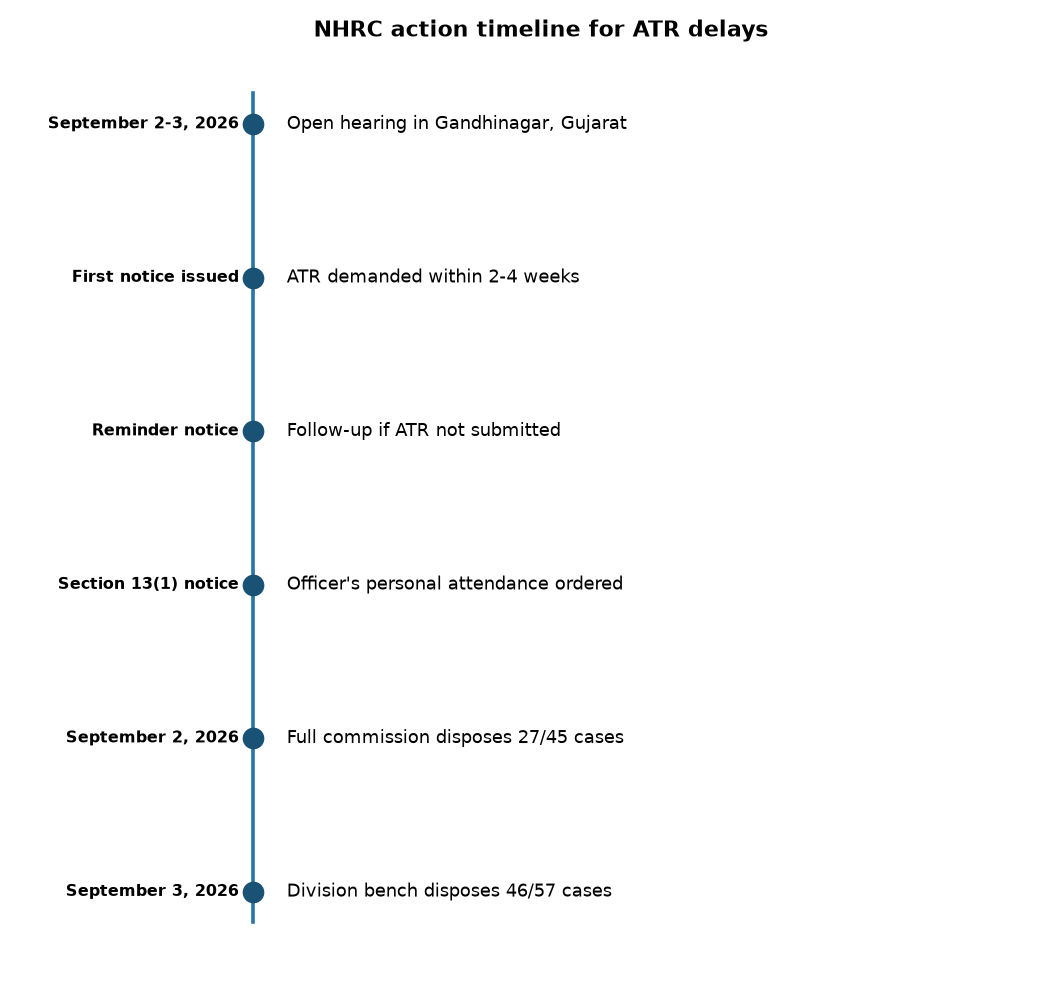
| Open hearings in Gujarat (September 2-3, 2026) | Demonstrates NHRC’s outreach mechanism to address regional human rights grievances through direct interaction with stakeholders. |
| Compensation awards (Rs 3.5 crore over two days) | Illustrates NHRC’s remedial role in providing immediate relief to victims of human rights violations. |
| Disposal of cases (73 out of 102 cases in two days) | Highlights operational efficiency of NHRC in adjudicating cases when government reports are submitted promptly. |
Why it Matters
Institutional
- Reinforces the NHRC’s mandate as a quasi-judicial body under the Protection of Human Rights Act, 1993, to monitor and redress human rights violations.
- Demonstrates the Commission’s proactive approach in addressing systemic delays in government compliance through statutory notices.
- Showcases the NHRC’s role in providing expeditious justice to marginalised groups, including bonded labourers, factory workers, and victims of custodial deaths.
Legal
- Highlights the procedural framework governing NHRC’s functioning, including timelines for ATR submissions and the legal recourse available for non-compliance.
- Illustrates the interplay between constitutional rights (Article 21) and statutory mechanisms for their enforcement.
Administrative
- Exposes challenges in inter-departmental coordination, as delays in ATR submissions hinder timely case disposal.
- Emphasises the need for streamlined administrative processes to align with NHRC’s statutory timelines.
Social
- Underscores the NHRC’s commitment to protecting vulnerable sections, including children, bonded labourers, and factory workers, through compensation and remedial measures.
- Highlights the Commission’s role in addressing structural failures leading to fatalities, such as factory accidents and civic negligence.
Challenges
1. Delays in government compliance with NHRC notices
- Non-adherence to statutory timelines for ATR submissions (2-4 weeks) delays case disposal and undermines the NHRC’s efficiency.
- Adjournments due to pending reports prolong legal recourse for victims, exacerbating their suffering.
- Systemic inefficiencies in inter-departmental coordination hinder timely submission of reports.
UPSC Link: Protection of Human Rights Act, 1993
2. Operational bottlenecks in NHRC’s case disposal
- High volume of cases (102 in two days) strains the NHRC’s capacity, despite efficient disposal when reports are submitted.
- Geographical limitations in conducting open hearings may restrict accessibility for victims in remote areas.
UPSC Link: NHRC Annual Reports
3. Ensuring compensation reaches victims promptly
- While compensation is awarded, delays in disbursement may defeat its purpose of immediate relief.
- Lack of standardised mechanisms for tracking compensation payments across states.
UPSC Link: Right to Life (Article 21)
4. Addressing systemic failures in civic and industrial safety
- Repeated incidents of factory accidents and civic negligence indicate gaps in regulatory enforcement.
- Need for stronger preventive measures to reduce fatalities and human rights violations.
UPSC Link: Factory Act, 1948
Challenges — UPSC Perspective
| Issue | Concern |
|---|---|
| Non-submission of ATRs within timelines | Delays case disposal and undermines NHRC’s statutory mandate. |
| Adjournments due to pending reports | Prolongs legal recourse for victims, exacerbating their suffering. |
| High case volume with limited resources | Strains NHRC’s operational capacity despite efficient disposal. |
| Delays in compensation disbursement | Defeats the purpose of immediate relief for victims. |
| Systemic failures in safety regulations | Indicates gaps in enforcement leading to repeated violations. |
Way Forward
- Strengthen inter-departmental coordination to ensure timely submission of ATRs in compliance with NHRC notices.
- Enhance NHRC’s operational capacity through increased staffing and digital case management systems.
- Establish a standardised grievance redressal portal for victims to track compensation payments and case status.
- Conduct periodic audits of industrial and civic safety regulations to identify systemic gaps and enforce preventive measures.
- Expand NHRC’s outreach programmes to remote areas to improve accessibility for victims of human rights violations.
- Introduce incentives for government departments to submit ATRs within statutory timelines.
- Collaborate with state human rights commissions to streamline case disposal and reduce adjournments.
- Publicise NHRC’s procedures and timelines to raise awareness among stakeholders and the general public.
UPSC Value Addition
Keywords for Mains Answer-Writing
National Human Rights Commission (NHRC) · Protection of Human Rights Act, 1993 · Action Taken Report (ATR) · Section 13(1) of the Protection of Human Rights Act · Compensation for human rights violations · Custodial deaths · Bonded labour · Workers’ safety and factory accidents · Open hearings by NHRC · Constitutional and statutory bodies for human rights · Role of NHRC in Gujarat · Compensation awards under human rights jurisprudence
Constitutional & Policy Linkages
- Article 21 (Right to Life and Personal Liberty): Ensures the NHRC’s mandate to protect fundamental rights.
Concept Flow
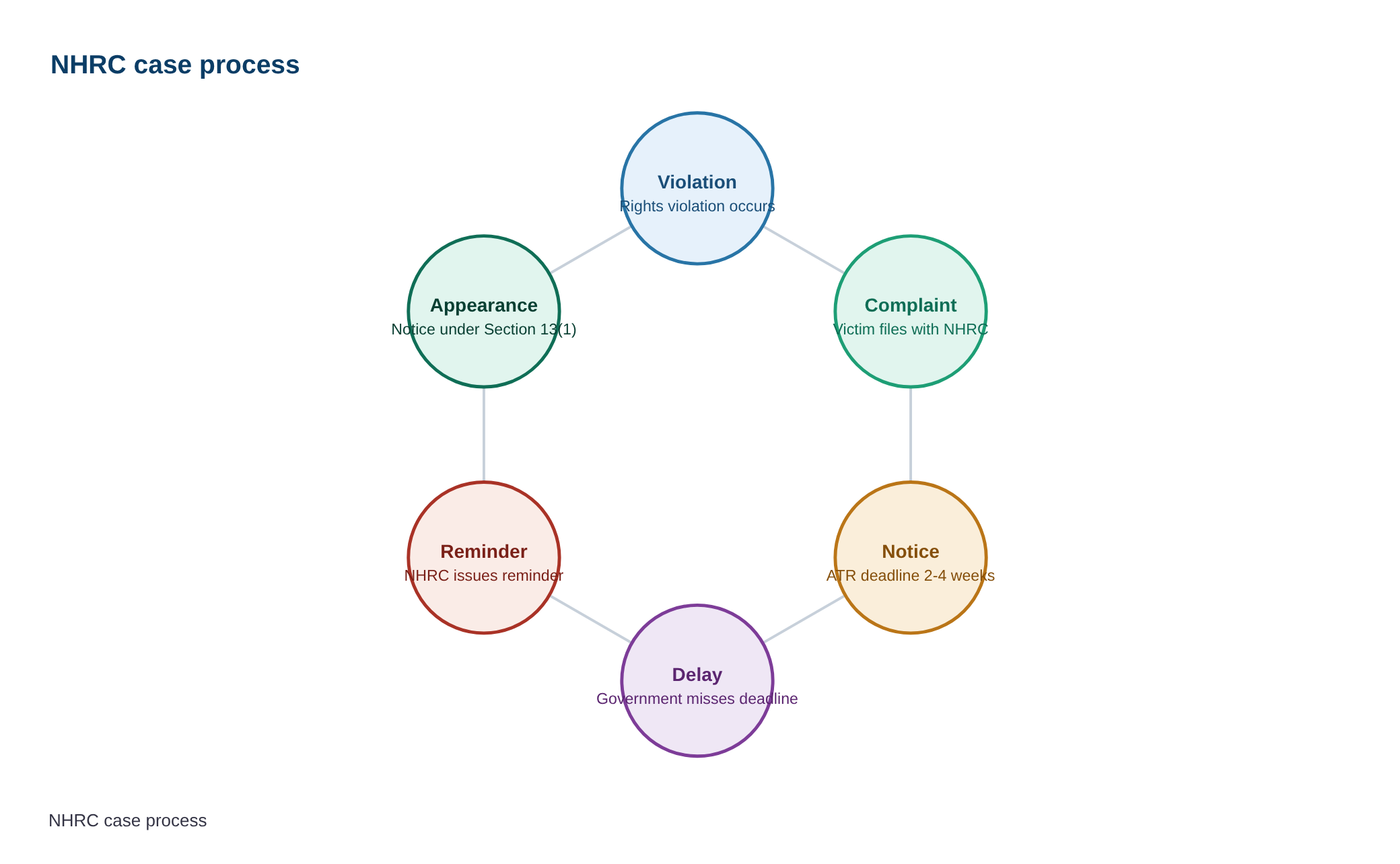
Human Rights Violation Occurs → Victim Files Complaint with NHRC → NHRC Issues Notice for ATR (2-4 weeks deadline) → Government Department Delays Submission → NHRC Issues Reminder → Further Delays → NHRC Issues Notice under Section 13(1) for Personal Appearance → ATR Submitted → Case Disposed or Compensation Awarded.
Prelims Practice Questions
Q1. Consider the following statements regarding the National Human Rights Commission (NHRC):
1. The NHRC can issue notices under Section 13(1) of the Protection of Human Rights Act for the personal attendance of officers.
2. The NHRC is empowered to award compensation to victims of human rights violations.
3. The NHRC can suo motu take cognisance of human rights violations.
4. The NHRC is a constitutional body.
How many of the above statements are correct?
- Only one
- Only two
- Only three
- All
Answer: All — Statements 1, 2, and 3 are correct. The NHRC is a statutory body established under the Protection of Human Rights Act, 1993, not a constitutional body (Statement 4 is incorrect).
Q2. Assertion (A): The NHRC can award compensation to victims of human rights violations.
Reason (R): The NHRC derives its power to award compensation from the constitutional provisions under Article 32 of the Indian Constitution.
Options:
A. Both A and R are true, and R is the correct explanation of A.
B. Both A and R are true, but R is not the correct explanation of A.
C. A is true, but R is false.
D. A is false, but R is true.
- A
- B
- C
- D
Answer: C — Assertion (A) is true; the NHRC can award compensation under the Protection of Human Rights Act, 1993. Reason (R) is false; the NHRC’s power to award compensation is statutory, not constitutional.
Mains Practice Question
✍ The National Human Rights Commission (NHRC) plays a pivotal role in safeguarding human rights in India. In this context, critically examine the institutional mechanisms available to the NHRC for ensuring compliance with its directives, particularly in cases of delayed Action Taken Reports (ATRs). Also, analyse the significance of the NHRC’s open hearing process in delivering timely justice to victims of human rights violations. (15 Marks)
Approach: MODEL-ANSWER SKELETON:
1. **Introduction (2 marks)**: Define NHRC and its constitutional/statutory basis (Protection of Human Rights Act, 1993). Mention its role as a watchdog for human rights violations.
2. **Institutional Mechanisms for Compliance (5 marks)**:
– **Section 13(1) of the Protection of Human Rights Act**: Power to summon officers for personal appearance if ATRs are delayed.
– **Escalation Process**: First notice (2–4 weeks), reminder, and final notice under Section 13(1) for personal attendance.
– **Compensation Awards**: Cite examples from the news (e.g., Rs 3.5 crore awarded in Gujarat over two days).
– **Jurisdictional Limits**: NHRC is a recommendatory body; coercive powers are limited (contrast with judiciary).
3. **Open Hearing Process (4 marks)**:
– **Purpose**: Expedited disposal of cases (e.g., 27 of 45 cases disposed in Gujarat in one day).
– **Stakeholder Involvement**: District magistrates, sub-divisional magistrates, and departmental officials attend.
– **Transparency and Accountability**: Real-time scrutiny of compensation payments and compliance.
– **Challenges**: Adjournments, delayed reports, and resource constraints.
4. **Significance and Limitations (4 marks)**:
– **Strengths**: Proactive role in Gujarat (e.g., bonded labour, factory accidents, child deaths).
– **Weaknesses**: Limited coercive powers; dependence on government cooperation.
– **Comparative Analysis**: Contrast with judicial remedies (e.g., PILs under Article 32/226).
– **Suggestions**: Strengthening NHRC’s powers, faster ATR timelines, and digital monitoring.
5. **Conclusion (2 marks)**: Summarise the NHRC’s role as a quasi-judicial body and its impact on human rights governance. Emphasise the need for institutional reforms to enhance efficacy.
Source: The Indian Express
Generated by AanyaAi for educational purpose.
Related guides on our sites
- Current affairs for upsc 2026
- Best PSIR optional coaching for upsc
- Best economics optional coaching for upsc
- Best PSIR optional teacher for upsc

- पेरियार टाइगर रिजर्व में 6 नई प्रजातियाँ खोजी गईं, जानिए क्या हैं विशेषताएँ - September 22, 2026
- Six New Species Discovered in Periyar Tiger Reserve: UPSC & PCS Key Biodiversity Insights - September 22, 2026
- तमिलनाडु में बस किराए में संशोधन: सरकार को चार सप्ताह और समय मिला, उच्च न्यायालय का फैसला - September 22, 2026

No Comments