


18 Aug Nilgiris Wetland Restoration: UPSC Exam Focus on Ecology & Climate
High-altitude wetlandsInvasive plant speciesNative biodiversityWater purificationFlood regulationCarbon sequestration✎ Wetland restoration in the Nilgiris addresses the dual challenges of invasive species management and climate resilience, aligning with India’s Wetlands (Conservation and Management) Rules, 2017, and the Ramsar Convention’s…
Subject Relevance — Where This Topic Fits
- GS Paper III — Environment and Ecology (Conservation, Wetland Management, Invasive Species, Climate Resilience)
- Prelims: Wetlands (Conservation and Management) Rules, 2017, Invasive Alien Species, Biodiversity Hotspots, Carbon Sequestration, Ecosystem Services, National Mission for Clean Ganga (NMCG), Western Ghats Ecology Expert Panel (WGEEP)
- Essay: The interplay between human development and ecological sustainability: Lessons from wetland restoration initiatives
Quick Revision: Wetland restoration in the Nilgiris addresses the dual challenges of invasive species management and climate resilience, aligning with India’s Wetlands (Conservation and Management) Rules, 2017, and the Ramsar Convention’s principles for sustainable wetland governance.
Why is this in the news?
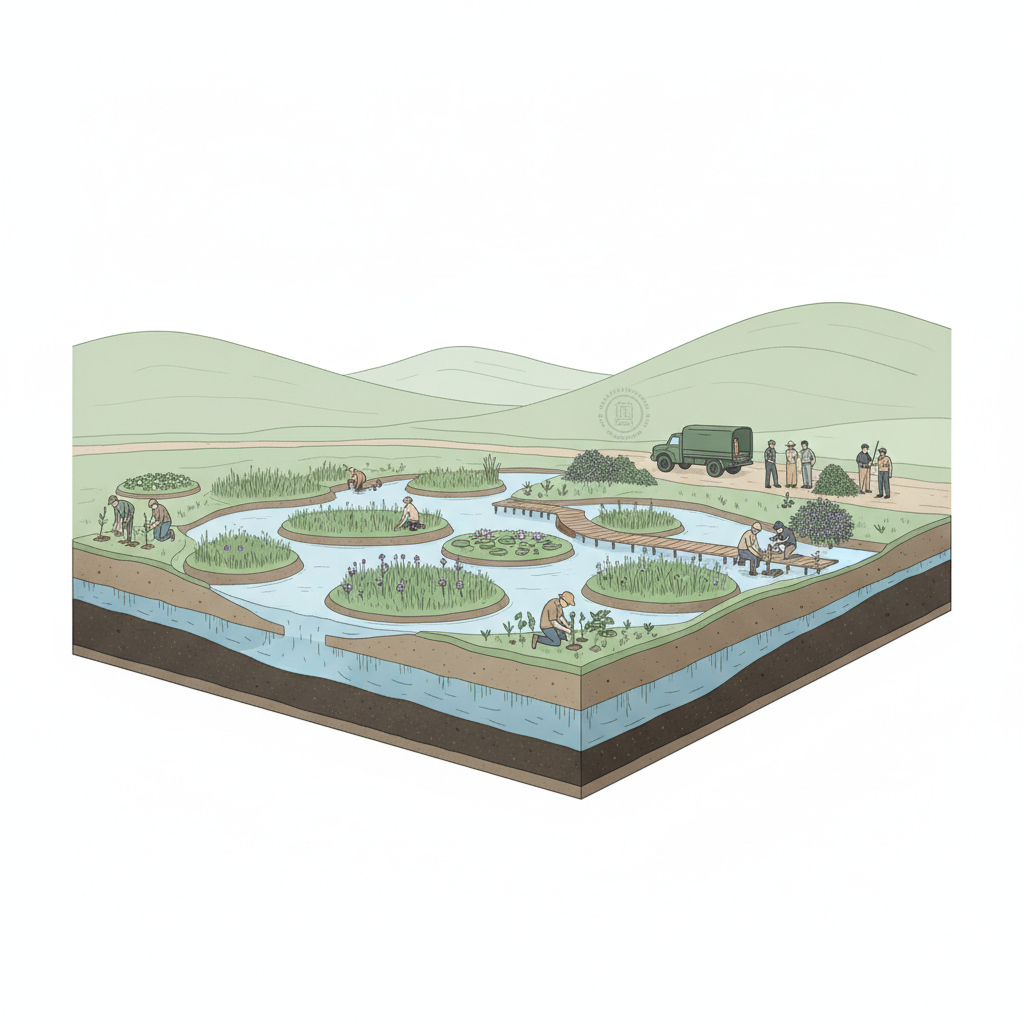
The launch of a wetland restoration initiative in the Nilgiris highlights the urgent need for targeted ecological interventions to address the degradation of high-altitude wetlands in the Western Ghats. This project, involving multiple stakeholders including NGOs, military units, and local communities, underscores the role of collaborative governance in mitigating threats posed by invasive plant species and restoring critical habitats for native biodiversity.
Background
- Wetlands are among the most productive ecosystems globally, providing essential services such as water purification, flood regulation, and carbon sequestration.
- The Nilgiris, part of the Western Ghats biodiversity hotspot, hosts numerous high-altitude wetlands that are ecologically fragile and increasingly threatened by anthropogenic pressures.
- Invasive alien plant species, such as *Silybum marianum* (Milk Thistle) and *Alternanthera philoxeroides* (Alligator Weed), disrupt local hydrology and displace native flora and fauna, exacerbating ecological imbalance.
- Collaborative restoration initiatives involving civil society, military institutions, and local communities have gained traction as cost-effective and sustainable models for ecological rehabilitation.
What is Wetland Restoration and Why is it Critical?
- Wetland restoration refers to the process of returning a degraded wetland to its natural or near-natural state by removing invasive species, re-establishing native vegetation, and restoring hydrological functions.
- High-altitude wetlands in the Nilgiris are particularly vulnerable due to their small size, limited water retention capacity, and sensitivity to climate change impacts such as altered precipitation patterns.
- Invasive plant species, often introduced unintentionally through human activities, outcompete native species, alter soil composition, and disrupt water flow, leading to long-term ecological degradation.
- Native flora restoration in wetlands enhances ecosystem resilience, supports pollinator networks, and improves carbon sequestration potential, thereby contributing to climate change mitigation.
- The Nilgiris project exemplifies a multi-stakeholder approach, combining scientific expertise (Upstream Ecology Foundation), conservation advocacy (Arulagam), and institutional support (Madras Regimental Centre), demonstrating the efficacy of participatory governance in ecological restoration.
- The initiative also serves as a model for integrating military institutions into conservation efforts, leveraging their logistical and manpower resources for large-scale ecological projects.
- Monitoring and adaptive management are critical components of successful restoration, requiring long-term data collection on species recovery, water quality, and ecosystem services.
Key Features
| Feature | Significance |
|---|---|
| Collaborative multi-stakeholder model | Demonstrates integrated governance involving NGOs, military institutions, and local communities for ecological restoration. |
| Invasive species eradication | Targets non-native flora (e.g., Silybum marianum, Alternanthera philoxeroides) to restore hydrological balance and indigenous biodiversity. |
| Native flora reintroduction | Rehabilitates wetland ecosystems with site-appropriate species to enhance carbon sequestration and climate resilience. |
| Military-NGO partnership | Leverages institutional resources (Madras Regimental Centre) for logistical support and community engagement. |
| Climate resilience focus | Aligns with global wetland conservation priorities by integrating carbon sequestration and ecosystem stability. |
Why it Matters
Ecological
- Restores critical wetland habitats in the Nilgiris, a biodiversity hotspot and UNESCO Biosphere Reserve.
- Mitigates biodiversity loss by removing invasive species that disrupt indigenous flora and fauna.
- Enhances hydrological functions, including groundwater recharge and flood mitigation.
- Contributes to climate change mitigation through natural carbon sequestration in restored wetlands.
Institutional
- Showcases the role of military institutions in environmental conservation through community-based projects.
- Highlights the efficacy of NGO-military collaborations in achieving sustainable ecological outcomes.
- Demonstrates grassroots-driven governance models for environmental restoration.
Strategic
- Strengthens India’s commitments under international conventions such as the Ramsar Convention on Wetlands.
- Supports national biodiversity targets under the National Mission for a Green India (GIM).
- Enhances local climate adaptation strategies by restoring ecosystem services.
Challenges
1. Invasive Species Management
- Risk of reinvasion by non-native species if restoration efforts are not sustained.
- Need for continuous monitoring and adaptive management to address emerging threats.
- Potential conflicts with agricultural practices that may inadvertently introduce invasive species.
UPSC Link: Environmental Impact Assessment (EIA) 2006
2. Community Engagement
- Ensuring long-term participation from local communities to prevent degradation post-restoration.
- Addressing socio-economic dependencies on wetland resources that may hinder conservation efforts.
- Overcoming apathy or lack of awareness among stakeholders regarding wetland importance.
UPSC Link: National Environment Policy 2006
3. Climate Change Vulnerability
- Increased frequency of extreme weather events may disrupt restoration timelines.
- Need to integrate climate projections into restoration planning for resilience.
- Potential for wetland desiccation due to altered precipitation patterns.
UPSC Link: Climate Change Action Plan (CCAP)
4. Resource Constraints
- Limited funding and technical expertise for large-scale wetland restoration projects.
- Dependence on external grants or partnerships may affect sustainability.
- Logistical challenges in remote or inaccessible wetland sites.
UPSC Link: Finance Commission recommendations on environmental funding
Challenges — UPSC Perspective
| Issue | Concern |
|---|---|
| Invasive species persistence | Reinvasion may negate restoration efforts without sustained control measures. |
| Local livelihood dependencies | Agricultural or resource extraction activities may conflict with conservation goals. |
| Climate-induced degradation | Extreme weather events can undermine restoration infrastructure and outcomes. |
| Monitoring and evaluation gaps | Lack of standardized metrics to assess restoration success over time. |
| Policy fragmentation | Overlapping jurisdictions between forest, water, and land-use authorities may delay approvals. |
Way Forward
- Formulate a long-term monitoring framework with measurable indicators for biodiversity and hydrological recovery.
- Expand community awareness programs to foster ownership and participation in wetland conservation.
- Integrate climate resilience strategies into restoration plans, including species selection and infrastructure design.
- Establish a dedicated fund for wetland restoration, leveraging public-private partnerships and corporate social responsibility (CSR) contributions.
- Develop inter-departmental coordination mechanisms to streamline approvals and address policy fragmentation.
- Conduct periodic ecological assessments to identify new invasive species and adapt management strategies.
- Promote research collaborations between academic institutions and restoration practitioners for evidence-based interventions.
UPSC Value Addition
Keywords for Mains Answer-Writing
Wetlands · Invasive Alien Species · Nilgiris Biosphere Reserve · Ecosystem Services · Biodiversity Conservation · Climate Resilience · Restoration Ecology · Hydrological Balance · Sustainable Development Goals · National Mission for Clean Ganga · Ramsar Convention · Community-Based Conservation
Concept Flow
Degradation of wetlands due to anthropogenic pressures and invasive species → Loss of indigenous biodiversity and disruption of hydrological cycles → Collaborative restoration initiative involving NGOs, military, and local communities → Eradication of invasive flora and reintroduction of native species → Enhanced ecosystem services including carbon sequestration and climate resilience → Sustainable management through community participation and institutional partnerships
Prelims Practice Questions
Q1. Consider the following statements regarding wetlands in India:
1. Wetlands are defined under the Environment (Protection) Act, 1986.
2. The Ramsar Convention is an intergovernmental treaty for the conservation of wetlands.
3. The National Mission for Clean Ganga (NMCG) includes wetland restoration as one of its components.
How many of the above statements are correct?
- Only one
- Only two
- All three
- None
Answer: All three — Statement 1 is incorrect: Wetlands are primarily governed under the Wetlands (Conservation and Management) Rules, 2017, framed under the Environment (Protection) Act, 1986, but not defined in the Act itself. Statements 2 and 3 are correct.
Q2. Assertion (A): Invasive Alien Species (IAS) pose a significant threat to native biodiversity in wetlands.
Reason (R): IAS often outcompete native species due to lack of natural predators in new ecosystems.
In the context of the above statements, which one of the following is correct?
- Both A and R are true, and R is the correct explanation of A.
- Both A and R are true, but R is not the correct explanation of A.
- A is true, but R is false.
- A is false, but R is true.
Answer: Both A and R are true, and R is the correct explanation of A. — Both A and R are true, and R correctly explains why IAS threaten native biodiversity. The absence of natural predators allows IAS to proliferate, displacing native species.
Q3. Which of the following pairs is correctly matched with respect to the Nilgiris Biosphere Reserve?
- A. Nilgiri Tahr — Endemic Mammal
- B. Shola Grasslands — Invasive Species
- C. Alligator Weed — Native Species
- D. Milk Thistle — Endemic Plant
Answer: A. Nilgiri Tahr — Endemic Mammal — The Nilgiri Tahr (Nilgiritragus hylocrius) is an endemic mammal of the Nilgiris Biosphere Reserve. Shola grasslands are native ecosystems, Alligator Weed and Milk Thistle are invasive species.
Mains Practice Question
✍ Wetland ecosystems are critical for biodiversity conservation and climate resilience, yet they face severe degradation due to anthropogenic pressures and invasive alien species. In this context, critically examine the ecological significance of wetlands and the challenges posed by invasive alien species. Also, outline the policy and institutional frameworks in India for wetland conservation and restoration. (15 Marks)
Approach: MODEL-ANSWER SKELETON:
1. **Ecological Significance of Wetlands** (5 points):
– Define wetlands and their role in biodiversity conservation (e.g., habitat for migratory birds, fish nurseries).
– Ecosystem services: flood mitigation, groundwater recharge, carbon sequestration, and nutrient cycling.
– Reference Ramsar Convention (1971) and its criteria for identifying wetlands of international importance.
– Cite data on wetland loss in India (e.g., 30% decline since 1900, per Wetlands International).
– Highlight the Nilgiris Biosphere Reserve as a case study for endemic biodiversity (e.g., Nilgiri Tahr, Shola forests).
2. **Challenges Posed by Invasive Alien Species (IAS)** (5 points):
– Define IAS and their ecological impact (e.g., displacement of native flora/fauna, disruption of hydrological cycles).
– Examples from the Nilgiris initiative: Alligator Weed (Alternanthera philoxeroides) and Milk Thistle (Silybum marianum).
– Mechanisms of invasion: lack of natural predators, rapid reproduction, and adaptability to disturbed habitats.
– Economic and social costs: reduced ecosystem services, increased management costs.
– Link to climate change: IAS may exacerbate vulnerabilities in fragile ecosystems.
3. **Policy and Institutional Frameworks in India** (5 points):
– **Legal Framework**: Wetlands (Conservation and Management) Rules, 2017; Environment (Protection) Act, 1986; National Green Tribunal (NGT) directives.
– **Institutional Mechanisms**: National Wetland Committee, State Wetland Authorities, and local bodies (e.g., municipal corporations).
– **Schemes and Missions**: National Mission for Clean Ganga (NMCG) for riverine wetlands; National Mission on Himalayan Studies (NMHS) for Himalayan wetlands.
– **Community Involvement**: Role of NGOs (e.g., Arulagam, Upstream Ecology Foundation) and local stakeholders in restoration projects.
– **Challenges in Implementation**: Lack of funding, overlapping jurisdictions, and inadequate monitoring mechanisms.
Source: The Hindu
Generated by AanyaAi for educational purpose.

- UPSC Alert: Air Marshal Ashutosh Dixit Appointed New Air Chief - October 7, 2026
- तमिलनाडु में रेत खनन घोटाले: मद्रास हाईकोर्ट में ED के 2024 पत्र पर चुनौती, जानिए पूरा मामला - October 7, 2026
- Supreme Court to Review Split Verdict on CEC Appointment Law - October 7, 2026

No Comments