


24 Sep NIS Chennai Organizes Week-Long Ayurveda Awareness Programs for UPSC 2026
✎ The National Institute of Siddha (NIS), Chennai, is an autonomous institution under the Ministry of AYUSH, dedicated to education, research, and drug standardisation in the Siddha system of medicine, recognised under the NCISM…
Subject Relevance — Where This Topic Fits
- GS Paper II — Health, Education and Human Resources | GS Paper III — Science and Technology
- Prelims: Ayurveda Day, National Institute of Siddha (NIS), Central Council for Research in Ayurvedic Sciences (CCRAS), Regional Ayurveda Research Institute (RARI), Siddha System of Medicine, Ministry of AYUSH, Standardisation of Ayurvedic Drugs
- Essay: The Role of Traditional Knowledge Systems in Modern Healthcare, Integrating Indigenous Medical Practices with Evidence-Based Medicine
Quick Revision: The National Institute of Siddha (NIS), Chennai, is an autonomous institution under the Ministry of AYUSH, dedicated to education, research, and drug standardisation in the Siddha system of medicine, recognised under the NCISM framework.
Why is this in the news?
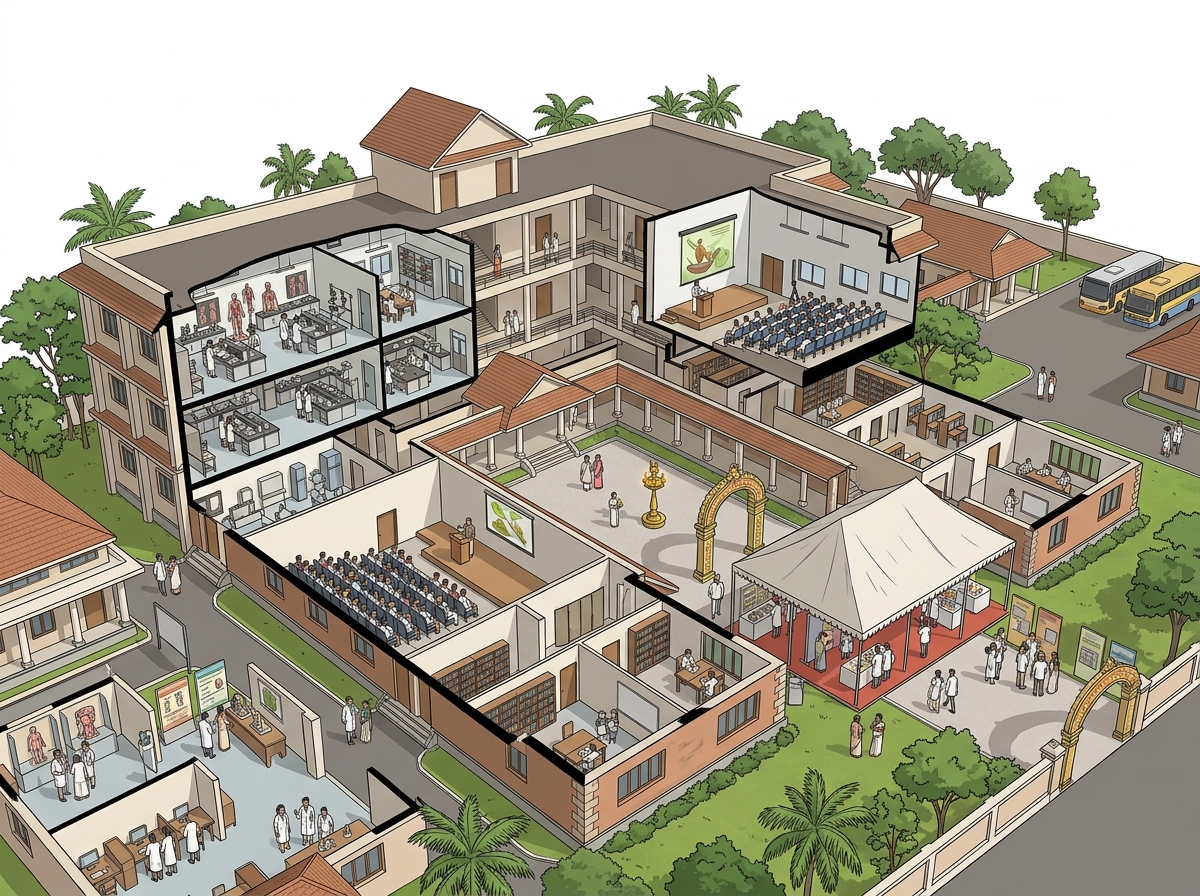
The National Institute of Siddha (NIS), Chennai, an autonomous institution under the Ministry of AYUSH, Government of India, organised a week-long series of academic and awareness programmes from 18 to 25 September 2026 to commemorate the 11th Ayurveda Day. These initiatives aimed to enhance awareness of Ayurveda, promote interdisciplinary education, and strengthen academic engagement among students, researchers, healthcare professionals, and faculty members. The events included seminars, institutional visits, and practical training, aligning with the Ministry’s vision for integrated healthcare systems.
Background
- Ayurveda Day is an annual observance initiated by the Ministry of AYUSH in 2016 to promote the significance of Ayurveda in public health and its holistic approach to wellness.
- The Siddha system of medicine is one of the oldest traditional healthcare systems, primarily practised in South India, and is recognised under the AYUSH framework.
- The National Institute of Siddha (NIS), Chennai, functions as an apex institution for education, research, and training in the Siddha system of medicine.
- The Ministry of AYUSH coordinates nationwide programmes to integrate traditional medicine systems with modern healthcare practices, emphasising evidence-based validation and standardisation.
- The Central Council for Research in Ayurvedic Sciences (CCRAS) and Regional Ayurveda Research Institutes (RARIs) play pivotal roles in research and standardisation of Ayurvedic and Siddha drugs.
- The Siddha system incorporates principles of *Tridosha* (Vatham, Pitham, Kapham) and utilises minerals, metals, and herbs in its therapeutic formulations.
What is the National Institute of Siddha (NIS), Chennai?
- The National Institute of Siddha (NIS) is an autonomous institution established under the Ministry of AYUSH, Government of India, to advance education, research, and training in the Siddha system of medicine.
- It serves as a Centre of Excellence for postgraduate education, PhD programmes, and specialised training in Siddha therapeutics, pharmacology, and clinical practices.
- NIS conducts research on drug standardisation, toxicity assessment, and evidence-based validation of Siddha formulations in collaboration with national and international institutions.
- The institute offers academic programmes such as MD (Siddha), MS (Siddha), and PhD in Siddha specialties, including *Maruthuvam* (Medicine), *Sirappu Maruthuvam* (Special Medicine), and *Noi Naadal* (Pathology).
- NIS operates under the *National Commission for Indian System of Medicine (NCISM)* for curriculum regulation and accreditation of Siddha medical colleges.
- The institute maintains a *Drug Standardisation Laboratory* to analyse and standardise Siddha drugs, ensuring compliance with pharmacopoeial standards.
- NIS collaborates with hospitals, research councils, and universities to integrate Siddha medicine with modern healthcare systems and promote interdisciplinary research.
- The institute also engages in public health initiatives, awareness campaigns, and community outreach programmes to disseminate knowledge of Siddha medicine.
Key Features
| Feature | Significance |
|---|---|
| National Institute of Siddha (NIS), Chennai | Autonomous apex institution under the Ministry of AYUSH, dedicated to research, education, and propagation of Siddha medicine, a classical Indian medical system. |
| 11th Ayurveda Day (18–25 September 2026) | Annual observance to promote awareness of Ayurveda, integrate traditional knowledge with modern healthcare, and foster interdisciplinary collaboration. |
| Academic and Awareness Programmes | Multi-day series of seminars, workshops, and institutional visits aimed at enhancing academic engagement, research, and public outreach in Ayurveda and integrated healthcare. |
| Interdisciplinary Education Initiatives | Programmes integrating Ayurveda with modern medical sciences, including dermatology (skin health), pharmacognosy (drug standardisation), and diagnostic principles. |
| Institutional Collaborations | Partnerships with VHS Hospital, Chennai, and Dr. Achanta Lakshmipathi Regional Ayurveda Research Institute (ALRARI) for academic exchange, practical demonstrations, and joint research. |
| Pharmacognosy and Drug Standardisation | Focus on advanced analytical techniques for standardising Siddha and Ayurvedic formulations to ensure safety, efficacy, and regulatory compliance. |
Why it Matters
Healthcare System Integration
- Promotes the integration of traditional Indian medical systems (Ayurveda, Siddha) with modern healthcare, enhancing holistic patient care and preventive health strategies.
- Supports the National Health Policy 2017’s objective of integrating AYUSH systems into mainstream healthcare delivery.
- Facilitates evidence-based validation of traditional medical practices through academic research and clinical demonstrations.
Academic and Research Advancement
- Strengthens the academic ecosystem for Siddha and Ayurveda by fostering interdisciplinary research and collaboration among students, faculty, and healthcare professionals.
- Enhances the curriculum with modern scientific methodologies, including pharmacognosy, pharmacology, and clinical diagnostics.
- Encourages postgraduate and doctoral research in classical medical systems, contributing to the growth of indigenous medical knowledge.
Public Health Awareness
- Raises awareness about the preventive and therapeutic potential of Ayurveda and Siddha, particularly in chronic diseases and lifestyle disorders.
- Disseminates evidence-based information on skin health, drug standardisation, and clinical diagnostics to the public and healthcare providers.
- Aligns with the Ministry of AYUSH’s mission to promote AYUSH systems as viable alternatives in primary healthcare.
Policy and Regulatory Alignment
- Supports the implementation of the Drugs and Cosmetics Act, 1940, and the AYUSH Standards for Quality Control and Standardisation of Ayurvedic, Siddha, and Unani drugs.
- Contributes to the development of standard operating procedures (SOPs) for clinical practices and drug manufacturing in traditional medicine.
Challenges
1. Standardisation of Traditional Formulations
- Lack of uniform quality control protocols for Ayurvedic and Siddha drugs across manufacturing units.
- Variability in raw material sourcing and processing affects the efficacy and safety of formulations.
- Need for advanced analytical techniques (e.g., HPLC, GC-MS) to standardise active principles and ensure batch-to-batch consistency.
UPSC Link: AYUSH Standards, Drugs and Cosmetics Act
2. Integration with Modern Healthcare Systems
- Limited acceptance of traditional medicine in mainstream healthcare due to perceived lack of scientific validation.
- Challenges in aligning traditional diagnostic frameworks (e.g., Nadi Pariksha) with modern clinical practices.
- Need for robust clinical trials and evidence generation to bridge the gap between traditional and modern medicine.
UPSC Link: National Health Policy 2017
3. Academic and Research Capacity Building
- Shortage of qualified faculty and researchers in classical medical systems, particularly in specialised domains like pharmacognosy and clinical diagnostics.
- Limited interdisciplinary research collaborations between traditional medicine institutions and modern medical colleges.
- Insufficient funding and infrastructure for high-end research in traditional medicine.
UPSC Link: AYUSH Research Policy
4. Public Awareness and Trust
- Misconceptions and scepticism among the public regarding the efficacy and safety of Ayurvedic and Siddha treatments.
- Lack of awareness about the scientific basis and regulatory standards governing traditional medicine.
- Need for targeted awareness campaigns to educate stakeholders about the benefits and limitations of traditional healthcare systems.
UPSC Link: AYUSH Mission
5. Regulatory and Legal Framework
- Complex regulatory landscape for traditional medicine, including licensing, manufacturing, and clinical practice standards.
- Challenges in enforcing quality control measures across unorganised sectors of traditional medicine.
- Need for harmonised regulations to ensure patient safety and promote the growth of the traditional medicine sector.
UPSC Link: Drugs and Cosmetics Act 1940
Challenges — UPSC Perspective
| Issue | Concern |
|---|---|
| Quality Control of Formulations | Inconsistent raw material sourcing and processing leading to variability in drug efficacy and safety. |
| Interdisciplinary Collaboration | Limited integration between traditional medicine institutions and modern medical colleges hinders holistic healthcare delivery. |
| Scientific Validation | Lack of robust clinical trials and evidence-based research to validate traditional medical practices. |
| Public Perception | Scepticism and misconceptions about traditional medicine affect its acceptance and utilisation. |
| Regulatory Compliance | Complex and fragmented regulatory framework challenges the enforcement of quality standards in traditional medicine. |
| Research Infrastructure | Insufficient funding and advanced laboratory facilities limit high-impact research in traditional medicine. |
Government Initiatives — Must-Memorise for Prelims
- National AYUSH Mission (NAM)
- Central Sector Scheme for Promotion of AYUSH Systems of Medicine
- AYUSH Standards for Quality Control and Standardisation of Ayurvedic, Siddha, and Unani Drugs
Way Forward
- Strengthen institutional collaborations between NIS, Chennai, and modern medical institutions to foster interdisciplinary research and clinical integration.
- Enhance capacity building in pharmacognosy, pharmacology, and clinical diagnostics through advanced training programmes and workshops for faculty and students.
- Promote evidence-based validation of traditional medical practices through clinical trials and collaborative research with modern medical institutions.
- Develop standard operating procedures (SOPs) for drug standardisation, manufacturing, and clinical practice to ensure regulatory compliance and patient safety.
- Launch targeted public awareness campaigns to educate stakeholders about the benefits, limitations, and regulatory standards of Ayurveda and Siddha.
- Increase funding and infrastructure support for high-end research in traditional medicine, including advanced analytical laboratories.
- Integrate traditional medicine modules into modern medical curricula to foster a holistic approach to healthcare education.
- Establish a national registry for traditional medicine practitioners to ensure standardised training and regulatory oversight.
UPSC Value Addition
Keywords for Mains Answer-Writing
National Institute of Siddha (NIS), Chennai · Ayurveda Day 2026 · Ministry of AYUSH · Siddha system of medicine · Ayurvedic pharmacopoeial standards · Integrative medicine · Clinical diagnosis in Ayurveda · AYUSH practices · Interdisciplinary education in healthcare · Standardisation of herbal drugs · Regional Ayurveda Research Institute (ALRARI) · Central Council for Research in Ayurvedic Sciences (CCRAS) · Skin health awareness in Ayurveda · Para-surgical procedures in Ayurveda · Academic collaboration in traditional medicine
Concept Flow
Observance of Ayurveda Day → Promotion of Ayurveda and integrated healthcare → Academic and awareness programmes → Interdisciplinary education and research → Standardisation of traditional formulations → Regulatory compliance and quality control → Enhanced public trust and mainstream integration → Policy alignment with National Health Policy 2017
Prelims Practice Questions
Q1. Consider the following statements regarding the National Institute of Siddha (NIS), Chennai:
1. NIS is an autonomous institution under the Ministry of AYUSH, Government of India.
2. NIS organised a week-long academic and awareness programme from 18–25 September 2026 to mark the 11th Ayurveda Day.
3. The programme included a seminar on ‘Refined instrumental approaches for pharmacopoeial standardisation’ held at the Yoga Hall of VHS Hospital Campus, Taramani.
4. The 11th Ayurveda Day celebrations at NIS were inaugurated with a seminar on ‘Healthy Skin, Strong Future – A Dermatologist Seminar’ as part of Skin Awareness Month.
How many of the above statements are correct?
- Only one
- Only two
- Only three
- All four
Answer: All four — Statements 1, 2, and 4 are correct. Statement 3 is incorrect as the seminar on pharmacopoeial standardisation was held at the Yoga Hall, New OPD Building, NIS, Chennai, not at VHS Hospital Campus.
Q2. Assertion (A): The Central Council for Research in Ayurvedic Sciences (CCRAS) is a statutory body under the Ministry of AYUSH.
Reason (R): CCRAS is responsible for the formulation of pharmacopoeial standards and research in Ayurveda.
In the context of the above two statements, which one of the following is correct?
- Both A and R are true, and R is the correct explanation of A
- Both A and R are true, but R is NOT the correct explanation of A
- A is true, but R is false
- A is false, but R is true
Answer: A is true, but R is false — Assertion (A) is true: CCRAS is a statutory body under the Ministry of AYUSH. Reason (R) is also true but does not fully explain (A), as CCRAS’s role includes research and standardisation but is not the sole reason for its statutory status.
Q3. Match the following institutions with their locations:
Column I (Institution) Column II (Location)
A. National Institute of Siddha (NIS) 1. New Delhi
B. Central Council for Research in Ayurvedic Sciences (CCRAS) 2. Chennai
C. Dr. Achanta Lakshmipati Regional Ayurveda Research Institute (ALRARI) 3. Bengaluru
D. All India Institute of Ayurveda (AIIA) 4. Kottayam
Select the correct match using the codes below:
- A-2, B-1, C-3, D-4
- A-2, B-1, C-4, D-3
- A-1, B-2, C-3, D-4
- A-3, B-1, C-2, D-4
Answer: A-2, B-1, C-4, D-3 — NIS is located in Chennai; CCRAS is headquartered in New Delhi; ALRARI is located in Kottayam, Kerala; and AIIA is in New Delhi. The correct pairing is A-2, B-1, C-4, D-3.
Mains Practice Question
✍ The National Institute of Siddha (NIS), Chennai, recently organised a week-long academic and awareness programme to commemorate the 11th Ayurveda Day (18–25 September 2026). In this context, critically examine the significance of institutional initiatives by the Ministry of AYUSH in promoting integrative healthcare systems in India. (15 Marks)
Approach: MODEL-ANSWER SKELETON:
1. **Introduction (2 marks)**: Define integrative healthcare systems and the role of the Ministry of AYUSH in promoting traditional medicine systems (Ayurveda, Siddha, Unani, Yoga, Naturopathy, Homoeopathy, Sowa-Rigpa).
2. **Institutional Framework (4 marks)**:
– Explain the statutory and autonomous institutions under the Ministry of AYUSH: CCRAS, CCRUM, CCRYN, CCRS, CCRH, and NIS.
– Highlight the role of NIS in academic research, standardisation, and capacity-building in Siddha medicine.
– Mention the collaboration with regional institutes like ALRARI and academic hospitals (e.g., VHS Hospital).
3. **Academic and Awareness Initiatives (4 marks)**:
– Discuss the structure of the 11th Ayurveda Day programme at NIS: seminars on pharmacopoeial standardisation, clinical diagnosis, integrative practices, and para-surgical procedures.
– Emphasise the interdisciplinary approach: inclusion of dermatology, yoga, and modern research methodologies.
– Link to the broader AYUSH vision of evidence-based integration of traditional and modern medicine.
4. **Challenges and Way Forward (3 marks)**:
– Challenges: Standardisation of herbal drugs, regulatory hurdles, limited clinical validation, and integration with modern medical education.
– Way forward: Strengthening research collaborations, promoting clinical trials, and incorporating AYUSH modules in medical curricula (e.g., through the National Medical Commission).
5. **Conclusion (2 marks)**: Summarise the importance of institutional initiatives in bridging the gap between traditional knowledge and contemporary healthcare needs, while ensuring quality, safety, and efficacy.
Source: PIB (Press Information Bureau)
Tamil Nadu PCS (TNPSC) — State PCS Practice
Prelims: Which of the following institutions in Tamil Nadu organized educational and awareness programs on the occasion of the 11th Ayurveda Day?
- A. Central Council for Research in Ayurvedic Sciences (CCRAS), New Delhi
- B. National Institute of Siddha (NIS), Chennai
- C. All India Institute of Medical Sciences (AIIMS), New Delhi
- D. Indian Council of Medical Research (ICMR), New Delhi
Answer: B. National Institute of Siddha (NIS), Chennai — The National Institute of Siddha (NIS) in Chennai organized educational and awareness programs to mark the 11th Ayurveda Day.
Mains: Discuss the significance of the National Institute of Siddha (NIS), Chennai, in promoting Siddha medicine and its role in public health awareness programs in Tamil Nadu. (150 words)
Generated by AanyaAi for educational purpose.
Related guides on our sites
- Current affairs for upsc 2026
- How to prepare for GS paper 1 for UPSC CSE mains exam
- Best UPSC coaching for IFOS exam
- Best mentorship programme for upsc

- राजनाथ सिंह का बड़ा बयान: भारत किसी की ज़मीन कब्ज़ा नहीं करेगा, लेकिन सुरक्षा पर होगा कठोर - September 27, 2026
- Exercise Tarang Shakti 2026: India’s Mega Multi-Nation Air Power Showcase - September 27, 2026
- रबी अभियान 2026: राष्ट्रीय सम्मेलन में केंद्र-राज्य तालमेल पर होगा जोर - September 27, 2026

No Comments