


17 Jul NITI Aayog’s Investment Friendliness Index: Boosting State Reforms for Growth
Subject Relevance — Where This Topic Fits
- GS Paper II — Governance, Constitution, Polity, Social Justice and International Relations (Government policies and interventions for development in various sectors and issues arising out of their design and implementation; Functions and responsibilities of the Union and the States, issues and challenges pertaining to the federal structure, devolution of powers and finances up to local levels and challenges therein; Mechanisms, laws, institutions and Bodies constituted for the welfare and protection of vulnerable sections) | GS Paper III — Economy (Indian Economy and issues relating to planning, mobilization of resources, growth, development and employment; Government Budgeting; Investment models; Infrastructure: Energy, Ports, Roads, Airports, Railways etc.)
- Prelims: NITI Aayog, Investment Friendliness Index (IFI), Competitive Federalism, Cooperative Federalism, Ease of Doing Business, Developed India @2047, State Investment Ecosystems, Governing Council
- Essay: The role of states in driving India’s economic growth and achieving the vision of Developed India @2047., Competitive and cooperative federalism as twin pillars for national development: An analysis with special reference to economic reforms.
Quick Revision: The NITI Aayog’s Investment Friendliness Index (IFI) is a data-driven framework designed to assess and improve state-level investment ecosystems, thereby strengthening competitive and cooperative federalism and accelerating India’s journey towards ‘Developed India @2047’.
Why is this in the news?
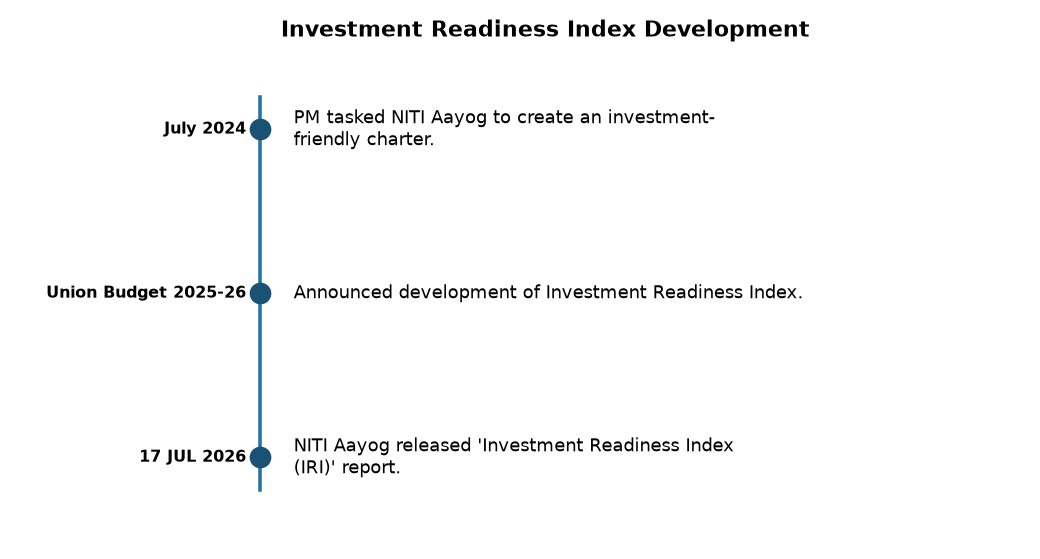
NITI Aayog recently released a report titled ‘Investment Friendliness Index (IFI)’, providing a structured and data-driven framework to assess the effectiveness of states and Union Territories in creating, enabling, and sustaining an investment-friendly environment. This initiative stems from a mandate given by the Prime Minister during the 9th Governing Council meeting of NITI Aayog in July 2024 and was subsequently announced in the Union Budget 2025-26, aiming to strengthen competitive and cooperative federalism by encouraging state-level reforms.
Background
- India’s aspiration to become a developed nation by 2047 necessitates a significant boost in investment rates, with private investment playing a crucial role in industrialization, innovation, and job creation.
- While the Union government establishes the overarching policy and macroeconomic framework, investment decisions are profoundly influenced by the quality of the business environment at the state level.
- Factors such as industrial land availability, quality of physical and digital infrastructure, regulatory efficiency, institutional capacity, and policy predictability are critical determinants of investment attractiveness.
- The 9th Governing Council meeting of NITI Aayog in July 2024 tasked NITI Aayog with developing an investment-friendly charter encompassing key policies, programs, and processes to attract investment.
- The Union Budget 2025-26 subsequently announced the development of an Investment Friendliness Index to incentivize reforms in states and foster a conducive investment ecosystem.
- The IFI is designed to provide a comparative assessment of state and UT investment ecosystems, moving beyond mere ranking to act as a catalyst for continuous improvement and adoption of best practices.
What is the Investment Friendliness Index (IFI)?
- The Investment Friendliness Index (IFI) is a structured and evidence-based framework developed by NITI Aayog to comparatively evaluate the investment ecosystems of all 28 states and 8 Union Territories in India.
- It assesses how effectively states and UTs create, enable, and maintain an environment conducive to investment, thereby strengthening India’s overall competitiveness.
- The index evaluates key policy, institutional, regulatory, and infrastructural parameters that influence investment decisions, offering a data-driven approach to ease of investment.
- Its primary objective is to encourage competitive and cooperative federalism by motivating states and UTs to adopt best practices and implement continuous reforms.
- The IFI aims to identify strengths, highlight areas needing improvement, promote mutual learning, and foster healthy competition among subnational entities.
- It is envisioned as a tool to support a sustained improvement in the investment environment, making India a more competitive and preferred destination for both domestic and foreign investment.
- The index is built upon eight pillars, encompassing various aspects of the investment ecosystem, providing a comprehensive assessment of state-level performance.
- The IFI aligns with the vision of ‘Developed India @2047’ by recognizing the pivotal role of state-level investment ecosystems in achieving higher economic growth rates.
Key Features
| Feature | Significance |
|---|---|
| Comprehensive Scope | Covers all 28 states and 8 UTs, ensuring a pan-India assessment of investment ecosystems. |
| Structured Framework | Utilizes a robust, data-driven methodology across eight pillars, providing a holistic view of investment friendliness. |
| Focus on State-Level Factors | Emphasizes the critical role of state governments in shaping the investment environment, beyond national policies. |
| Catalyst for Reforms | Designed to identify strengths and weaknesses, promoting adoption of best practices and continuous improvement among states. |
| Promotes Federalism | Strengthens competitive and cooperative federalism by encouraging states to vie for investment and learn from each other. |
| Alignment with Vision 2047 | Directly contributes to the ‘Developed India @2047’ goal by enhancing India’s overall investment attractiveness and economic growth. |
Why it Matters
Economic Growth and Investment Attraction
- The IFI is crucial for attracting both domestic and foreign direct investment (FDI) by providing a transparent and comparable assessment of state-level investment environments.
- By identifying areas for improvement, it helps states streamline regulations, enhance infrastructure, and improve institutional capacities, which are vital for sustained economic growth.
- Increased investment leads to industrialization, innovation, and job creation, directly contributing to India’s aspiration of becoming a developed nation by 2047.
Strengthening Cooperative and Competitive Federalism
- The index fosters healthy competition among states to improve their investment climate, driving a ‘race to the top’ in terms of governance and ease of doing business.
- It facilitates cooperative federalism by promoting the sharing of best practices and mutual learning among states, enabling them to collectively enhance India’s investment ecosystem.
- This approach ensures that national development goals are pursued through collaborative efforts between the Union and state governments, respecting the federal structure.
Policy Formulation and Governance Reforms
- The data-driven insights from the IFI provide valuable inputs for both Union and state governments to formulate targeted policies and implement governance reforms.
- It helps in identifying specific bottlenecks in regulatory frameworks, infrastructure development, and institutional efficiency at the subnational level.
- By offering a comparative assessment, the IFI empowers states to benchmark their performance against peers and adopt evidence-based strategies for improvement.
Enhanced Transparency and Accountability
- The structured framework and public reporting of the IFI enhance transparency regarding state-level investment conditions, making it easier for investors to make informed decisions.
- It promotes accountability among state governments by publicly evaluating their efforts in creating a conducive investment environment, encouraging them to deliver on reform promises.
- This transparency can also reduce information asymmetry for potential investors, thereby lowering perceived risks and transaction costs.
Challenges
1. Data Accuracy and Reliability
- Ensuring the accuracy, consistency, and reliability of data collected from various state and UT government departments can be a significant challenge.
- Variations in data collection methodologies and reporting standards across states might compromise the comparability and credibility of the index.
UPSC Link: GS Paper II — Governance; GS Paper III — Economy
2. Political Will and Implementation Gaps
- Despite the index, the actual implementation of reforms depends heavily on the political will and administrative capacity of state governments.
- Resistance from vested interests or bureaucratic inertia can hinder the adoption of recommended best practices and necessary policy changes.
UPSC Link: GS Paper II — Governance; GS Paper IV — Ethics
3. Uniformity vs. Diversity
- Balancing the need for a uniform framework for comparison with the diverse socio-economic and geographical realities of different states and UTs is complex.
- A ‘one-size-fits-all’ approach might not adequately capture the unique challenges and opportunities present in each subnational entity.
UPSC Link: GS Paper II — Federalism; GS Paper I — Geography
4. Impact vs. Perception
- The index measures ‘friendliness’ which can be subjective and may not always directly translate into actual investment inflows or sustained economic impact.
- Perceptions of investors, often influenced by factors beyond the measured parameters, can significantly affect investment decisions.
UPSC Link: GS Paper III — Economy
5. Resource Constraints
- Smaller states or UTs with limited administrative and financial resources might struggle to implement the extensive reforms required to improve their ranking.
- This could exacerbate regional disparities if not adequately addressed through supportive central schemes or capacity building initiatives.
UPSC Link: GS Paper II — Social Justice; GS Paper III — Economy
Challenges — UPSC Perspective
| Issue | Concern |
|---|---|
| Data Integrity | Potential for data manipulation or incomplete reporting by states to improve rankings, undermining the index’s credibility. |
| Sustainability of Reforms | Ensuring that reforms are not merely cosmetic for ranking purposes but are deeply embedded and sustained over time. |
| Inter-State Disparities | Risk of widening the gap between high-performing and low-performing states if the latter lack the capacity or incentive to improve. |
| Investor Confidence | While the index provides data, actual investor confidence is built on consistent policy, rule of law, and ease of doing business on the ground. |
| Dynamic Economic Environment | The investment landscape is constantly evolving; the index must remain agile and adapt to new economic realities and investor expectations. |
Government Initiatives — Must-Memorise for Prelims
- Make in India
- Startup India
- Production Linked Incentive (PLI) Scheme
- National Infrastructure Pipeline (NIP)
- PM Gati Shakti National Master Plan
- Ease of Doing Business (EoDB) initiatives (DPIIT)
- National Single Window System (NSWS)
- Invest India
- Scheme for Financial Assistance to States for Capital Investment
- Special Economic Zones (SEZ) Act
Way Forward
- Establish robust mechanisms for independent data validation and auditing to ensure the accuracy and reliability of information provided by states.
- Offer targeted capacity-building programs and technical assistance to states, particularly those with resource constraints, to facilitate reform implementation.
- Incorporate qualitative feedback from investors and industry associations to complement quantitative metrics, providing a more holistic view of the investment climate.
- Develop a dynamic and adaptive framework for the IFI, allowing for periodic review and adjustment of parameters to reflect evolving economic conditions and investor priorities.
- Promote a culture of continuous learning and knowledge sharing among states through platforms for exchanging best practices and success stories.
- Incentivize states through performance-linked grants or special financial assistance for achieving significant improvements in their investment friendliness scores.
- Strengthen the ‘single window clearance’ systems at the state level, ensuring genuine ease of doing business rather than mere procedural compliance.
- Focus on improving judicial efficiency and contract enforcement mechanisms, as these are critical for investor confidence and often beyond the direct purview of economic ministries.
UPSC Value Addition
Keywords for Mains Answer-Writing
Investment Friendliness Index · NITI Aayog · Competitive Federalism · Cooperative Federalism · Developed India @2047 · State Investment Ecosystems · Ease of Doing Business · Subnational Economic Growth · Policy Predictability · Regulatory Efficiency · Infrastructure Development · Institutional Capacity
Constitutional & Policy Linkages
- Article 246: Distribution of legislative powers between Union and States.
- Seventh Schedule: Lists defining Union, State, and Concurrent legislative domains.
- Article 282: Grants by the Union and States for public purposes.
- Article 292 & 293: Borrowing by the Government of India and States.
- NITI Aayog: Successor to Planning Commission, fostering cooperative federalism.
- Finance Commission: Recommends distribution of taxes between Union and States.
Concept Flow
NITI Aayog’s mandate for Investment Friendliness Index (IFI) → IFI assesses state-level investment ecosystems (8 pillars) → IFI promotes competitive & cooperative federalism → States implement reforms based on IFI insights → Improved Ease of Doing Business & Investment Climate → Increased Domestic & Foreign Investment → Accelerated Economic Growth & Developed India @2047
Prelims Practice Questions
Q1. With reference to the Investment Friendliness Index (IFI), consider the following statements:
1. The IFI is developed and released by the Department for Promotion of Industry and Internal Trade (DPIIT).
2. It aims to strengthen competitive and cooperative federalism by encouraging state-level reforms.
3. The index evaluates key policy, institutional, regulatory, and infrastructural parameters that influence investment decisions.
Which of the statements given above is/are correct?
- A. 1 and 2 only
- B. 2 and 3 only
- C. 3 only
- D. 1, 2 and 3
Answer: B. 2 and 3 only — Statement 1 is incorrect. The IFI is developed and released by NITI Aayog, not DPIIT. Statement 2 is correct, as the index aims to promote competitive and cooperative federalism. Statement 3 is also correct, as the IFI assesses various parameters influencing investment decisions.
Q2. The vision of ‘Developed India @2047’ is closely associated with which of the following?
1. Significant increase in investment rates.
2. Enhanced role of private investment in industrialization and job creation.
3. Strengthening of state-level investment ecosystems.
4. Promotion of competitive and cooperative federalism.
Select the correct answer using the code given below:
- A. 1 and 2 only
- B. 3 and 4 only
- C. 1, 2, 3 and 4
- D. 1, 2 and 3 only
Answer: C. 1, 2, 3 and 4 — All four statements are correct. The vision of ‘Developed India @2047’ inherently requires a substantial increase in investment, particularly from the private sector, which is facilitated by robust state-level investment ecosystems and a strong framework of competitive and cooperative federalism. The IFI directly contributes to these objectives.
Mains Practice Question
✍ The NITI Aayog’s Investment Friendliness Index (IFI) is envisioned as a critical tool to foster subnational economic growth and strengthen India’s federal structure. Discuss the significance of the IFI in achieving the vision of ‘Developed India @2047’ and critically examine the challenges associated with its implementation and effectiveness. (250 words)
Approach: Begin by introducing the IFI and its purpose as an assessment tool by NITI Aayog. In the first part, elaborate on its significance, linking it to economic growth, attraction of investment (domestic and FDI), promotion of competitive and cooperative federalism, and its role in achieving ‘Developed India @2047’. In the second part, critically examine the challenges, such as data accuracy, political will, balancing uniformity with diversity, and the gap between perception and actual impact. Conclude with a forward-looking statement on how these challenges can be mitigated for the IFI to realize its full potential.
Source: PIB (Press Information Bureau)
Generated by AanyaAi for educational purpose.

- अटल वयो अभ्युदय योजना: वरिष्ठ नागरिकों के लिए एकीकृत देखभाल व्यवस्था - October 24, 2026
- मद्रास उच्च न्यायालय ने तमिलनाडु धर्मार्थ विभाग की लापरवाही पर कड़ी टिप्पणी की - October 23, 2026
- PM Modi’s Vision: Capacity Building Commission & Mission Karmayogi for Civil Services - October 23, 2026

No Comments