


06 Aug NITI Aayog’s Vision 2047: Empowering Caregivers for India’s Future
✎ Caregiving must be recognised as a skilled profession with formal training, social security, and economic value to leverage India’s demographic dividend and meet global care workforce shortages.
Subject Relevance — Where This Topic Fits
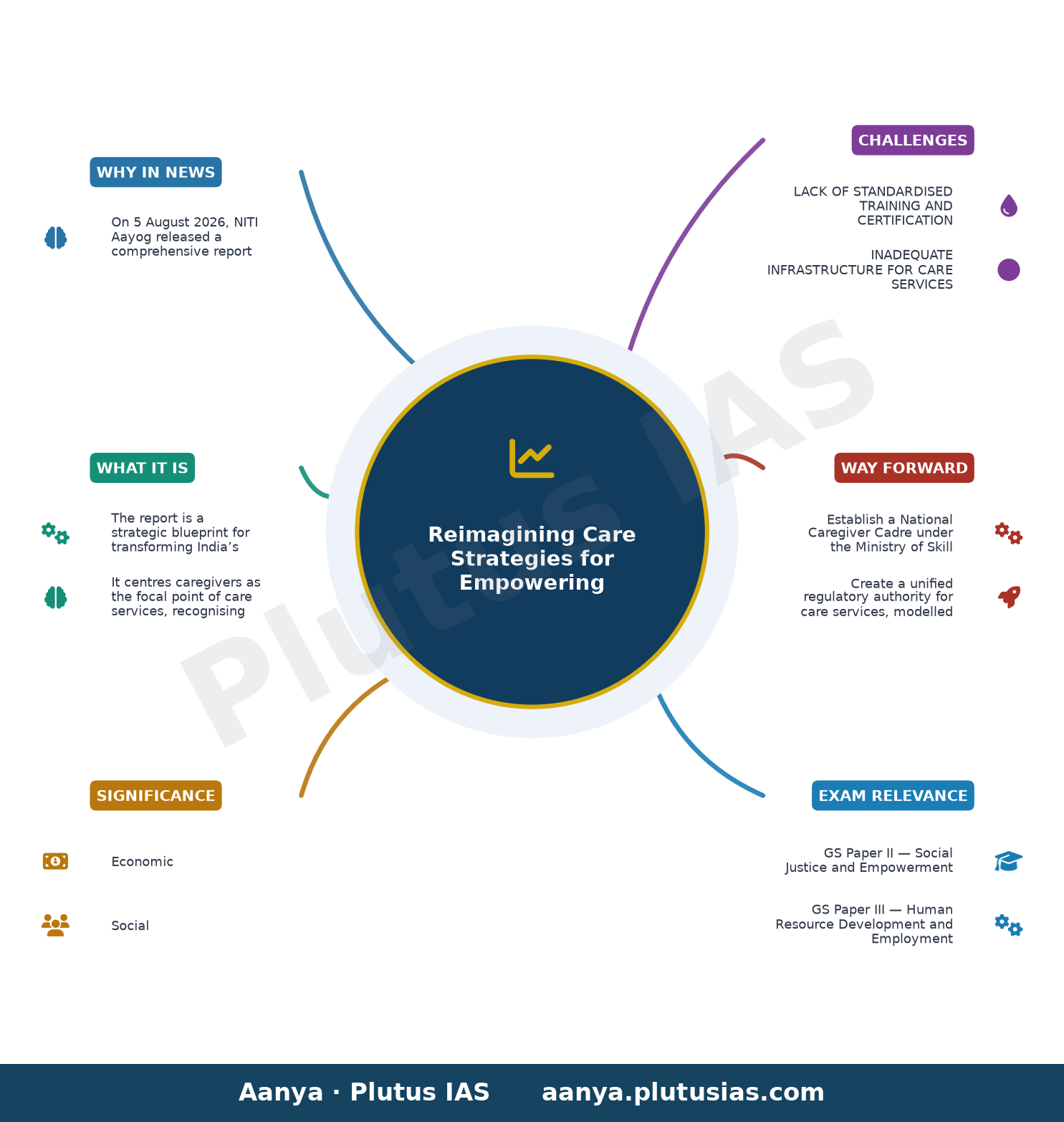
- GS Paper II — Social Justice and Empowerment | GS Paper III — Human Resource Development and Employment | GS Paper IV — Ethics and Human Interface
- Prelims: Caregiver workforce, demographic dividend, Amrit Kaal, Viksit Bharat@2047, National Institution for Transforming India (NITI Aayog), Social Justice and Empowerment, Divyangjan Sashaktikaran, Skill Development and Entrepreneurship, National Care System, Global Care Services
- Essay: Ethical Foundations of a Caring Society: Balancing Tradition and Modernity in India’s Development Journey, Demographic Dividend as a Catalyst for Inclusive Growth: The Case of India’s Care Economy
Quick Revision: Caregiving must be recognised as a skilled profession with formal training, social security, and economic value to leverage India’s demographic dividend and meet global care workforce shortages.
Why is this in the news?
On 5 August 2026, NITI Aayog released a comprehensive report titled ‘Reimagining Care Strategies for Empowering Caregivers in Viksit Bharat@2047’, outlining a strategic framework to transform India’s care ecosystem into an organised, professional, accessible, and future-ready system. The report positions caregivers at the centre of care services, emphasises the recognition of caregiving as a skilled profession, and highlights India’s demographic advantage in meeting global demand for care services while ensuring social security and economic value creation.
Background
- India’s demographic dividend presents a unique opportunity to address the growing global demand for care services, projected to rise significantly due to ageing populations and rising chronic disease burdens in developed nations.
- The care economy in India remains largely informal, with over 90% of caregivers operating without formal training, recognition, or social security, leading to low productivity and high attrition rates.
- Global care workforce shortages are estimated at 13.6 million by 2030 (ILO, 2024), with India positioned to supply trained caregivers through its demographic dividend and cultural ethos of care.
- International collaborations, including with the WHO, UNFPA, and ILO, have highlighted India’s potential to become a global hub for care services, leveraging its soft power and cultural heritage.
What is the NITI Aayog Report on Reimagining Care Strategies?
- The report is a strategic blueprint for transforming India’s care ecosystem into an organised, professional, and future-ready system by 2047, aligning with the vision of Viksit Bharat@2047.
- It centres caregivers as the focal point of care services, recognising caregiving as a skilled profession that requires formal training, recognition, and social security.
- The report proposes a comprehensive action plan to address the growing demand for care services, including the development of a trained caregiver cadre, institutional coordination, and integration of family and community-based care models.
- It emphasises the need for high-quality, affordable, and accessible care services, with a focus on professional standards, workforce welfare, and ethical practices.
- The report identifies India’s demographic dividend as a strategic advantage to meet global care workforce shortages, particularly in ageing societies and post-pandemic healthcare recovery.
- It highlights the economic potential of the care sector, estimating significant job creation, foreign exchange earnings through export of care services, and contribution to GDP growth.
- The report advocates for the integration of India’s traditional ethos of compassionate care with modern professional standards to create a globally competitive care workforce.
- It recommends policy interventions such as skill certification, wage parity, social security coverage, and institutional partnerships to formalise the care sector and enhance its productivity.
Key Features
| Feature | Significance |
|---|---|
| Recognition of Caregivers as Central Stakeholders | Shifts the paradigm from informal, unrecognised care to a formal, valued profession, aligning with Sustainable Development Goal 8 (Decent Work and Economic Growth). |
| Professionalisation of Caregiving | Establishes caregiving as a skill-based profession with structured training, certification, and career progression pathways, addressing the global shortage of skilled care workers. |
| Institutional Collaboration Framework | Proposes a multi-stakeholder governance model involving ministries (Social Justice, Health, Skill Development), UN agencies (WHO, UNFPA), and international financial institutions (World Bank, ADB) to ensure policy coherence and resource mobilisation. |
| Demand-Supply Gap Mitigation Strategy | Highlights the necessity of a trained caregiver cadre to meet India’s demographic dividend-driven demand, reducing reliance on unskilled, informal care arrangements. |
| Global Employment Opportunities for Indian Caregivers | Positions India as a net exporter of skilled care professionals, leveraging demographic advantage to enhance foreign exchange earnings and soft power. |
| Integration of Cultural Ethos with Modern Care Systems | Reinforces India’s traditional values of compassion and service (e.g., ‘Seva’ in Indian philosophy) within a modern, professional care ecosystem. |
| Affordable and Accessible Care Services | Emphasises equity by ensuring that high-quality care is available to all socio-economic strata, including rural and marginalised communities. |
Why it Matters
Economic
- Creation of a new employment sector with potential to generate millions of jobs, particularly for women and youth, thus enhancing labour force participation rates.
- Leveraging India’s demographic dividend to supply skilled caregivers to global markets, positioning India as a leader in the $1.3 trillion global care economy (World Bank estimates).
- Generation of foreign exchange through export of care services, similar to India’s IT-BPM sector, with potential to contribute 1-2% of GDP annually.
- Stimulation of ancillary industries such as healthcare infrastructure, training academies, and technology-enabled care solutions (e.g., telemedicine, AI-assisted care).
Social
- Promotion of gender equality by recognising and remunerating unpaid care work, which disproportionately burdens women, as per the ‘Care Economy’ framework of the ILO.
- Strengthening social inclusion by ensuring dignified care for the elderly, persons with disabilities, and chronically ill, reducing dependency ratios.
- Enhancing community resilience by fostering a culture of mutual support and intergenerational solidarity, aligning with the ‘Vasudhaiva Kutumbakam’ ethos.
Strategic
- Enhancement of India’s soft power by exporting culturally attuned care models, akin to India’s global leadership in yoga and Ayurveda.
- Reduction of brain drain by creating high-skill, high-wage employment opportunities within India, retaining talent in the domestic economy.
- Alignment with India’s G20 presidency priorities on ‘Women-led Development’ and ‘Lifestyle for Environment (LiFE)’ by integrating care as a sustainable livelihood.
Policy
- Fulfils constitutional directive principles under Article 41 (Right to Work) and Article 47 (Duty of the State to raise the level of nutrition and standard of living), by formalising care work.
- Supports the implementation of the National Policy for Senior Citizens (2019) and the Rights of Persons with Disabilities Act (2016) by ensuring accessible and professional care services.
- Complements the National Health Policy 2017 and Ayushman Bharat by integrating care services into the broader healthcare continuum.
Challenges
1. LACK OF STANDARDISED TRAINING AND CERTIFICATION
- Absence of a national framework for caregiver training leads to variability in service quality and undermines professional credibility.
- Limited recognition of informal care work as a formal skill, resulting in low wages and poor working conditions.
UPSC Link: GS2: Skill Development & Employment (Articles 21, 41)
2. INADEQUATE INFRASTRUCTURE FOR CARE SERVICES
- Shortage of care facilities (e.g., old-age homes, day-care centres) in rural and semi-urban areas, exacerbating the urban-rural divide.
- High cost of establishing and maintaining care infrastructure, particularly for low-income families.
UPSC Link: GS1: Social Sector Services (Articles 38, 46)
3. GENDER AND SOCIAL STIGMA ASSOCIATED WITH CARE WORK
- Caregiving is predominantly perceived as a female responsibility, reinforcing gender stereotypes and limiting male participation in the sector.
- Stigma attached to professions involving intimate care (e.g., elderly or disability care) deters formal employment in the sector.
UPSC Link: GS1: Gender & Social Justice (Articles 15, 16)
4. REGULATORY AND GOVERNANCE GAPS
- Fragmented policy landscape with multiple ministries (Health, Social Justice, Skill Development) overseeing overlapping domains, leading to coordination failures.
- Lack of a unified regulatory body for caregiver certification and service standards, akin to the National Council for Vocational Education and Training (NCVET).
UPSC Link: GS2: Governance & Policy Implementation (Articles 246, 249)
5. FINANCING AND SUSTAINABILITY CHALLENGES
- High out-of-pocket expenditure on care services, particularly for low-income households, creating financial distress.
- Limited public-private partnerships (PPPs) in the care sector due to low perceived profitability and high regulatory risks.
UPSC Link: GS3: Economic Development & Finance (Articles 38, 39)
6. TECHNOLOGICAL AND DIGITAL DIVIDE
- Limited adoption of digital tools (e.g., telecare, AI-driven monitoring) in rural and underserved areas due to infrastructure gaps and low digital literacy.
- Risk of exacerbating inequalities if technology-enabled care solutions are not inclusive.
UPSC Link: GS3: Science & Technology (Articles 51A(h))
Challenges — UPSC Perspective
| Issue | Concern |
|---|---|
| Informal Care Economy | Unrecognised and unregulated care work perpetuates low wages, poor working conditions, and gender disparities. |
| Demographic Dividend Paradox | While India’s youth bulge offers a potential caregiver workforce, lack of skills and formalisation limits its utilisation. |
| Urban-Rural Disparities | Concentration of care services in urban centres leaves rural populations underserved, exacerbating migration pressures. |
| Policy Fragmentation | Multiple ministries with overlapping mandates create silos, hindering integrated care delivery. |
| Cultural Barriers | Deep-rooted societal attitudes towards care work as ‘women’s work’ deter formalisation and professionalisation. |
| Financial Sustainability | High costs of care services and limited public funding models restrict access, particularly for vulnerable groups. |
Way Forward
- Establish a National Caregiver Cadre under the Ministry of Skill Development and Entrepreneurship, with standardised training modules and certification aligned to NSQF (National Skills Qualification Framework).
- Create a unified regulatory authority for care services, modelled on the National Medical Commission (NMC) or Nursing Council of India, to ensure quality control and professional ethics.
- Launch a ‘Caregiver Mission’ under the National Health Mission (NHM) to integrate care services into primary healthcare, with dedicated funding for rural and tribal areas.
- Develop a National Care Infrastructure Plan to address the shortage of care facilities, leveraging PPP models and CSR funds from healthcare and IT sectors.
- Institute a ‘Care Economy Incentive Scheme’ to provide wage subsidies, tax benefits, and social security cover for caregivers, particularly women and youth.
- Integrate digital literacy and telecare training into caregiver curricula to bridge the urban-rural divide and enable remote care delivery.
- Foster international collaborations with countries facing care worker shortages (e.g., Japan, Germany, Gulf nations) to facilitate skill certification and employment exchanges.
- Promote research and innovation in care technologies (e.g., assistive devices, AI-driven monitoring) through grants from the Department of Science and Technology (DST).
- Conduct periodic national surveys on the care economy to assess demand-supply gaps, inform policy, and track progress towards SDG 8.5 (full employment and decent work for all).
UPSC Value Addition
Keywords for Mains Answer-Writing
Care economy · Caregivers empowerment · NITI Aayog Report 2026 · Viksit Bharat@2047 · Care workforce development · Social security for caregivers · Demographic dividend utilisation · Inclusive growth through care services · Skill development in care sector · Global care services market
Concept Flow
Demographic Transition → Rising Elderly & Disabled Population → Increased Demand for Care Services → Recognition of Caregivers as Economic Actors → Need for Professionalisation and Formalisation → Policy Intervention (NITI Aayog Report) → Establishment of National Caregiver Cadre → Integration with Skill Development & Health Systems → Economic Growth & Social Inclusion → Gender Inequality in Unpaid Care Work → Low Female Labour Force Participation → Recognition of Care as Formal Employment → Policy Shift to Remunerate Care Work → Empowerment of Women & Youth → Enhanced Economic Contribution → Sustainable Development → Global Labour Market Trends → Shortage of Skilled Care Workers in Developed Nations → India’s Demographic Advantage → Export of Care Services → Foreign Exchange Earnings → Strengthening of Soft Power & Global Influence → Traditional Indian Values (Seva, Dharma) → Cultural Ethos of Compassionate Care → Modernisation of Care Systems → Professionalisation of Caregiving → Alignment with Global Standards (ILO, WHO) → India as Global Leader in Care Economy
Prelims Practice Questions
Q1. Consider the following statements regarding the care economy in India:
1. The care economy is primarily driven by informal family-based care.
2. NITI Aayog’s 2026 report emphasises the need for a trained and professionalised care workforce.
3. The report identifies the care economy as a potential sector for India’s demographic dividend utilisation.
4. The report recommends reducing the role of community-based care to enhance professional standards.
How many of the above statements are correct?
- Only one
- Only two
- Only three
- All
Answer: Only three — Statements 1, 2, and 3 are correct as the report highlights the dominance of informal care, the need for professionalisation, and demographic dividend utilisation. Statement 4 is incorrect because the report advocates strengthening community-based care.
Q2. Assertion (A): NITI Aayog’s 2026 report on care strategies for Viksit Bharat@2047 recommends establishing India as a global leader in care services.
Reason (R): The report identifies the care economy as a key sector for generating employment and economic value while addressing demographic challenges.
- Both A and R are true, and R is the correct explanation of A
- Both A and R are true, but R is not the correct explanation of A
- A is true, but R is false
- A is false, but R is true
Answer: Both A and R are true, and R is the correct explanation of A — Both the assertion and reason are true. The report explicitly aims to position India as a global leader in care services, and the reason correctly explains this strategic intent by linking it to employment generation and demographic challenges.
Q3. Match the following stakeholders with their roles in NITI Aayog’s 2026 care economy report:
Column I (Stakeholder)
A. Caregivers
B. NITI Aayog
C. Ministry of Social Justice and Empowerment
D. United Nations Population Fund (UNFPA)
Column II (Role)
1. Implementing training programmes for caregivers
2. Releasing the report on care strategies
3. Providing policy recommendations and global standards
4. Ensuring social security and empowerment of caregivers
- A-1, B-2, C-4, D-3
- A-2, B-3, C-1, D-4
- A-3, B-1, C-4, D-2
- A-4, B-2, C-1, D-3
Answer: A-1, B-2, C-4, D-3 — A-1: Caregivers are central to the report and its recommendations for training. B-2: NITI Aayog released the report. C-4: The Ministry of Social Justice and Empowerment is tasked with social security and empowerment. D-3: UNFPA provides global standards and policy recommendations.
Mains Practice Question
✍ Critically examine the significance of NITI Aayog’s 2026 report on care strategies for achieving the goals of Viksit Bharat@2047. Also, discuss the challenges in operationalising a professionalised care workforce in India. (15 Marks)
Approach: MODEL-ANSWER SKELETON:
1. **Introduction (2 marks)**
– Briefly state the context: NITI Aayog’s 2026 report on care strategies for Viksit Bharat@2047.
– Define the care economy and its role in socio-economic transformation.
2. **Significance of the Report (6 marks)**
– **Economic Dimension**: Highlight the report’s emphasis on the care economy as a driver of employment, GDP growth, and demographic dividend utilisation.
– **Social Dimension**: Discuss the report’s focus on social inclusion, gender equity, and empowerment of caregivers.
– **Institutional Dimension**: Explain the role of NITI Aayog in providing a policy roadmap and fostering multi-stakeholder collaboration.
– **Global Leadership**: Elaborate on the report’s vision of positioning India as a global leader in care services.
3. **Challenges in Operationalisation (6 marks)**
– **Structural Challenges**: Discuss the dominance of informal care, lack of standardised training, and low social recognition of caregivers.
– **Policy and Governance Gaps**: Highlight issues such as fragmented policy frameworks, inadequate funding, and weak institutional coordination.
– **Economic and Labour Market Challenges**: Address the precarious nature of care work, low wages, and lack of social security.
– **Cultural and Social Barriers**: Discuss societal attitudes towards care work, gender stereotypes, and the need for behavioural change.
4. **Conclusion (1 mark)**
– Summarise the transformative potential of the report while acknowledging the need for sustained policy efforts and stakeholder engagement.
Source: PIB (Press Information Bureau)
Generated by AanyaAi for educational purpose.

- तमिलनाडु के लिए क्या है ‘एल नीनो’ और उत्तर-पूर्वी मानसून का खतरा? - September 23, 2026
- El Nino & Northeast Monsoon: Impact on Tamil Nadu for UPSC 2026 - September 23, 2026
- हिमाचल में डिजिटल भुगतान क्रांति: बिलासपुर अव्वल, महिलाओं की भागीदारी 93% तक पहुंची - September 23, 2026

No Comments