


17 Jul NMBA: Community Participation Reaches 29.32 Cr Citizens in Anti-Drug Drive
Subject Relevance — Where This Topic Fits
- GS Paper I — Social Issues (Role of women and women’s organization, population and associated issues, poverty and developmental issues, urbanization, their problems and their remedies) | GS Paper II — Governance (Government policies and interventions for development in various sectors and issues arising out of their design and implementation; Welfare schemes for vulnerable sections of the population by the Centre and States and the performance of these schemes; mechanisms, laws, institutions and Bodies constituted for the protection and betterment of these vulnerable sections) | GS Paper III — Internal Security (Linkages between development and spread of extremism; Role of external state and non-state actors in creating challenges to internal security; Challenges to internal security through communication networks, role of media and social networking sites in internal security challenges, basics of cyber security; money-laundering and its prevention; security challenges and their management in border areas – linkages of organized crime with terrorism)
- Prelims: Nasha Mukt Bharat Abhiyaan (NMBA), National Action Plan for Drug Demand Reduction (NAPDDR), Ministry of Social Justice and Empowerment, Integrated Rehabilitation Centres for Addicts (IRCAs), Community-Based Peer-Led Intervention Centres (CPLIs), Addiction Treatment Facilities (ATFs), Narcotics Control Bureau (NCB), Drug abuse prevention strategies, Vulnerable sections (youth, women), Jan Andolan
- Essay: The Youth as Architects of a Drug-Free India: Challenges and Opportunities., From Policy to People: Evaluating the Efficacy of Community-Led Initiatives in Social Transformation.
Quick Revision: The Nasha Mukt Bharat Abhiyaan is a Ministry of Social Justice and Empowerment initiative under NAPDDR, driving a ‘Jan Andolan’ against drug abuse through awareness, community engagement, and strengthened treatment infrastructure, aiming for a drug-free India.
Why is this in the news?
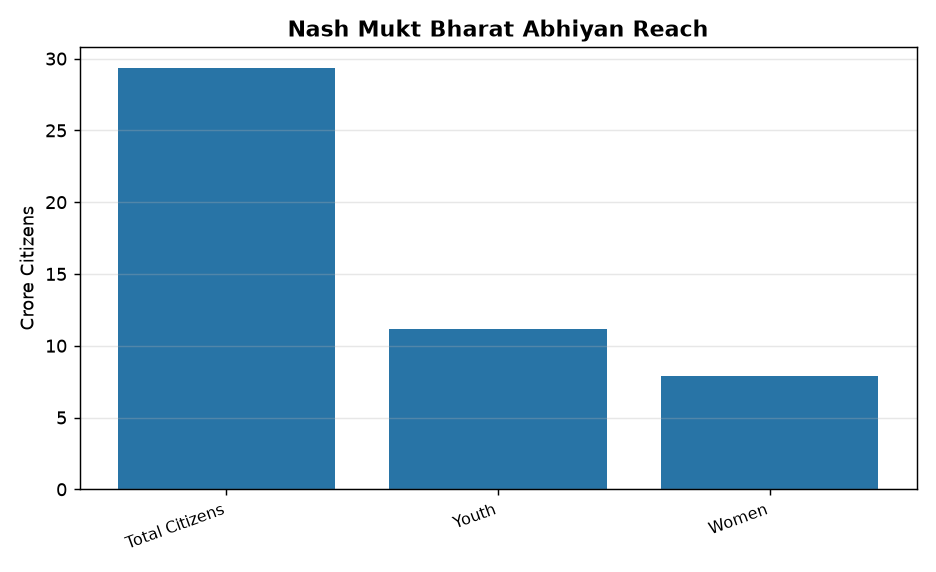
The ‘Nasha Mukt Bharat Abhiyaan’ (NMBA), spearheaded by the Ministry of Social Justice and Empowerment, has achieved significant outreach, engaging over 29.32 crore citizens nationwide through community participation and widespread awareness campaigns. This includes substantial involvement from youth (11.20 crore) and women (7.92 crore), alongside the organization of over 21 lakh awareness activities in educational institutions, demonstrating the campaign’s evolving success in fostering a drug-free India.
Background
- Substance abuse in India is a pervasive socio-economic and health challenge, impacting individuals, families, and national productivity.
- The problem is exacerbated by factors such as unemployment, peer pressure, easy availability of drugs, and lack of awareness.
- India’s geographical proximity to major illicit drug producing regions (Golden Crescent and Golden Triangle) makes it vulnerable to drug trafficking and consumption.
- The Ministry of Social Justice and Empowerment is the nodal ministry for drug demand reduction, focusing on prevention, treatment, and rehabilitation.
- The National Action Plan for Drug Demand Reduction (NAPDDR) 2018-2025 provides an overarching framework for addressing drug abuse.
- NMBA was launched on August 15, 2020, under the NAPDDR, initially targeting 272 vulnerable districts, and has since expanded nationwide.
What is Nasha Mukt Bharat Abhiyaan (NMBA)?
- NMBA is a flagship campaign of the Ministry of Social Justice and Empowerment, launched on August 15, 2020, to create a ‘Drug-Free India’.
- It operates under the umbrella of the National Action Plan for Drug Demand Reduction (NAPDDR).
- The campaign’s primary objective is to curb drug abuse through a multi-pronged strategy encompassing awareness, community participation, treatment, rehabilitation, and social reintegration.
- It adopts an evidence-based approach, focusing on preventive education and early intervention.
- NMBA emphasizes a ‘Jan Andolan’ (people’s movement) approach, encouraging every citizen to contribute to the eradication of substance abuse.
- It targets vulnerable sections, particularly youth and women, engaging them through educational institutions, youth clubs, and women’s groups.
- The campaign fosters collaboration among various stakeholders, including the Narcotics Control Bureau (NCB), state governments, district administrations, police, NGOs, hospitals, and educational institutions.
- Key components include awareness generation, strengthening treatment and rehabilitation infrastructure, and providing helpline services.
Key Features
| Feature | Significance |
|---|---|
| Community Participation | Transforms the fight against drug abuse into a ‘Jan Andolan’, fostering collective responsibility and local ownership. |
| Awareness & Sensitization | Educates citizens, especially youth and women, on the ill effects of drug abuse, promoting a drug-free lifestyle. |
| Treatment & Rehabilitation Infrastructure | Strengthens a network of IRCAs, CPLIs, ODICs, and ATFs, ensuring comprehensive care for affected individuals. |
| Nasha Mukti Helpline (14446) | Provides immediate counselling, information, and referral services, acting as a crucial first point of contact for those seeking help. |
| Inter-Ministerial & Stakeholder Convergence | Ensures a holistic and coordinated approach by bringing together various government bodies, NGOs, and educational institutions. |
| Focus on Vulnerable Groups | Prioritizes youth and women, recognizing their susceptibility and potential as agents of change in combating drug abuse. |
Why it Matters
Social Significance
- Fosters a healthier and more disciplined youth, crucial for national development and demographic dividend realization.
- Reduces the social stigma associated with drug addiction, encouraging more individuals to seek help and reintegrate into society.
- Empowers women and youth as active participants in social change, strengthening community resilience against substance abuse.
- Promotes a culture of empathy and collective responsibility towards individuals struggling with addiction.
Health and Welfare Significance
- Expands access to treatment and rehabilitation services, leading to a significant increase in the number of people receiving care.
- Reduces the burden of drug-related health issues on the public health system.
- Improves the quality of life for individuals and families affected by substance abuse.
- Provides crucial counselling and support through dedicated helplines, preventing relapses and promoting long-term recovery.
Governance and Policy Significance
- Demonstrates a robust, evidence-based policy approach to a complex social problem, aligning with SDG 3 (Good Health and Well-being).
- Enhances inter-agency coordination and collaboration, leading to more effective policy implementation and resource utilization.
- Strengthens the institutional framework for drug demand reduction, from national policy to grassroots implementation.
- Promotes data-driven decision-making through monitoring and evaluation of campaign reach and impact.
Challenges
1. Stigma and Social Acceptance
- Societal stigma often prevents individuals from seeking help, fearing discrimination and ostracization.
- Lack of understanding about addiction as a disease rather than a moral failing hinders effective intervention.
UPSC Link: GS I – Social Issues; GS II – Welfare Schemes
2. Accessibility and Reach of Services
- Despite expansion, geographical disparities persist in the availability of treatment and rehabilitation centres, especially in rural and remote areas.
- Financial barriers and lack of awareness about existing services limit access for vulnerable populations.
UPSC Link: GS II – Governance; GS III – Internal Security
3. Evolving Nature of Drug Abuse
- Emergence of new psychoactive substances (NPS) and synthetic drugs poses challenges for detection, treatment, and law enforcement.
- Online drug trafficking and dark web transactions complicate traditional enforcement strategies.
UPSC Link: GS III – Internal Security; GS II – Health
4. Rehabilitation and Social Reintegration
- Ensuring sustained recovery and successful reintegration into society requires comprehensive aftercare, vocational training, and employment opportunities.
- High rates of relapse due to lack of adequate post-treatment support and societal acceptance.
UPSC Link: GS I – Social Issues; GS II – Welfare Schemes
5. Resource Constraints
- Adequate funding, trained personnel (counsellors, therapists), and infrastructure are crucial for scaling up interventions effectively.
- Attrition rates among healthcare professionals in addiction treatment can be high.
UPSC Link: GS II – Governance; GS III – Economy
Challenges — UPSC Perspective
| Issue | Concern |
|---|---|
| Lack of comprehensive data | Absence of real-time, granular data on drug use patterns and prevalence hinders targeted interventions. |
| Cross-border drug trafficking | Porous borders and international syndicates facilitate the influx of illicit drugs, undermining domestic efforts. |
| Youth vulnerability | Peer pressure, academic stress, and easy access to information (including about drugs) via digital platforms make youth susceptible. |
| Inadequate legal framework | Challenges in adapting existing laws to address new forms of drug abuse and online trafficking effectively. |
| Limited public awareness in certain pockets | Despite widespread campaigns, pockets of society, especially in remote areas, may still lack adequate awareness. |
| Funding and sustainability of NGOs | Many NGOs working in this sector face funding challenges, impacting the sustainability and scale of their operations. |
Government Initiatives — Must-Memorise for Prelims
- National Action Plan for Drug Demand Reduction (NAPDDR)
- Assistance for Prevention of Alcoholism and Substance (Drugs) Abuse and for Social Defence Services
- Scheme of Financial Assistance to Voluntary Organisations for Services for Persons with Disabilities (SIPDA)
- Pradhan Mantri Jan Arogya Yojana (PMJAY) – for health coverage
- National Mental Health Programme (NMHP)
- Integrated Rehabilitation Centres for Addicts (IRCAs)
Way Forward
- Strengthen data collection and research mechanisms to develop evidence-based and localized intervention strategies.
- Enhance cross-border cooperation and intelligence sharing with neighboring countries to curb illicit drug trafficking.
- Integrate drug abuse prevention and life skills education into school curricula from an early age.
- Leverage technology, including AI and social media, for targeted awareness campaigns and early identification of at-risk individuals.
- Expand and decentralize treatment and rehabilitation facilities, ensuring equitable access across all regions, especially rural areas.
- Focus on post-rehabilitation support, including vocational training, skill development, and employment opportunities, to ensure successful social reintegration.
- Promote public-private partnerships to mobilize resources and expertise for prevention, treatment, and rehabilitation efforts.
- Regularly review and update legal frameworks to address emerging challenges posed by new psychoactive substances and online drug trade.
UPSC Value Addition
Keywords for Mains Answer-Writing
Nasha Mukt Bharat Abhiyaan · Drug Demand Reduction · Community Participation · Social Reintegration · Vulnerable Sections · Evidence-Based Approach · Inter-Ministerial Convergence · Jan Andolan · Harm Reduction · Rehabilitation Infrastructure · Youth Empowerment · Public Health Challenge
Constitutional & Policy Linkages
- Article 47: Duty of the State to raise the level of nutrition and the standard of living and to improve public health (prohibition of consumption of intoxicating drinks and of drugs which are injurious to health).
- Seventh Schedule (List I – Union List): Entry 81 (Inter-State migration; inter-State quarantine). Entry 82 (Taxes on income other than agricultural income). Entry 84 (Duties of excise on tobacco and other goods manufactured or produced in India except alcoholic liquors for human consumption, opium, Indian hemp and other narcotic drugs and narcotics).
- Seventh Schedule (List II – State List): Entry 8 (Intoxicating liquors, that is to say, the production, manufacture, possession, transport, purchase and sale of intoxicating liquors). Entry 6 (Public health and sanitation; hospitals and dispensaries).
- Narcotic Drugs and Psychotropic Substances (NDPS) Act, 1985: Comprehensive legislation for control and regulation of narcotic drugs and psychotropic substances.
- Juvenile Justice (Care and Protection of Children) Act, 2015: Addresses child victims of drug abuse and provides for their care and protection.
Concept Flow
Substance Abuse Prevalence (Problem) → National Action Plan for Drug Demand Reduction (Policy Framework) → Nasha Mukt Bharat Abhiyaan (Flagship Campaign) → Awareness, Community Participation, Treatment (Intervention Strategies) → Rehabilitation and Social Reintegration (Outcome Focus) → Drug-Free Society (Ultimate Goal)
Prelims Practice Questions
Q1. Consider the following statements regarding the ‘Nasha Mukt Bharat Abhiyaan’ (NMBA):
1. It was launched under the National Action Plan for Drug Demand Reduction (NAPDDR).
2. The Ministry of Health and Family Welfare is the nodal ministry for its implementation.
3. The campaign initially focused on 272 vulnerable districts and has now expanded nationwide.
Which of the statements given above is/are correct?
- A. 1 only
- B. 1 and 2 only
- C. 1 and 3 only
- D. 1, 2 and 3
Answer: C. 1 and 3 only — Statement 1 is correct: NMBA was indeed launched under the NAPDDR. Statement 2 is incorrect: The Ministry of Social Justice and Empowerment is the nodal ministry for NMBA. Statement 3 is correct: The campaign initially targeted 272 vulnerable districts and has since expanded across the country.
Q2. Which of the following are key components of the ‘Nasha Mukt Bharat Abhiyaan’?
1. Awareness generation and community participation.
2. Strengthening treatment and rehabilitation services.
3. Providing helpline services for counselling and referral.
4. Promoting cultivation of specific medicinal plants for drug production.
Select the correct answer using the code given below:
- A. 1 and 2 only
- B. 2, 3 and 4 only
- C. 1, 2 and 3 only
- D. 1, 2, 3 and 4
Answer: C. 1, 2 and 3 only — Statements 1, 2, and 3 are correct as they represent core strategies of NMBA. Statement 4 is incorrect as NMBA focuses on drug demand reduction and prevention of illicit drug use, not promotion of drug production.
Mains Practice Question
✍ The ‘Nasha Mukt Bharat Abhiyaan’ represents a significant stride towards addressing the multifaceted challenge of substance abuse in India. Critically analyze the campaign’s approach, its achievements, and the persistent challenges in fostering a truly drug-free society. Suggest measures for further strengthening its impact. (250 words)
Approach: Begin by briefly introducing NMBA and its overarching goal. In the first part, critically analyze its approach, highlighting key strategies like community participation, awareness, and integrated treatment. Subsequently, discuss its achievements, citing data on outreach and increased access to services. In the latter part, identify persistent challenges such as stigma, accessibility gaps, evolving drug patterns, and rehabilitation issues. Conclude by suggesting actionable measures for strengthening the campaign, focusing on data-driven interventions, enhanced post-rehabilitation support, and leveraging technology, thereby offering a balanced and comprehensive perspective.
Source: PIB (Press Information Bureau)
Generated by AanyaAi for educational purpose.

- सीएक्यूएम ने दिल्ली में धूल प्रदूषण नियंत्रण के लिए उठाए कदम, एमसीडी को मिले निर्देश - October 22, 2026
- India-Australia AUSTRAHIND 2026 Exercise: Key Highlights for UPSC & State PCS - October 22, 2026
- एससीओ बैठक में भारत का आतंकवाद विरोध: क्षेत्रीय सहयोग पर जोर - October 22, 2026

No Comments