


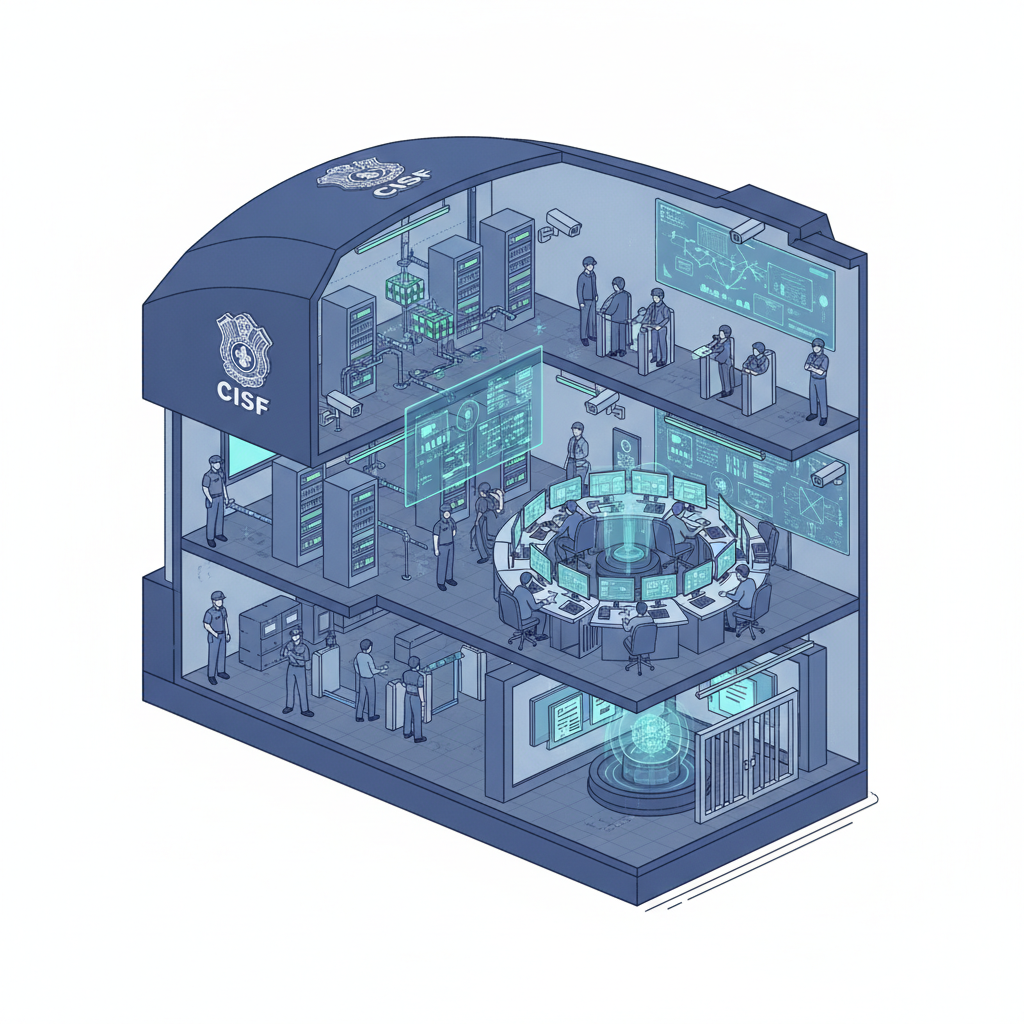
22 Sep NTA Overhaul 2026: CISF, AI & Nandan Nilekani’s Role After NEET Leak
✎ The NTA is transitioning from an exam-centric to a functional-vertical structure, integrating CISF security and AI monitoring, and recruiting domain specialists to address vulnerabilities exposed by NEET-UG paper leak…
Subject Relevance — Where This Topic Fits
- GS Paper II — Governance, Transparency and Accountability | GS Paper III — Science and Technology (AI and Cybersecurity in Governance)
- Prelims: National Testing Agency (NTA), NEET-UG, paper leak, CISF, AI monitoring, K Radhakrishnan committee, Nandan Nilekani task force, High-Powered Steering Committee (HPSC), High-level Committee of Experts (HLCE), functional-vertical structure, Government of India Press Building, Minto Road, New Delhi
- Essay: Governance reforms in public examination systems: Balancing efficiency, security, and public trust, The role of technology in enhancing transparency and accountability in institutional frameworks
Quick Revision: The NTA is transitioning from an exam-centric to a functional-vertical structure, integrating CISF security and AI monitoring, and recruiting domain specialists to address vulnerabilities exposed by NEET-UG paper leak allegations, as part of reforms guided by the K Radhakrishnan committee and the Nandan Nilekani task force.
Why is this in the news?
The National Testing Agency (NTA) is undergoing significant institutional reforms following allegations of paper leaks in examinations such as NEET-UG, which have exposed vulnerabilities in its exam-conduct systems. These reforms, detailed in affidavits submitted to the Supreme Court, include structural overhauls, enhanced security protocols, and the recruitment of domain specialists, aimed at restoring public trust and ensuring the integrity of competitive examinations in India.
Background
- The NTA, established in 2017 as an autonomous body under the Ministry of Education, conducts major entrance examinations such as NEET-UG, JEE Main, and UGC-NET.
- Allegations of paper leaks in NEET-UG 2024 and subsequent re-examinations have severely undermined public confidence in the agency’s ability to conduct fair and secure examinations.
- The Supreme Court has been monitoring the NTA’s compliance with reformatory measures through affidavits and periodic reviews, highlighting the judiciary’s role in ensuring accountability in public institutions.
- The Government of India Press Building on Minto Road, New Delhi, has been allotted to the NTA for its operations, marking a shift from its previous headquarters.
- The reforms are guided by recommendations from two high-level committees: the K Radhakrishnan-led committee (constituted in 2024) and the Nandan Nilekani-headed High Power Task Force, both tasked with addressing governance, security, and technological gaps.
- The Centre has emphasised the implementation of a functional-vertical structure to enhance domain-specific expertise within the NTA.
What is the National Testing Agency (NTA)?
- The NTA is an autonomous organisation under the Ministry of Education, Government of India, established in 2017 to conduct major entrance examinations for higher education institutions.
- It was created to address concerns about the transparency and efficiency of examinations previously conducted by multiple agencies, including CBSE and AICTE.
- The NTA’s mandate includes conducting examinations such as NEET-UG (for medical admissions), JEE Main (for engineering admissions), UGC-NET (for academic recruitment), and others.
- The NTA’s governance structure has traditionally been exam-centric, with resources allocated based on specific examination requirements, leading to fragmentation of expertise.
- Post-NEET leak controversies, the NTA has been subjected to structural and procedural reforms to enhance its operational robustness and public credibility.
- The reforms include the adoption of a functional-vertical structure, which organises the agency into domain-specific units (e.g., Technology, Human Resources, Assessment R&D) to build specialised capabilities.
- The NTA’s operations have been relocated to the Government of India Press Building on Minto Road, New Delhi, as part of a broader institutional restructuring.
Key Features
| Feature | Significance |
|---|---|
| Relocation to Minto Road Office | Centralised operational control and enhanced administrative efficiency within a secure government complex |
| CISF Security Deployment | Institutionalised physical security framework to prevent unauthorised access and mitigate risks of malpractice |
| AI-driven Monitoring Systems | Real-time surveillance and anomaly detection to strengthen test integrity and deter irregularities |
| Functional-Vertical Structure | Domain-specific verticals (e.g., Technology, Assessment R&D) to build specialised expertise and improve governance |
| Domain Specialist Recruitment | Appointment of professionals in Information Security, Test Security, and Vigilance to address systemic vulnerabilities |
Why it Matters
Governance Reforms
- Transition from exam-specific silos to a functional-vertical model enhances institutional capacity and accountability
- Institutionalisation of governance mechanisms through the Nilekani Task Force recommendations ensures long-term structural resilience
- Strengthened oversight via High-Powered Steering Committee (HPSC) and High-level Committee of Experts (HLCE) improves policy implementation fidelity
Technological Advancement
- AI-enabled monitoring systems represent a paradigm shift towards predictive security and automated vigilance in high-stakes examinations
- Specialised recruitment in Information Security and Test Security underscores the integration of technology in safeguarding assessment integrity
- Centralised operations at Minto Road facilitate seamless technological integration and inter-departmental coordination
Public Trust & Credibility
- Proactive restructuring post-NEET-UG leak aims to restore stakeholder confidence in the National Testing Agency’s operational credibility
- Transparent reporting to the Supreme Court demonstrates adherence to judicial oversight and institutional accountability
- Structural reforms signal a commitment to systemic integrity, addressing concerns of malpractice and procedural lapses
Challenges
1. Implementation Lag in Recruitment
- Domain specialist recruitment processes may face delays due to stringent selection criteria and bureaucratic procedures
- Risk of knowledge gaps persisting until new hires achieve full operational readiness
UPSC Link: GS2: Public Sector Undertakings (PSUs) recruitment challenges
2. Technological Dependency Risks
- Over-reliance on AI monitoring systems may introduce vulnerabilities if algorithms are not rigorously audited for bias or failure modes
- Cybersecurity threats targeting centralised databases require continuous upgradation of defensive protocols
UPSC Link: GS3: Cybersecurity and data protection challenges
3. Operational Disruptions During Transition
- Relocation to Minto Road may temporarily disrupt ongoing processes, necessitating robust change management strategies
- Coordination challenges between legacy and new systems during the transition phase
UPSC Link: GS2: Government organisational restructuring challenges
4. Sustainability of Security Measures
- Physical and digital security frameworks demand sustained funding and periodic upgrades to counter evolving threats
- Risk of complacency in security protocols post-immediate crisis resolution
UPSC Link: GS3: Security sector reforms and resource allocation
5. Stakeholder Resistance to Change
- Resistance from existing staff accustomed to traditional exam-centric structures may impede cultural transformation
- Need for extensive capacity-building programmes to align personnel with new functional-vertical roles
UPSC Link: GS4: Organisational change management challenges
Challenges — UPSC Perspective
| Issue | Concern |
|---|---|
| Recruitment Delays | Potential knowledge gaps delaying full operationalisation of new governance structure |
| AI System Vulnerabilities | Risk of algorithmic bias or failure in real-time monitoring systems |
| Transition Disruptions | Temporary operational inefficiencies during relocation and restructuring |
| Funding Sustainability | Long-term financial viability of security and technological upgrades |
| Cultural Resistance | Inertia within existing staff towards adopting new functional-vertical roles |
Way Forward
- Finalise and expedite recruitment of domain specialists in Technology, Security, and Assessment R&D to fill critical knowledge gaps
- Conduct rigorous third-party audits of AI monitoring systems to validate efficacy and address potential biases
- Develop a phased transition roadmap for staff reorientation, including capacity-building programmes aligned with functional-vertical roles
- Establish a dedicated cybersecurity task force to continuously monitor and upgrade digital infrastructure against emerging threats
- Institutionalise periodic reviews by the HPSC and HLCE to ensure sustained implementation of reforms and address emerging challenges
- Enhance transparency in reporting progress to the Supreme Court and public stakeholders to reinforce accountability mechanisms
- Pilot computer-based testing in select regions to assess feasibility and scalability before nationwide rollout
- Strengthen inter-agency coordination between NTA, CISF, and state police forces for integrated security planning
UPSC Value Addition
Keywords for Mains Answer-Writing
National Testing Agency (NTA) · NEET-UG paper leak · exam security reforms · High-level Committee of Experts (HLCE) · High-Powered Steering Committee (HPSC) · K Radhakrishnan committee · Nandan Nilekani task force · functional-vertical structure in governance · computer-based testing (CBT) · institutional restructuring · exam integrity mechanisms · Supreme Court oversight of NTA · CISF security for examinations · AI-driven monitoring in examinations · Terms of Reference (ToR) for institutional reforms
Concept Flow
NEET-UG Paper Leak Allegations → Public Trust Erosion → Supreme Court Oversight → Formation of HLCE and HPSC → Recommendations for Structural Reforms → HLCE Recommendations → Functional-Vertical Restructuring + Domain Specialist Recruitment → CISF Security Deployment + AI Monitoring Systems → Implementation of Reforms → Relocation to Minto Road Office → Enhanced Governance Mechanisms → Restoration of Institutional Credibility → Technological Integration → AI Systems + Cybersecurity Protocols → Real-Time Vigilance → Deterrence of Malpractice → Nilekani Task Force ToR → Governance Institutionalisation → Long-Term Policy Framework → Sustainability of Reforms
Prelims Practice Questions
Q1. Consider the following statements regarding the restructuring of the National Testing Agency (NTA) after the NEET-UG paper leak controversy:
1. The NTA has been allocated new office space in the Government of India Press Building on Minto Road, New Delhi.
2. The High-level Committee of Experts (HLCE) recommended a shift from domain-specific to exam-wise verticals in human resource deployment.
3. The NTA is recruiting domain specialists across verticals such as Technology, Human Resources, and Test Security.
4. The Nilekani-headed task force was constituted to solely investigate the NEET-UG paper leak allegations.
How many of the above statements are correct?
- Only one
- Only two
- Only three
- All
Answer: Only three — Statements 1 and 3 are correct. Statement 2 is incorrect because the HLCE recommended a functional-vertical structure (domain-specific capability-building) rather than exam-wise verticals. Statement 4 is incorrect as the Nilekani task force was constituted to strengthen and institutionalise NTA’s governance mechanisms broadly, not solely to investigate the NEET-UG paper leak.
Q2. Assertion (A): The National Testing Agency (NTA) has implemented a functional-vertical structure to enhance domain-specific capability-building.
Reason (R): This restructuring was recommended by the High-level Committee of Experts (HLCE) to address vulnerabilities exposed during the NEET-UG paper leak.
In the context of the above two statements, which of the following is correct?
- Both A and R are true, and R is the correct explanation of A
- Both A and R are true, but R is NOT the correct explanation of A
- A is true, but R is false
- A is false, but R is true
Answer: Both A and R are true, and R is the correct explanation of A — Both the Assertion (A) and Reason (R) are true, and R correctly explains A. The functional-vertical structure was indeed recommended by the HLCE to address security and capability gaps revealed during the NEET-UG paper leak.
Q3. Match the following committees/task forces with their respective roles in the restructuring of the National Testing Agency (NTA):
Column I (Committee/Task Force) | Column II (Role)
——————————————————
A. High-level Committee of Experts (HLCE) | 1. Investigating the NEET-UG paper leak allegations
B. High-Powered Steering Committee (HPSC) | 2. Monitoring implementation of HLCE recommendations
C. K Radhakrishnan-led committee | 3. Recommending organisational restructuring and governance mechanisms
D. Nilekani-headed task force | 4. Assessing progress and reviewing measures periodically
Select the correct match:
- A-3, B-4, C-2, D-1
- A-2, B-4, C-3, D-1
- A-3, B-2, C-4, D-1
- A-1, B-2, C-3, D-4
Answer: A-3, B-4, C-2, D-1 — Correct matches: A-3 (HLCE recommended organisational restructuring), B-4 (HPSC monitors implementation), C-2 (K Radhakrishnan committee was constituted after the NEET-UG paper leak to assess vulnerabilities), D-1 (Nilekani task force was constituted to investigate the NEET-UG paper leak allegations).
Mains Practice Question
✍ The National Testing Agency (NTA) has undergone significant institutional restructuring in response to the NEET-UG paper leak controversy. Critically examine the key reforms introduced, including the functional-vertical structure, domain specialist recruitment, and the role of oversight committees such as the High-level Committee of Experts (HLCE) and the Nilekani-headed task force. Also, analyse the implications of these reforms for the integrity and credibility of competitive examinations in India. (15 Marks)
Approach: MODEL-ANSWER SKELETON:
1. **Context and Background (2 marks)**
– Brief overview of the NEET-UG paper leak controversy and its impact on NTA’s credibility.
– Mention the Supreme Court’s oversight role in monitoring NTA’s restructuring efforts.
2. **Key Reforms Introduced (5 marks)**
– **Functional-Vertical Structure**: Explain the shift from exam-wise verticals to domain-specific capability-building (e.g., Technology, Human Resources, Test Security). Cite the HLCE’s recommendations and the affidavit filed in the Supreme Court.
– **Domain Specialist Recruitment**: Highlight the recruitment of professionals across verticals such as Information Security, Vigilance, and Assessment R&D. Mention the ongoing selection process.
– **Oversight Mechanisms**: Discuss the roles of the High-Powered Steering Committee (HPSC) and the Nilekani-headed task force in monitoring reforms and institutionalising governance mechanisms.
– **Security Enhancements**: Reference the involvement of the Central Industrial Security Force (CISF) and AI-driven monitoring for exam integrity.
3. **Institutional and Governance Reforms (4 marks)**
– **Terms of Reference (ToR)**: Explain how the Nilekani task force’s ToR includes strengthening NTA’s statutory framework, organisational structure, and human resource management.
– **Committee Recommendations**: Discuss the K Radhakrishnan-led committee’s role in assessing vulnerabilities and recommending measures to prevent future leaks.
– **Computer-Based Testing (CBT)**: Analyse the potential shift to CBT as a long-term reform to enhance security and efficiency.
4. **Implications for Exam Integrity (3 marks)**
– **Positive Outcomes**: Discuss how these reforms may enhance transparency, reduce vulnerabilities, and restore public trust in competitive examinations.
– **Challenges**: Highlight potential challenges such as implementation delays, resource constraints, and the need for continuous monitoring.
– **Comparative Perspective**: Briefly compare India’s reforms with global best practices (e.g., China’s Gaokao, BRICS nations’ exam systems).
5. **Conclusion (1 mark)**
– Summarise the significance of these reforms in restoring credibility to NTA and competitive examinations in India.
Source: The Indian Express
Generated by AanyaAi for educational purpose.
Related guides on our sites
- Current affairs for upsc 2026
- How to prepare for GS paper 1 for UPSC CSE mains exam
- Best Neet coaching
- Best neet coaching

- NTA Overhaul 2026: CISF, AI & Nandan Nilekani’s Role After NEET Leak - September 22, 2026
- सुप्रीम कोर्ट ने दिया मंजूरी, 21 साल से लंबित भोपाल मास्टर प्लान का ड्राफ्ट होगा जारी - September 22, 2026
- Supreme Court Clears Bhopal Master Plan Draft; Sealing Drive to Continue - September 22, 2026

No Comments