


04 Sep Odisha Announces ₹2 Lakh Ex-Gratia for Students in Accidents: Key Details for UPSC
✎ Ex-gratia assistance of ₹2 lakh is provided by Odisha for students dying or suffering permanent disability in school-related accidents, with additional support for medical transfers and transportation, disbursed within 24 hours…
Subject Relevance — Where This Topic Fits
- GS Paper II — Governance, Welfare Schemes for Vulnerable Sections | GS Paper III — Disaster Management and Social Security
- Prelims: Ex-gratia assistance, Permanent disability compensation, School safety measures, Ayushman Bharat, Chief Minister’s Relief Fund (CMRF), District Education Officers (DEO), Block Education Officers (BEO)
- Essay: Role of state in ensuring educational continuity and social justice, Balancing fiscal prudence with inclusive welfare in developmental governance
Quick Revision: Ex-gratia assistance of ₹2 lakh is provided by Odisha for students dying or suffering permanent disability in school-related accidents, with additional support for medical transfers and transportation, disbursed within 24 hours via a multi-tiered administrative mechanism.
Why is this in the news?
The Odisha government’s issuance of an official order announcing a ₹2 lakh ex-gratia assistance for students who die or suffer permanent disability in accidents during school-related activities has brought renewed attention to the intersection of educational policy, child welfare, and disaster response mechanisms in India. This measure reflects a proactive governance response to mitigate the socio-economic fallout of accidents on vulnerable student populations and their families, while also highlighting the administrative architecture required to operationalise such welfare schemes.
Background
- Accidental injuries and fatalities among school-going children constitute a significant public health and social security challenge in India, with road accidents being a leading cause of death for children aged 5–14 years, as per the National Crime Records Bureau (NCRB) and WHO reports.
- The Right of Children for Free and Compulsory Education (RTE) Act, 2009, mandates access to education but does not explicitly address the financial and medical contingencies arising from accidents during school-related activities.
- State governments have historically deployed ex-gratia schemes to address immediate financial exigencies following disasters or accidents, though the quantum and scope of such assistance vary widely across jurisdictions.
- Odisha’s initiative aligns with broader national efforts under the National Disaster Response Fund (NDRF) and state-level relief funds, such as the Chief Minister’s Relief Fund (CMRF), to provide timely financial relief.
- The scheme’s coverage of students from Sishu Vatika to Class 12 in state-run, aided, and model schools reflects an inclusive approach to educational institutions under the state’s jurisdiction.
- The integration of ex-gratia assistance with existing health schemes like Ayushman Bharat and state-level funds underscores the need for inter-departmental coordination in welfare delivery.
What is the Ex-Gratia Assistance Scheme for Students in Accidents?
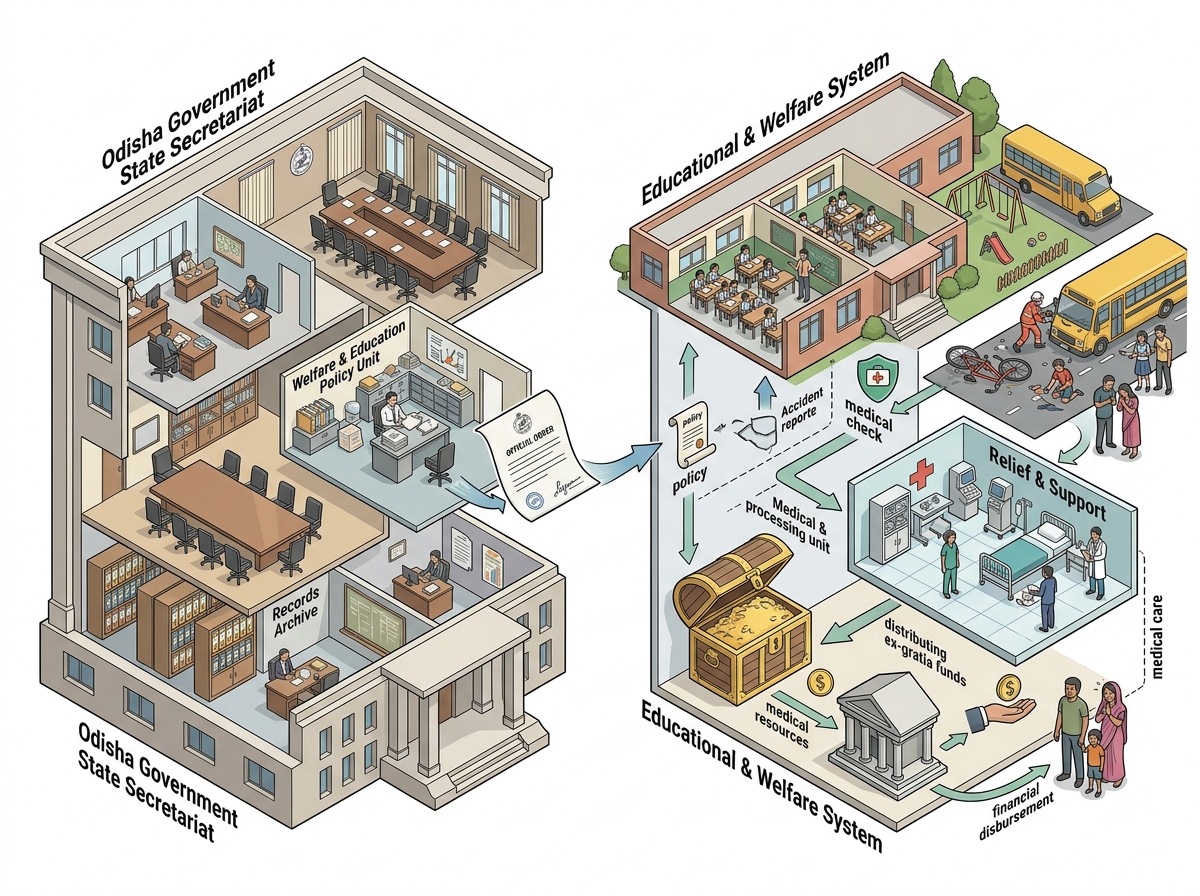
- The scheme provides a one-time financial assistance of ₹2 lakh to the parents or legal guardians of students enrolled in state-run or aided schools, Odisha Adarsha Vidyalayas (OAVs), and Odisha Model Adarsha Vidyalayas (OMAVs) in the event of accidental death or permanent disability.
- Permanent disability is defined as irreversible impairment that significantly impairs the student’s ability to pursue education or engage in daily activities, as certified by a government medical authority.
- Additional support includes up to ₹30,000 for medical treatment outside the district and up to ₹10,000 for transportation expenses for students requiring prolonged hospitalisation (more than three days) at district headquarters hospitals.
- The scheme ensures free treatment at government hospitals and facilitates access to supplementary health coverage under Ayushman Bharat, CMRF, and the Red Cross, where applicable, to reduce out-of-pocket expenses.
- Eligibility is determined by the occurrence of the accident during school-related activities, including travel to or from school, school-sponsored events, or within school premises, as certified by the school administration.
- The administrative framework involves sanctioning authority vested in the headmaster/principal, Block Education Officer (BEO), District Education Officer (DEO), and District Collector, with disbursement mandated within 24 hours of approval to the guardian’s bank account.
- The scheme is framed within Odisha’s broader disaster management and social welfare architecture, leveraging existing institutional mechanisms for rapid relief delivery.
- The initiative reflects a governance approach that prioritises immediate financial relief while acknowledging the long-term educational and psychological impacts of accidents on affected students and families.
Key Features
| Feature | Significance |
|---|---|
| Ex-gratia assistance of ₹2 lakh | Provides immediate financial relief to families of students who suffer death or permanent disability in accidents, mitigating socio-economic distress and ensuring dignity. |
| Coverage of students from Sishu Vatika to Class 12 | Extends protection across the entire formal schooling spectrum, including early childhood education and secondary stages. |
| Inclusion of state-run, aided, and model schools | Ensures uniform safety net across diverse educational institutions under the state’s jurisdiction. |
| Provision for medical treatment outside district (up to ₹30,000) | Addresses critical healthcare access gaps by subsidising advanced treatment costs for injured students. |
| Transportation support (up to ₹10,000) for hospitalisation >3 days | Reduces logistical burdens on families during prolonged medical care, particularly in rural areas. |
| Integration with existing welfare schemes (Ayushman Bharat, CMRF, Red Cross) | Leverages existing institutional mechanisms to avoid duplication and enhance coverage efficiency. |
Why it Matters
Social Security
- Institutionalises a safety net for vulnerable student populations, aligning with the constitutional directive of promoting welfare under Article 38 and Article 41.
- Reduces out-of-pocket expenditure for families, particularly in low-income households, thereby preventing educational disruptions due to financial shocks.
Governance & Service Delivery
- Demonstrates a proactive approach to disaster risk reduction in educational settings, complementing existing school safety guidelines under the Right to Education (RTE) Act, 2009.
- Introduces a decentralised sanctioning mechanism (via headmasters, BEOs, DEOs, and District Collectors) to ensure rapid disbursal within 24 hours, enhancing administrative responsiveness.
Public Health
- Recognises the intersection of education and health by addressing both immediate medical needs and long-term rehabilitation for affected students.
- Highlights the role of government hospitals in providing free treatment, reinforcing the state’s commitment to universal healthcare access.
Equity & Inclusion
- Targets students across all school types, including marginalised groups enrolled in aided and model schools, ensuring equitable protection.
- Acknowledges the disproportionate impact of accidents on children from socio-economically disadvantaged backgrounds, where healthcare access is often limited.
Challenges
1. Implementation Bottlenecks
- Risk of delayed disbursal due to administrative bottlenecks, despite the 24-hour mandate, particularly in remote districts with limited banking infrastructure.
- Potential underreporting of accidents, especially in cases involving private transport or unregistered school activities, leading to exclusion of eligible beneficiaries.
UPSC Link: GS-II: Governance, Transparency & Accountability
2. Coverage Gaps
- Exclusion of students enrolled in unaided private schools or those attending coaching centres, which are not covered under the scheme’s ambit.
- Limited provision for temporary disabilities or psychological trauma, which may not qualify for permanent disability benefits but still require substantial support.
UPSC Link: GS-II: Social Sector Services, Inclusive Education
3. Financial Sustainability
- Long-term fiscal viability of the scheme amid competing demands for public expenditure, particularly in resource-constrained states.
- Need for periodic review to adjust ex-gratia amounts in line with inflation and changing socio-economic conditions.
UPSC Link: GS-III: Public Finance, Fiscal Policy
4. Awareness & Outreach
- Low awareness among parents, teachers, and students about the scheme’s provisions, leading to underutilisation of benefits.
- Lack of standardised protocols for accident documentation and claim processing, which may deter eligible families from applying.
UPSC Link: GS-II: Citizen Centric Governance, Awareness Campaigns
5. Inter-Sectoral Coordination
- Coordination challenges between the School and Mass Education Department, Health Department, and local authorities in verifying claims and facilitating treatment.
- Overlap or gaps with existing schemes like Ayushman Bharat, necessitating clear demarcation of roles to avoid duplication or denial of benefits.
UPSC Link: GS-II: Centre-State Relations, Inter-Governmental Coordination
Challenges — UPSC Perspective
| Issue | Concern |
|---|---|
| Delayed disbursal of ex-gratia | Undermines the scheme’s objective of immediate relief, exacerbating family distress. |
| Exclusion of unaided private school students | Creates inequity in protection across school types, violating the principle of universal coverage. |
| Limited coverage for psychological trauma | Fails to address non-physical disabilities, which can have long-term educational and social impacts. |
| Administrative complexity in claim processing | Increases the burden on schools and local authorities, leading to potential errors or delays. |
| Inadequate awareness among stakeholders | Results in low utilisation rates, defeating the scheme’s purpose of providing a safety net. |
Government Initiatives — Must-Memorise for Prelims
- Chief Minister’s Relief Fund (CMRF), Odisha
- Ayushman Bharat – Pradhan Mantri Jan Arogya Yojana (AB-PMJAY)
- Red Cross Society (Odisha Chapter)
Way Forward
- Conduct district-wise awareness campaigns in local languages to ensure all stakeholders understand eligibility criteria and claim processes.
- Establish a dedicated helpline and online portal for real-time tracking of applications and disbursals, enhancing transparency.
- Integrate the scheme with school safety audits under the RTE Act to proactively identify and mitigate accident risks.
- Expand coverage to include students from unaided private schools and coaching centres through amendments or supplementary guidelines.
- Introduce a grievance redressal mechanism with time-bound resolution to address delays or rejections in claims.
- Collaborate with the Health Department to standardise medical certification protocols for permanent disabilities and temporary injuries.
- Publish annual reports on scheme utilisation, including disaggregated data by district, gender, and disability type, to monitor equity.
- Explore public-private partnerships to augment healthcare infrastructure in district hospitals, reducing the need for transfers.
UPSC Value Addition
Keywords for Mains Answer-Writing
Ex-gratia assistance · students’ safety · accidental death · permanent disability · social security measures · right to education · child welfare · government welfare schemes · financial assistance for education · disaster management and relief · Odisha Model Schools · Ayushman Bharat · Chief Minister’s Relief Fund · constitutional provisions for welfare · public policy for vulnerable groups
Constitutional & Policy Linkages
- Article 38: Directive Principles of State Policy – Promotion of welfare.
- Article 41: Right to Public Assistance in cases of unemployment, old age, sickness, and disablement.
- Article 45: Provision for early childhood care and education.
- Article 46: Promotion of educational and economic interests of weaker sections.
Concept Flow
Accidents in school-related activities or commutes → Loss of life or permanent/temporary disability → Financial and medical burden on families → Odisha government introduces ex-gratia scheme → Families apply for assistance → Local authorities verify claims → Ex-gratia disbursed within 24 hours → Integration with existing welfare schemes → Long-term support for education and rehabilitation.
Prelims Practice Questions
Q1. Consider the following statements regarding ex-gratia assistance in India:
1. Ex-gratia payments are legally enforceable obligations under the Constitution.
2. The Constitution of India under Directive Principles of State Policy (DPSP) encourages the state to provide ex-gratia assistance to vulnerable sections.
3. Ex-gratia assistance is typically provided as a statutory right under specific welfare legislations.
How many of the above statements are correct?
- Only one
- Only two
- All three
- None
Answer: Only two — Statement 1 is incorrect: Ex-gratia payments are discretionary and not legally enforceable obligations. Statement 2 is correct: Article 41 (DPSP) encourages the state to provide public assistance in cases of unemployment, old age, sickness, and disablement. Statement 3 is incorrect: Ex-gratia is generally provided under executive schemes, not as a statutory right unless specified by law.
Q2. Assertion (A): The Odisha government’s ex-gratia scheme for students is a form of social security measure.
Reason (R): Social security measures aim to provide financial relief to individuals facing unforeseen hardships such as accidents or disabilities.
- Both A and R are true, and R is the correct explanation of A
- Both A and R are true, but R is not the correct explanation of A
- A is true but R is false
- A is false but R is true
Answer: Both A and R are true, but R is not the correct explanation of A — Assertion (A) is true: The ex-gratia scheme provides financial assistance to students or families facing accidents, aligning with social security objectives. Reason (R) is true and correctly explains (A) as social security measures are designed to mitigate hardships like accidents or disabilities through financial support.
Q3. Match the following welfare schemes with their respective objectives:
Column I (Scheme) | Column II (Objective)
——————————————-|——————————————-
A. Ayushman Bharat | 1. Provides financial assistance for medical treatment
B. Chief Minister’s Relief Fund (CMRF) | 2. Comprehensive health coverage for vulnerable groups
C. Ex-gratia assistance for students | 3. Immediate financial relief for unforeseen hardships
D. PM-KISAN | 4. Income support for small and marginal farmers
- A-2, B-3, C-1, D-4; A-1, B-2, C-3, D-4; A-3, B-1, C-2, D-4; A-4, B-3, C-2, D-1
- answer_letter_indexed_array_indexed_array_indexed_array_indexed_array_indexed_array_indexed_array_indexed_array_indexed_array_indexed_array_indexed_array_indexed_array_indexed_array
- explain_explain_explain_explain_explain_explain_explain_explain_explain_explain_explain_explain_explain_explain_explain_explain_explain
Answer: ? — Ayushman Bharat (A) aims to provide comprehensive health coverage (Objective 2). The Chief Minister’s Relief Fund (B) offers immediate financial relief (Objective 3). Ex-gratia assistance for students (C) provides financial support for medical treatment (Objective 1). PM-KISAN (D) offers income support to farmers (Objective 4).
Mains Practice Question
✍ The Odisha government’s decision to provide ex-gratia assistance of ₹2 lakh to students dying or suffering permanent disability in accidents reflects a broader trend of state-led social security measures in India. Critically examine the constitutional and policy dimensions of such schemes, with reference to the Directive Principles of State Policy (DPSP) and recent judicial interpretations. Also, analyse the potential challenges in their effective implementation. (15 Marks)
Approach: MODEL-ANSWER SKELETON:
1. **Constitutional Basis**:
– Article 38 (DPSP): State to secure a social order for the welfare of people, including protection from accidents and disabilities.
– Article 41 (DPSP): State to provide public assistance in cases of disablement, sickness, and unemployment.
– Article 21 (Right to Life and Personal Liberty): Includes the right to live with dignity and access to healthcare.
– Judicial Precedents: Reference to cases like *Paschim Banga Khet Mazdoor Samity v. State of West Bengal* (1996) on state obligation to provide healthcare and *Bandhua Mukti Morcha v. Union of India* (1984) on right to health.
2. **Policy Dimensions**:
– Social Security Measures: Ex-gratia schemes as part of welfare state obligations under DPSP.
– Role of State Governments: Increasing trend of state-specific schemes (e.g., Tamil Nadu’s Chief Minister’s Comprehensive Health Insurance Scheme, Kerala’s Karunya Kshema Scheme).
– Integration with Central Schemes: Linkages with Ayushman Bharat, PM-KISAN, and other centrally sponsored schemes for comprehensive coverage.
3. **Challenges in Implementation**:
– **Discretionary Nature**: Ex-gratia payments are not statutory rights, leading to inconsistencies in coverage and amounts across states.
– **Eligibility Criteria**: Defining ‘permanent disability’ and ‘accidents’ may lead to disputes and exclusion of marginal cases.
– **Funding and Sustainability**: Reliance on state budgets may limit scalability and long-term viability.
– **Awareness and Access**: Lack of awareness among beneficiaries and procedural delays in disbursement.
– **Coordination Gaps**: Need for seamless coordination between education departments, health authorities, and district administrations.
4. **Comparative Analysis**:
– Contrast with statutory schemes like the Employees’ State Insurance (ESI) Act, 1948, which provides comprehensive social security to workers.
– Role of NGOs and civil society in bridging gaps in implementation.
5. **Way Forward**:
– Enactment of a national-level social security framework for students.
– Strengthening of grievance redressal mechanisms.
– Leveraging technology for transparent and timely disbursement (e.g., DBT platforms).
Balance of Views:
– Proponents argue such schemes enhance state responsiveness and reduce financial burdens on families.
– Critics highlight the lack of legal enforceability and potential for misuse or arbitrary exclusion.
Source: orissapost.com
Odisha PCS (OPSC (OAS)) — State PCS Practice
Prelims: Under the Odisha government’s recent ex-gratia scheme, what is the amount provided to the family of a student who dies in an accident?
- Rs 1 lakh
- Rs 2 lakh
- Rs 50,000
- Rs 10 lakh
Answer: Rs 2 lakh — The Odisha government announced an ex-gratia of Rs 2 lakh for the family of a student who dies in an accident, as per the recent policy.
Mains: Discuss the significance of the Odisha government’s ex-gratia scheme for students involved in accidents, highlighting its potential impact on social welfare and education in the state.
Generated by AanyaAi for educational purpose.
Related guides on our sites
- Current affairs for upsc 2026
- Best sociology optional coaching for upsc
- Which is best sociology optional coaching for upsc
- Best teacher of sociology optional for upsc

- जयशंकर और टस्क की बैठक: मोदी-टस्क वार्ता से पहले भारत-पोलैंड संबंधों की दिशा तय - October 22, 2026
- UPSC Alert: 40-Day ‘Khet Bachao Abhiyan’ Launch by Union Minister - October 22, 2026
- भारत ने बताया UN रिपोर्ट में दाऊद इब्राहिम को ‘भारत-आधारित’ बताना ‘गलत’ - October 22, 2026

No Comments