


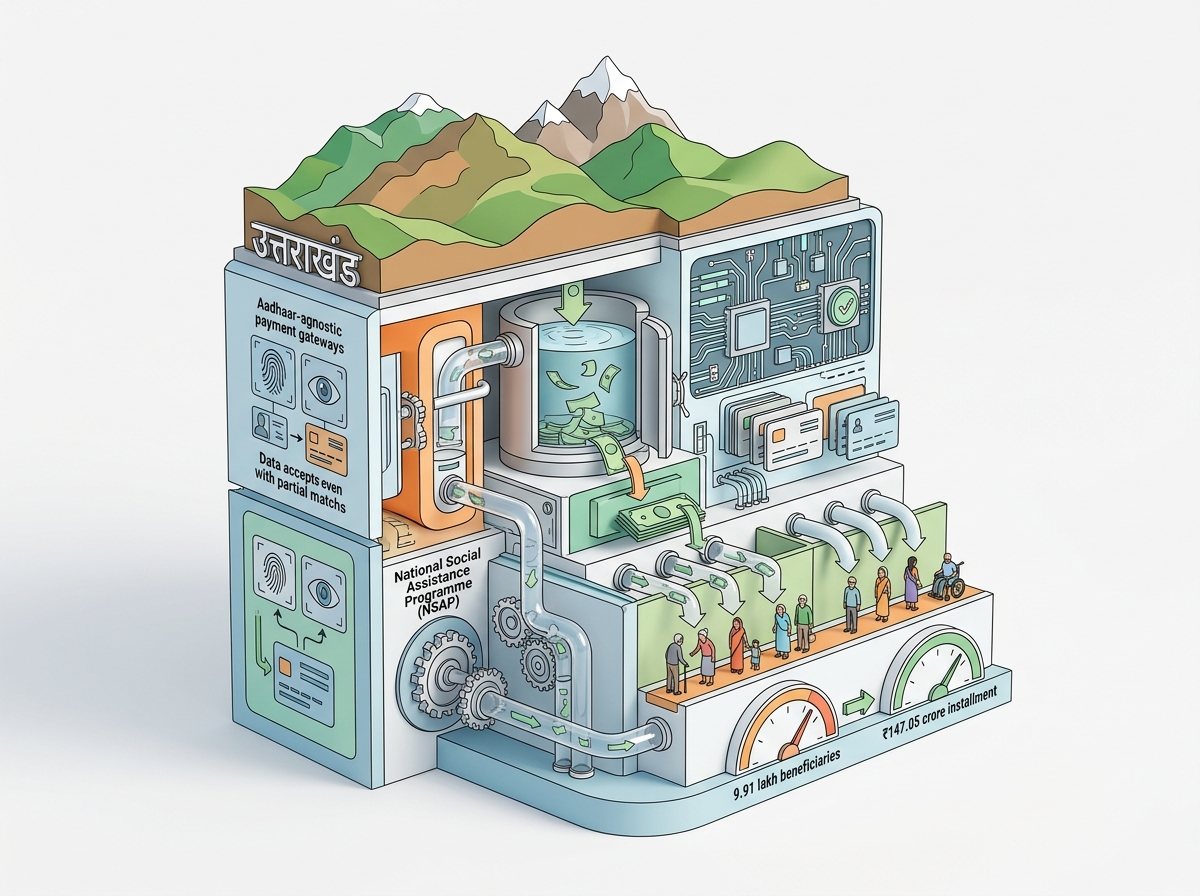
04 Sep UPSC Alert: Uttarakhand CM releases ₹147 crore pension to 9.91 lakh beneficiaries
✎ Social security pensions in India are governed by the National Social Assistance Programme (NSAP), with disbursement increasingly routed through Aadhaar-enabled Direct Benefit Transfer (DBT) to ensure transparency and reduce…
Subject Relevance — Where This Topic Fits
- GS Paper II — Governance, Administration and Challenges (Social Sector Schemes) | GS Paper III — Indian Economy and Issues relating to Planning, Mobilisation of Resources
- Prelims: Social Security Pension, Direct Benefit Transfer (DBT), National Social Assistance Programme (NSAP), Aadhaar-based Payment System, Financial Inclusion, Pension Disbursement, Beneficiary Identification, Exclusion Errors, Inclusion Errors
- Essay: Inclusive growth through targeted welfare delivery mechanisms, Role of state capacity in ensuring last-mile delivery of social welfare
Quick Revision: Social security pensions in India are governed by the National Social Assistance Programme (NSAP), with disbursement increasingly routed through Aadhaar-enabled Direct Benefit Transfer (DBT) to ensure transparency and reduce leakages.
Why is this in the news?
The Government of Uttarakhand recently disbursed ₹147.05 crore as the August 2026 installment of social security pensions to 9.91 lakh beneficiaries, including 5,605 newly approved recipients. This development underscores the operationalisation of India’s social security architecture in a hill state with challenging terrain and demographic diversity, and highlights the government’s emphasis on ensuring seamless, Aadhaar-agnostic payment systems to prevent exclusion of eligible beneficiaries.
Background
- Social security pensions in India are a non-contributory, tax-funded welfare mechanism designed to provide financial support to vulnerable sections such as the elderly, widows, persons with disabilities, and other marginalised groups.
- The National Social Assistance Programme (NSAP), launched in 1995, is the flagship centrally sponsored scheme under which the central government provides financial assistance to states for disbursing pensions to eligible beneficiaries.
- Uttarakhand, a Himalayan state with significant rural and tribal populations, faces unique challenges in pension delivery due to geographical dispersion, limited banking infrastructure in remote areas, and issues related to Aadhaar seeding and biometric authentication.
- The state government supplements central support with its own pension schemes, including those for farmers, deserted women, and specific social categories like ‘Tilū Rautēlī’ and ‘Bāuna’ pensions, reflecting local socio-economic priorities.
- The shift from physical cash disbursement to Direct Benefit Transfer (DBT) via Aadhaar-enabled payment systems has aimed to reduce leakages, improve transparency, and accelerate fund flow to beneficiaries.
- Despite progress, challenges persist in ensuring 100% Aadhaar seeding, resolving biometric authentication failures, and addressing last-mile connectivity issues in hilly regions.
What are Social Security Pensions?
- Social security pensions are monthly cash transfers provided by the state to individuals who lack formal income security, particularly the elderly, widows, persons with disabilities, and other marginalised groups.
- These pensions are non-contributory, meaning beneficiaries are not required to make prior contributions; eligibility is determined by predefined criteria such as age, income, or disability status.
- The primary legal framework governing social security pensions in India is the National Social Assistance Programme (NSAP), implemented under the Ministry of Rural Development, Government of India.
- NSAP comprises five sub-schemes: Indira Gandhi National Old Age Pension Scheme (IGNOAPS), Indira Gandhi National Widow Pension Scheme (IGNWPS), Indira Gandhi National Disability Pension Scheme (IGNDPS), National Family Benefit Scheme (NFBS), and Annapurna Scheme.
- States are empowered to design and implement additional pension schemes tailored to local needs, as seen in Uttarakhand’s supplementary schemes for farmers, deserted women, and specific social categories.
- The disbursement of pensions is now predominantly routed through Direct Benefit Transfer (DBT) using the Aadhaar Payment Bridge System (APBS) and Aadhaar Enabled Payment System (AEPS), ensuring speed, transparency, and reduced leakages.
- Aadhaar seeding—linking Aadhaar numbers with bank accounts—has become critical for seamless pension delivery, though states must ensure alternative mechanisms for beneficiaries who face authentication failures or lack Aadhaar.
- The success of pension schemes hinges on robust beneficiary identification, grievance redressal, and periodic updation of beneficiary databases to prevent exclusion errors and inclusion of ineligible individuals.
Key Features
| Feature | Significance |
|---|---|
| Direct Benefit Transfer (DBT) mechanism | Ensures timely, transparent, and leakage-proof transfer of pension amounts directly to beneficiaries’ bank accounts, reducing intermediaries and administrative delays. |
| Coverage of multiple pension schemes | Integrates central (NSAP) and state-specific pension schemes, ensuring comprehensive social security for vulnerable groups including elderly, widows, disabled, and farmers. |
| Inclusion of new beneficiaries | Expands the safety net by adding 5,605 new pensioners in August 2026, demonstrating progressive expansion of social security coverage. |
| Aadhaar-linked payment facilitation | Directives to resolve Aadhaar-related bottlenecks ensure that eligible individuals are not excluded due to biometric authentication failures. |
| Monthly disbursal cycle | Regular, predictable release of pension amounts aligns with the fiscal cycle and supports household financial planning for recipients. |
Why it Matters
Social Security Architecture
- Demonstrates the operationalisation of India’s constitutional directive principle of welfare state (Article 38) through targeted cash transfers to marginalised sections.
- Highlights the role of state governments in supplementing central schemes (e.g., NSAP) to address localised vulnerabilities such as mountainous terrain and climate-induced livelihood risks in Uttarakhand.
- Reinforces the paradigm shift from in-kind support to direct cash transfers, enhancing beneficiary autonomy and reducing exclusion errors.
Fiscal Federalism
- Showcases the fiscal collaboration between the Union and state governments in delivering social welfare, with Uttarakhand augmenting central allocations with state funds.
- Illustrates the use of technology (DBT) to streamline fund flow, reducing transaction costs and improving accountability in public expenditure management.
Inclusive Governance
- Emphasises the importance of last-mile delivery mechanisms in ensuring that geographically dispersed and socio-economically disadvantaged populations access entitlements.
- Underscores the need for inter-departmental coordination (e.g., revenue, social welfare, and Aadhaar authorities) to resolve systemic bottlenecks.
Economic Multiplier Effect
- Pension disbursements inject liquidity into rural and semi-urban economies, supporting local markets and small enterprises through increased consumption.
- Contributes to poverty alleviation by providing a stable income floor for households, particularly in regions prone to seasonal unemployment.
Challenges
1. Last-Mile Delivery Gaps
- Geographical barriers in hilly regions (e.g., Chamoli) may delay physical verification or Aadhaar seeding, leading to exclusion of eligible beneficiaries.
- Dependence on digital infrastructure (e.g., banking networks, Aadhaar authentication) exposes recipients to systemic risks during connectivity failures.
UPSC Link: GS-II: Welfare Schemes
2. Aadhaar Seeding Delays
- Incomplete Aadhaar enrolment among marginalised groups (e.g., elderly, disabled) can disrupt pension disbursement despite eligibility.
- Biometric authentication failures in remote areas necessitate alternative identification mechanisms to prevent exclusion.
UPSC Link: GS-II: Governance
3. Fiscal Sustainability
- Expansion of pension coverage increases recurring expenditure, requiring robust resource mobilisation and prioritisation within state budgets.
- Dependence on central transfers (e.g., NSAP) may create fiscal vulnerabilities if Union allocations are reduced or delayed.
UPSC Link: GS-III: Inclusive Growth
4. Targeting Errors
- Risk of inclusion errors (e.g., non-poor receiving benefits) due to outdated socio-economic surveys or lack of real-time data integration.
- Exclusion errors may persist if local officials lack capacity to verify eligibility criteria accurately.
UPSC Link: GS-II: Poverty Alleviation
5. Financial Literacy
- Low awareness among elderly and rural populations about DBT mechanisms can lead to underutilisation of pension amounts.
- Need for financial education initiatives to ensure beneficiaries understand account operations, withdrawal processes, and grievance redressal.
UPSC Link: GS-II: Social Sector
Challenges — UPSC Perspective
| Issue | Concern |
|---|---|
| Aadhaar authentication failures | Exclusion of eligible pensioners due to biometric mismatches or connectivity issues in remote areas. |
| Incomplete beneficiary data | Lack of updated socio-economic surveys may result in incorrect targeting or delays in new enrolments. |
| Banking infrastructure gaps | Limited access to formal banking in rural Uttarakhand may hinder smooth disbursement of pension amounts. |
| Seasonal migration | Temporary absence of beneficiaries during migration periods may lead to lapses in pension receipt without proper tracking. |
| Grievance redressal delays | Inadequate institutional mechanisms for addressing complaints may erode trust in the pension system. |
Government Initiatives — Must-Memorise for Prelims
- National Social Assistance Programme (NSAP)
- Uttarakhand Old Age Pension Scheme
- Uttarakhand Widow Pension Scheme
- Uttarakhand Disability Pension Scheme
- Uttarakhand Farmer Pension Scheme
Way Forward
- Strengthen last-mile delivery by deploying mobile verification units in remote hilly regions to resolve Aadhaar and eligibility issues proactively.
- Integrate pension databases with Aadhaar and socio-economic surveys to enable real-time eligibility verification and reduce inclusion/exclusion errors.
- Expand financial literacy campaigns in local languages, focusing on elderly and rural populations to enhance awareness of DBT mechanisms.
- Invest in rural banking infrastructure, including banking correspondents and digital kiosks, to improve access to pension disbursement points.
- Establish a state-level grievance redressal portal with multi-lingual support and dedicated helplines for pension-related queries.
- Conduct periodic audits of pension disbursement processes to identify systemic bottlenecks and ensure compliance with fiscal transparency norms.
- Collaborate with NGOs and self-help groups to facilitate enrolment drives and awareness sessions in underserved communities.
- Explore the use of geo-tagging and blockchain-based tracking for pension disbursements to enhance accountability and reduce fraud.
UPSC Value Addition
Keywords for Mains Answer-Writing
Social Security Pension · National Social Assistance Programme · State Social Security Pensions · Direct Benefit Transfer · Aadhaar-enabled Payment System · Old-age Pension · Widow Pension · Disability Pension · Digital Governance · Inclusive Development · Fiscal Federalism · Welfare State · Constitutional Directive Principles · Article 41 of the Constitution · Social Justice · Financial Inclusion
Constitutional & Policy Linkages
- Article 41: Directive Principle of State Policy on public assistance in cases of unemployment, old age, sickness, and disablement.
- Article 46: Promotion of educational and economic interests of weaker sections, including scheduled castes and scheduled tribes.
- Seventh Schedule, State List (Entry 26): Social security and social insurance; employment and unemployment.
Concept Flow
State identifies vulnerable groups (elderly, widows, disabled) through socio-economic surveys and eligibility criteria. → Central and state schemes (e.g., NSAP, Uttarakhand Old Age Pension) are operationalised via administrative frameworks. → Aadhaar enrolment and seeding are completed to enable biometric authentication for DBT. → Pension amounts are calculated based on scheme-specific norms and credited to beneficiaries’ bank accounts via DBT. → Beneficiaries withdraw amounts using Aadhaar-enabled payment systems or bank cards, with grievances addressed through designated channels. → Periodic reviews and audits ensure transparency, reduce errors, and expand coverage to new eligible individuals.
Prelims Practice Questions
Q1. Consider the following statements regarding the National Social Assistance Programme (NSAP) in India:
1. NSAP is a centrally sponsored scheme providing social security pensions to the elderly, widows, and disabled persons.
2. The scheme is governed by the Ministry of Rural Development.
3. Under NSAP, the central government bears 100% of the financial burden.
4. The eligibility criteria for old-age pension under NSAP is 60 years and above.
How many of the above statements are correct?
- Only one
- Only two
- Only three
- All
Answer: Only three — Statements 1 and 2 are correct. NSAP is a centrally sponsored scheme providing social security pensions to the elderly, widows, and disabled persons, and it is governed by the Ministry of Rural Development. Statement 3 is incorrect as the financial burden is shared between the Centre and the States. Statement 4 is incorrect as the eligibility criteria for old-age pension under NSAP is 65 years and above.
Q2. Assertion (A): The Direct Benefit Transfer (DBT) mechanism ensures timely and transparent delivery of social security pensions to beneficiaries.
Reason (R): DBT reduces leakages and delays by transferring funds directly into the bank accounts of beneficiaries.
Select the correct option from the following:
- Both A and R are true, and R is the correct explanation of A
- Both A and R are true, but R is NOT the correct explanation of A
- A is true, but R is false
- A is false, but R is true
Answer: Both A and R are true, and R is the correct explanation of A — Both Assertion (A) and Reason (R) are true. DBT ensures timely and transparent delivery of social security pensions by reducing leakages and delays through direct transfer into bank accounts. R correctly explains A.
Q3. Match the following social security pension schemes in India with their respective implementing agencies:
Column I (Scheme) Column II (Implementing Agency)
A. Old-age Pension 1. Ministry of Social Justice and Empowerment
B. Widow Pension 2. Ministry of Women and Child Development
C. Disability Pension 3. Ministry of Rural Development
D. National Social Assistance Programme (NSAP)
Select the correct match:
- A-3, B-2, C-1, D-3
- A-3, B-2, C-1, D-1
- A-1, B-2, C-3, D-3
- A-2, B-1, C-3, D-3
Answer: A-3, B-2, C-1, D-3 — A. Old-age Pension is implemented by the Ministry of Rural Development under NSAP. B. Widow Pension is implemented by the Ministry of Women and Child Development. C. Disability Pension is implemented by the Ministry of Social Justice and Empowerment. D. NSAP is implemented by the Ministry of Rural Development.
Mains Practice Question
✍ The expansion of social security pensions in India, exemplified by Uttarakhand’s recent disbursement to 9.91 lakh beneficiaries, reflects the state’s commitment to inclusive development. Examine the constitutional and statutory framework underpinning social security pensions in India. Also, analyse the challenges in ensuring last-mile delivery and suggest measures to enhance the efficacy of such welfare schemes. (15 Marks)
Approach: MODEL-ANSWER SKELETON:
1. **Constitutional and Statutory Framework:**
– **Directive Principles of State Policy (DPSP):** Article 41 of the Constitution mandates the state to provide public assistance in cases of unemployment, old age, sickness, disablement, and undeserved want.
– **Central and State Schemes:** National Social Assistance Programme (NSAP) under the Ministry of Rural Development (2000) provides central assistance for old-age, widow, and disability pensions. States supplement these with additional schemes (e.g., Uttarakhand’s state-specific pensions).
– **Legal Backing:** State-level legislations and rules govern eligibility, amounts, and disbursement mechanisms.
2. **Uttarakhand’s Initiative:**
– **Scope:** 9.91 lakh beneficiaries across old-age, widow, disability, farmer, deserted women, and other categories.
– **Financial Outlay:** ₹147.05 crore disbursed via Direct Benefit Transfer (DBT) and Aadhaar-enabled Payment System (AePS).
– **Innovations:** Inclusion of new beneficiaries (5,605 in August 2026) and efforts to address Aadhaar-related exclusions.
3. **Challenges in Last-Mile Delivery:**
– **Identification and Exclusion Errors:** Inaccurate beneficiary lists, lack of updated Aadhaar data, and administrative bottlenecks.
– **Digital Divide:** Limited access to banking services in remote areas (e.g., Himalayan regions of Uttarakhand).
– **Awareness Gaps:** Beneficiaries unaware of entitlements or procedural requirements.
– **Fiscal Constraints:** State budgets may face pressure to expand coverage without commensurate central support.
4. **Measures to Enhance Efficacy:**
– **Strengthening DBT and AePS:** Expand banking infrastructure, especially in rural and tribal areas; integrate with local post offices and cooperative banks.
– **Grievance Redressal:** Establish dedicated helplines and digital portals for real-time tracking and resolution of payment issues.
– **Data Integration:** Use of Aadhaar, land records, and ration cards for dynamic beneficiary identification to reduce exclusion errors.
– **Inter-Ministerial Coordination:** Align state and central schemes to avoid duplication and ensure holistic coverage.
– **Capacity Building:** Train local officials on digital governance tools and welfare scheme protocols.
5. **Conclusion:**
– Social security pensions are a critical instrument for social justice and poverty alleviation. While Uttarakhand’s initiative demonstrates progress, sustained efforts are needed to address systemic challenges and ensure universal coverage. The model can serve as a template for other states, provided fiscal federalism and digital inclusion are prioritized.
Source: amarujala.com
Uttarakhand PCS (UKPSC) — State PCS Practice
Prelims: As per recent reports, how many people in Uttarakhand have been benefitted under social security pension schemes, as announced by Chief Minister Pushkar Singh Dhami?
- 9.91 lakh
- 10.5 lakh
- 8.75 lakh
- 11.2 lakh
Answer: 9.91 lakh — The Chief Minister announced that 9.91 lakh people in Uttarakhand have been provided social security pensions under various schemes.
Mains: Discuss the significance of the recent announcement by Chief Minister Pushkar Singh Dhami regarding the distribution of social security pension installments to 9.91 lakh beneficiaries in Uttarakhand. Highlight the socio-economic impact and the role of such schemes in addressing poverty and social welfare in the state.
Generated by AanyaAi for educational purpose.
Related guides on our sites
- Current affairs for upsc 2026
- Best sociology optional coaching for upsc
- Which is best sociology optional coaching for upsc
- Best teacher of sociology optional for upsc

- उत्तराखंड राज्यपाल की पीएम मोदी से महत्वपूर्ण बैठक: जानिए मुख्य बिंदु - October 23, 2026
- How India’s Rs 20,000 Cr CCUS Budget Can Drive Net-Zero Goals - October 23, 2026
- पंजाब-हरियाणा में पराली जलाने पर सीएक्यूएम की सख्त समीक्षा, तुरंत उठाये गये कदमों पर जोर - October 23, 2026

No Comments