


19 Sep Odisha Assembly Monsoon Session: MMDR Bill Withdrawal Key Demand
✎ The MMDR Amendment Bill aims to reform India’s mineral governance by introducing seamless transition mechanisms and enhancing transparency, but its passage has triggered debates on Centre-State relations and the constitutional…
Subject Relevance — Where This Topic Fits
- GS Paper II — Functions and Responsibilities of the Union and the States | GS Paper III — Indian Economy and Issues Relating to Planning, Mobilisation of Resources, Growth, Development and Employment
- Prelims: MMDR Act, 1957, Ministry of Mines, State List (Seventh Schedule), Legislative Assembly Session, Parliamentary Standing Committees
- Essay: Federalism in India: Balancing Centre-State Relations in Resource Governance, The Role of Opposition in Parliamentary Democracy: Ensuring Accountability in Legislative Processes
Quick Revision: The MMDR Amendment Bill aims to reform India’s mineral governance by introducing seamless transition mechanisms and enhancing transparency, but its passage has triggered debates on Centre-State relations and the constitutional division of powers in the Seventh Schedule.
Why is this in the news?
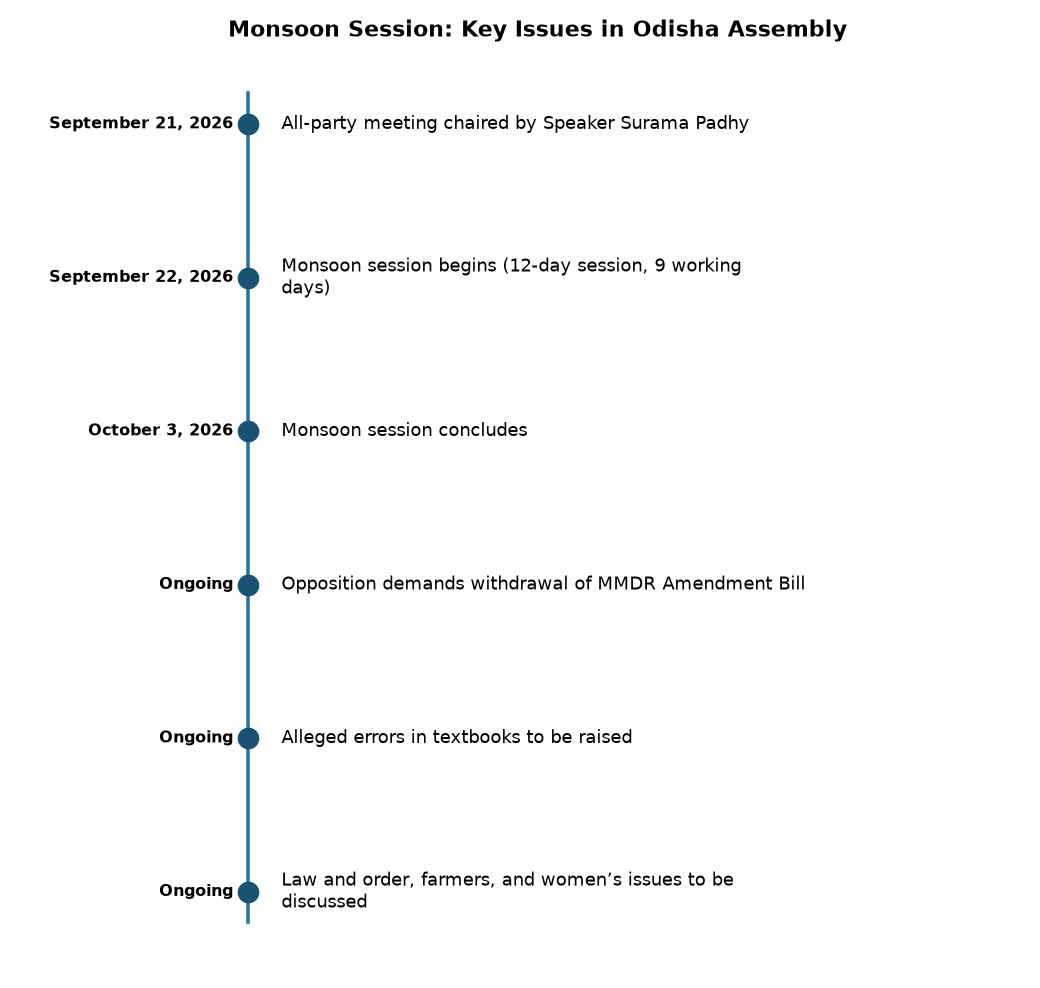
The Monsoon Session of the Odisha Legislative Assembly, commencing on September 22, 2026, has placed the MMDR (Mines and Minerals Development and Regulation) (Amendment) Bill at the centre of political discourse. The Opposition in Odisha has demanded the withdrawal of the Bill, asserting that it undermines the state’s interests in mineral resource governance. This development underscores the constitutional dynamics between the Union and State governments in the regulation of natural resources, particularly in mineral-rich states like Odisha.
Background
- The MMDR Act, 1957, is the primary legislation governing the mining sector in India, regulating the grant of mineral concessions and the development of minerals.
- Odisha, a mineral-rich state, contributes significantly to India’s mineral production, particularly in iron ore, bauxite, coal, and chromite.
- The Opposition in Odisha alleges that the Amendment Bill encroaches upon the state’s legislative and executive powers under the Seventh Schedule of the Constitution, particularly the State List (Entry 23: Regulation of mines and mineral development subject to the provisions of Entry 54 of the Union List).
- The Monsoon Session of the Odisha Legislative Assembly provides a platform for legislative scrutiny, debate, and potential recommendations to the Union Government on matters affecting state interests.
What is the MMDR Amendment Bill?
- The MMDR Amendment Bill seeks to amend the MMDR Act, 1957, to introduce reforms in the mining sector, including provisions for seamless transition of mineral concessions, enhanced transparency in auctions, and measures to curb illegal mining.
- Key amendments proposed in the Bill include the introduction of a seamless transition mechanism for existing mineral concessions, enabling their conversion into auctioned concessions without fresh auctions, subject to compliance with statutory requirements.
- The Bill proposes to empower the Union Government to frame rules for the grant of mineral concessions in areas where state governments have not conducted auctions within the stipulated timelines, ensuring continuity in mineral production.
- Provisions for the establishment of a National Mineral Exploration Trust and a National Mineral Index are included to promote systematic geological mapping and data-driven decision-making in the sector.
- The Bill aims to address challenges such as delays in auction processes, multiplicity of authorities, and lack of uniformity in mineral governance across states.
- Critics argue that certain provisions of the Bill may infringe upon the legislative and executive autonomy of state governments, particularly in matters related to mineral resource governance.
- The Bill is aligned with the Union Government’s broader policy objectives of promoting ease of doing business, attracting investment, and ensuring sustainable mineral development.
- The Bill underwent scrutiny by the Parliamentary Standing Committee on Coal and Mines, which recommended several amendments to balance Centre-State interests and address stakeholder concerns.
Key Features
| Feature | Significance |
|---|---|
| Monsoon Session of Odisha Legislative Assembly (OLA) | A structured platform for legislative scrutiny, debate, and oversight of executive actions, ensuring democratic accountability in state governance. |
| MMDR Amendment Bill, 2023 (Union Parliament) | Proposes amendments to the Mines and Minerals (Development and Regulation) Act, 1957, aiming to streamline mineral governance and attract investment, while raising concerns over state autonomy in resource management. |
| All-Party Meeting (September 21, 2026) | A procedural step to align legislative priorities, ensure consensus on procedural norms, and mitigate disruptions during the session. |
| Opposition’s Demand for Bill Withdrawal | Highlights federal tensions between Centre and State over resource governance, reflecting constitutional debates on legislative jurisdiction and cooperative federalism. |
| Textbook Errors and Education Policy | Raises governance concerns over quality control in state-sponsored educational materials, impacting pedagogical standards and student outcomes. |
Why it Matters
Economic
- Mineral resources constitute a critical revenue stream for Odisha, contributing significantly to state GDP and employment; amendments to MMDR Act directly impact royalty sharing, auction mechanisms, and investment flows.
- The MMDR Amendment Bill’s provisions on mineral auctions and pricing may alter the state’s fiscal federalism dynamics, particularly in revenue-sharing formulas under Article 279A of the Constitution.
- Textbook errors reflect governance lapses in educational administration, potentially undermining human capital development—a key determinant of long-term economic growth.
Federalism
- The Opposition’s demand for withdrawal of the MMDR Amendment Bill underscores tensions between Union and State governments over legislative jurisdiction in natural resource management.
- Cooperative federalism requires balancing Centre’s policy objectives (e.g., ease of doing business) with State’s fiscal and administrative autonomy, particularly in resource-rich regions.
- The session’s focus on textbook errors exemplifies sub-national governance challenges, where states bear primary responsibility for education but face Centre’s policy interventions (e.g., NEP 2020).
Governance
- Legislative sessions serve as a mechanism for oversight, with Opposition parties using the platform to question executive actions and demand accountability.
- Procedural norms (e.g., all-party meetings) aim to ensure smooth conduct of sessions, reducing disruptions and enhancing legislative productivity.
- Issues like textbook errors highlight the need for robust inter-departmental coordination between education, printing, and quality assurance wings.
Legal
- The MMDR Amendment Bill, if enacted, would amend the Mines and Minerals (Development and Regulation) Act, 1957, introducing changes to mineral auction processes, royalty structures, and exploration rights.
- State governments’ objections to the Bill may invoke constitutional provisions on legislative competence (Entry 54, List I vs. Entry 23, List II, Seventh Schedule).
- Procedural irregularities in textbook publication may violate the Right to Education (RTE) Act, 2009, which mandates quality standards in educational materials.
Challenges
1. Federal Tensions in Mineral Governance
- Disputes over legislative jurisdiction between Centre and State may delay or dilute policy implementation, affecting investor confidence.
- Revenue-sharing formulas under the MMDR Act may be perceived as inequitable, exacerbating fiscal imbalances between mineral-rich and non-mineral states.
- Lack of consensus on mineral auction mechanisms could lead to suboptimal resource utilization and reduced state revenues.
UPSC Link: GS-II: Federalism, Cooperative Federalism
2. Governance Deficits in Education Policy
- Systemic errors in textbooks reveal gaps in quality control mechanisms, undermining pedagogical effectiveness and student learning outcomes.
- Delays in rectifying errors may violate the Right to Education (RTE) Act, 2009, which guarantees equitable and quality education.
- Inter-departmental coordination failures between education boards, printing agencies, and content developers hinder policy implementation.
UPSC Link: GS-II: Education, RTE Act
3. Legislative Productivity and Disruptions
- Opposition’s demands for Bill withdrawal may lead to prolonged debates, reducing the session’s legislative output.
- Procedural norms (e.g., all-party meetings) may not always prevent disruptions, affecting the smooth conduct of legislative business.
- Short session duration (12 days) limits the scope for comprehensive deliberations on complex issues.
UPSC Link: GS-II: Parliament, Legislative Procedures
4. Law and Order Concerns
- Allegations of errors in textbooks and other governance lapses may fuel public discontent, potentially leading to protests or law-and-order situations.
- Inadequate grievance redressal mechanisms for affected stakeholders (e.g., students, parents) may erode trust in state institutions.
- Delays in addressing issues may exacerbate social tensions, particularly in regions with high literacy rates and civic awareness.
UPSC Link: GS-II: Law and Order, Public Administration
5. Fiscal Federalism and Revenue Sharing
- Amendments to the MMDR Act may alter royalty-sharing formulas, impacting state revenues and fiscal autonomy.
- Lack of clarity on revenue-sharing mechanisms could lead to disputes between Centre and State, affecting budgetary planning.
- Potential reduction in state’s share of mineral revenues may constrain funding for social sector schemes.
UPSC Link: GS-II: Fiscal Federalism, Finance Commission
Challenges — UPSC Perspective
| Issue | Concern |
|---|---|
| MMDR Amendment Bill | Perceived erosion of state autonomy in mineral governance, leading to federal tensions and potential revenue losses. |
| Textbook Errors | Systemic governance failures in education policy, violating RTE Act and undermining student outcomes. |
| Short Session Duration | Limited time for deliberations, reducing legislative productivity and oversight capacity. |
| Law and Order | Public discontent due to governance lapses may escalate into protests or law-and-order challenges. |
| Revenue Sharing Disputes | Alterations in royalty formulas may exacerbate fiscal imbalances between Centre and State. |
| Procedural Disruptions | Lack of consensus on legislative priorities may lead to disruptions, affecting session outcomes. |
Way Forward
- Constitute a high-level inter-departmental committee to audit textbook quality control mechanisms and rectify errors within a stipulated timeline.
- Engage in structured dialogue with the Union Ministry of Mines to address state-specific concerns regarding the MMDR Amendment Bill, emphasizing cooperative federalism.
- Enhance procedural norms for legislative sessions, including pre-session briefings for Opposition leaders to align priorities and reduce disruptions.
- Strengthen grievance redressal mechanisms for education-related issues, ensuring timely resolution of complaints from students, parents, and teachers.
- Review revenue-sharing formulas under the MMDR Act to ensure equitable distribution of mineral revenues between Centre and State.
- Promote transparency in mineral auctions by publishing bid documents, evaluation criteria, and post-auction reports to build investor confidence.
- Institute periodic reviews of law-and-order situations in districts with high public discontent, proactively addressing grievances to prevent escalation.
- Leverage the session’s limited duration by prioritizing key legislative items and deferring non-urgent issues to subsequent sessions.
UPSC Value Addition
Keywords for Mains Answer-Writing
Mines and Minerals (Development and Regulation) Amendment Bill, 2023 · Odisha Legislative Assembly Monsoon Session 2026 · State autonomy in natural resource governance · Parliamentary legislative competence over minerals · Federalism in India · Mineral auction regime · Concurrent List Entry 54 · State revenue from minerals · Legislative Assembly procedures · Opposition legislative strategy · MMDR Act, 1957 · Constitutional provisions on Centre-State relations · Mineral resource exploitation · State fiscal federalism · Legislative accountability in resource governance
Concept Flow
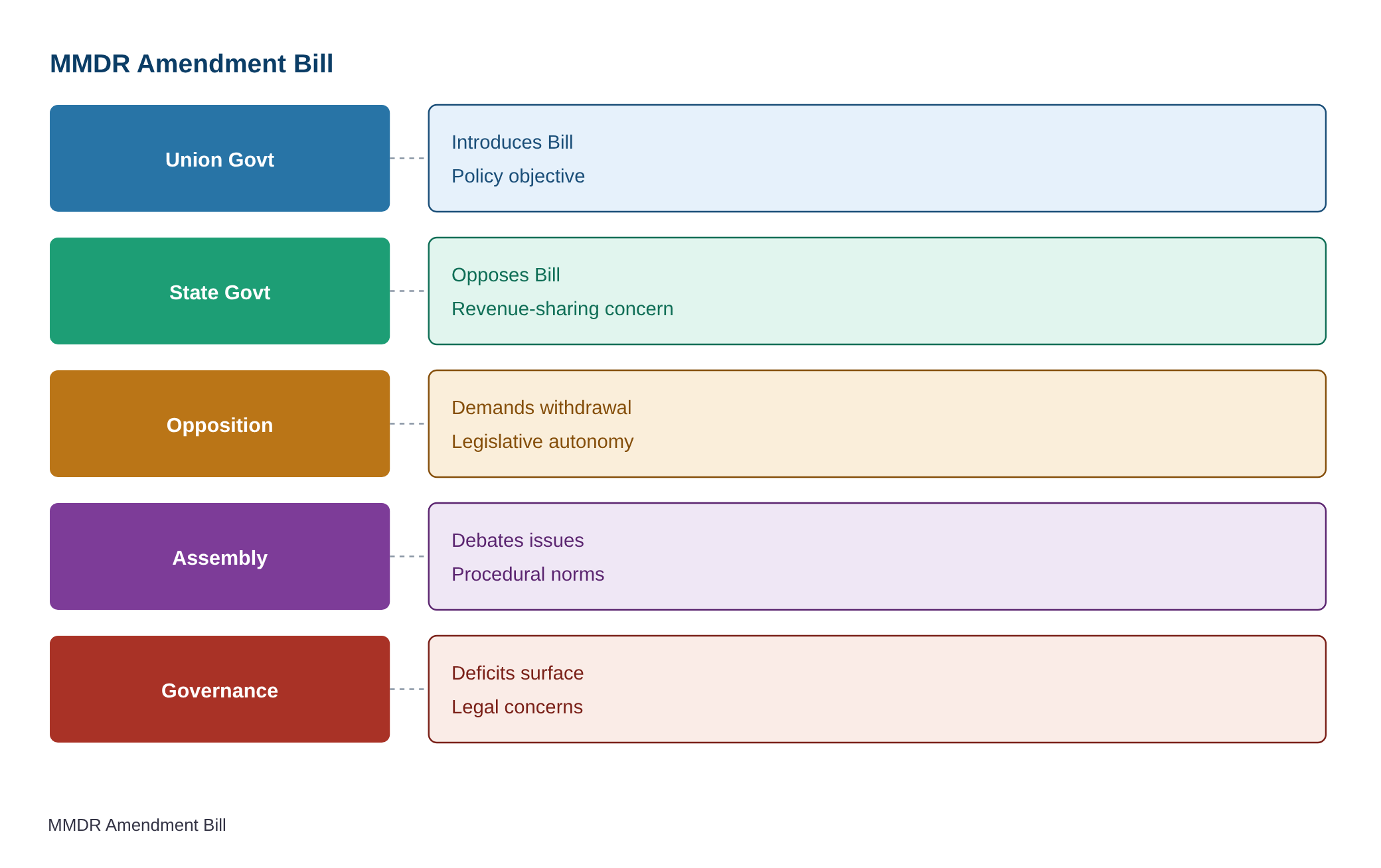
Centre introduces MMDR Amendment Bill in Parliament → State governments express concerns over federalism and revenue-sharing → Opposition in State Assembly demands withdrawal of the Bill → Legislative session convened to debate issues → Procedural norms (all-party meeting) fail to prevent disruptions → Governance deficits (textbook errors) surface, raising legal concerns under RTE Act → Short session duration limits comprehensive deliberations → Potential fiscal imbalances and law-and-order challenges emerge → Way forward: Inter-departmental committees, dialogue, and transparency measures proposed.
Prelims Practice Questions
Q1. Consider the following statements regarding the Mines and Minerals (Development and Regulation) Act, 1957 (MMDR Act):
1. The MMDR Act is a Union List subject under the Seventh Schedule of the Constitution of India.
2. The Act empowers the Central Government to exclusively regulate the mining of major minerals.
3. State governments are required to conduct mineral auctions as per the provisions of the MMDR Act.
4. The MMDR Amendment Bill, 2023 seeks to vest exclusive legislative competence over minor minerals with the Centre.
How many of the above statements are correct?
- Only one
- Only two
- Only three
- All four
Answer: Only three — Statement 1 is incorrect: mining and minerals are a Concurrent List subject (Entry 54). Statement 2 is incorrect: the Act provides for shared regulation, with states retaining certain powers. Statement 3 is correct: state governments conduct auctions for major minerals under the MMDR Act. Statement 4 is incorrect: the 2023 Amendment does not vest exclusive competence over minor minerals with the Centre.
Q2. Assertion (A): The Parliament of India can amend the Mines and Minerals (Development and Regulation) Act, 1957 to override state legislative competence over minor minerals.
Reason (R): Entry 54 of the Concurrent List empowers Parliament to legislate on matters relating to mining and minerals, including minor minerals, thereby superseding state laws.
In the context of the above two statements, which one of the following is correct?
- Both A and R are true, and R is the correct explanation of A
- Both A and R are true, but R is not the correct explanation of A
- A is true, but R is false
- A is false, but R is true
Answer: A is true, but R is false — Assertion (A) is true: Parliament can legislate on minor minerals under Entry 54. Reason (R) is true but is not the correct explanation: Entry 54 does not automatically supersede state laws; it requires a legislative act and may be subject to judicial review under federal principles.
Q3. Which of the following constitutional provisions empowers the State Legislatures to levy taxes on minerals located within the state?
- Article 246
- Entry 50 of the State List
- Entry 49 of the State List
- Article 265
Answer: Entry 49 of the State List — Entry 49 of the State List empowers state legislatures to levy taxes on lands and buildings, including minerals. Entry 50 pertains to taxes on mineral rights, which is the correct basis for state taxation of minerals under Entry 50 of the State List.
Mains Practice Question
✍ Critically examine the constitutional framework governing the regulation of minerals in India, with particular reference to the Mines and Minerals (Development and Regulation) Amendment Bill, 2023. How far does the Bill align with the principles of federalism enshrined in the Constitution? Also, discuss the implications of the Bill for state autonomy in mineral resource governance. (15 Marks)
Approach: MODEL-ANSWER SKELETON:
1. **Constitutional Framework**:
– Entry 54 (Concurrent List): Mining and minerals.
– Entry 49 (State List): Taxes on lands and buildings; Entry 50 (State List): Taxes on mineral rights.
– Article 246: Distribution of legislative powers.
– Doctrine of federalism: Balancing Centre-State powers.
2. **MMDR Act, 1957**:
– Original Act: Centralised regulation with state participation.
– Key provisions: Mineral concession rules, auction regime, revenue sharing.
– Constitutional validity: Supreme Court rulings on federal balance (e.g., State of West Bengal v. Union of India, 1963).
3. **MMDR Amendment Bill, 2023**:
– Key amendments: Centralised auction regime for major minerals, changes to minor mineral regulations.
– Provisions affecting state autonomy: Vesting of powers with the Centre, revenue sharing mechanisms.
– Controversies: Allegations of encroachment on state powers, lack of consultation with states.
4. **Federalism Principles**:
– Cooperative federalism vs. competitive federalism.
– Judicial interpretation: Landmark cases (e.g., State of Karnataka v. Union of India, 2020; Mineral Area Development Authority v. Steel Authority of India, 2021).
– Balance of powers: Centre’s role in national interest vs. state’s right to resource governance.
5. **Implications for State Autonomy**:
– Fiscal federalism: Impact on state revenue from minerals.
– Policy autonomy: State’s ability to design mineral policies.
– Legal recourse: States’ options under Article 131 (original jurisdiction of Supreme Court) or Article 256 (obligation of states to comply).
6. **Conclusion**:
– Alignment with federalism: Evaluate whether the Bill respects the constitutional balance.
– Recommendations: Suggest measures for harmonious Centre-State relations (e.g., consultations, revenue-sharing formulas).
Key thinkers/cases: Dr. B.R. Ambedkar’s views on federalism, Granville Austin’s ‘Working of a Democratic Constitution’, Supreme Court judgments on federal disputes.
Source: orissapost.com
Generated by AanyaAi for educational purpose.
Related guides on our sites
- Anthropology VS PSIR
- Best PSIR optional coaching
- Best PSIR optional coaching online
- Best PSIR optional teacher

- Odisha Assembly Monsoon Session: MMDR Bill Withdrawal Key Demand - September 19, 2026
- मध्य प्रदेश में स्वास्थ्य सेवाओं का विस्तार: पीपीपी मॉडल और एमबीबीएस सीटों में वृद्धि - September 19, 2026
- MP’s Health Sector Progress Reviewed by Union Health Minister JP Nadda - September 19, 2026

No Comments