


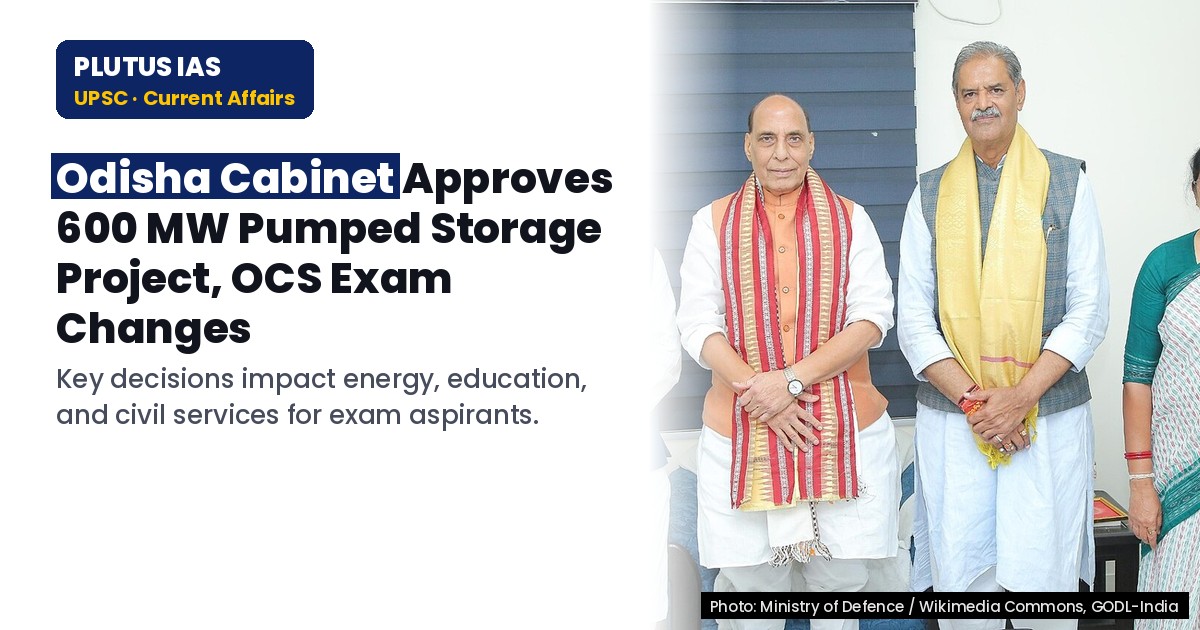
10 Nov Odisha Cabinet Approves Pumped Storage Project & OCS Exam Changes
✎ The Odisha cabinet has approved a 600 MW pumped storage project for energy grid stability, removed attempt limits for state civil services exams, launched a free college Wi-Fi initiative, and finalised the paddy procurement…
Subject Relevance — Where This Topic Fits
- GS Paper II — Governance and Social Justice | GS Paper III — Infrastructure, Energy, and Agriculture
- Prelims: Pumped Storage Project, Renewable Energy Storage, Grid Stability, Public Distribution System (PDS), Minimum Support Price (MSP), Odisha Civil Services Examination, Digital Infrastructure, State Cabinet Functions
- Essay: Sustainable Energy Development and Grid Modernisation in India, The Role of State Governments in Promoting Human Capital Development and Food Security
Quick Revision: The Odisha cabinet has approved a 600 MW pumped storage project for energy grid stability, removed attempt limits for state civil services exams, launched a free college Wi-Fi initiative, and finalised the paddy procurement policy for the 2026-27 Kharif Marketing Season.
Why is this in the news?
The Odisha cabinet recently approved several significant proposals, including a substantial investment in a 600 MW Upper Indravati Pumped Storage Project, aimed at enhancing the state’s energy storage capacity and grid stability. Additionally, key policy changes were sanctioned, such as the removal of attempt limits for the Odisha Civil Services Examination, the implementation of a free Wi-Fi project for college students, and the finalisation of the Paddy Procurement Policy for the Kharif Marketing Season 2026-27.
Background
- India’s increasing focus on renewable energy sources necessitates robust energy storage solutions to manage intermittency and ensure grid stability.
- Pumped storage projects are crucial for large-scale energy storage, absorbing surplus power during off-peak hours and releasing it during peak demand.
- State civil services examinations are a primary pathway for recruitment into the state administration, with rules governing attempts and age limits varying across states.
- Digital connectivity, particularly in educational institutions, is a key component of the Digital India initiative, aiming to bridge the digital divide and enhance learning opportunities.
- Paddy procurement policies are vital for ensuring food security and providing remunerative prices to farmers, forming a critical part of agricultural support mechanisms.
- The Public Distribution System (PDS) is a cornerstone of India’s food security architecture, providing essential commodities at subsidised rates through fair price shops.
Key Initiatives Approved by the Odisha Cabinet
- The 600 MW Upper Indravati Pumped Storage Project, located in Ranibahal, Kalahandi district, is the first of its kind in Odisha, with an estimated cost of Rs 4,708.64 crore.
- This project is designed to operate as a grid-scale energy storage system, generating approximately 1,040 million units of annual peak electricity by absorbing surplus power during off-peak periods.
- The Odisha Civil Services (Combined Competitive Recruitment Examination) Rules, 1991, have been amended to eliminate all restrictions on the number of attempts, allowing candidates to appear until they reach the prescribed upper age limit.
- The Odisha Shikshanet project, valued at Rs 393.62 crore, aims to provide free campus Wi-Fi with a daily limit of 1 GB across 601 colleges, benefiting approximately six lakh students.
- The Paddy Procurement Policy for the Kharif Marketing Season 2026-27 sets a target to procure at least 78 lakh metric tonnes of paddy from farmers at a rate of Rs 3,100 per quintal, with direct bank transfers for payments within 24-48 hours.
- Three proposals from the Water Resources Department, amounting to Rs 450 crore, were approved for in-stream storage projects and mega lift irrigation units, enhancing water management capabilities.
- The tenure of approximately 5,000 private fair price shop (PDS) dealers has been extended by one year, until September 30, 2027, to ensure continuity in the public distribution system.
Key Features
| Feature | Significance |
|---|---|
| 600 MW Upper Indravati Pumped Storage Project | First of its kind in Odisha, targeted for commissioning by FY 2030-31. |
| Rs 4,708.64 crore investment | Substantial capital outlay for energy infrastructure development. |
| Generation of 1,040 MU annual peak electricity | Addresses peak electricity demand and enhances grid stability. |
| Grid-scale energy storage system | Absorbs surplus electricity during off-peak hours and releases it during peak demand. |
| Elimination of OCS exam attempt limits | Allows candidates to appear for the Odisha Civil Services Examination until the prescribed upper age limit. |
| Odisha Shikshanet project (Rs 393.62 crore) | Provides free campus Wi-Fi (1 GB daily limit) to approximately six lakh students across 601 colleges. |
| Paddy Procurement Policy for Kharif Marketing Season 2026-27 | Procurement of at least 78 lakh metric tonnes of paddy at Rs 3,100 per quintal, with direct bank transfers to farmers. |
Why it Matters
Energy Security and Grid Stability
- The pumped storage project will enhance Odisha’s energy security by providing a reliable source of peak power, crucial for managing fluctuations in demand and supply.
- It acts as a grid-scale energy storage system, absorbing surplus renewable energy during off-peak hours and dispatching it during periods of high demand, thereby integrating intermittent renewable sources more effectively into the grid.
- The project contributes to a balanced energy mix, reducing reliance on conventional thermal power plants for peak load management and potentially lowering carbon emissions.
Economic Development and Infrastructure
- The substantial investment in the pumped storage project and other water resources initiatives stimulates economic activity, creates employment opportunities during construction and operation phases, and fosters industrial growth.
- Improved irrigation facilities through in-stream storage projects and mega lift irrigation units will boost agricultural productivity and farmer incomes, contributing to rural economic development.
- The development of robust energy infrastructure is a prerequisite for attracting further industrial investment and ensuring sustainable economic growth in the state.
Human Capital Development and Social Welfare
- The Odisha Shikshanet project, providing free Wi-Fi to college students, aims to bridge the digital divide, enhance access to educational resources, and promote digital literacy among the youth.
- Removing the cap on attempts for the Odisha Civil Services Examination promotes inclusivity and provides greater opportunities for aspirants to succeed, fostering a meritocratic public service.
- The Paddy Procurement Policy ensures fair prices for farmers’ produce, providing income stability and food security, which are critical components of social welfare.
Challenges
1. Environmental and Social Impact of Hydropower Projects
- Large-scale pumped storage projects often entail land acquisition, potential displacement of local communities, and alterations to local ecosystems, necessitating comprehensive environmental impact assessments and rehabilitation plans.
- The construction of dams and reservoirs can affect riverine ecology, biodiversity, and downstream water availability, requiring careful mitigation strategies.
- Ensuring sustainable water management practices is crucial to balance energy generation with ecological preservation and community needs.
UPSC Link: Environmental Impact Assessment, Sustainable Development
2. Project Implementation and Cost Overruns
- Large infrastructure projects are susceptible to delays in execution, cost overruns, and technical complexities, requiring robust project management and oversight mechanisms.
- Securing timely clearances, managing contractor performance, and addressing unforeseen geological or logistical challenges are critical for successful project completion within budget and timeline.
- Effective financial planning and risk management are essential to mitigate the economic burden of such capital-intensive projects.
UPSC Link: Infrastructure Development, Public-Private Partnerships
3. Digital Infrastructure and Access Equity
- While free Wi-Fi is provided, ensuring equitable access, reliable connectivity, and cybersecurity across all colleges, particularly in remote areas, remains a challenge.
- The effective utilization of digital resources depends on digital literacy and access to appropriate devices, which may vary among students.
- Maintaining and upgrading the digital infrastructure to meet evolving technological demands requires continuous investment and technical expertise.
UPSC Link: Digital India, Education Policy, Social Justice
4. Agricultural Market Dynamics and Procurement
- Paddy procurement policies, while beneficial for farmers, can face challenges related to storage infrastructure, quality control, and efficient payment mechanisms.
- Ensuring that the benefits of procurement reach all eligible farmers, including small and marginal farmers, and preventing leakages or exploitation by intermediaries, is crucial.
- Market price fluctuations and the impact of climate change on agricultural output can pose challenges to consistent procurement targets and farmer income stability.
UPSC Link: Agricultural Policy, Food Security, Farmer Welfare
Challenges — UPSC Perspective
| Issue | Concern |
|---|---|
| Land acquisition for pumped storage project | Potential displacement of communities and impact on livelihoods. |
| Environmental clearances and ecological balance | Ensuring minimal impact on biodiversity and riverine ecosystems. |
| Financial viability and project cost overruns | Managing the substantial investment and mitigating financial risks. |
| Quality and reliability of digital connectivity | Ensuring consistent and secure Wi-Fi access across all educational institutions. |
| Efficiency of paddy procurement and payment | Timely and transparent payments to farmers, and adequate storage. |
| Sustainability of water resources projects | Balancing irrigation needs with environmental considerations and water availability. |
Government Initiatives — Must-Memorise for Prelims
- Odisha Shikshanet project
- Paddy Procurement Policy for Kharif Marketing Season 2026-27
Way Forward
- Implement a robust environmental management plan for the pumped storage project, including comprehensive impact assessments and effective rehabilitation and resettlement policies.
- Establish a dedicated project monitoring unit with technical expertise to ensure timely execution, adherence to budget, and quality control for all infrastructure projects.
- Invest in advanced grid management technologies to optimize the integration of pumped storage with other renewable energy sources, enhancing grid stability and efficiency.
- Develop a comprehensive digital literacy program alongside the Wi-Fi provision to ensure students can effectively utilize online resources for educational and skill development purposes.
- Strengthen the agricultural procurement infrastructure, including storage facilities and digital payment systems, to ensure transparency, efficiency, and direct benefit transfer to farmers.
- Promote public awareness and stakeholder engagement for all major projects to foster community participation and address local concerns proactively.
- Conduct regular audits and impact assessments for all new policies, such as the OCS exam rule changes, to evaluate their effectiveness and make necessary adjustments.
UPSC Value Addition
Keywords for Mains Answer-Writing
Pumped Storage Projects · Renewable Energy Integration · Grid Stability · Energy Storage Systems · Peak Load Management · Sustainable Development · Infrastructure Development · State Civil Services Examination Reforms · Public Distribution System · Paddy Procurement Policy · Digital Education Initiatives · Fiscal Prudence
Constitutional & Policy Linkages
- {‘article’: ‘Article 246’, ‘note’: ‘Distribution of legislative powers’}
- {‘article’: ‘Seventh Schedule, List III (Concurrent List)’, ‘note’: ‘Electricity, economic and social planning’}
Concept Flow
Odisha Cabinet approves pumped storage project → Investment in energy infrastructure and storage capacity → Enhanced grid stability and peak power availability → Support for economic development and renewable energy integration → Improved educational access and farmer welfare through other policies
Prelims Practice Questions
Q1. Consider the following statements regarding Pumped Storage Projects (PSPs) in India:
1. PSPs primarily function as energy storage systems, absorbing surplus electricity during off-peak hours.
2. They are crucial for grid stability and integrating intermittent renewable energy sources like solar and wind.
3. The Upper Indravati Pumped Storage Project is the first such project approved in Odisha.
How many of the above statements are correct?
- Only one
- Only two
- All three
- None
Answer: All three — Statement 1 is correct: PSPs store energy by pumping water to an upper reservoir during low demand and generating power by releasing it through turbines during peak demand. Statement 2 is correct: Their ability to quickly ramp up or down makes them vital for balancing the grid and accommodating variable renewable generation. Statement 3 is correct: The news explicitly states that the Upper Indravati Pumped Storage Project is the first of its kind in Odisha.
Q2. Which of the following is NOT a primary benefit of Pumped Storage Projects (PSPs)?
- Providing grid stability and ancillary services.
- Facilitating the integration of intermittent renewable energy.
- Generating continuous baseload power.
- Managing peak electricity demand.
Answer: Generating continuous baseload power. — PSPs are designed for energy storage and peak load management, not for continuous baseload power generation. They operate by cycling between pumping and generating modes based on grid demand and energy availability.
Mains Practice Question
✍ Examine the significance of Pumped Storage Projects (PSPs) in achieving India’s renewable energy targets and ensuring grid stability. Discuss the challenges associated with their implementation and suggest measures to overcome them. (15 Marks)
Approach: The answer should begin by defining Pumped Storage Projects (PSPs) and their operational mechanism. It must then elaborate on their significance in the context of India’s renewable energy goals (e.g., 500 GW non-fossil fuel capacity by 2030, Net Zero by 2070) and their role in grid stability (e.g., peak load management, frequency regulation, black start capability, integration of intermittent renewables like solar and wind). Key challenges in implementation should be discussed, including high initial capital costs, long gestation periods, environmental and social impacts (e.g., land acquisition, displacement, ecological disruption), geological suitability, and regulatory hurdles. Measures to overcome these challenges should include policy support (e.g., ‘must-run’ status, financial incentives, simplified clearances), technological advancements, robust environmental impact assessments and rehabilitation plans, public-private partnerships, and capacity building.
Source: orissapost.com
Odisha PCS (OPSC (OAS)) — State PCS Practice
Prelims: The Odisha Cabinet recently approved a significant pumped storage project. What is the estimated cost of this project?
- A. Rs 2,500 crore
- B. Rs 3,800 crore
- C. Rs 4,708 crore
- D. Rs 5,200 crore
Answer: C. Rs 4,708 crore — The Odisha Cabinet approved a pumped storage project with an estimated cost of Rs 4,708 crore.
Mains: Discuss the significance and potential benefits of pumped storage projects for Odisha’s energy security and grid stability, in light of the recently approved Rs 4,708-crore project by the state cabinet.
Generated by AanyaAi for educational purpose.
Related guides on our sites

- DRI Foils Elephant Tusk Trafficking in Assam: UPSC & State PCS - November 10, 2026
- आयुष मंत्रालय की विशेष अभियान 6.0 में महत्वपूर्ण प्रगति - November 10, 2026
- SC on Cyber Criminals: No Bail, Jails Only for Them - November 10, 2026

No Comments