


30 Aug Odisha Women Lead Forest Conservation: PM Modi’s Mann Ki Baat Spotlight
✎ Community-led forest conservation models, such as those highlighted in Odisha and Nagaland, demonstrate how integrating livelihood diversification with ecological restoration can achieve sustainable development and climate goals.
Subject Relevance — Where This Topic Fits
- GS Paper II — Governance, Transparency and Accountability | GS Paper III — Environment, Conservation and Sustainable Development | GS Paper III — Issues Relating to Development and Management of Social Sector/Services relating to Health, Education, Human Resources
- Prelims: Community Forest Rights under FRA 2006, Eco-tourism as livelihood, Joint Forest Management (JFM), Mahua and Kendu leaf collection, Forest-dependent communities
- Essay: Sustainable livelihoods through conservation: Balancing ecology and economy, Role of grassroots initiatives in national development
Quick Revision: Community-led forest conservation models, such as those highlighted in Odisha and Nagaland, demonstrate how integrating livelihood diversification with ecological restoration can achieve sustainable development and climate goals.
Why is this in the news?
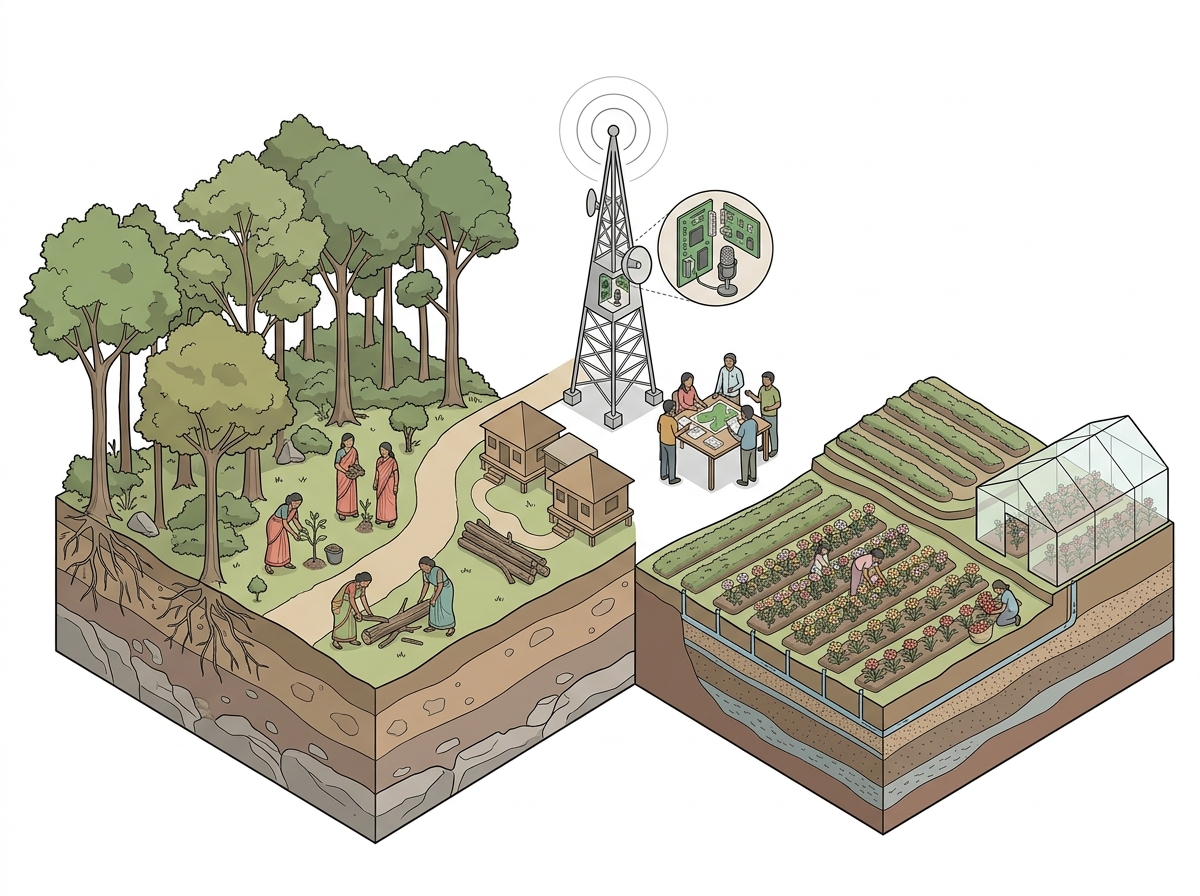
The 137th episode of the Prime Minister’s monthly radio programme, ‘Mann Ki Baat’, highlighted two distinct yet interconnected models of community-led natural resource management: (1) the role of women in forest conservation and eco-tourism in Odisha’s Debrigarh region, and (2) the transformation of a hobby into a livelihood through scientific flower cultivation in Nagaland’s Phek district. These examples underscore the potential of grassroots initiatives in achieving sustainable development goals while addressing climate change and rural poverty.
Background
- The Forest Rights Act (FRA), 2006, legally recognises the rights of forest-dwelling communities, including Scheduled Tribes and other traditional forest dwellers, to access and manage forest resources for livelihood and cultural practices.
- Joint Forest Management (JFM), introduced in the 1990s, promotes collaborative forest management between forest departments and local communities to restore degraded forests and enhance biodiversity.
- Eco-tourism has emerged as a sustainable livelihood option in forest-rich regions, integrating conservation with economic benefits for local communities.
- The National Mission for a Green India (GIM), launched under the National Action Plan on Climate Change (NAPCC), aims to enhance forest cover and improve ecosystem services through afforestation and participatory management.
- India’s Nationally Determined Contributions (NDCs) under the Paris Agreement include a commitment to create an additional carbon sink of 2.5 to 3 billion tonnes of CO2 equivalent through afforestation and reforestation by 2030.
- The Mahua and Kendu leaf collection is a traditional livelihood activity in central and eastern India, providing income to millions of forest-dependent households.
Community-led Conservation and Livelihood Diversification: Key Concepts and Models
- **Community Forest Rights (CFR) under FRA 2006**: Recognises the rights of forest-dwelling communities to access, use, and manage forest resources for livelihood, cultural, and subsistence needs. CFRs empower local communities to participate in forest governance and conservation efforts.
- The **Debrigarh Eco-Tourism Model**: Demonstrates how eco-tourism can be integrated with forest conservation to generate livelihoods. Women-led initiatives in Debrigarh have diversified income sources by engaging in activities such as wildlife protection, grassland restoration, and eco-tourism services, thereby reducing pressure on forest resources.
- **Scientific Flower Cultivation in Nagaland**: Illustrates the potential of horticulture as a livelihood option. Training in scientific cultivation techniques, access to markets, and value addition can transform traditional farming into a profitable enterprise, particularly for women and youth.
- **Joint Forest Management (JFM)**: A collaborative approach between forest departments and local communities to restore degraded forests. JFM committees, often comprising women, manage forest resources sustainably while ensuring equitable benefit-sharing.
- **Eco-tourism as a Conservation Tool**: Eco-tourism promotes biodiversity conservation by incentivising local communities to protect natural habitats. It also provides alternative livelihoods that reduce dependence on extractive forest activities like logging or overharvesting of non-timber forest products (NTFPs).
- **Non-Timber Forest Products (NTFPs)**: Include items such as Mahua flowers, Kendu leaves, bamboo shoots, and medicinal plants. These products provide supplementary income to forest-dependent communities and are often central to traditional livelihoods.
- **Gender and Conservation**: Women play a pivotal role in forest conservation due to their traditional knowledge of forest resources and their dependence on NTFPs for household needs. Their involvement in conservation efforts enhances both ecological outcomes and livelihood security.
- **Climate Change Mitigation and Adaptation**: Community-led conservation contributes to climate goals by enhancing carbon sequestration, reducing deforestation, and promoting climate-resilient livelihoods. Such models align with India’s NDCs and global commitments under the Paris Agreement.
Key Features
| Feature | Significance |
|---|---|
| Community-led forest conservation in Debrigarh, Odisha | Demonstrates how local participation, particularly of women, can integrate livelihood generation with environmental protection, aligning with India’s National Forest Policy 1988 and the National Mission for a Green India. |
| Integration of eco-tourism with forest conservation | Shows how sustainable livelihoods can be derived from natural resources without depleting them, supporting the objectives of the National Wildlife Action Plan (2017-2031) and the UN Sustainable Development Goal 15 (Life on Land). |
| Scientific training in alternative livelihoods (e.g., flower cultivation) | Highlights the role of skill development in transforming traditional practices into economically viable enterprises, consistent with the National Skill Development Mission and the Pradhan Mantri Kaushal Vikas Yojana. |
| Women’s leadership in natural resource management | Underscores the importance of gender-inclusive governance in environmental conservation, reflecting the constitutional mandate for gender equality (Article 15) and the National Policy for Women 2016. |
| Decentralised environmental governance through local institutions | Illustrates the effectiveness of gram panchayats and self-help groups in implementing conservation policies, in line with the 73rd Constitutional Amendment Act and the Forest Rights Act, 2006. |
Why it Matters
Environmental Conservation
- Reinforces the principle of participatory forest management, where local communities, especially women, act as stewards of biodiversity rather than mere beneficiaries of forest resources.
- Demonstrates how conservation can be economically rewarding, reducing pressure on forests by providing alternative income sources.
- Aligns with India’s commitment to the Paris Agreement (2015) and the Convention on Biological Diversity (CBD), particularly Target 1 of the Kunming-Montreal Global Biodiversity Framework.
Livelihood Security
- Provides a model for integrating traditional knowledge with modern agricultural and eco-tourism practices to enhance rural incomes.
- Reduces dependency on forest extraction by diversifying livelihood options, thereby mitigating climate-induced vulnerabilities in tribal and forest-dependent communities.
- Supports the objectives of the Mahatma Gandhi National Rural Employment Guarantee Scheme (MGNREGS) by creating local employment in conservation and allied sectors.
Social Empowerment
- Empowers women through leadership roles in natural resource management, enhancing their socio-economic status and decision-making authority within households and communities.
- Strengthens social capital by fostering collective action, which is critical for the success of community-based conservation initiatives.
- Promotes inter-generational knowledge transfer, ensuring the preservation of indigenous conservation practices.
Policy Relevance
- Serves as a case study for the implementation of the National Forest Policy 1988, which advocates for people’s participation in forest management.
- Demonstrates the practical application of the Forest Rights Act, 2006, which recognises the rights of forest-dwelling communities over forest resources.
- Provides empirical evidence for the effectiveness of the National Mission for a Green India, which aims to enhance forest cover and improve ecosystem services.
Challenges
1. Scalability of Community-Led Models
- Ensuring that successful local initiatives can be replicated across diverse ecological and socio-economic contexts without compromising ecological integrity.
- Addressing structural barriers such as limited access to credit, markets, and technical training for marginalised groups.
UPSC Link: GS-III: Environment & Ecology
2. Balancing Conservation with Livelihood Needs
- Preventing over-exploitation of forest resources while ensuring that alternative livelihoods do not lead to new forms of environmental degradation (e.g., monoculture plantations).
- Managing conflicts between conservation goals and the immediate economic needs of communities, particularly in times of economic distress.
UPSC Link: GS-III: Environment & Ecology
3. Institutional Capacity and Governance
- Strengthening the capacity of gram panchayats and self-help groups to manage conservation projects effectively and transparently.
- Ensuring equitable benefit-sharing mechanisms to prevent elite capture and ensure marginalised groups are not excluded from decision-making.
UPSC Link: GS-II: Governance
4. Climate Change and Ecological Vulnerability
- Mitigating the impacts of climate change on forest ecosystems, which can undermine the sustainability of community-led conservation efforts.
- Adapting conservation strategies to changing environmental conditions, such as altered rainfall patterns and increased frequency of extreme weather events.
UPSC Link: GS-III: Environment & Ecology
5. Market Access and Economic Viability
- Ensuring that products derived from eco-tourism and alternative livelihoods (e.g., flowers, bamboo) have stable and remunerative markets.
- Overcoming logistical challenges in transporting goods from remote forest areas to markets, which can increase costs and reduce profitability.
UPSC Link: GS-III: Economic Development
Challenges — UPSC Perspective
| Issue | Concern |
|---|---|
| Limited access to finance for women-led initiatives | Restricts the ability to scale up conservation projects or invest in necessary infrastructure. |
| Dependence on seasonal forest produce | Creates income instability, particularly for communities reliant on non-timber forest products (NTFPs). |
| Regulatory hurdles in land and forest rights | Delays in securing titles under the Forest Rights Act, 2006, can hinder community participation in conservation. |
| Climate-induced forest degradation | Alters ecosystem services, reducing the availability of forest resources and undermining livelihoods. |
| Lack of technical training in sustainable practices | Limits the adoption of scientific methods in forest management and alternative livelihoods. |
| Market fluctuations for eco-tourism and NTFPs | Affects the economic viability of conservation-linked enterprises. |
Way Forward
- Strengthen institutional support for women-led conservation groups through targeted capacity-building programmes under the National Rural Livelihood Mission (NRLM).
- Expand access to microfinance and credit facilities for forest-dependent communities to enable investment in sustainable livelihood projects.
- Integrate climate-resilient practices into community-led conservation models to mitigate the impacts of climate change on forest ecosystems.
- Develop market linkages for eco-tourism and non-timber forest products (NTFPs) to ensure stable and remunerative income streams.
- Enhance the role of gram panchayats in decentralised forest governance by providing them with technical and financial resources.
- Promote inter-state and international knowledge exchange programmes to replicate successful models like Debrigarh’s eco-tourism initiative.
- Incorporate gender-sensitive monitoring and evaluation frameworks in conservation projects to ensure equitable participation and benefit-sharing.
- Leverage digital platforms to provide real-time market information and training in sustainable practices for rural communities.
UPSC Value Addition
Keywords for Mains Answer-Writing
Community-based natural resource management · Women-led forest conservation · Eco-tourism as livelihood · Joint Forest Management (JFM) · Mahua and Kendu leaf collection · Forest Rights Act, 2006 · Sustainable forest management · Non-Timber Forest Products (NTFPs) · Decentralisation of forest governance · Gender and environmental governance
Concept Flow
Traditional forest-dependent livelihoods (e.g., firewood, NTFPs) → Over-exploitation and degradation of forest resources → Recognition of need for sustainable alternatives → Formation of women-led conservation groups → Training in eco-tourism and scientific practices → Generation of alternative livelihoods → Economic empowerment of women → Reinvestment in conservation → Scalability of the model → Policy integration (e.g., Forest Rights Act, 2006) → National and international recognition (e.g., SDGs, Paris Agreement).
Prelims Practice Questions
Q1. Consider the following statements regarding the Forest Rights Act, 2006:
1. It recognises the rights of forest-dwelling communities, including Scheduled Tribes and other traditional forest dwellers.
2. It provides for the conservation of forests and biodiversity by ensuring that the responsibilities of forest protection are shared with local communities.
3. The Act mandates the establishment of Forest Rights Committees at the village level to process claims.
4. It grants absolute ownership rights to forest dwellers over all forest land and resources.
How many of the above statements are correct?
- Only one
- Only two
- Only three
- All
Answer: Only three — Statements 1, 2, and 3 are correct as per the Forest Rights Act, 2006. Statement 4 is incorrect because the Act does not grant absolute ownership; it recognises individual and community rights subject to conservation and regulatory provisions.
Q2. Assertion (A): Joint Forest Management (JFM) is a collaborative approach involving forest departments and local communities in the management and protection of forests.
Reason (R): JFM aims to reduce the burden on forest departments by transferring all management responsibilities to local communities.
Options:
A. Both A and R are true, and R is the correct explanation of A.
B. Both A and R are true, but R is not the correct explanation of A.
C. A is true, but R is false.
D. A is false, but R is true.
- A
- B
- C
- D
Answer: C — Assertion (A) is true as JFM is indeed a collaborative approach. Reason (R) is false because JFM does not transfer all management responsibilities to local communities; it is a shared responsibility model.
Q3. Which of the following is NOT a Non-Timber Forest Product (NTFP)?
- Mahua flowers
- Kendu leaves
- Bamboo shoots
- Teak wood
Answer: Teak wood — Teak wood is a timber product, whereas Mahua flowers, Kendu leaves, and Bamboo shoots are classified as Non-Timber Forest Products (NTFPs) used for livelihood and commercial purposes.
Mains Practice Question
✍ ‘The success of community-led forest conservation initiatives hinges on the convergence of livelihood security and ecological sustainability.’ Critically examine this statement with reference to recent initiatives in India, such as the Forest Rights Act, 2006, and Joint Forest Management (JFM). Also, analyse the role of women in such initiatives. (15 Marks)
Approach: MODEL-ANSWER SKELETON:
1. Introduction (2 marks): Define community-led forest conservation and its significance in India’s forest governance.
2. Forest Rights Act, 2006 (4 marks):
– Key provisions: Recognition of forest rights, individual and community claims, and conservation responsibilities.
– Role in empowering forest-dwelling communities, including women.
– Challenges: Delayed implementation, bureaucratic hurdles, and conflicts over land titles.
3. Joint Forest Management (JFM) (4 marks):
– Definition and objectives: Collaborative forest management between forest departments and local communities.
– Role in livelihood generation (e.g., NTFPs, eco-tourism) and ecological sustainability.
– Limitations: Limited autonomy for communities, power imbalances, and sustainability concerns.
4. Women’s role (3 marks):
– Empowerment through participation in forest conservation (e.g., Debrigarh case study).
– Challenges: Gender disparities in decision-making, access to resources, and socio-cultural barriers.
5. Conclusion (2 marks): Balancing livelihood and ecology requires stronger institutional support, capacity building, and policy integration. Highlight the need for gender-inclusive approaches.
Source: orissapost.com
Odisha PCS (OPSC (OAS)) — State PCS Practice
Prelims: Which of the following initiatives was specifically highlighted by PM Modi in his ‘Mann Ki Baat’ episode for Odisha women’s contribution to forest conservation?
- A. Van Mitra Scheme
- B. Mission Shakti
- C. Mahila Samriddhi Yojana
- D. Odisha Forest Rights Act
Answer: B. Mission Shakti — PM Modi praised the ‘Mission Shakti’ initiative of Odisha for empowering women to lead forest conservation efforts.
Mains: Discuss the significance of Odisha’s ‘Mission Shakti’ initiative in promoting women-led forest conservation, with reference to its impact on socio-economic empowerment and environmental sustainability.
Generated by AanyaAi for educational purpose.
Related guides on our sites
- Current affairs for upsc 2026
- Best sociology optional coaching for upsc
- Which is best sociology optional coaching for upsc
- Best teacher of sociology optional for upsc

- UPSC Alert: 40-Day ‘Khet Bachao Abhiyan’ Launch by Union Minister - October 22, 2026
- भारत ने बताया UN रिपोर्ट में दाऊद इब्राहिम को ‘भारत-आधारित’ बताना ‘गलत’ - October 22, 2026
- GRAP Stage I activated in Delhi-NCR amid rising AQI: Key actions for aspirants - October 22, 2026

No Comments