


18 Sep Odisha Women’s FPO Launches Dual-Use Solar Farm on 13 Acres
✎ PM-KUSUM Component-A supports decentralised grid-connected solar power plants on agricultural land under agri-voltaic systems, enabling dual land use for food and energy production while enhancing farmers’ income and promoting…
Subject Relevance — Where This Topic Fits
- GS Paper III — Agriculture | GS Paper III — Environment and Sustainable Development | GS Paper III — Energy | GS Paper III — Rural Development
- Prelims: PM-KUSUM Scheme, Farmers’ Producer Organisations (FPOs), Agri-voltaics, Renewable Purchase Obligations (RPO), KUSUM Component-C
- Essay: Sustainable agriculture and energy security: Pathways for rural transformation, Women-led development: Empowerment through technology and entrepreneurship
Quick Revision: PM-KUSUM Component-A supports decentralised grid-connected solar power plants on agricultural land under agri-voltaic systems, enabling dual land use for food and energy production while enhancing farmers’ income and promoting sustainable agriculture.
Why is this in the news?
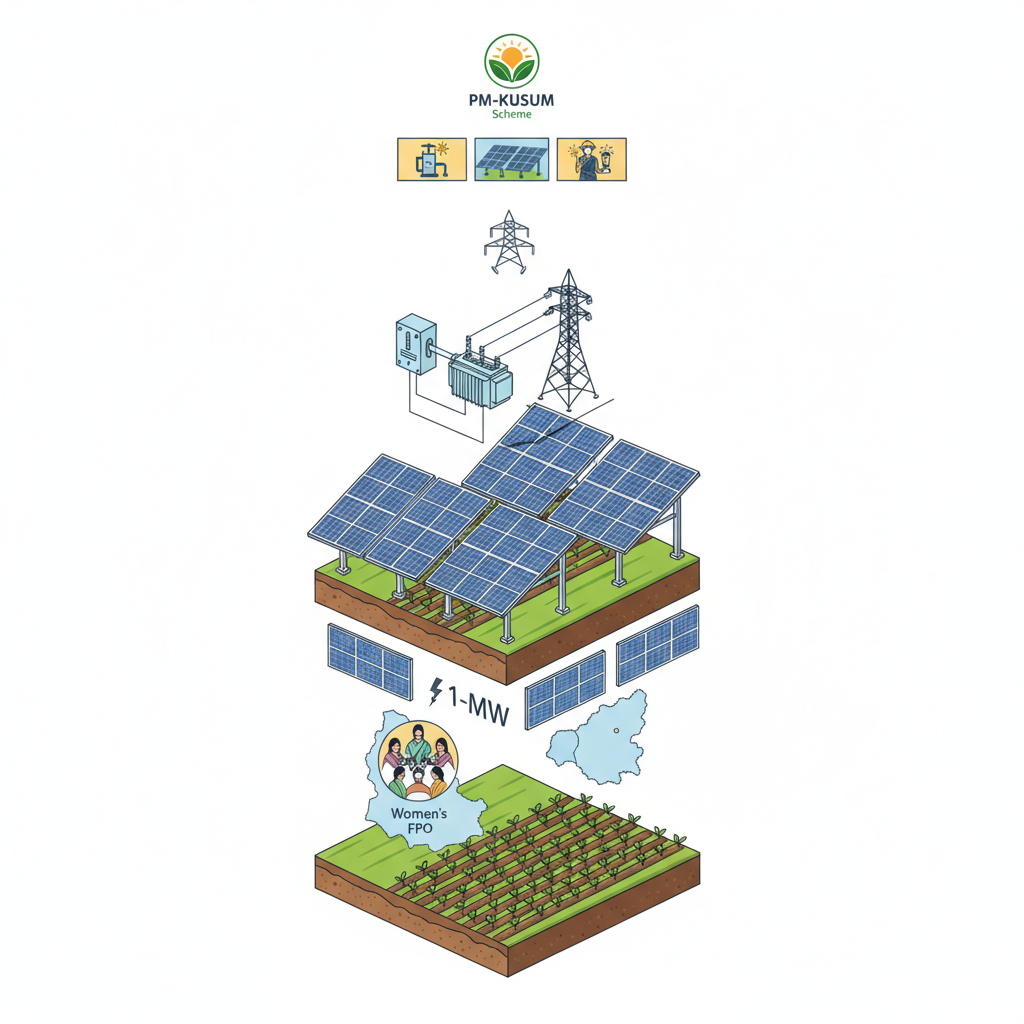
A women-led Farmers’ Producer Organisation (FPO) in Koraput, Odisha, has successfully implemented a 1-megawatt (MW) solar power project on 13 acres of agricultural land under the PM-KUSUM Scheme, integrating energy generation with traditional farming. This initiative, the first of its kind in Odisha under PM-KUSUM, demonstrates the potential of community-based agri-solar models to enhance rural incomes, promote sustainable energy, and empower women farmers through technological adoption and collective enterprise.
Background
- The PM-KUSUM (Pradhan Mantri Kisan Urja Suraksha evam Utthaan Mahabhiyaan) Scheme, launched in 2019 by the Ministry of New and Renewable Energy (MNRE), aims to provide financial and infrastructure support for the installation of solar pumps and grid-connected solar power plants by farmers and FPOs. The scheme has three components: Component-A (10,000 MW of decentralised ground-mounted grid-connected renewable power plants), Component-B (installation of 20 lakh standalone solar agriculture pumps), and Component-C (solarisation of 15 lakh grid-connected agriculture pumps).
- Component-A of PM-KUSUM specifically supports the establishment of solar power plants on barren or cultivable wasteland, with a provision for utilisation of agricultural land under agri-voltaic systems, where solar panels are installed above crops to enable dual land use.
- The scheme incentivises FPOs, cooperatives, and individual farmers to adopt renewable energy solutions, aligning with the national targets of 450 GW renewable energy capacity by 2030 and doubling farmers’ income by 2022 (extended to 2025).
- Women-led FPOs have emerged as key stakeholders in rural development, supported by government schemes such as the DAY-NRLM (Deendayal Antyodaya Yojana-National Rural Livelihoods Mission) and initiatives by NGOs like Heifer International and Passing Gift, which provide technical and financial assistance for sustainable livelihood projects.
- Odisha, with its significant agricultural and horticultural potential, has been a focus for pilot projects under PM-KUSUM, particularly in tribal and remote districts like Koraput, where land fragmentation and low productivity pose challenges to income generation.
- The concept of agri-voltaics, where solar panels are installed at a height sufficient to allow farming activities below, has gained traction globally as a solution to land-use conflicts between food and energy production, while also mitigating climate change impacts on agriculture.
Agri-Solar Models under PM-KUSUM: Key Features and Benefits
- Dual Land Use: The agri-solar model enables farmers to utilise the same land for both agriculture and solar power generation. Solar panels are installed at a height of 3-4 metres, allowing sunlight to reach the crops while generating electricity. This approach maximises land productivity and diversifies income sources for farmers.
- Income Diversification: The Koraput project exemplifies how FPOs can leverage agri-solar models to generate additional revenue streams. The FPO earns income from both agricultural produce (ginger, turmeric, millets, and horticultural crops) and electricity sales to Tata Power, with Tata Power paying the FPO at least ₹50 lakh annually.
- Empowerment of Women Farmers: The initiative is led by a women-led FPO, Alekh Mahima, comprising 513 women farmers from eight panchayats. Such models align with the government’s focus on women-led development under schemes like DAY-NRLM and the Mahila Kisan Sashaktikaran Pariyojana (MKSP), which aim to enhance the participation of women in agriculture and allied sectors.
- Sustainable Agriculture: The integration of solar power with farming practices supports sustainable agriculture by reducing dependence on fossil fuels, lowering carbon emissions, and providing farmers with a reliable energy source for irrigation, processing, and value addition. This is particularly relevant in regions like Koraput, where climate variability and water scarcity are growing concerns.
- Technological Adoption and Training: The project involved technical training and capacity-building for women farmers, including exposure visits to similar initiatives in Uttar Pradesh. This highlights the role of NGOs, government departments, and technical agencies in facilitating knowledge transfer and skill development for rural communities.
- Market Linkages and Value Addition: The FPO’s focus on market demand-driven agriculture and the sale of produce to consumers ensures better price realisation for farmers. Additionally, the electricity generated can be sold to discoms under long-term power purchase agreements (PPAs), providing a stable income source.
- Scalability and Replicability: The Koraput project serves as a model for other states and regions facing land constraints or low agricultural productivity. Its success could encourage the adoption of agri-solar models in other parts of India, particularly in tribal and rainfed areas where diversification of livelihoods is critical.
Key Features
| Feature | Significance |
|---|---|
| Dual-purpose land use | Demonstrates integrated land utilisation where agricultural productivity and solar energy generation coexist on the same parcel, enhancing land efficiency. |
| Women-led FPO model | Showcases the role of women-led Farmers’ Producer Organisations in rural economic empowerment and collective entrepreneurship. |
| Community pooling of land | Illustrates the pooling of fragmented land holdings (13 acres from five landowners) for a larger productive purpose under the FPO framework. |
| PM-KUSUM Yojana linkage | Represents the first community-based agricultural solar power project in Odisha under the Pradhan Mantri Kisan Urja Suraksha evam Utthaan Mahabhiyaan, a central scheme promoting solarisation of agriculture. |
| Technology integration in agriculture | Highlights the adoption of solar technology as a supplementary income stream (‘third crop’) while maintaining traditional agricultural practices. |
Why it Matters
Economic
- Provides additional annual income of ₹50 lakh to the FPO through solar power sales, augmenting agricultural earnings.
- Enhances income diversification for 513 women farmers, reducing dependence on seasonal agricultural income.
- Demonstrates potential for rural energy entrepreneurship, aligning with the ‘Atmanirbhar Bharat’ vision.
- Attracts investment in rural infrastructure and technology, fostering local economic growth.
Environmental
- Promotes renewable energy adoption in agriculture, reducing carbon footprint associated with conventional energy sources.
- Dual land use minimises land degradation and deforestation pressures by utilising existing farmland for energy generation.
- Supports Odisha’s renewable energy targets under the State Action Plan on Climate Change.
Social
- Empowers women farmers through collective action, skill development, and leadership in rural governance structures.
- Strengthens rural women’s participation in decision-making processes related to agriculture and energy.
- Serves as a replicable model for other marginalised communities seeking livelihood diversification.
Governance
- Demonstrates effective convergence of central (PM-KUSUM), state, and district-level initiatives for rural development.
- Showcases the role of FPOs as institutional platforms for grassroots governance and service delivery.
- Highlights the importance of technical and financial support from NGOs and government agencies in rural innovation.
Challenges
1. Land Tenure and Fragmentation
- Fragmented land holdings pose challenges in pooling and managing land for large-scale projects.
- Legal ambiguities in land ownership and leasing arrangements may complicate long-term project sustainability.
UPSC Link: Land Reforms (Article 39(b), Directive Principles)
2. Technical and Operational Capacity
- Limited technical expertise among rural women farmers in managing solar infrastructure and grid connectivity.
- Dependence on external agencies (e.g., Heifer International) for training and maintenance may create sustainability risks.
UPSC Link: Skill Development (Article 21A, Fundamental Duties)
3. Market and Revenue Risks
- Fluctuations in solar power tariffs or delays in power purchase agreements (PPAs) could impact revenue streams.
- Market volatility in agricultural produce may affect the dual-income model’s stability.
UPSC Link: Agricultural Marketing (APMC Act, State List)
4. Policy and Regulatory Hurdles
- Complexities in availing subsidies under PM-KUSUM, including delayed disbursements and bureaucratic delays.
- Grid integration challenges, especially in remote areas like Koraput, may hinder efficient power transmission.
UPSC Link: Electricity Act, 2003 (Concurrent List)
5. Social and Cultural Barriers
- Resistance to adopting non-traditional livelihoods (e.g., solar energy) among conservative rural communities.
- Gender-based constraints in accessing training, credit, and decision-making roles within the FPO.
UPSC Link: Women Empowerment (Article 15, Fundamental Rights)
Challenges — UPSC Perspective
| Issue | Concern |
|---|---|
| Land pooling challenges | Fragmented holdings and legal ambiguities in land ownership may delay or complicate project implementation. |
| Technical skill gaps | Limited expertise in solar technology and grid management among rural women farmers. |
| Revenue uncertainty | Dependence on external agencies for training and maintenance; market risks in agricultural produce. |
| Policy implementation gaps | Delays in subsidy disbursement and bureaucratic hurdles under PM-KUSUM. |
| Grid integration issues | Remote location of Koraput may pose challenges in efficient power transmission and distribution. |
| Social acceptance barriers | Cultural resistance to adopting solar energy as a livelihood option in traditional farming communities. |
Government Initiatives — Must-Memorise for Prelims
- Pradhan Mantri Kisan Urja Suraksha evam Utthaan Mahabhiyaan (PM-KUSUM)
- State Action Plan on Climate Change (Odisha)
- Mahatma Gandhi National Rural Employment Guarantee Scheme (MGNREGS) for skill development
Way Forward
- Strengthen institutional capacity of FPOs through targeted skill development programmes in solar technology and agricultural management.
- Simplify land pooling processes by streamlining legal frameworks for collective land use in rural projects.
- Enhance convergence between PM-KUSUM and state-level schemes to reduce bureaucratic delays in subsidy disbursement.
- Promote public-private partnerships (PPPs) to provide technical and financial support for scaling similar projects.
- Develop market linkages for solar power and agricultural produce to ensure stable revenue streams for FPOs.
- Expand training programmes for women farmers on dual-use land management and renewable energy technologies.
- Establish a monitoring and evaluation framework to assess the project’s socio-economic and environmental impact.
- Document and disseminate best practices from the Kulabir project to replicate in other districts and states.
UPSC Value Addition
Keywords for Mains Answer-Writing
Women-led Farmers’ Producer Organisations (FPOs) · Agri-voltaics · PM-KUSUM Scheme · Community-based renewable energy · Integrated farming systems · Women empowerment in agriculture · Solar power generation · Farmland dual-use · Sustainable livelihoods · Odisha renewable energy initiatives · Agricultural diversification · Energy security and rural development · Convergence of agriculture and energy sectors · Decentralised energy production · Farmers’ income augmentation
Constitutional & Policy Linkages
- Directive Principles of State Policy (Article 39(b) – equitable distribution of resources)
- Fundamental Duties (Article 51A(g) – protection of environment)
- Fundamental Rights (Article 15 – gender equality)
- State List (Entry 14 – Agriculture; Entry 38 – Electricity)
Concept Flow
Women farmers face income volatility due to seasonal agriculture → Formation of Alekh Mahima FPO to pool resources and diversify livelihoods → Identification of solar energy as a supplementary income source → Application for PM-KUSUM scheme to access subsidies and technical support → Land pooling and infrastructure setup for dual-purpose agricultural-solar project → Installation of 1,735 solar panels generating 1 MW of electricity → Sale of electricity to Tata Power, generating ₹50 lakh annually → Reinvestment of earnings into agricultural productivity and community welfare → Replication potential as a model for integrated rural development.
Prelims Practice Questions
Q1. Consider the following statements regarding the PM-KUSUM Scheme:
1. It aims to provide financial and water security to farmers by promoting solarisation of grid-connected agriculture pumps.
2. The scheme includes three components: solar pumps, grid-connected solar power plants, and solarisation of existing grid-connected agriculture pumps.
3. The scheme is implemented by the Ministry of New and Renewable Energy (MNRE) with no involvement of state governments.
4. The scheme allows for the installation of solar power plants on barren or fallow land, not on farmland.
How many of the above statements are correct?
- Only one
- Only two
- Only three
- All four
Answer: Only three — Statements 1 and 2 are correct as per the official PM-KUSUM Scheme guidelines. Statement 3 is incorrect because state governments play a key role in implementation. Statement 4 is incorrect as the scheme permits solar power plants on farmland under the agri-voltaic component.
Q2. Assertion (A): The PM-KUSUM Scheme mandates that solar power plants installed under Component-C must be set up on barren or fallow land exclusively.
Reason (R): The scheme aims to avoid any conflict with agricultural land use and prioritise non-arable land for solar power generation.
In the context of the above two statements, which of the following is correct?
- Both A and R are true, and R is the correct explanation of A.
- Both A and R are true, but R is not the correct explanation of A.
- A is true, but R is false.
- A is false, but R is true.
Answer: A is false, but R is true. — Assertion (A) is false because the PM-KUSUM Scheme permits solar power plants on farmland under Component-B (grid-connected solar power plants) and Component-C (solarisation of existing pumps), including agri-voltaic systems. Reason (R) is true as the scheme encourages utilisation of non-arable land but does not mandate exclusivity.
Q3. Match the following components of the PM-KUSUM Scheme with their respective objectives:
Column I (Component) | Column II (Objective)
1. Component-A | A. Solarisation of existing grid-connected agriculture pumps
2. Component-B | B. Installation of stand-alone solar pumps
3. Component-C | C. Setting up grid-connected solar power plants on farmland
Select the correct match:
- 1-B, 2-C, 3-A
- 1-C, 2-A, 3-B
- 1-B, 2-A, 3-C
- 1-A, 2-C, 3-B
Answer: 1-C, 2-A, 3-B — Component-A involves the installation of stand-alone solar pumps. Component-B pertains to solarisation of existing grid-connected agriculture pumps. Component-C covers the setting up of grid-connected solar power plants, including on farmland under agri-voltaic systems.
Mains Practice Question
✍ The convergence of agriculture and renewable energy sectors through models like agri-voltaics represents a transformative approach to sustainable livelihoods in rural India. Critically examine the potential of such integrated systems in addressing the twin challenges of food security and energy access, with reference to the PM-KUSUM Scheme and recent initiatives like the Odisha women-led FPO project. Also, analyse the socio-economic and environmental implications of such models. (15 Marks)
Approach: MODEL-ANSWER SKELETON:
1. **Introduction (2 marks)**
– Define agri-voltaics and its significance as a dual-use land system combining agriculture and solar power generation.
– Contextualise with the PM-KUSUM Scheme’s objectives: solarisation of agriculture, water and energy security, and farmers’ income augmentation.
2. **PM-KUSUM Scheme: Framework and Components (3 marks)**
– Briefly outline the three components of PM-KUSUM:
– Component-A: Stand-alone solar pumps for irrigation.
– Component-B: Solarisation of existing grid-connected agriculture pumps.
– Component-C: Grid-connected solar power plants, including agri-voltaic systems on farmland.
– Highlight the scheme’s financial outlay (Rs 34,422 crore) and target of 30.8 GW solar capacity by 2026.
3. **Case Study: Odisha Women-led FPO Project (3 marks)**
– Describe the project: 1 MW solar plant on 13 acres of farmland, dual-use model, and income generation (Rs 50 lakh annually from Tata Power).
– Explain the socio-economic benefits: additional income (Rs 3–4 lakh per woman annually), women empowerment, and market linkages for agricultural produce.
– Highlight the role of institutions: FPO structure, Heifer International, Passing Gift, and district agriculture departments.
4. **Potential in Addressing Food Security and Energy Access (3 marks)**
– **Food Security**: Agri-voltaics enable continued agricultural production on the same land, ensuring no compromise on food output while generating energy.
– **Energy Access**: Decentralised solar power generation enhances energy security in rural areas, reducing dependence on grid electricity for agriculture.
– **Climate Resilience**: Reduced carbon footprint through renewable energy adoption and sustainable land use practices.
5. **Socio-Economic and Environmental Implications (2 marks)**
– **Socio-Economic**:
– Income diversification for farmers, particularly women-led FPOs.
– Potential for scaling up similar models to enhance rural livelihoods.
– Challenges: High initial capital costs, technical expertise requirements, and market risks.
– **Environmental**:
– Reduced greenhouse gas emissions through solar power adoption.
– Land-use efficiency and avoidance of deforestation or land degradation.
– Potential trade-offs: Impact on microclimate due to shading from solar panels and long-term soil health.
6. **Conclusion and Way Forward (2 marks)**
– Summarise the transformative potential of agri-voltaics in achieving sustainable development goals (SDGs 1, 2, 7, and 13).
– Recommendations:
– Strengthening institutional support (training, financing, and market linkages).
– Policy incentives for scaling agri-voltaic models, including subsidies and tax benefits.
– Research and development to optimise crop selection and solar panel placement for maximum yield and energy generation.
Source: orissapost.com
Generated by AanyaAi for educational purpose.
Related guides on our sites
- Best sociology optional coaching
- Best coaching for sociology optional
- Best sociology optional coaching online
- is sociology good optional

- Odisha Women’s FPO Launches Dual-Use Solar Farm on 13 Acres - September 18, 2026
- AI हथियारीकरण का खतरा: क्या सचमुच डराने-धमकाने की रणनीति? - September 18, 2026
- AI Weaponisation Scare: Profit-Driven Hype or Real Threat for UPSC? - September 18, 2026

No Comments