


22 Jul Odisha’s Blue Economy Boost: PMMSY’s ₹1,301 Crore Push for Fisheries
Subject Relevance — Where This Topic Fits
- GS Paper III — Agriculture, Animal Husbandry and Fisheries; GS Paper III — Food Processing and Technology; GS Paper III — Government Budgeting and Financial Inclusion
- Prelims: Blue Economy, PMMSY, Kisan Credit Card (KCC), Aqua Parks, Fisheries Infrastructure, Sustainable Fisheries, Value Chain Development, Subvention on KCC Loans
- Essay: Blue Economy as a Sustainable Development Paradigm: Balancing Economic Growth and Environmental Conservation, Role of Government Schemes in Transforming Rural Livelihoods: A Case Study of Fisheries Sector Reforms
Quick Revision: The PMMSY is India’s flagship scheme through infrastructure development, sustainability, and financial inclusion, with Odisha leveraging ₹1,301.18 crore for integrated aqua parks, modern fish markets, and subsidised KCC loans.
Why is this in the news?
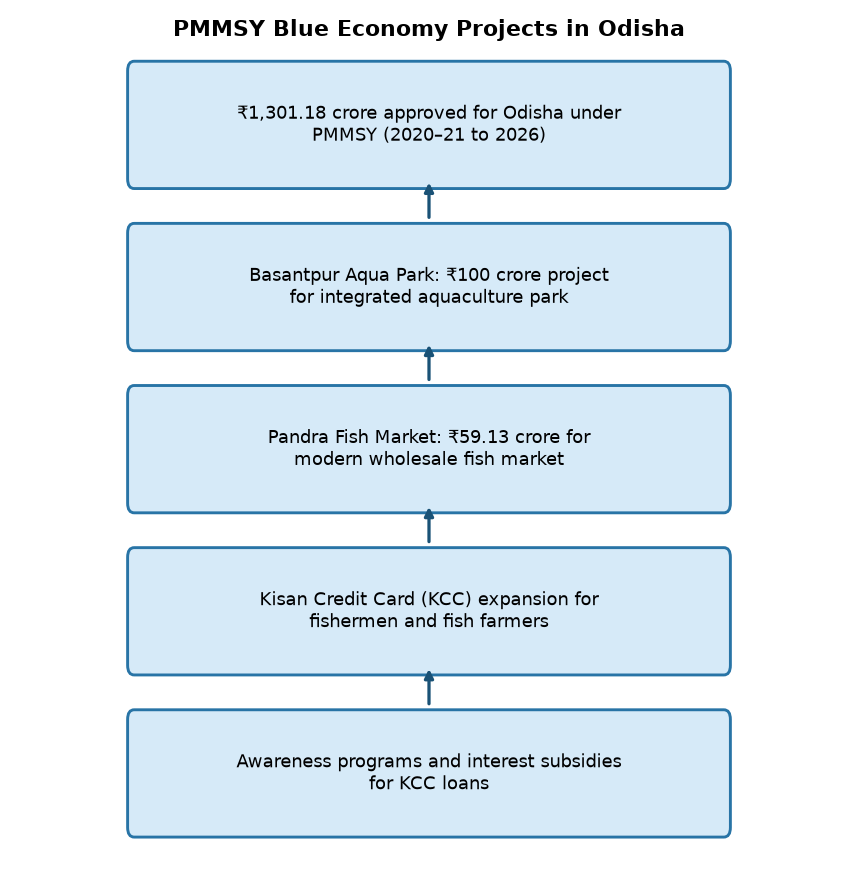
The Press Information Bureau (PIB) released a detailed update on 22 July 2026 highlighting Odisha’s strategic deployment of the Pradhan Mantri Matsya Sampada Yojana (PMMSY) to advance its Blue Economy agenda. The release underscores the approval of ₹1,301.18 crore for fisheries development projects in Odisha, including a ₹100 crore integrated aqua park in Sambalpur and a ₹59.13 crore modern wholesale fish market in Bhubaneswar, alongside expanded financial inclusion measures such as subsidised Kisan Credit Cards for fishers. This intervention is significant for UPSC aspirants as it integrates infrastructure development, sustainability, and financial access—core themes in India’s blue growth strategy and the PMMSY’s implementation framework.
Background
- The Pradhan Mantri Matsya Sampada Yojana (PMMSY) was launched in September 2020 under the aegis of the Ministry of Fisheries, Animal Husbandry and Dairying to enhance fish production, productivity, and sustainability in India.
- Odisha, with a coastline of 480 km and significant inland water resources, is a key contributor to India’s fisheries sector, accounting for approximately 6% of the national marine fish production and 3% of inland fish production.
- The Blue Economy concept, adopted by the Government of India, emphasises sustainable utilisation of ocean and aquatic resources for economic growth, improved livelihoods, and ecosystem health, aligning with SDG 14 (Life Below Water).
- The PMMSY is a flagship scheme under the Blue Economy framework, aiming to create employment for 5.5 million people.
- Financial inclusion in the fisheries sector has historically been constrained by high risk perception and lack of collateral among fishers, necessitating targeted interventions like Kisan Credit Cards (KCC) and interest subvention schemes.
- The PMMSY’s focus on integrated infrastructure—such as aqua parks, wholesale markets, and processing units—reflects a shift from fragmented interventions to holistic value chain development in the fisheries sector.
What is the Pradhan Mantri Matsya Sampada Yojana (PMMSY)?
- Launched in September 2020 as a Centrally Sponsored Scheme under the Ministry of Fisheries, Animal Husbandry and Dairying.
- Promotes sustainable aquaculture practices, including recirculatory aquaculture systems (RAS), cage culture, and integrated multi-trophic aquaculture (IMTA).
Key Features
| Feature | Significance |
|---|---|
| Integrated Aqua Park at Basantpur, Sambalpur (₹100 crore) | Establishes a modern aquaculture value chain with in-house hatchery, grow-out ponds, processing units, research facilities, and wastewater treatment—enhancing production efficiency and reducing post-harvest losses. |
| Modern Wholesale Fish Market at Pandra, Bhubaneswar (₹59.13 crore) | Introduces a state-of-the-art market with 44 wholesale and 99 retail units, incorporating renewable energy systems and rainwater harvesting to improve sustainability and reduce carbon footprint. |
| Kisan Credit Card (KCC) Expansion for Fisheries | Facilitates timely access to working capital for fishers and aquaculture farmers, with interest subsidies (4% for loans ≤ ₹1 lakh and 2% for ₹1–3 lakh) making credit more affordable and reducing financial barriers. |
| Central-State Coordination Mechanism | Ensures seamless implementation of PMMSY through collaboration between the Department of Fisheries, State Governments, and SLBCs for effective fund disbursal and monitoring. |
| Awareness Campaigns and Subsidy Schemes | State-led initiatives, including fisheries and livestock fairs and district-level meetings, enhance beneficiary participation and uptake of PMMSY schemes. |
Why it Matters
Economic
- Strengthens Odisha’s blue economy by modernising aquaculture and fisheries infrastructure, thereby increasing productivity and export potential.
- Enhances value addition through integrated processing units, reducing dependency on raw material exports and improving farmer incomes.
- Promotes sustainable practices via renewable energy integration and wastewater management, aligning with global climate commitments.
Strategic
- Bolsters food security by augmenting fish production, addressing protein deficiency, and supporting nutritional goals under national nutrition programmes.
- Reduces post-harvest losses through modern storage and processing facilities, ensuring higher returns for stakeholders.
- Supports coastal and inland fisheries, diversifying livelihoods and reducing pressure on over-exploited marine resources.
Social
- Empowers marginalised fishing communities by providing financial inclusion through KCC and interest subsidies, reducing debt burdens.
- Creates employment opportunities across the fisheries value chain, from hatcheries to retail markets, benefiting rural and tribal populations.
- Enhances gender inclusion as women often play key roles in fish processing and marketing, with improved infrastructure enabling their participation.
Environmental
- Adopts circular economy principles via wastewater treatment and renewable energy use, minimising ecological degradation.
- Promotes responsible aquaculture practices to mitigate risks of disease outbreaks and environmental pollution from traditional methods.
Challenges
1. Climate Vulnerability
- Coastal fisheries in Odisha are highly susceptible to cyclones, storm surges, and sea-level rise, threatening infrastructure and livelihoods.
- Inland aquaculture faces risks from erratic monsoons and water scarcity, impacting pond-based farming systems.
UPSC Link: GS3: Disaster Management
2. Infrastructure Gaps
- Inadequate cold chain and storage facilities lead to post-harvest losses, estimated at 20-30% in traditional supply chains.
- Limited access to modern processing units in remote areas increases dependency on intermediaries, reducing farmer profits.
UPSC Link: GS3: Food Processing Industries
3. Financial Inclusion Barriers
- Low awareness and documentation gaps among small-scale fishers hinder KCC uptake, despite subsidy benefits.
- High collateral requirements for larger loans deter marginal farmers from scaling up operations.
UPSC Link: GS3: Financial Inclusion
4. Market Linkages and Price Fluctuations
- Weak market integration results in price volatility, affecting income stability for fishers and aquaculture farmers.
- Lack of standardised grading and certification systems limits access to premium markets and export opportunities.
UPSC Link: GS3: Agricultural Marketing
5. Regulatory and Governance Challenges
- Fragmented regulatory frameworks across states and central agencies create delays in project approvals and fund disbursal.
- Inadequate enforcement of aquaculture guidelines leads to overstocking and environmental degradation in some regions.
UPSC Link: GS2: Government Policies and Interventions
Challenges — UPSC Perspective
| Issue | Concern |
|---|---|
| Climate-induced disruptions | Increased frequency of cyclones and floods damages infrastructure and disrupts fishing seasons. |
| Post-harvest losses | Lack of cold storage and processing facilities leads to spoilage and reduced marketable surplus. |
| Access to credit | Small-scale fishers face barriers due to stringent collateral requirements and limited financial literacy. |
| Market volatility | Price fluctuations and weak bargaining power reduce profitability for primary producers. |
| Regulatory delays | Cumbersome approval processes and inter-agency coordination gaps slow project implementation. |
| Environmental degradation | Unregulated aquaculture practices contribute to water pollution and biodiversity loss. |
Government Initiatives — Must-Memorise for Prelims
- Pradhan Mantri Matsya Sampada Yojana (PMMSY)
- Kisan Credit Card (KCC) Scheme for Fisheries
Way Forward
- Accelerate completion of infrastructure projects under PMMSY, with a focus on cold chain integration and renewable energy adoption.
- Strengthen climate-resilient aquaculture practices through research and extension services, including early warning systems for extreme weather.
- Expand financial literacy programmes to enhance KCC uptake among small-scale fishers, with simplified documentation processes.
- Develop market linkages via cooperative models and digital platforms to ensure fair pricing and reduce intermediation costs.
- Enforce aquaculture certification standards and traceability systems to access premium domestic and international markets.
- Promote public-private partnerships for technology adoption in hatcheries, processing, and waste management.
- Integrate fisheries schemes with rural employment programmes (e.g., MGNREGS) for skill development and infrastructure augmentation.
- Establish a state-level monitoring mechanism to track project progress and address bottlenecks in real time.
UPSC Value Addition
Keywords for Mains Answer-Writing
Blue Economy · Pradhan Mantri Matsya Sampada Yojana (PMMSY) · Aquaculture Infrastructure · Integrated Aqua Parks · Fisheries Value Chain · Sustainable Fisheries · Kisan Credit Card (KCC) for Fisheries · Fisheries Subsidies · Odisha Fisheries Sector · Marine and Inland Fisheries · Agri-Infrastructure Development · Fisheries Credit Facilitation · Resource Efficiency in Fisheries · Renewable Energy in Fisheries · Aquatic Animal Health and Research
Concept Flow
Decline in traditional fisheries productivity due to overfishing and environmental degradation → Implementation of PMMSY to modernise aquaculture and fisheries infrastructure → Establishment of integrated aqua parks and wholesale markets with sustainable features → Expansion of KCC access and interest subsidies to improve financial inclusion → Enhanced value addition and reduced post-harvest losses through processing units → Increased employment and income for fishing communities via value chain integration → Strengthened food security and export competitiveness of India’s blue economy
Prelims Practice Questions
Q1. Consider the following statements regarding the Pradhan Mantri Matsya Sampada Yojana (PMMSY):
1. PMMSY is implemented by the Ministry of Fisheries, Animal Husbandry and Dairying.
2. The scheme aims to double the income of fish farmers and fish workers by 2024.
3. Under PMMSY, the central government has sanctioned ₹100 crore for the establishment of an integrated aqua park in Sambalpur, Odisha.
4. The scheme does not cover inland fisheries or aquaculture activities.
Which of the statements given above are correct?
- 1 and 2 only
- 1, 2 and 3 only
- 1 and 3 only
- 2, 3 and 4 only
Answer: 1 and 3 only — Statement 1 is correct as PMMSY is implemented by the Ministry of Fisheries, Animal Husbandry and Dairying. Statement 2 is incorrect; the scheme aims to enhance fish production and productivity, not specifically to double income by 2024. Statement 3 is correct as ₹100 crore has been sanctioned for the integrated aqua park in Sambalpur. Statement 4 is incorrect as PMMSY covers both marine and inland fisheries.
Q2. Which of the following interventions are supported under the Pradhan Mantri Matsya Sampada Yojana (PMMSY) to strengthen the fisheries and aquaculture value chain?
1. Establishment of integrated aqua parks.
2. Construction of modern wholesale fish markets.
3. Provision of Kisan Credit Card (KCC) to fishers and fish farmers.
4. Subsidies for agricultural machinery in fisheries.
Select the correct answer using the code given below:
- 1, 2 and 3 only
- 1 and 3 only
- 2 and 4 only
- 1, 2, 3 and 4
Answer: 1, 2 and 3 only — PMMSY supports the establishment of integrated aqua parks (Statement 1) and modern wholesale fish markets (Statement 2) to strengthen the value chain. It also facilitates Kisan Credit Card (KCC) for fishers and fish farmers (Statement 3). Subsidies for agricultural machinery are not a part of PMMSY interventions (Statement 4 is incorrect).
Mains Practice Question
✍ Examine the significance of the Pradhan Mantri Matsya Sampada Yojana (PMMSY) in transforming India’s fisheries sector. Discuss the key interventions under PMMSY and their potential impact on the Blue Economy, with special reference to Odisha’s initiatives.
Approach: Begin by defining the Blue Economy and its relevance to India’s fisheries sector. Highlight the objectives and key components of PMMSY, such as infrastructure development (integrated aqua parks, wholesale fish markets), credit facilitation (Kisan Credit Card), and sustainability measures (renewable energy integration). Discuss Odisha’s initiatives under PMMSY, including the integrated aqua park in Sambalpur and modern wholesale fish market in Bhubaneswar, emphasizing their role in enhancing productivity, reducing post-harvest losses, and promoting sustainable practices. Conclude by assessing the broader economic, social, and environmental impacts of PMMSY on India’s fisheries sector and the Blue Economy.
Source: PIB (Press Information Bureau)
Generated by AanyaAi for educational purpose.

- महाराष्ट्र में त्योहार जुलूसों पर बॉम्बे हाईकोर्ट का बड़ा फैसला: पटाखे, लेजर और संगीत पर रोक - September 24, 2026
- Bombay HC Bans Firecrackers, Music in Maharashtra Processions: Key UPSC Analysis - September 24, 2026
- तमिलनाडु में महिला कर्मचारियों के लिए सवैतनिक माहवारी अवकाश नीति पर HC का आदेश - September 24, 2026

No Comments