


23 Sep Odisha’s Nirman Shramik Scheme: 2,000 Fake Marriage Records Exposed in Audit Report
✎ Fraudulent manipulation of welfare databases, such as marriage records in Odisha’s Nirman Shramik Scheme, exploits systemic design flaws and lapses in registration protocols, necessitating robust validation mechanisms and…
Subject Relevance — Where This Topic Fits
- GS Paper II — Governance, Transparency and Accountability | GS Paper III — Issues relating to Direct and Indirect Farm Subsidies and Minimum Support Prices; Public Distribution System
- Prelims: Nirman Shramik Scheme, Odisha Building and Other Construction Workers’ Welfare Board, PAReSHRAM Portal, Comptroller and Auditor General (CAG), National Food Security Act (NFSA), State Food Security Scheme, Orissa Hindu Marriages and Registration Rules, 1960, Block Development Office (BDO), Subsidised foodgrain distribution
- Essay: Transparency and accountability in public welfare schemes: Challenges and solutions
Quick Revision: Fraudulent manipulation of welfare databases, such as marriage records in Odisha’s Nirman Shramik Scheme, exploits systemic design flaws and lapses in registration protocols, necessitating robust validation mechanisms and transparent audit trails to safeguard public funds.
Why is this in the news?
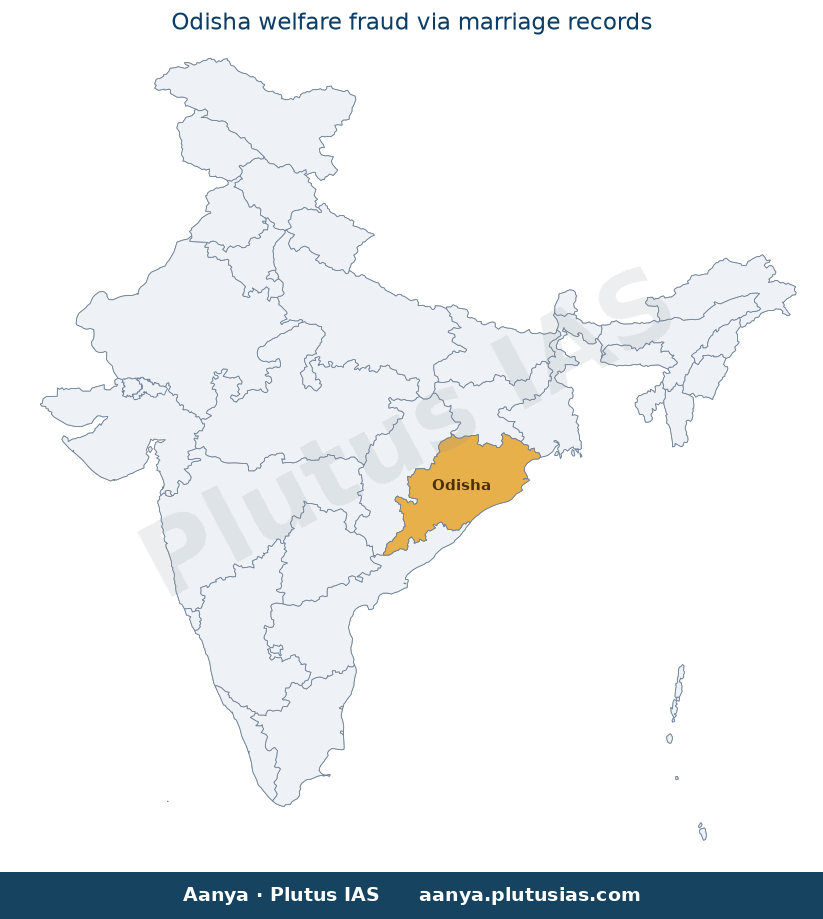
A draft audit report by the Comptroller and Auditor General (CAG) for 2024-2025 has exposed systemic fraud in Odisha’s Nirman Shramik Scheme, where nearly 2,000 marriage records were allegedly manipulated to claim ₹6.29 crore in marriage assistance. The findings highlight vulnerabilities in the state’s welfare delivery mechanisms, including flaws in the Nirmal Shramik Portal and lapses in marriage registration protocols, raising concerns about the integrity of welfare databases and the efficacy of anti-fraud measures.
Background
- The Odisha Building and Other Construction Workers’ Welfare Board administers welfare schemes for registered construction workers under the Building and Other Construction Workers (Regulation of Employment and Conditions of Service) Act, 1996.
- The Nirman Shramik Scheme provides financial assistance of ₹50,000 for the marriage of an unmarried female beneficiary or two unmarried daughters above 18 years of a registered construction worker.
- The Board had amassed over ₹4,000 crore by 2024, indicating significant financial outlays for welfare schemes.
- The Orissa Hindu Marriages and Registration Rules, 1960, mandate the compulsory registration of marriages within 30 days of solemnisation, with penalties for non-compliance.
- Prior audit findings revealed instances where deceased workers’ nominees continued to receive benefits, including subsidised foodgrain under the National Food Security Act (NFSA) and the State Food Security Scheme.
What is the Nirman Shramik Scheme and its associated vulnerabilities?
- The Nirman Shramik Scheme is a welfare initiative under the Odisha Building and Other Construction Workers’ Welfare Board, providing financial assistance for marriages of eligible beneficiaries among registered construction workers.
- The scheme is governed by the Building and Other Construction Workers (Regulation of Employment and Conditions of Service) Act, 1996, and its rules, which mandate the registration of workers and their dependents for welfare benefits.
- The scheme’s financial assistance of ₹50,000 is disbursed upon verification of eligibility criteria, including the marital status of the beneficiary and the worker’s registration status.
- Instances of backdating marriage certificates, maintaining blank registers, and lack of recipient signatures in Block Development Offices (BDOs) were flagged as critical lapses in the registration and disbursement process.
- The Board’s accumulation of over ₹4,000 crore underscores the scale of welfare outlays and the importance of safeguarding these funds from fraudulent claims.
- The scheme operates alongside other welfare measures, such as the National Food Security Act (NFSA) and State Food Security Scheme, which provide subsidised foodgrain to eligible beneficiaries.
Key Features
| Feature | Significance |
|---|---|
| Nirman Shramik Scheme | Provides financial assistance of ₹50,000 for the marriage of unmarried female beneficiaries or two unmarried daughters of registered construction workers in Odisha. |
| Odisha Building and Other Construction Workers’ Welfare Board | Administers welfare schemes for construction workers, including the Nirman Shramik Scheme, and manages a corpus exceeding ₹4,000 crore as of 2024. |
| Nirmal Shramik Portal | Digital platform for registration and disbursement of welfare benefits, but found to have systemic flaws enabling fraudulent claims. |
| Marriage Registration Protocols (Orissa Hindu Marriages and Registration Rules, 1960) | Mandates registration of marriages within 30 days of solemnisation, with penalties for non-compliance to ensure authenticity of records. |
| Legacy Database Analysis | Audit identified discrepancies in marriage records, including registration dates predating the actual marriage dates, indicating systemic weaknesses in data validation. |
Why it Matters
Governance and Accountability
- Exposure of systemic fraud in welfare disbursement highlights the need for robust audit mechanisms in social sector schemes to prevent financial leakages.
- Demonstrates the critical role of digital governance in ensuring transparency, but also underscores the risks of inadequate validation in e-governance portals.
- Questions the efficacy of institutional safeguards, such as marriage registration protocols, when enforcement is weak or non-existent.
Economic Implications
- Misappropriation of ₹6.29 crore in marriage assistance funds indicates a significant diversion of public resources, impacting the intended beneficiaries.
- Large-scale fraud undermines the fiscal sustainability of welfare schemes, necessitating corrective measures to restore public trust in government initiatives.
Legal and Procedural Compliance
- Violations of marriage registration rules reveal gaps in inter-departmental coordination between welfare boards and civil registration authorities.
- Blank registers and missing signatures in marriage certificate issuance at Block Development Offices suggest procedural lapses in record-keeping and accountability.
Challenges
1. Systemic Fraud in Welfare Disbursement
- Fraudulent manipulation of marriage records to claim undue benefits indicates a failure in the design and implementation of the Nirman Shramik Scheme.
- Lack of real-time validation and cross-verification mechanisms in the Nirmal Shramik Portal enabled ineligible individuals to exploit the system.
- Legacy database inconsistencies, such as registration dates predating marriages, reflect poor data integrity and inadequate pre-audit checks.
UPSC Link: GS-II: Welfare schemes for vulnerable sections
2. Weak Enforcement of Marriage Registration Protocols
- Non-compliance with the mandatory 30-day registration period under the Orissa Hindu Marriages and Registration Rules, 1960, undermines the legal framework.
- Absence of stringent penalties for non-registration or delayed registration contributes to the proliferation of fraudulent claims.
- Inadequate oversight in Block Development Offices, evidenced by blank registers and missing signatures, highlights institutional neglect.
UPSC Link: GS-II: Government policies and interventions
3. Digital Governance Risks
- Over-reliance on digital portals without robust backend validation mechanisms exposes welfare schemes to cyber-enabled fraud.
- Audit findings of ₹2.90 crore disbursed in Khariar BDO without verifiable records underscore the risks of paperless systems without adequate safeguards.
UPSC Link: GS-III: Science & Technology
4. Fiscal Sustainability of Welfare Schemes
- Large-scale fraud diverts public funds away from genuine beneficiaries, compromising the scheme’s intended social impact.
- Corpus erosion due to leakages reduces the financial capacity of the welfare board to fund future initiatives for construction workers.
UPSC Link: GS-III: Indian Economy
5. Inter-Departmental Coordination Gaps
- Lack of integration between the welfare board, civil registration authorities, and audit mechanisms facilitates fraudulent activities.
- Delayed or absent sharing of data between departments hampers real-time verification of beneficiary claims.
UPSC Link: GS-II: Government policies and interventions
Challenges — UPSC Perspective
| Issue | Concern |
|---|---|
| Fraudulent marriage records | Undermines the integrity of welfare disbursement and diverts public funds from intended beneficiaries. |
| Blank registers and missing signatures | Indicates procedural lapses in record-keeping and lack of accountability in Block Development Offices. |
| System design flaws in Nirmal Shramik Portal | Enables ineligible individuals to exploit the portal due to inadequate validation mechanisms. |
| Non-compliance with marriage registration rules | Weakens the legal framework and facilitates fraudulent claims through delayed or absent registrations. |
| Legacy database inconsistencies | Reflects poor data integrity, complicating audit processes and enabling historical frauds to go undetected. |
Government Initiatives — Must-Memorise for Prelims
- Nirman Shramik Scheme
- Odisha Building and Other Construction Workers’ Welfare Board
Way Forward
- Strengthen backend validation mechanisms in the Nirmal Shramik Portal to ensure real-time verification of beneficiary claims.
- Implement mandatory cross-verification of marriage records with civil registration databases before disbursing welfare benefits.
- Enforce strict penalties for non-compliance with marriage registration protocols under the Orissa Hindu Marriages and Registration Rules, 1960.
- Conduct regular audits of legacy databases and digitised records to identify and rectify discrepancies proactively.
- Enhance inter-departmental coordination between the welfare board, civil registration authorities, and audit institutions to prevent fraud.
- Introduce blockchain or AI-based verification tools to authenticate beneficiary identities and transaction histories in welfare disbursement.
- Establish a grievance redressal mechanism for beneficiaries to report anomalies in welfare disbursements and marriage records.
- Undertake capacity-building initiatives for Block Development Office staff to ensure adherence to procedural protocols and record-keeping standards.
UPSC Value Addition
Keywords for Mains Answer-Writing
Social Sector Subsidies and Welfare Fraud · Public Distribution System (PDS) and Food Security · Construction Workers Welfare Schemes · Audit and Financial Accountability in Public Funds · Marriage Registration Laws and Systemic Leakages · Comptroller and Auditor General (CAG) Reports · Digital Governance and Portal-Based Service Delivery · State Welfare Boards and Institutional Safeguards · National Food Security Act (NFSA) and State Food Security Schemes · Governance Challenges in Implementation of Welfare Schemes
Concept Flow
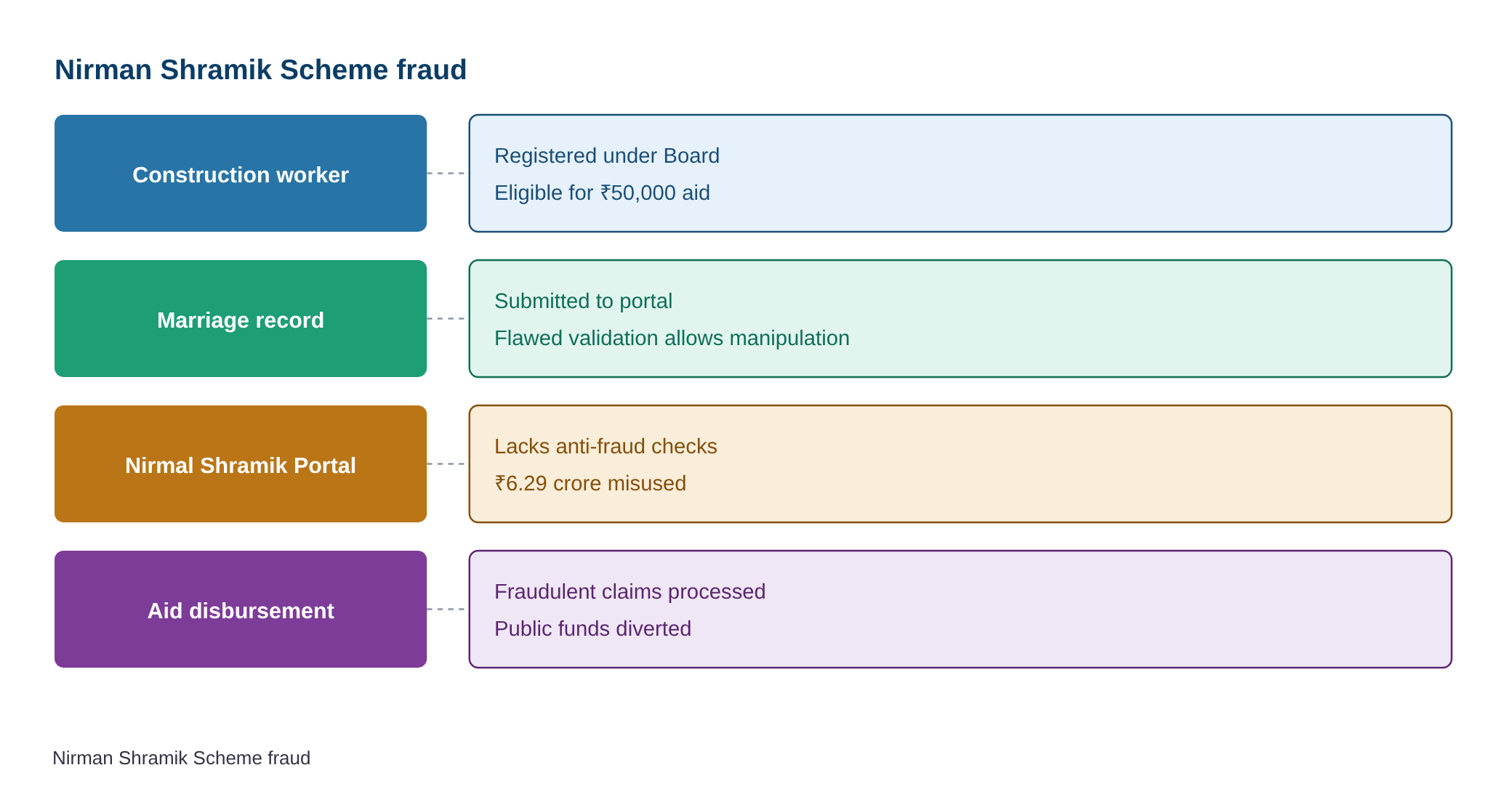
Construction workers register under the Odisha Building and Other Construction Workers’ Welfare Board → Marriage of a registered worker or their daughters makes them eligible for ₹50,000 assistance under the Nirman Shramik Scheme → Marriage records are submitted to the Nirmal Shramik Portal for verification and disbursement → Systemic flaws in the portal (lack of validation) allow manipulation of marriage dates or creation of fake records → Fraudulent claims are processed and funds are disbursed without cross-verification with civil registration records → Audit exposes discrepancies, including registration dates predating marriages and blank registers in Block Development Offices → Findings highlight the need for stricter enforcement of marriage registration rules and robust digital governance safeguards
Prelims Practice Questions
Q1. Consider the following statements regarding the National Food Security Act (NFSA), 2013:
1. The NFSA provides for the supply of subsidised foodgrains to up to 75% of the rural population and up to 50% of the urban population.
2. The Act mandates the use of Aadhaar for the identification of beneficiaries to eliminate duplicates and leakages.
3. The Central Government is responsible for the identification of eligible households under the NFSA.
4. The Act specifies the entitlements of beneficiaries as 5 kg of foodgrains per person per month at subsidised prices.
How many of the above statements are correct?
- Only one
- Only two
- Only three
- All four
Answer: All four — Statements 1, 2, and 4 are correct. Statement 3 is incorrect as the identification of eligible households is the responsibility of the State Governments under the NFSA.
Q2. Assertion (A): The Comptroller and Auditor General (CAG) of India conducts performance audits of welfare schemes to assess their efficiency and effectiveness.
Reason (R): The CAG’s mandate under the Constitution of India includes auditing the receipts and expenditure of the Union and State Governments, including welfare schemes.
Options:
A. Both A and R are true, and R is the correct explanation of A.
B. Both A and R are true, but R is not the correct explanation of A.
C. A is true, but R is false.
D. A is false, but R is true.
Answer: ? — Both Assertion (A) and Reason (R) are true, and Reason (R) correctly explains Assertion (A). The CAG’s constitutional mandate includes performance audits to evaluate the efficiency and effectiveness of welfare schemes.
Q3. Match the following welfare schemes with their respective implementing authorities:
Column I (Scheme) Column II (Implementing Authority)
1. Nirman Shramik Scheme A. Ministry of Labour and Employment, Government of India
2. National Food Security Act (NFSA) B. State Food and Civil Supplies Department
3. Orissa Hindu Marriages and C. Odisha Building and Other Construction Workers’ Welfare Board
Registration Rules, 1960
4. Mahatma Gandhi National Rural D. Registrar of Marriages, State Government
Employment Guarantee Scheme (MGNREGS)
Options:
A. 1-C, 2-B, 3-D, 4-A
B. 1-A, 2-B, 3-C, 4-D
C. 1-B, 2-A, 3-D, 4-C
D. 1-D, 2-C, 3-A, 4-B
- A
- B
- C
- D
Answer: A — Correct matches: 1-C (Nirman Shramik Scheme is implemented by the Odisha Building and Other Construction Workers’ Welfare Board), 2-B (NFSA is implemented by State Food and Civil Supplies Departments), 3-D (Orissa Hindu Marriages and Registration Rules, 1960 are implemented by the Registrar of Marriages, State Government), 4-A (MGNREGS is implemented by the Ministry of Labour and Employment, Government of India).
Mains Practice Question
✍ The exploitation of welfare schemes through systemic fraud and administrative lacunae undermines the integrity of public institutions and erodes public trust. Critically analyse the governance failures that enabled the manipulation of marriage records under the Nirman Shramik Scheme in Odisha. Also, outline the constitutional and statutory safeguards that must be strengthened to prevent such leakages in welfare delivery systems. (15 Marks)
Approach: MODEL-ANSWER SKELETON:
1. **Context and Incident Overview (2 Marks)**
– Briefly describe the Odisha case: manipulation of ~2,000 marriage records to claim ₹6.29 crore under the Nirman Shramik Scheme.
– Reference the CAG audit report (2024-25) and its findings on systemic flaws in the Nirmal Shramik Portal.
2. **Governance Failures Identified (5 Marks)**
– **Administrative Lapses**: Lack of validation mechanisms, blank registers in Block Development Offices, absence of recipient signatures.
– **Procedural Violations**: Marriage registration dates preceding solemnisation, contravention of Orissa Hindu Marriages and Registration Rules, 1960 (30-day registration mandate).
– **Digital Governance Gaps**: Flaws in the Nirmal Shramik Portal design enabling ineligible claims.
– **Institutional Weakness**: Inadequate oversight by the Odisha Building and Other Construction Workers’ Welfare Board despite amassing ₹4,000 crore.
3. **Constitutional and Statutory Safeguards (4 Marks)**
– **Constitutional Provisions**: Article 282 (discretionary grants for welfare), Directive Principles of State Policy (Articles 38, 39, 41, 42) mandating social security.
– **Statutory Frameworks**: National Food Security Act (NFSA), 2013 (Aadhaar seeding for beneficiary identification), Mahatma Gandhi National Rural Employment Guarantee Scheme (MGNREGS) Act, 2005 (transparency in payments).
– **Audit Mechanisms**: Role of CAG in conducting performance and compliance audits (Article 149 of the Constitution).
4. **Recommended Reforms (4 Marks)**
– **Strengthening Digital Governance**: Mandatory Aadhaar-PAN linking for beneficiaries, real-time verification of marriage certificates via state registrars.
– **Institutional Safeguards**: Regular third-party audits, mandatory geo-tagging of beneficiary addresses, digitisation of legacy records.
– **Legal Enforcement**: Strict penalties under the Prevention of Corruption Act, 1988, and the Benami Transactions (Prohibition) Act, 1988 for fraudulent claims.
– **Citizen Engagement**: Grievance redressal portals, whistle-blower protections, and public disclosure of beneficiary lists (Right to Information Act, 2005).
Balance of Views:
– Acknowledge that digital governance can reduce leakages but must be complemented by robust offline verification.
– Highlight the tension between welfare expansion and fiscal prudence, necessitating multi-layered safeguards.
Source: The Hindu
Odisha PCS (OPSC (OAS)) — State PCS Practice
Prelims: As per a recent report, nearly 2,000 marriage records in Odisha were manipulated to claim which of the following welfare aids?
- A. KALIA Scheme benefits
- B. MGNREGA wages
- C. PM-KISAN payments
- D. Old Age Pension
Answer: A. KALIA Scheme benefits — The manipulation of marriage records was reportedly done to claim benefits under the KALIA (Krushak Assistance for Livelihood and Income Augmentation) Scheme, a flagship welfare initiative of Odisha for farmers.
Mains: Analyze the socio-economic implications of large-scale manipulation of official records in welfare schemes like KALIA in Odisha. Suggest measures to prevent such frauds while ensuring genuine beneficiaries are not excluded.
Generated by AanyaAi for educational purpose.
Related guides on our sites
- Current affairs for upsc 2026
- Best PSIR optional coaching for upsc
- Best economics optional coaching for upsc
- Best PSIR optional teacher for upsc

- महाराष्ट्र में त्योहार जुलूसों पर बॉम्बे हाईकोर्ट का बड़ा फैसला: पटाखे, लेजर और संगीत पर रोक - September 24, 2026
- Bombay HC Bans Firecrackers, Music in Maharashtra Processions: Key UPSC Analysis - September 24, 2026
- तमिलनाडु में महिला कर्मचारियों के लिए सवैतनिक माहवारी अवकाश नीति पर HC का आदेश - September 24, 2026

No Comments