


20 Jul PAiMANA Portal: Monitoring of Infrastructure Projects for UPSC 2026
Subject Relevance — Where This Topic Fits
- GS Paper II — Governance, Transparency and Accountability | GS Paper III — Infrastructure Development and Project Management
- Prelims: PAiSA Portal, Ministry of Statistics and Programme Implementation (MoSPI), Project Monitoring, Land Acquisition Delays, Environmental Clearances, Cost Overruns in Infrastructure Projects, Flash Reports, API-based Data Integration
- Essay: The Imperative of Transparent Governance in Infrastructure Development, Balancing Speed and Sustainability in India’s Infrastructure Push
Quick Revision: PAiMANA portal is MoSPI’s digital tool for real-time monitoring of central infrastructure projects costing ₹150 crore+, using APIs, dashboards, and monthly reviews to curb delays and cost overruns.
Why is this in the news?
The Ministry of Statistics and Programme Implementation (MoSPI) has been entrusted with the monitoring of central infrastructure projects costing ₹150 crore or more. This initiative, announced via a Press Information Bureau release on 20 July 2026, aims to curb delays and cost overruns in high-value infrastructure projects while ensuring transparency through real-time data dissemination and evidence-based governance. The portal aggregates project-wise data, identifies bottlenecks, and facilitates structured stakeholder coordination through monthly review meetings.
Background
- Infrastructure development is a critical enabler for India’s economic growth, with significant investments planned under schemes such as the National Infrastructure Pipeline (NIP) and the PM Gati Shakti National Master Plan.
- Delays and cost overruns in infrastructure projects have historically plagued India’s public expenditure, with studies indicating that over 50% of major projects face time and cost overruns, often due to land acquisition, environmental clearances, and utility relocations.
- The Ministry of Statistics and Programme Implementation (MoSPI) was established in 1999 to serve as the nodal agency for monitoring and evaluating central sector schemes, including infrastructure projects.
- The portal aligns with the government’s broader push for ‘Minimum Government, Maximum Governance’ by reducing bureaucratic delays and enhancing accountability through transparent data dissemination.
What is the PAiMANA Portal?
- PAiMANA (Project Assessment, Infrastructure Monitoring and Analytics for Nation-Building) is a web-based monitoring system developed by MoSPI to track the progress of central infrastructure projects costing ₹150 crore or more.
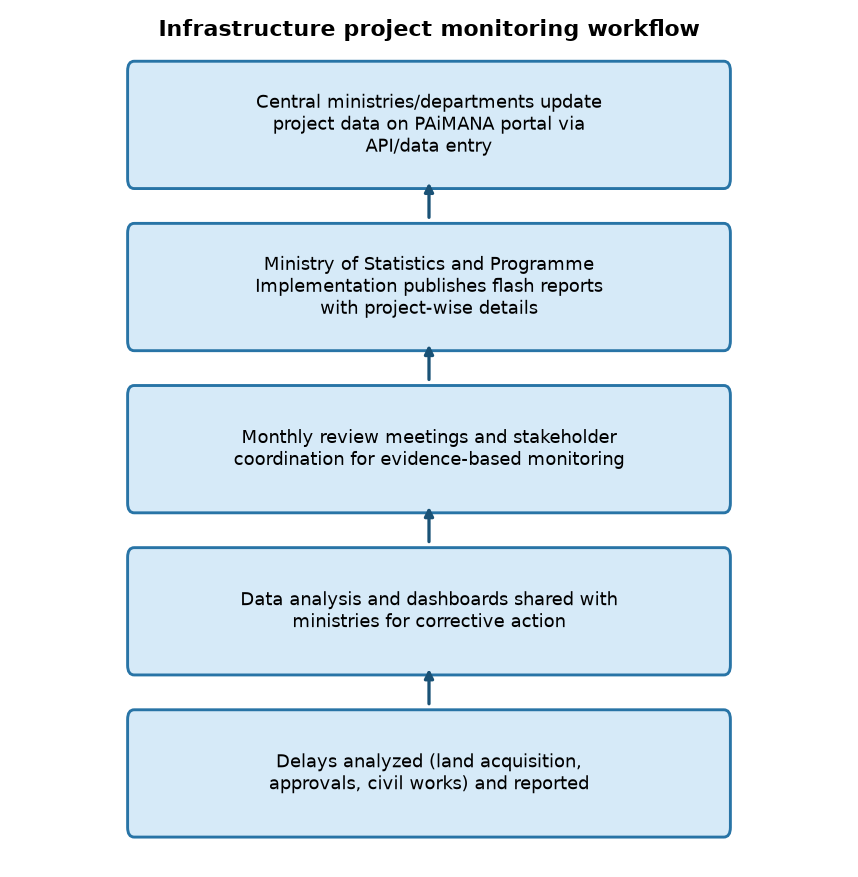
- The portal aggregates real-time data from implementing agencies, ministries, and departments via Application Programming Interfaces (APIs) and manual data entry, ensuring accuracy and timeliness.
- Key features include project-wise flash reports, customizable dashboards for top-level monitoring, and analytical outputs to identify trends in delays and cost overruns.
- The portal enables evidence-based decision-making by providing stakeholders with granular insights into project bottlenecks, such as land acquisition issues, environmental clearances, and utility relocations.
- Monthly review meetings and other communication channels facilitate structured coordination among ministries, departments, and implementing agencies to address challenges proactively.
- The portal’s transparency mechanism ensures that project details, including delays and cost escalations, are publicly accessible via the URL: https://paimana-proj.mospi.gov.in/ReportPage.
- PAiMANA’s design incorporates lessons from past monitoring systems, such as the Project Monitoring Group (PMG), by integrating advanced analytics and user-friendly interfaces to enhance usability.
Key Features
| Feature | Significance |
|---|---|
| PAiSANA Portal (Project Assessment, Infrastructure Monitoring and Analytics for Nation-Building) | A centralised digital platform for real-time monitoring of infrastructure projects exceeding ₹150 crore, ensuring evidence-based decision-making and transparency. |
| Flash Reports on MOSPI Website | Monthly publication of project-wise details, enabling stakeholders to assess progress and identify bottlenecks in infrastructure development. |
| API and Data Entry Modes | Facilitates seamless integration of project data from all ministries/departments, ensuring up-to-date and accurate information on project status. |
| Customised Dashboards and Reports | Provides high-level monitoring tools with analytical outputs, enabling ministries to track delays, cost overruns, and implementation challenges. |
| Monthly Review Meetings | Regular coordination with stakeholders ensures proactive mitigation of project-related issues and alignment with national priorities. |
Why it Matters
Economic Efficiency
- Reduces cost overruns in high-value infrastructure projects by identifying delays early, thereby optimising public expenditure.
- Enhances fiscal discipline by linking project funding to performance metrics and transparency.
- Supports macroeconomic stability by preventing stalled projects from disrupting supply chains and economic growth.
Strategic Infrastructure Development
- Ensures timely completion of critical infrastructure such as highways, railways, and urban transport systems, which are essential for national connectivity and competitiveness.
- Facilitates evidence-based prioritisation of projects based on data analytics, aligning with national development goals.
- Strengthens India’s logistics performance, a key determinant of trade competitiveness and economic integration.
Governance and Transparency
- Promotes accountability among implementing agencies by making project data publicly accessible, reducing scope for discretionary delays.
- Enhances trust between government and citizens by providing verifiable data on project progress and challenges.
- Supports the Digital India initiative by leveraging technology for efficient governance and real-time monitoring.
Environmental and Social Compliance
- Ensures adherence to environmental and forest clearance norms by tracking approvals and mitigating delays in project execution.
- Facilitates compliance with land acquisition laws, reducing disputes and ensuring fair compensation to affected stakeholders.
Challenges
1. Land Acquisition and Rehabilitation
- Delays due to disputes over compensation, inadequate rehabilitation measures, or resistance from local communities.
- Complex legal frameworks and multiple approvals required under the Right to Fair Compensation and Transparency in Land Acquisition Act, 2013 (LARR Act).
UPSC Link: Land Reforms & Dispute Resolution
2. Environmental and Forest Clearances
- Prolonged approval processes for environmental impact assessments (EIAs) and forest clearances under the Forest (Conservation) Act, 1980.
- Challenges in balancing developmental needs with environmental conservation, particularly in ecologically sensitive areas.
UPSC Link: Environmental Governance & Clearances
3. Inter-Ministerial Coordination Gaps
- Lack of synchronisation between central ministries, state governments, and implementing agencies leading to duplication or conflicts in project execution.
- Bureaucratic inertia and siloed decision-making processes hinder timely resolution of bottlenecks.
UPSC Link: Centre-State Relations
4. Technical and Administrative Delays
- Inadequate project planning, poor contract management, or delays in utility relocations (e.g., power, water, telecom lines).
- Shortages of skilled labour, equipment, or materials, particularly in remote or underdeveloped regions.
UPSC Link: Project Management & Governance
5. Data Integrity and Standardisation
- Inconsistencies in data reporting across ministries/departments due to lack of standardised formats or digital literacy gaps.
- Risk of data manipulation or incomplete reporting, which undermines the credibility of the PAiSANA portal.
UPSC Link: Data Governance & Digital Infrastructure
6. Legal and Law-and-Order Issues
- Disruptions due to local law-and-order situations, protests, or insurgency-affected regions delaying project execution.
- Delays in obtaining statutory clearances or resolving disputes through judicial processes.
UPSC Link: Public Order & Legal Framework
Challenges — UPSC Perspective
| Issue | Concern |
|---|---|
| Land Acquisition | Legal disputes, inadequate compensation, and rehabilitation challenges leading to project delays. |
| Environmental Clearances | Prolonged EIA and forest clearance processes under statutory frameworks. |
| Inter-Ministerial Coordination | Siloed decision-making and lack of synchronisation between agencies. |
| Technical Delays | Poor project planning, utility relocations, and shortages of skilled labour. |
| Data Standardisation | Inconsistent reporting formats and risks of data manipulation. |
| Law-and-Order Disruptions | Protests, insurgency, or statutory delays in clearances. |
Way Forward
- Strengthen the PAiSANA portal by integrating AI-driven predictive analytics to forecast delays and cost overruns in real time.
- Establish a dedicated grievance redressal mechanism for land acquisition and environmental clearance issues to expedite resolutions.
- Conduct capacity-building programmes for state governments and implementing agencies on data reporting standards and project management.
- Enhance inter-ministerial coordination through a unified dashboard that highlights cross-cutting project dependencies.
- Promote the use of geospatial technologies for land use planning and environmental impact assessments to reduce approval delays.
- Incentivise timely project completion through performance-linked funding and penalties for non-compliance.
- Expand the scope of PAiSANA to include social impact assessments and community engagement metrics for holistic monitoring.
- Ensure regular audits of the portal’s data integrity to maintain transparency and credibility in project monitoring.
UPSC Value Addition
Keywords for Mains Answer-Writing
Infrastructure Monitoring · Project Monitoring Portal (PAiSANA) · Cost Overruns in Infrastructure Projects · Land Acquisition Delays · Environmental Clearances · Project Implementation Agencies · Evidence-Based Monitoring · Public Investment in Infrastructure · Transparency in Project Execution · Ministry of Statistics and Programme Implementation (MoSPI) · Project Assessment and Analytics · Central Sector Projects · Delays in Infrastructure Development
Concept Flow
Infrastructure Project Approval → Implementation → Monitoring via PAiSANA Portal → Data Collection → Analysis of Delays/Cost Overruns → Corrective Actions → Timely Completion → Economic Growth and Development
Prelims Practice Questions
Q1. Which of the following is the primary objective of the PAiSANA portal launched by the Ministry of Statistics and Programme Implementation (MoSPI)?
- A. To facilitate direct cash transfers to beneficiaries of infrastructure projects
- B. To monitor and analyse the implementation of central infrastructure projects costing ₹150 crore and above
- C. To provide a platform for online bidding in infrastructure projects
- D. To conduct environmental impact assessments for new infrastructure projects
Answer: B. To monitor and analyse the implementation of central infrastructure projects costing ₹150 crore and above — The PAiSANA (Project Assessment, Infrastructure Monitoring and Analytics for Nation-Building) portal is designed to monitor and analyse the implementation of central infrastructure projects costing ₹150 crore and above, ensuring transparency and preventing cost overruns and delays.
Q2. Which of the following is NOT a common cause of delays in infrastructure projects as highlighted by the PAiSANA portal?
- A. Land acquisition issues
- B. Environmental and wildlife clearances
- C. Shortage of skilled labour in urban areas
- D. Utility shifting delays
Answer: C. Shortage of skilled labour in urban areas — The PAiSANA portal identifies land acquisition issues, environmental clearances, and utility shifting as key causes of delays. Shortage of skilled labour in urban areas is not explicitly mentioned as a cause in the portal’s findings.
Q3. The PAiSANA portal is managed by which of the following ministries?
- A. Ministry of Road Transport and Highways
- B. Ministry of Statistics and Programme Implementation
- C. Ministry of Environment, Forest and Climate Change
- D. Ministry of Finance
Answer: B. Ministry of Statistics and Programme Implementation — The PAiSANA portal is managed by the Ministry of Statistics and Programme Implementation (MoSPI), as stated in the press release.
Mains Practice Question
✍ Discuss the significance of evidence-based monitoring mechanisms like the PAiSANA portal in ensuring timely and cost-effective implementation of infrastructure projects in India. Analyse how such mechanisms contribute to transparency and accountability in public expenditure.
Approach: Begin by defining evidence-based monitoring and its necessity in infrastructure projects. Highlight the role of the PAiSANA portal in tracking delays and cost overruns, citing causes such as land acquisition and environmental clearances. Explain how real-time data analysis and stakeholder coordination improve transparency and accountability. Conclude with the broader impact on public expenditure efficiency and citizen trust in government projects.
Source: PIB (Press Information Bureau)
Generated by AanyaAi for educational purpose.


No Comments