


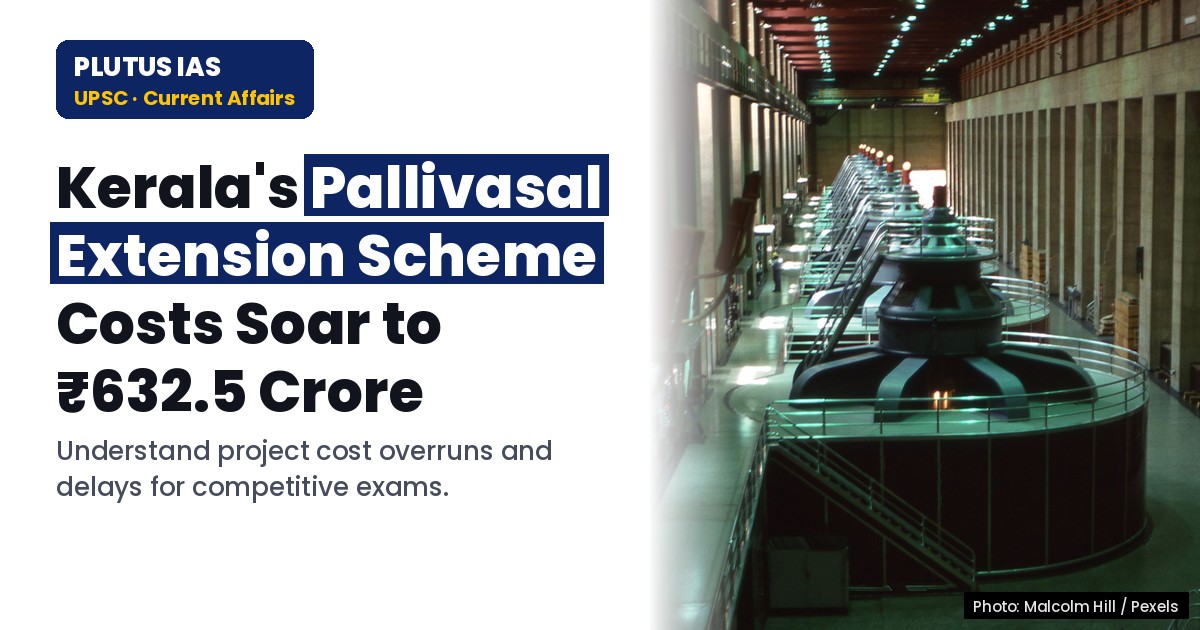
25 Nov Pallivasal Extension Scheme: Cost Overruns & Delays Analysis
✎ The Pallivasal Extension Scheme, a 60-MW hydropower project in Kerala, incurred significant cost overruns and delays, highlighting critical challenges in public infrastructure project management and the imperative for robust…
Subject Relevance — Where This Topic Fits
- GS Paper III — Economy (Infrastructure, Energy, Investment Models, Project Management) | GS Paper III — Environment (Hydropower, Sustainable Development) | GS Paper II — Governance (Public Sector Undertakings, Regulatory Bodies, Accountability)
- Prelims: Pallivasal Extension Scheme, Kerala State Electricity Board (KSEB), Hydropower projects, Project cost overruns, Administrative sanction, Kerala State Electricity Regulatory Commission, Public Sector Undertakings (PSUs)
- Essay: Challenges in Infrastructure Development and Project Implementation in India, The Role of Regulatory Bodies in Ensuring Fiscal Prudence and Accountability in Public Projects
Quick Revision: The Pallivasal Extension Scheme, a 60-MW hydropower project in Kerala, incurred significant cost overruns and delays, highlighting critical challenges in public infrastructure project management and the imperative for robust financial oversight and regulatory scrutiny.
Why is this in the news?
The Pallivasal Extension Scheme, a 60-MW hydropower project in Kerala, has recently received a formal revised administrative sanction for ₹632.59 crore, significantly exceeding its initial administrative sanction of ₹175.86 crore in 2001. This substantial cost escalation, attributed to delays spanning over two decades and contractual issues, has brought public infrastructure project management and fiscal oversight into sharp focus, prompting the Kerala State Electricity Board (KSEB) to initiate an independent study into project management practices.
Background
- The Pallivasal Extension Scheme, designed as an extension to Kerala’s first hydro project (the 37.5-MW Pallivasal Hydroelectric Project commissioned in 1940), was conceived to address the state’s increasing power demand.
- The project received administrative sanction in 2001 for an estimated cost of ₹175.86 crore, with the contract subsequently awarded in 2006 for ₹268.01 crore.
- Significant technical and contractual impediments led to the termination of the initial contract in 2018, necessitating the execution of balance works through separate packages.
- The project, initially scheduled for completion by March 2011, eventually took over 20 years to commission, with its inauguration occurring in March 2026.
- The total completion cost, inclusive of miscellaneous works, interest, finance charges, and administrative expenses, has been reported as ₹632.59 crore, leading to the recent issuance of a formal revised administrative sanction by the KSEB.
- The Kerala State Electricity Regulatory Commission’s examination of a petition concerning the capital investment plan of the scheme prompted the KSEB to issue the revised sanction, highlighting the role of regulatory oversight in public projects.
- The KSEB has decided to conduct an independent study through an external expert agency or committee to examine and recommend improvements to project management practices, acknowledging the factors contributing to the prolonged delays and cost overruns.
- In February 2026, the KSEB management decided against taking action against its officials for the delays, accepting a Vigilance wing report that deemed such action ‘undesirable’.
- The project adds 60 MW and 153.9 million units (mu) to Kerala’s power grid, contributing to the state’s energy security despite the implementation challenges.
- The KSEB had previously issued ‘piece-meal sanctions’ for balance works due to uncertainty regarding the project’s completion, rather than a consolidated revised administrative sanction.
- The project’s journey from conception to commissioning illustrates the complex interplay of technical challenges, contractual disputes, financial management, and regulatory scrutiny inherent in large-scale public infrastructure projects.
Understanding Hydropower Projects and Project Management in India
- Hydropower projects harness the energy of flowing water to generate electricity, offering a renewable and clean source of energy, crucial for India’s energy security and climate change mitigation goals.
- These projects typically involve significant capital investment, long gestation periods, and complex engineering, often necessitating meticulous planning and execution.
- Project management in public infrastructure involves planning, executing, monitoring, controlling, and closing projects to achieve specific goals within a defined timeframe and budget, often adhering to stringent public procurement norms.
- Cost overruns occur when the actual cost of a project exceeds its estimated or budgeted cost, frequently stemming from delays, unforeseen technical challenges, changes in scope, inflation, and inefficient resource management.
- Administrative sanction refers to the formal approval granted by the competent authority for incurring expenditure on a project, establishing the financial limits and scope within which the project must operate.
- Regulatory commissions, such as the Kerala State Electricity Regulatory Commission, play a vital role in overseeing the financial and operational aspects of public utilities, ensuring transparency, accountability, and consumer protection.
- Public Sector Undertakings (PSUs) are government-owned corporations established to provide goods and services, often operating in strategic sectors like energy and infrastructure, and are subject to specific governance and accountability frameworks.
- Effective contract management is crucial for large-scale projects, involving the administration of contracts from their inception to completion, including dispute resolution, performance monitoring, and ensuring compliance with terms and conditions.
- Independent studies or audits are often commissioned to evaluate project performance, identify causes of delays and cost overruns, and recommend corrective measures to improve future project management practices and enhance efficiency.
- The ‘piece-meal sanction’ approach, as observed in the Pallivasal Extension Scheme, involves granting approvals for project components in stages, which can sometimes lead to fragmented oversight and difficulties in comprehensive cost control.
Key Features
| Feature | Significance |
|---|---|
| Pallivasal Extension Scheme | A 60-MW hydropower project in Kerala, designed as an extension to the state’s first hydroelectric project, Pallivasal (commissioned 1940). |
| Project Timeline | Originally sanctioned in 2001, awarded in 2006, and scheduled for completion by March 2011. Ultimately commissioned in March 2026, taking over 20 years. |
| Cost Escalation | Initial administrative sanction for ₹175.86 crore in 2001. The final cost, including miscellaneous works, interest, and administrative expenses, reached ₹632.59 crore. |
| Contractual Issues | The initial contract awarded to ESSAR-DEC-CPPL Consortium in 2006 was terminated in 2018 due to technical and contractual hiccups, leading to balance works being executed in separate packages. |
| Regulatory Oversight | The Kerala State Electricity Regulatory Commission directed the KSEB to issue a formal revised administrative sanction while examining a petition on the project’s capital investment plan. |
| Independent Study | KSEB has decided to conduct an independent study through an external expert agency or committee to examine and recommend improvements to project management practices. |
Why it Matters
Energy Security and Infrastructure Development
- The commissioning of the Pallivasal Extension Scheme adds 60 MW/153.9 MU to Kerala’s power grid, contributing to the state’s energy security and meeting increasing power demand.
- Hydropower projects are crucial for sustainable energy generation, reducing reliance on fossil fuels and supporting India’s renewable energy targets.
Fiscal Prudence and Project Management
- The substantial cost escalation from ₹175.86 crore to ₹632.59 crore highlights critical issues in project planning, execution, and financial management within public sector undertakings.
- The decision to conduct an independent study on project management practices underscores the importance of accountability and efficiency in public infrastructure projects.
Regulatory Framework and Governance
- The intervention of the Kerala State Electricity Regulatory Commission in directing a formal revised administrative sanction demonstrates the role of regulatory bodies in ensuring transparency and financial discipline in the power sector.
- The case illustrates the complexities of managing large-scale infrastructure projects, involving multiple stakeholders, long gestation periods, and potential for unforeseen challenges.
Challenges
1. Project Delays and Time Overruns
- The project took over 20 years to complete against an original schedule of approximately five years, indicating significant inefficiencies in execution.
- Prolonged delays lead to deferred benefits, including delayed power generation and economic returns.
UPSC Link: Infrastructure: Energy
2. Cost Escalation and Financial Management
- The project’s cost increased by over 260% from its initial administrative sanction, reflecting poor cost estimation, inflation, and additional expenses incurred due to delays and contractual issues.
- Such escalations strain public finances and divert resources that could be used for other developmental projects.
UPSC Link: Government Budgeting
3. Contractual and Technical Hiccups
- The termination of the initial contract due to ‘technical and contractual hiccups’ points to deficiencies in contract design, contractor selection, and project oversight.
- Managing complex contracts in large infrastructure projects requires robust legal and technical expertise.
UPSC Link: Public Sector Management
4. Accountability and Governance
- The KSEB’s initial decision not to take action against officials for delays raises questions about accountability mechanisms within public utilities.
- The subsequent decision for an independent study indicates a recognition of the need for improved governance and project management practices.
UPSC Link: Ethics in Public Administration
Challenges — UPSC Perspective
| Issue | Concern |
|---|---|
| Extended Project Duration | The 20-year completion period for a 60-MW project signifies significant operational inefficiencies and opportunity costs. |
| Budgetary Overruns | A 260% increase in project cost from initial estimates indicates flaws in financial planning and project risk assessment. |
| Contract Termination | The failure of the initial contract points to potential issues in vendor selection, contract enforcement, or inadequate technical specifications. |
| Piece-meal Sanctions | Issuing ‘piece-meal sanction’ instead of a ‘consolidated revised administrative sanction’ suggests a lack of comprehensive financial oversight and planning. |
| Lack of Immediate Accountability | The initial decision not to penalize officials for delays could undermine accountability and deter future improvements in project management. |
Way Forward
- Implement robust project planning and appraisal mechanisms to ensure accurate cost estimation and realistic timelines for infrastructure projects.
- Strengthen contract management frameworks, including clear performance indicators, penalty clauses, and efficient dispute resolution mechanisms, to minimize contractual hiccups.
- Enhance regulatory oversight by empowering bodies like Electricity Regulatory Commissions to ensure financial discipline and transparency in public utility projects.
- Establish clear accountability frameworks for project delays and cost overruns, with appropriate consequences for officials responsible, to foster a culture of efficiency.
- Mandate independent third-party audits and studies for large-scale public projects to identify systemic issues and recommend improvements in project management practices.
- Adopt modern project management tools and techniques, including risk assessment and mitigation strategies, to proactively address potential challenges.
- Promote continuous capacity building for project managers and technical personnel in public sector undertakings to enhance their expertise in complex project execution.
UPSC Value Addition
Keywords for Mains Answer-Writing
Hydropower projects · Project cost overruns · Delay analysis · Infrastructure development · Public sector project management · Kerala State Electricity Board (KSEB) · Electricity Regulatory Commissions · Energy security · Sustainable development goals · Cost-benefit analysis in public projects
Concept Flow
Increasing power demand necessitates new generation capacity. → Hydropower project conceived and administratively sanctioned. → Project execution faces delays and contractual issues. → Cost escalates significantly over extended period. → Regulatory body directs formal revised sanction. → Project commissioned, adding to power grid. → Independent study initiated to improve project management.
Prelims Practice Questions
Q1. Consider the following statements regarding hydropower projects in India:
1. Hydropower projects typically have long gestation periods compared to thermal power projects.
2. The Kerala State Electricity Board (KSEB) is a statutory body responsible for electricity generation and distribution in Kerala.
3. Cost overruns in public infrastructure projects are often attributed to delays, changes in scope, and unforeseen technical challenges.
How many of the above statements are correct?
- Only one
- Only two
- All three
- None
Answer: All three — Statement 1 is correct: Hydropower projects involve significant civil engineering works, land acquisition, and environmental clearances, leading to longer gestation periods. Statement 2 is correct: KSEB is indeed a statutory body. Statement 3 is correct: Delays, scope changes, and technical issues are common causes of cost overruns in large-scale public projects.
Q2. Which of the following is a primary objective of establishing State Electricity Regulatory Commissions (SERCs) in India?
- To manage the day-to-day operations of state electricity boards.
- To promote competition, protect consumer interests, and regulate tariffs in the power sector.
- To directly fund new power generation projects.
- To advise the state government on national energy policy formulations.
Answer: To promote competition, protect consumer interests, and regulate tariffs in the power sector. — SERCs are established under the Electricity Act, 2003, primarily to regulate tariffs, ensure fair competition, and protect the interests of consumers and licensees within their respective states. They do not manage daily operations or directly fund projects.
Mains Practice Question
✍ Examine the factors contributing to time and cost overruns in large-scale public infrastructure projects in India. Discuss the institutional mechanisms available to mitigate such issues, with particular reference to the power sector. (15 Marks)
Approach: MODEL-ANSWER SKELETON:
1. **Introduction:** Briefly define time and cost overruns in public projects and their implications for development and public finance.
2. **Factors Contributing to Overruns:**
* **Planning and Feasibility:** Inadequate initial surveys, inaccurate cost estimations, poor risk assessment.
* **Execution Delays:** Land acquisition issues, environmental clearances, contractual disputes (e.g., termination, re-tendering), technical challenges, supply chain disruptions, law and order issues.
* **Financial Aspects:** Inflation, interest rate fluctuations, funding delays, changes in scope without corresponding budget revisions.
* **Governance and Oversight:** Lack of effective project monitoring, accountability deficits, bureaucratic inefficiencies, corruption.
3. **Institutional Mechanisms for Mitigation (with reference to power sector):**
* **Regulatory Bodies:** Role of State Electricity Regulatory Commissions (SERCs) in scrutinising capital investment plans, tariff determination, and ensuring financial prudence (e.g., KSERC’s role in the Pallivasal case).
* **Project Management Frameworks:** Implementation of robust project management methodologies (e.g., PERT, CPM), independent third-party evaluations, use of modern technology for monitoring.
* **Contractual Reforms:** Clearer contract terms, performance-based incentives/penalties, dispute resolution mechanisms (arbitration, conciliation).
* **Financial Discipline:** Phased funding, stringent budget controls, regular financial audits, cost-benefit analysis.
* **Accountability Mechanisms:** Internal vigilance committees, public audits, role of Comptroller and Auditor General (CAG), parliamentary/legislative oversight.
* **Policy Initiatives:** National Infrastructure Pipeline (NIP), PM Gati Shakti National Master Plan for integrated planning and execution.
4. **Conclusion:** Summarise the importance of integrated planning, robust regulatory oversight, and accountability in ensuring timely and cost-effective delivery of critical infrastructure projects for national development.
Source: The Hindu
Kerala PCS (Kerala PSC (KAS)) — State PCS Practice
Prelims: Consider the following statements regarding the Pallivasal Extension Scheme:
1. The scheme is associated with the Kerala State Electricity Board (KSEB).
2. The project cost has increased significantly due to delays.
3. The initial estimated cost was ₹632.5 crore.
Which of the statements given above is/are correct?
- A. 1 only
- B. 2 only
- C. 1 and 2 only
- D. 1, 2 and 3
Answer: C. 1 and 2 only — Statements 1 and 2 are correct as per the topic. Statement 3 is incorrect because ₹632.5 crore is the current cost after delays, not the initial estimate.
Mains: Discuss the potential socio-economic implications of significant cost overruns and delays in key infrastructure projects like the Pallivasal Extension Scheme for the state of Kerala, particularly from the perspective of the Kerala State Electricity Board (KSEB).
Generated by AanyaAi for educational purpose.
Related guides on our sites
- Anthropology VS PSIR
- Best PSIR optional coaching
- Best PSIR optional coaching online
- Best PSIR optional teacher

- Pallivasal Extension Scheme: Cost Overruns & Delays Analysis - November 25, 2026
- केंद्रीय मंत्रिमंडल ने CIE विनिर्माण को बढ़ावा देने हेतु ₹11,000 करोड़ की योजना को मंज़ूरी दी - November 25, 2026
- SC Quashes CBI, ED Probe Against Rahul Gandhi - November 25, 2026

No Comments