


08 Aug Parliament Bill: Ban on Social Media Accounts for Kids Under 13
✎ The SHIELD Bill, 2025, proposes mandatory age verification, and a ban on personalised advertising targeting children, alongside strict penalties for platforms failing to safeguard minors from harmful digital content.
Subject Relevance — Where This Topic Fits
- GS Paper II — Social Justice and Governance | GS Paper III — Science and Technology (Digital Governance and Cybersecurity) | GS Paper IV — Ethics and Integrity in Governance (Digital Ethics and Child Protection)
- Prelims: Digital Personal Data Protection Act, 2023, Information Technology (Intermediary Guidelines and Digital Media Ethics Code) Rules, 2021, Section 69A of the IT Act, Age-verification mechanisms, Personalised advertising, Online gaming regulations, Pornography and extremist content moderation
- Essay: The Role of Technology in Child Protection: Balancing Innovation with Ethical Responsibility, Regulating the Digital Public Square: The State’s Duty to Safeguard Vulnerable Populations
Quick Revision: The SHIELD Bill, 2025, proposes mandatory age verification, and a ban on personalised advertising targeting children, alongside strict penalties for platforms failing to safeguard minors from harmful digital content.
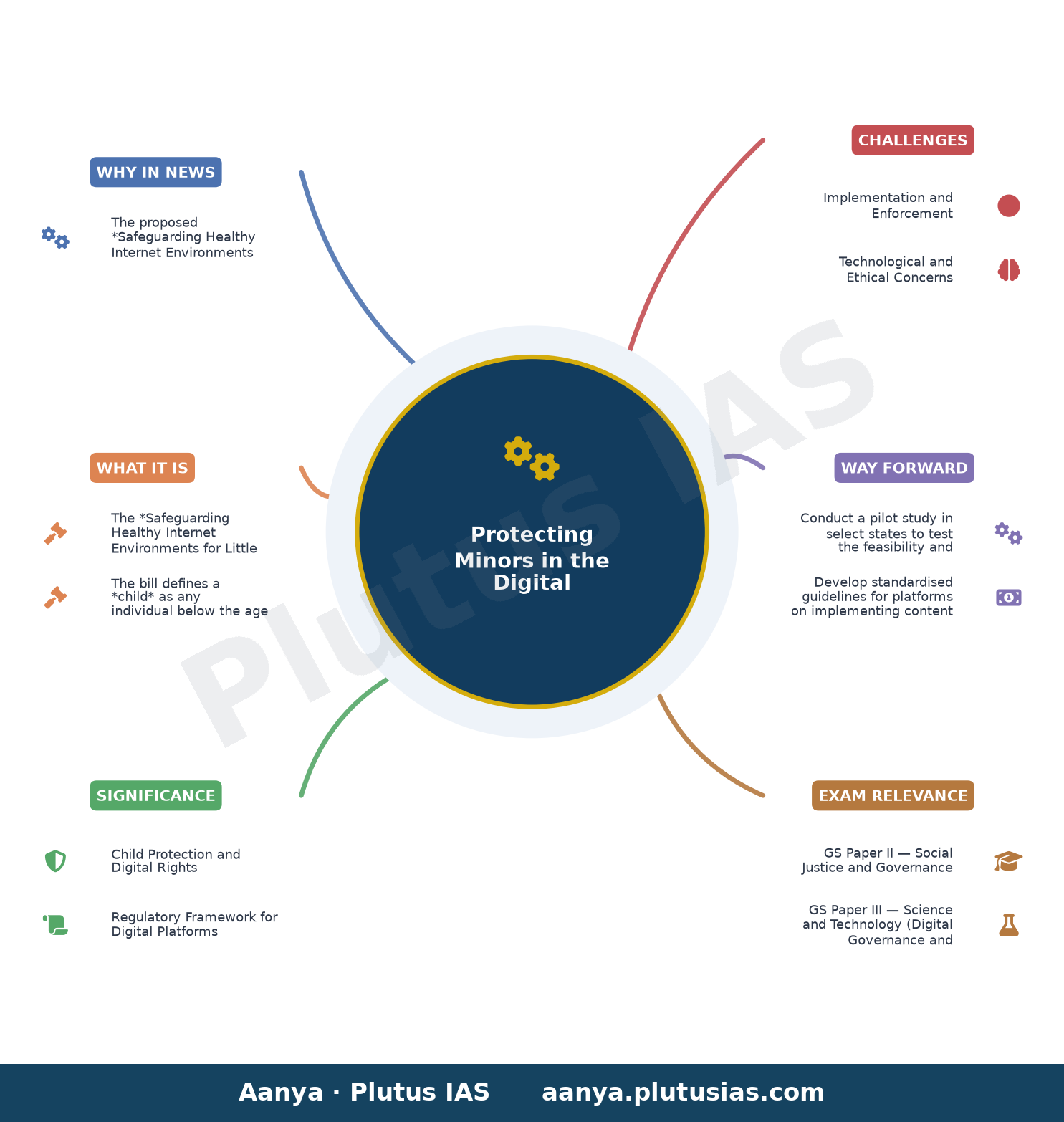
Why is this in the news?
The proposed *Safeguarding Healthy Internet Environments for Little Digital-Natives (SHIELD) Bill, 2025*, introduced as a private member’s bill by BJP MP Baijayant Panda, seeks to impose stringent safeguards on social media, gaming, and other digital platforms to protect minors. The bill, which could not be tabled due to parliamentary adjournments, proposes age-verification systems, parental consent requirements, and restrictions on personalised advertising. It also mandates platforms to prevent exposure to harmful content such as pornography, gambling, and extremist material, reflecting growing legislative and societal concerns about the digital safety of children in India.
Background
- The exponential growth of social media and online gaming platforms has raised significant concerns about child safety, privacy, and exposure to harmful content, necessitating regulatory interventions.
- India’s *Digital Personal Data Protection Act, 2023* (DPDP Act) introduced a framework for data protection but lacked specific provisions for minors, leaving gaps in safeguarding their digital rights.
- The *Information Technology (Intermediary Guidelines and Digital Media Ethics Code) Rules, 2021* require intermediaries to take measures to protect minors but do not mandate age verification or parental consent, leading to inconsistent enforcement.
- Global precedents, such as the *Children’s Online Privacy Protection Act (COPPA) in the USA* and the *UK’s Age-Appropriate Design Code*, have set benchmarks for protecting minors online, influencing India’s legislative approach.
- The *Protection of Children from Sexual Offences (POCSO) Act, 2012* and the *Juvenile Justice (Care and Protection of Children) Act, 2015* provide a legal framework for child protection but do not address digital risks comprehensively.
- Parliamentary records indicate that private member’s bills rarely become law, with only about a dozen passing since Independence, highlighting the need for broader political consensus for such reforms.
What is the SHIELD Bill, 2025?
- The *Safeguarding Healthy Internet Environments for Little Digital-Natives (SHIELD) Bill, 2025* is a private member’s bill introduced to regulate digital platforms to ensure child safety and privacy.
- The bill defines a *child* as any individual below the age of 18.
- It mandates *age verification* for minors accessing social media, gaming, and other digital platforms, and children under 13 could be barred from creating accounts without parental consent.
- The bill prohibits *personalised advertising* targeting minors, requiring platforms to use non-targeted or contextual advertising instead.
- Platforms must implement *parental-control dashboards* to allow guardians to monitor activity, manage privacy settings, and restrict screen time.
- The bill imposes *safety obligations* on platforms to prevent exposure to harmful content, including pornography, gambling, extremist material, and drug-related content.
- Violations of the proposed law could attract penalties of up to ₹10 crore, with repeated or wilful breaches potentially leading to temporary suspension or blocking under *Section 69A of the IT Act*.
- The bill reflects a *rights-based approach* to digital governance, prioritising the protection of minors’ privacy, dignity, and developmental needs in the online space.
Key Features
| Feature | Significance |
|---|---|
| Age Verification System | Mandatory verification to confirm parental consent for account creation by minors, ensuring compliance with the proposed age threshold. |
| Parental-Control Dashboards | Tools for guardians to monitor activity, manage privacy settings, and restrict screen time, enhancing child protection in digital spaces. |
| Prohibition on Personalised Advertising | Ban on tracking, profiling, or targeted advertising for children, reducing exposure to manipulative content and safeguarding mental well-being. |
| Content Restrictions | Platforms must prevent exposure to pornography, gambling, extremist material, and drug-related content, aligning with child welfare objectives. |
| Penalties and Enforcement | Fines up to ₹10 crore for violations, with potential suspension or blocking of services under Section 69A of the IT Act, ensuring accountability. |
Why it Matters
Child Protection and Digital Rights
- Addresses the vulnerability of minors to online risks such as cyberbullying, grooming, and exposure to harmful content.
- Aligns with the UN Convention on the Rights of the Child (UNCRC), which India ratified in 1992, emphasising the state’s obligation to protect children in digital environments.
- Balances digital access with safeguards, recognising the internet as a critical space for education and socialisation but not without risks.
Regulatory Framework for Digital Platforms
- Introduces a structured regulatory approach for social media and gaming platforms, addressing gaps in existing laws like the IT Act and the Protection of Children from Sexual Offences (POCSO) Act.
- Shifts the onus of child protection from parents to platforms, ensuring systemic accountability rather than individual responsibility.
- Sets a precedent for future legislation on digital safety, particularly in emerging areas like AI and deepfake content.
Parental and Societal Responsibility
- Empowers parents with tools to monitor and control their children’s digital activity, fostering a collaborative approach to child safety.
- Encourages societal awareness of digital risks, reducing the stigma around discussing online threats and promoting proactive parenting.
- Highlights the role of schools and civil society in educating children about safe internet practices.
Challenges
1. Implementation and Enforcement
- Age verification systems may face resistance due to privacy concerns, as they require collection and storage of sensitive personal data.
- Platforms may struggle to implement robust verification mechanisms without compromising user experience or violating data protection laws like the Digital Personal Data Protection Act, 2023.
- Enforcement of penalties and suspension of services could be delayed due to bureaucratic hurdles and legal challenges.
UPSC Link: IT Act Section 69A
2. Technological and Ethical Concerns
- Personalised advertising bans may reduce revenue for platforms, leading to potential resistance or circumvention of restrictions.
- AI-driven content moderation tools may struggle to accurately identify and filter harmful content, particularly in multilingual and regional contexts.
- The definition of ‘child’ as under 18 may conflict with existing laws like the Juvenile Justice Act, which defines a child as under 18 but minors as under 16 in certain contexts.
3. Digital Divide and Accessibility
- Strict age verification could disproportionately affect marginalised children who lack access to parental consent or digital literacy, exacerbating inequalities.
- Platforms may prioritise compliance in high-income markets, leading to a fragmented digital ecosystem where children in lower-income regions face higher risks.
4. Jurisdictional and Cross-Border Challenges
- Global platforms may face difficulties in complying with varying national laws, leading to inconsistent enforcement and potential conflicts with international data protection frameworks.
- The proposed bill may clash with laws in other jurisdictions, such as the EU’s Digital Services Act or the US’s Children’s Online Privacy Protection Act (COPPA), complicating compliance for multinational platforms.
5. Public Awareness and Behavioural Change
- Low awareness among parents and children about digital safety could limit the effectiveness of parental-control tools and content restrictions.
- Resistance from users accustomed to unrestricted access may lead to circumvention of safeguards, such as the use of VPNs or fake accounts.
6. Private Member’s Bill Limitations
- Private member’s bills rarely pass into law, as seen historically, limiting the immediate impact of the SHIELD Bill without government support.
- The bill’s success depends on political consensus and prioritisation, which may be challenging in a contentious legislative environment.
Challenges — UPSC Perspective
| Issue | Concern |
|---|---|
| Data Privacy in Age Verification | Risk of misuse or leakage of sensitive personal data collected for verification purposes. |
| Platform Compliance Costs | High financial and operational burden on platforms to implement verification and moderation systems. |
| Cultural and Regional Variations | Diverse societal norms and digital literacy levels may require tailored approaches, complicating uniform enforcement. |
| Monitoring and Reporting Mechanisms | Lack of clear guidelines on how platforms should report violations or cooperate with authorities. |
| Balancing Safety and Access | Risk of over-restriction that limits children’s legitimate access to educational and social resources. |
| Legal Ambiguities | Potential conflicts with existing laws, such as the Right to Privacy under Article 21 of the Constitution. |
Way Forward
- Conduct a pilot study in select states to test the feasibility and effectiveness of age verification and parental-control systems before nationwide rollout.
- Develop standardised guidelines for platforms on implementing content moderation tools, ensuring consistency and reducing compliance costs.
- Launch a national digital literacy campaign targeting parents, children, and educators to promote safe internet practices and awareness of the new safeguards.
- Establish a dedicated grievance redressal mechanism for children and parents to report violations or seek assistance with digital safety concerns.
- Collaborate with state governments to integrate digital safety education into school curricula, ensuring long-term behavioural change.
- Strengthen inter-ministerial coordination between the Ministry of Electronics and Information Technology (MeitY), Ministry of Women and Child Development (MWCD), and Ministry of Education to ensure holistic implementation.
- Encourage industry self-regulation through voluntary codes of conduct, complementing statutory requirements and fostering a culture of accountability.
- Monitor and evaluate the impact of the proposed measures through periodic audits and data-driven assessments to inform future policy refinements.
UPSC Value Addition
Keywords for Mains Answer-Writing
Digital Personal Data Protection Act 2023 · Children’s online safety · Parental consent mechanisms · Personalised advertising restrictions · Age verification systems · Online gaming regulation · Information Technology (Intermediary Guidelines and Digital Media Ethics Code) Rules 2021 · Section 69A of the IT Act · SHIELD Bill 2025 · Privacy rights of minors · Digital intermediaries obligations · Profiling and tracking of minors · Parental control dashboards · Exposure to harmful content
Constitutional & Policy Linkages
- Article 15(3) – Empowers the state to make special provisions for children.
- Article 21 – Right to Privacy and Protection of Personal Data.
- Article 39(f) – Directive Principle of State Policy on child welfare.
- Article 45 – Provision for early childhood care and education.
Concept Flow
Rise in online risks for minors (cyberbullying, grooming, harmful content) → Proposal of SHIELD Bill to regulate digital platforms → Mandatory age verification and parental consent → Parental-control dashboards and content restrictions → Enforcement via penalties and Section 69A of IT Act → Challenges in implementation and compliance → Way forward: pilot studies, digital literacy, inter-ministerial coordination → Long-term impact: safer digital environment for children.
Prelims Practice Questions
Q1. Consider the following statements regarding the SHIELD Bill 2025:
1. The bill proposes to bar children under 13 from creating accounts on social media and gaming platforms without verified parental consent.
2. Platforms are prohibited from tracking, profiling, or using personalised advertising for children under 18.
3. Violations of the proposed law could result in penalties up to ₹5 crore.
4. The bill mandates age-verification systems for platforms accessible to minors.
How many of the above statements are correct?
- Only one
- Only two
- Only three
- All
Answer: Only three — Statement 1 and 4 are correct. Statement 2 is incorrect as the bill defines a child as below 18 but restricts personalised advertising for children under 13. Statement 3 is incorrect as the penalty proposed is up to ₹10 crore, not ₹5 crore.
Q2. Assertion (A): The SHIELD Bill 2025 proposes to prohibit platforms from exposing children to pornography, gambling, and violent content.
Reason (R): The bill seeks to impose safety obligations on digital intermediaries to prevent harm to minors.
Options:
A. Both A and R are true, and R is the correct explanation of A.
B. Both A and R are true, but R is not the correct explanation of A.
C. A is true, but R is false.
D. A is false, but R is true.
- A
- B
- C
- D
Answer: A — Both A and R are true. The bill explicitly prohibits exposure to harmful content (A). The reason (R) correctly explains the rationale behind the assertion, as the bill imposes safety obligations on intermediaries to protect minors.
Q3. Match the following provisions of the SHIELD Bill 2025 with their corresponding objectives:
Column I (Provisions)
1. Age-verification systems
2. Parental-control dashboards
3. Penalties for violations
4. Prohibition of personalised advertising
Column II (Objectives)
A. Ensure verified consent for account creation
B. Monitor and restrict child activity
C. Prevent tracking and profiling of minors
D. Deter non-compliance with safety obligations
Select the correct match:
1 2 3 4
A. A B D C
B. A B C D
C. D A B C
D. B A D C
- A
- B
- C
- D
Answer: B — 1-A (Age-verification ensures verified consent), 2-B (Parental dashboards monitor and restrict activity), 3-D (Penalties deter non-compliance), 4-C (Prohibition of personalised advertising prevents tracking).
Mains Practice Question
✍ Critically examine the provisions of the SHIELD Bill 2025 in the context of balancing children’s online safety with digital rights and parental responsibilities. Also assess the feasibility of its enforcement mechanisms, including age-verification systems and penalties under Section 69A of the IT Act. (15 Marks)
Approach: MODEL-ANSWER SKELETON:
1. **Introduction (2 Marks)**
– Context: Rising concerns over minors’ exposure to harmful content, personalised advertising, and data exploitation.
– Objective of SHIELD Bill 2025: Safeguard minors in digital spaces via age verification, parental controls, and restrictions on profiling.
2. **Key Provisions (4 Marks)**
– Definition of ‘child’ (below 18) and ‘digital intermediaries’ (social media, gaming, pornography platforms).
– Mandatory age-verification systems for platforms accessible to minors.
– Parental consent for account creation (age <13) and parental-control dashboards.
– Prohibition of tracking, profiling, and personalised advertising for children under 13.
– Penalties: Up to ₹10 crore per violation; suspension/blocking under Section 69A of IT Act.
3. **Strengths (4 Marks)**
– **Child-centric approach**: Aligns with UN Convention on the Rights of the Child (Article 16 on privacy).
– **Preventive measures**: Addresses exposure to pornography, gambling, and extremist content.
– **Parental empowerment**: Dashboards enable monitoring and screen-time management.
– **Deterrent penalties**: High fines and potential blocking under Section 69A ensure compliance.
4. **Challenges & Criticisms (3 Marks)**
– **Enforcement feasibility**: Age-verification may infringe privacy (biometric data concerns).
– **Overbreadth**: Defining ‘child’ as <18 may be too broad; 13–18 age group lacks tailored provisions.
– **Technical hurdles**: Age-verification systems may be bypassed (e.g., VPNs, fake IDs).
– **Private member’s bill**: Low success rate (~12 bills passed since Independence); political feasibility uncertain.
5. **Comparative Perspective (1 Mark)**
– Contrast with Digital Personal Data Protection Act 2023: DPDP focuses on data processing, while SHIELD targets intermediaries’ obligations.
– Reference to EU’s Digital Services Act (DSA) and UK’s Online Safety Act for global best practices.
6. **Conclusion (1 Mark)**
– SHIELD Bill is a progressive step but requires refinement in enforcement, age thresholds, and privacy safeguards. Its success hinges on inter-ministerial coordination (MeitY, MoWCD) and stakeholder consultations.
Source: Hindustan Times
Generated by AanyaAi for educational purpose.

- यूपी में पहली बार तेंदुओं का बधियाकरण: मानव-वन्यजीव संघर्ष रोकेगा अभियान - September 24, 2026
- UP’s Groundbreaking Leopard Sterilization Plan to Curb Human-Wildlife Conflict - September 24, 2026
- महाराष्ट्र में त्योहार जुलूसों पर बॉम्बे हाईकोर्ट का बड़ा फैसला: पटाखे, लेजर और संगीत पर रोक - September 24, 2026

No Comments