


08 Aug Parliament Considers Bill to Ban Social Media Accounts for Kids Under 13
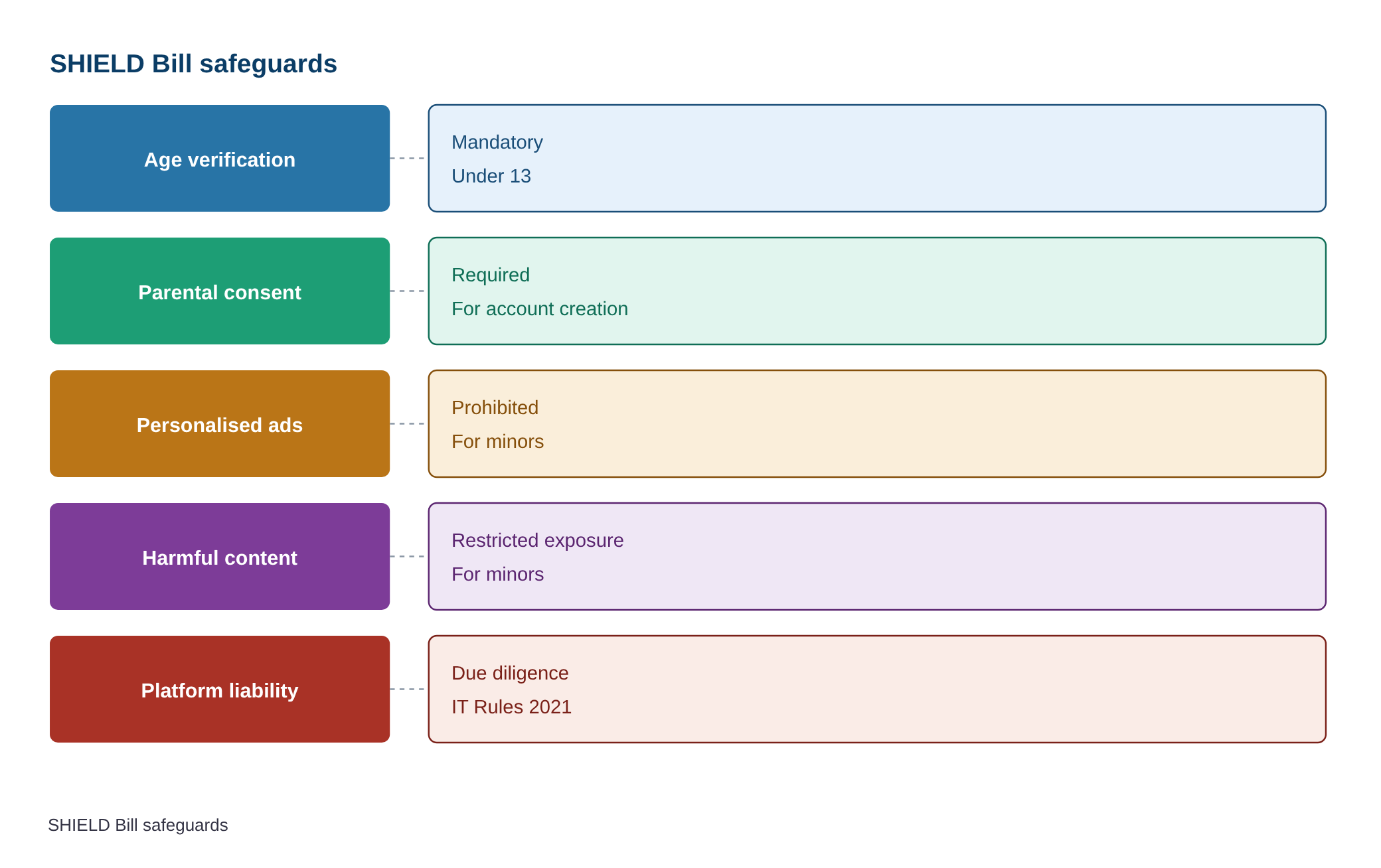
✎ The SHIELD Bill, 2025, proposes mandatory age verification, parental consent for account creation by children under 13, and prohibitions on personalised advertising and exposure to harmful content on social media and gaming…
Subject Relevance — Where This Topic Fits
- GS Paper II — Governance, Constitution, Polity, Social Justice and International Relations | GS Paper III — Science and Technology, including IT and Computers
- Prelims: Digital Personal Data Protection Act, 2023, Information Technology (Intermediary Guidelines and Digital Media Ethics Code) Rules, 2021, Section 69A of the IT Act, Age-verification mechanisms, Personalised advertising restrictions, Online gaming regulation, Protection of Children from Sexual Offences (POCSO) Act, 2012
- Essay: The ethical governance of emerging technologies: Balancing innovation with child protection in the digital age, Digital sovereignty and the role of the state in safeguarding vulnerable populations
Quick Revision: The SHIELD Bill, 2025, proposes mandatory age verification, parental consent for account creation by children under 13, and prohibitions on personalised advertising and exposure to harmful content on social media and gaming platforms.
Why is this in the news?
The proposed Safeguarding Healthy Internet Environments for Little Digital-Natives (SHIELD) Bill, 2025, introduced as a private member’s bill by BJP MP Baijayant Panda, seeks to impose stringent restrictions on social media and online gaming platforms to protect minors from digital harms. The bill, which could not be introduced due to parliamentary adjournments, proposes mandatory age verification, parental consent for account creation by children under 13, and prohibitions on personalised advertising and exposure to harmful content. This legislative initiative reflects growing concerns over the unregulated digital exposure of children and aligns with global trends in child protection within digital spaces.
Background
- The exponential growth of social media and online gaming among minors has raised concerns about digital addiction, exposure to inappropriate content, and privacy violations.
- India’s regulatory framework for digital platforms has evolved through the Information Technology Act, 2000, and its subsequent amendments, including the IT (Intermediary Guidelines and Digital Media Ethics Code) Rules, 2021, which mandate due diligence by intermediaries.
- The Digital Personal Data Protection Act, 2023, introduced principles of data minimisation and purpose limitation, but explicit provisions for child protection in digital ecosystems remain limited.
- Global precedents include the European Union’s Digital Services Act (DSA) and the United Kingdom’s Age Appropriate Design Code, which impose obligations on platforms to safeguard minors.
- The Protection of Children from Sexual Offences (POCSO) Act, 2012, and the Juvenile Justice (Care and Protection of Children) Act, 2015, provide a legal foundation for protecting minors from online exploitation and abuse.
- Private member’s bills in India have historically faced challenges in becoming law, with only about a dozen such bills passed since Independence, underscoring the need for government-backed legislative action.
What is the SHIELD Bill, 2025?
- The Safeguarding Healthy Internet Environments for Little Digital-Natives (SHIELD) Bill, 2025, is a private member’s bill introduced by BJP MP Baijayant Panda to regulate digital platforms accessible to minors, including social media and online gaming platforms.
- The bill defines a ‘child’ as any individual below the age of 18.
- Key provisions include mandatory age-verification systems to prevent underage account creation without verified parental consent, ensuring that platforms cannot allow children under 13 to register accounts independently.
- The bill prohibits platforms from tracking, profiling, or targeting minors with personalised advertising, aligning with principles of data minimisation and child-specific privacy protections.
- Platforms are mandated to implement parental-control dashboards, enabling guardians to monitor activity, manage privacy settings, and restrict screen time, thereby fostering responsible digital parenting.
- The bill imposes obligations on platforms to prevent exposure of minors to harmful content, including pornography, gambling, simulated betting, violent or extremist material, and drug-related content, through algorithmic and content moderation measures.
Key Features
| Feature | Significance |
|---|---|
| Age verification system | Mandatory for platforms accessible to minors, ensuring only verified users below 18 can access services, enhancing accountability of digital intermediaries. |
| Parental consent requirement | Prohibits children under 13 from creating accounts without explicit parental approval, aligning with global standards for child protection in digital spaces. |
| Prohibition on personalised advertising | Restricts tracking, profiling, and targeted advertising for minors, reducing exposure to manipulative content and safeguarding mental well-being. |
| Parental-control dashboard | Empowers guardians to monitor activity, manage privacy settings, and restrict screen time, fostering responsible digital parenting. |
| Content moderation obligations | Platforms must prevent exposure to pornography, gambling, extremist material, and drug-related content, ensuring a safer online environment for children. |
| Penalties for non-compliance | Violations may attract fines up to ₹10 crore and potential service suspension under Section 69A of the IT Act, enforcing strict adherence to the proposed law. |
Why it Matters
Child Protection and Digital Well-being
- Addresses rising concerns over cyberbullying, online predators, and mental health impacts on minors due to unrestricted social media and gaming access.
- Aligns with the United Nations Convention on the Rights of the Child (UNCRC), which mandates protection from harm in digital spaces.
- Reduces exposure to addictive algorithms and manipulative advertising, promoting healthier digital habits among children.
Regulatory Framework for Digital Intermediaries
- Introduces a structured legal framework for social media, gaming, and other digital platforms, addressing gaps in existing IT Act provisions.
- Shifts responsibility from reactive content removal to proactive safeguards, setting a precedent for future digital governance.
- Encourages platforms to adopt age-verification technologies, fostering innovation in digital identity management.
Parental and Guardian Empowerment
- Provides tools for parents to monitor and control their children’s digital activities, bridging the gap between technology and parenting.
- Promotes collaborative digital parenting, reducing the burden on schools and law enforcement to address online harms.
- Encourages family discussions on responsible internet use, fostering a culture of digital literacy.
Economic Implications for Platforms
- May increase operational costs for platforms due to mandatory age-verification and content moderation systems.
- Potential reduction in advertising revenue from minors, necessitating alternative monetisation strategies.
- Could drive consolidation in the gaming and social media sectors, favouring platforms with robust child-safety measures.
Challenges
1. Implementation and Enforcement
- Age-verification systems may face resistance due to privacy concerns and potential data breaches.
- Platforms may struggle to uniformly enforce age restrictions across diverse user bases and geographies.
- Lack of standardised digital identity infrastructure in India could hinder effective verification.
UPSC Link: GS Paper 2: Governance, Transparency & Accountability
2. Balancing Child Protection and Digital Inclusion
- Overly restrictive measures may exclude underprivileged children from essential digital services, exacerbating the digital divide.
- Parental consent requirements could disproportionately affect children in households with limited digital literacy or access.
- Need to ensure that safeguards do not stifle creativity, learning, and social interaction in digital spaces.
UPSC Link: GS Paper 1: Social Empowerment
3. Technological and Ethical Dilemmas
- Development of reliable age-verification tools without compromising user privacy remains a technical challenge.
- Risk of false positives/negatives in age verification could lead to either over-restriction or under-protection.
- Ethical concerns over surveillance-like parental control dashboards and their long-term impact on child autonomy.
UPSC Link: GS Paper 4: Ethics, Integrity & Aptitude
4. Legal and Jurisdictional Hurdles
- Private member’s bills rarely become law, raising questions about the bill’s eventual passage and implementation.
- Potential conflicts with existing laws, such as the IT Rules 2021, may require harmonisation.
- Cross-border nature of digital platforms complicates enforcement, especially for global tech giants.
UPSC Link: GS Paper 2: Government Policies & Interventions
5. Public Awareness and Behavioural Change
- Low awareness among parents and children about digital risks may limit the effectiveness of the proposed measures.
- Resistance from tech-savvy youth who view restrictions as infringements on their digital freedom.
- Need for sustained campaigns to educate stakeholders on the benefits and usage of parental-control tools.
UPSC Link: GS Paper 4: Ethics, Integrity & Aptitude
Challenges — UPSC Perspective
| Issue | Concern |
|---|---|
| Privacy in age verification | Risk of data breaches or misuse of sensitive personal information during verification processes. |
| Digital divide | Potential exclusion of underprivileged children from essential digital services due to restrictive measures. |
| Platform compliance | Challenges in uniform enforcement across diverse platforms, especially global tech giants. |
| Parental literacy | Limited digital literacy among parents may reduce the efficacy of parental-control dashboards. |
| False positives in age verification | Risk of misclassifying users due to flawed verification systems, leading to either over-restriction or under-protection. |
| Cross-border enforcement | Difficulty in regulating global platforms operating in multiple jurisdictions with varying laws. |
Way Forward
- Conduct pilot studies to test age-verification systems and parental-control tools in select states to assess feasibility and impact.
- Collaborate with tech companies to develop privacy-preserving age-verification technologies, such as blockchain-based or AI-driven solutions.
- Launch nationwide awareness campaigns to educate parents, children, and educators about digital risks and the proposed safeguards.
- Establish a multi-stakeholder task force comprising government, tech platforms, child psychologists, and civil society to oversee implementation.
- Harmonise the bill with existing laws, such as the IT Rules 2021 and the Protection of Children from Sexual Offences (POCSO) Act, to avoid legal conflicts.
- Develop standardised training modules for parents and teachers to effectively utilise parental-control dashboards and monitor digital activities.
- Encourage research on the long-term psychological and social impacts of digital restrictions on children’s development and well-being.
- Explore international best practices, such as the EU’s Digital Services Act, to refine India’s regulatory framework for digital intermediaries.
UPSC Value Addition
Keywords for Mains Answer-Writing
Digital Personal Data Protection Act 2023 · Protection of Children from Sexual Offences Act 2012 · Information Technology (Intermediary Guidelines and Digital Media Ethics Code) Rules 2021 · UN Convention on the Rights of the Child · Parental consent mechanisms · Age verification systems · Personalised advertising to minors · Online gaming regulation · Cybersecurity for children · Data localisation under DPDP Act · Section 69A of IT Act · Digital literacy for children · Safeguarding minors online · Right to Privacy under Article 21 · Children’s rights in digital space
Constitutional & Policy Linkages
- Article 21: Right to Privacy (Puttaswamy Judgement)
- Article 14: Equality and Non-Discrimination
- Article 39(f): Directive Principle on Child Protection
Concept Flow
Rising concerns over child safety in digital spaces → Proposal of SHIELD Bill, 2025 → Mandatory age verification and parental consent → Restrictions on personalised advertising for minors → Enhanced parental control and content moderation → Enforcement via penalties and Section 69A of IT Act → Long-term impact on digital governance and child welfare.
Prelims Practice Questions
Q1. Consider the following statements regarding the proposed SHIELD Bill, 2025:
1. The bill proposes to bar children under 13 from creating accounts on social media and gaming platforms without verified parental consent.
2. The bill defines a child as anyone below 18 years of age.
3. Platforms violating the proposed law could face penalties of up to ₹10 crore or temporary suspension under Section 69A of the Information Technology Act.
How many of the above statements are correct?
- Only one
- Only two
- All three
- None
Answer: All three — Statements 1 and 3 are correct as per the bill’s provisions. Statement 2 is incorrect because the bill defines a child as anyone below 18, but the age threshold for account creation restrictions is set at 13.
Q2. Assertion (A): The Digital Personal Data Protection Act, 2023, mandates age verification mechanisms for platforms accessible to minors.
Reason (R): The Act empowers the Data Protection Board of India to impose penalties on platforms failing to comply with data protection norms for children.
In the context of the above two statements, which one of the following is correct?
- Both A and R are true, and R is the correct explanation of A.
- Both A and R are true, but R is not the correct explanation of A.
- A is true, but R is false.
- A is false, but R is true.
Answer: A is true, but R is false. — Assertion (A) is false because the DPDP Act, 2023, does not explicitly mandate age verification mechanisms; it focuses on data protection principles. Reason (R) is true as the Act empowers the Data Protection Board to impose penalties for non-compliance, including for violations affecting children.
Q3. Match the following provisions with their respective legal frameworks:
Column I (Provision)
A. Prohibition of personalised advertising to minors
B. Mandatory age-verification systems for platforms
C. Temporary suspension of services for violations
D. Data localisation requirements for sensitive data
Column II (Legal Framework)
1. Digital Personal Data Protection Act, 2023
2. Information Technology (Intermediary Guidelines and Digital Media Ethics Code) Rules, 2021
3. Proposed SHIELD Bill, 2025
4. Section 69A of the Information Technology Act
Select the correct match:
- A-3, B-3, C-4, D-1
- A-2, B-3, C-1, D-4
- A-1, B-2, C-4, D-3
- A-3, B-1, C-2, D-4
Answer: A-3, B-3, C-4, D-1 — A-3: Prohibition of personalised advertising to minors is proposed under the SHIELD Bill, 2025. B-3: Mandatory age-verification systems are also proposed under the SHIELD Bill. C-4: Temporary suspension of services for violations is covered under Section 69A of the IT Act. D-1: Data localisation requirements for sensitive data are mandated under the Digital Personal Data Protection Act, 2023.
Mains Practice Question
✍ The proposed Safeguarding Healthy Internet Environments for Little Digital-Natives (SHIELD) Bill, 2025, seeks to regulate the digital ecosystem for minors by imposing stringent obligations on social media, gaming platforms, and other digital intermediaries. Critically examine the constitutional and statutory foundations of such regulation, including the balance between children’s rights and platform accountability. Also, analyse the potential challenges in its implementation. (15 Marks)
Approach: MODEL-ANSWER SKELETON:
1. **Constitutional Foundations**:
– Right to Privacy (Article 21) and Right to Education (Article 21A) as enabling rights for children’s digital safety.
– State’s obligation under Article 39(f) to ensure children’s development and protection.
– UN Convention on the Rights of the Child (UNCRC) ratified by India, mandating protection from harm in digital spaces.
2. **Statutory Framework**:
– Digital Personal Data Protection Act, 2023: Principles of data minimisation, purpose limitation, and consent for processing children’s data.
– Protection of Children from Sexual Offences Act (POCSO), 2012: Provisions for online child abuse and exploitation.
– Information Technology (Intermediary Guidelines and Digital Media Ethics Code) Rules, 2021: Due diligence obligations for intermediaries.
3. **Provisions of SHIELD Bill**:
– Age verification and parental consent mechanisms for minors under 13.
– Prohibition of personalised advertising and tracking of minors.
– Mandatory safety measures against exposure to harmful content (pornography, gambling, extremist material).
– Penalties up to ₹10 crore and suspension under Section 69A of IT Act for violations.
4. **Balance of Rights and Accountability**:
– **Children’s Rights**: Right to access information (Article 19(1)(a)), freedom of expression, and digital literacy.
– **Platform Accountability**: Duty of care under tort law and intermediary liability frameworks.
– **Parental Role**: Need for informed consent and digital parenting support mechanisms.
5. **Challenges in Implementation**:
– **Technological**: Feasibility of robust age-verification systems (e.g., biometric verification, AI-based tools).
– **Privacy Concerns**: Risk of over-collection of data for age verification.
– **Enforcement**: Jurisdictional challenges in cross-border digital platforms and lack of regulatory capacity.
– **Digital Divide**: Unequal access to digital literacy programs and parental awareness.
– **Censorship vs. Safety**: Risk of over-censorship and stifling of legitimate content for minors.
6. **Comparative Perspective**:
– Reference to the Children’s Online Privacy Protection Act (COPPA) in the USA or General Data Protection Regulation (GDPR) in the EU for age-verification and consent models.
7. **Way Forward**:
– Multi-stakeholder approach involving government, platforms, civil society, and parents.
– Investment in digital literacy programs and parental control tools.
– Strengthening grievance redressal mechanisms under the DPDP Act.
**Conclusion**: The SHIELD Bill represents a progressive step in safeguarding minors online but must be balanced with constitutional rights and practical feasibility to avoid unintended consequences.
Source: Hindustan Times
Generated by AanyaAi for educational purpose.

- यूपी में पहली बार तेंदुओं का बधियाकरण: मानव-वन्यजीव संघर्ष रोकेगा अभियान - September 24, 2026
- UP’s Groundbreaking Leopard Sterilization Plan to Curb Human-Wildlife Conflict - September 24, 2026
- महाराष्ट्र में त्योहार जुलूसों पर बॉम्बे हाईकोर्ट का बड़ा फैसला: पटाखे, लेजर और संगीत पर रोक - September 24, 2026

No Comments