


27 Jul Parliament Monsoon Session: Anti-Paper Leak Bill Delayed Amid Opposition Protests
Subject Relevance — Where This Topic Fits
- GS Paper II — Polity and Governance (Parliamentary procedures, legislative process, fundamental rights) | GS Paper III — Internal Security (examination malpractice as a socio-economic threat)
- Prelims: Public Examinations (Prevention of Unfair Means) Act, 2024, Special Fast Track Courts, Organised crime under IPC, Right to Education (RTE) Act, 2009, Article 14 (Equality before law), Article 21 (Right to life and personal liberty)
- Essay: Examination integrity as a pillar of meritocracy in India, The role of legislative intervention in addressing systemic failures of governance
Quick Revision: The Public Examinations (Prevention of Unfair Means) Amendment Bill, 2026, seeks to strengthen penalties for examination malpractice, including paper leaks, by introducing stricter punishments and Special Fast Track Courts, while addressing concerns over police excesses during student protests.
Why is this in the news?
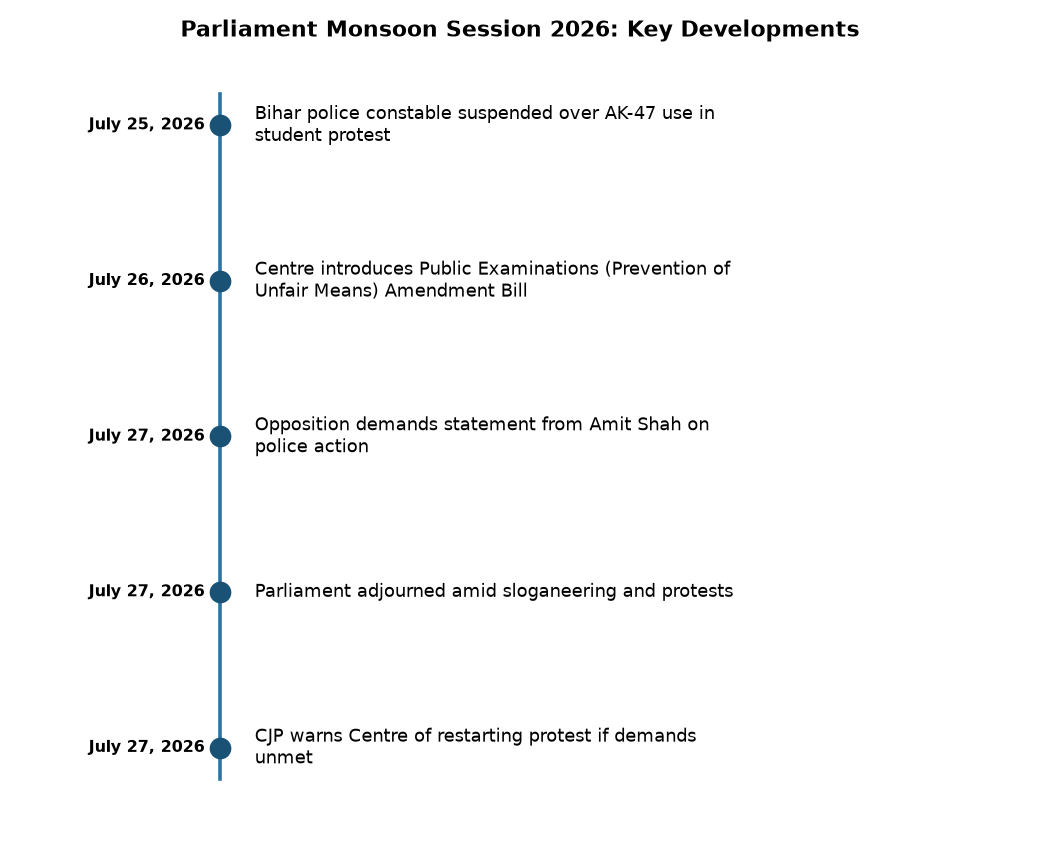
Its introduction amid Opposition protests—over alleged police excesses during student demonstrations and demands for accountability—highlights the Bill’s contentious nature, with the Chief Justice of India (CJI) issuing an ultimatum to the Centre regarding the resumption of protests. The Bill’s legislative journey reflects broader debates on governance, accountability, and the protection of constitutional rights in the context of competitive examinations.
Background
- The Public Examinations (Prevention of Unfair Means) Act, 2024, was enacted to address the growing menace of paper leaks and malpractices in competitive examinations, which undermine the integrity of India’s meritocratic system.
- Recent incidents, including viral videos of alleged police brutality during student protests in Bihar’s Siwan district, have intensified public scrutiny over state responses to examination-related grievances.
- The 2024 Act introduced penalties for organised crime related to examination malpractice, but concerns persist over its implementation and the adequacy of punitive measures.
- Parliamentary disruptions during the Monsoon Session underscore the Opposition’s demand for accountability, particularly regarding the alleged misuse of force against protesting students.
- Competitive examinations in India, such as the UPSC Civil Services Examination, NEET, and JEE, are critical gateways for youth employment and social mobility, making examination integrity a matter of national importance.
What is the Public Examinations (Prevention of Unfair Means) Amendment Bill, 2026?
- The Bill amends the Public Examinations (Prevention of Unfair Means) Act, 2024, to introduce stricter penalties for examination-related malpractice, including paper leaks and organised crime.
- Key provisions include increasing the minimum punishment for organised crime from five to seven years, with imprisonment extendable up to 10 years and fines up to ₹10 crore for organised offences.
- The Bill mandates the establishment of Special Fast Track Courts to expedite trials in examination malpractice cases, addressing delays in the judicial process.
- It expands the definition of ‘unfair means’ to include digital and technological manipulations, such as hacking or impersonation, in addition to traditional malpractices.
- The legislation seeks to deter organised syndicates involved in paper leaks, which have disrupted examinations like NEET, JEE, and UPSC in recent years.
- The Bill reflects the government’s intent to safeguard the integrity of examinations, which are pivotal for youth employment and social equity in India.
- Parliamentary Affairs Minister Kiren Rijiju has urged the Opposition to support the Bill, emphasising its importance for students and young people.
Key Features
| Feature | Significance |
|---|---|
| Public Examinations (Prevention of Unfair Means) Amendment Bill, 2026 | Introduces stricter penalties (up to 10 years imprisonment and Rs 10 crore fine) for organised examination malpractice, including paper leaks, aiming to restore credibility in competitive examinations critical for youth employment. |
| Special Fast Track Courts | Proposed to expedite trials in examination-related offences, addressing delays and ensuring timely justice for victims of paper leaks and malpractice. |
| Increased Minimum Punishment | Raises the minimum imprisonment for organised crime from 5 to 7 years and for individuals from 5 to 10 years, reflecting heightened deterrence against examination fraud. |
| Opposition Disruptions | Demands for a statement from the Union Home Minister on alleged police excesses during student protests highlight tensions between governance and accountability in law enforcement. |
| CJP’s Ultimatum to Centre | Chief Justice of India’s warning to restart protests underscores judicial oversight of executive actions, particularly concerning student rights and police conduct during demonstrations. |
Why it Matters
Social
- The Bill targets systemic examination fraud that disproportionately affects marginalised youth relying on competitive exams (e.g., UPSC, NEET, JEE) for socio-economic mobility.
- Student protests and police action reflect broader societal grievances over governance failures in public examinations, a critical gateway for employment in India.
- The opposition’s demand for accountability in police conduct during protests highlights the tension between law-and-order imperatives and democratic dissent.
- The Bill’s emphasis on organised crime aligns with growing concerns over nexus between coaching mafia, administrative collusion, and cybercrime in examination fraud.
Legal-Administrative
- The proposed amendments strengthen the 2024 Act by introducing stringent penalties and fast-track courts, addressing lacunae in existing legal frameworks.
- Judicial intervention (CJP’s ultimatum) signals the judiciary’s role in monitoring executive actions during protests, ensuring adherence to constitutional rights (e.g., Article 19(1)(a)).
- Parliamentary disruptions reflect institutional challenges in balancing legislative priorities with opposition demands for accountability, impacting governance efficiency.
Economic
- Examination fraud undermines the integrity of merit-based selection systems, distorting labour markets and reducing the efficiency of public sector recruitment.
- Stringent penalties and fast-track courts may deter malpractice, reducing long-term economic costs associated with retests, litigation, and reputational damage to institutions.
Challenges
1. Institutional Credibility Gap
- Public trust in examination systems remains fragile due to recurring scandals, necessitating robust implementation mechanisms beyond legislative amendments.
- Opposition disruptions and demands for accountability highlight a perception of executive overreach, risking legislative paralysis.
- Police conduct during protests (e.g., Siwan incident) raises concerns over disproportionate use of force, requiring independent oversight and transparency.
UPSC Link: GS-II: Role of Parliament and State Legislatures
2. Implementation Bottlenecks
- Fast-track courts require significant judicial infrastructure and manpower, which may be constrained by existing backlogs in the judicial system.
- Stringent penalties may face legal challenges on grounds of proportionality, particularly if applied indiscriminately to minor offences.
- Coordination between central agencies (e.g., NTA, CBI) and state governments is critical but often fraught with federalism-related delays.
UPSC Link: GS-II: Judiciary and Judicial Reforms
3. Societal Polarisation
- Student protests and opposition disruptions reflect deep societal divides over governance, law enforcement, and youth aspirations.
- Media amplification of police actions (e.g., viral videos) risks escalating tensions, requiring calibrated communication strategies by authorities.
- The Bill’s focus on organised crime may overlook systemic issues like coaching mafia collusion, necessitating multi-stakeholder solutions.
UPSC Link: GS-IV: Ethics in Governance
4. Judicial-Executive Tensions
- CJP’s ultimatum underscores the judiciary’s proactive role in governance, which may encroach upon executive prerogatives and legislative autonomy.
- Balancing judicial oversight with democratic dissent requires nuanced interpretations of constitutional rights and separation of powers.
UPSC Link: GS-II: Separation of Powers
5. Cybersecurity and Organised Crime
- Examination fraud increasingly involves cybercrime (e.g., hacking, data leaks), requiring collaboration with cybersecurity agencies and digital forensics capabilities.
- Organised crime syndicates exploit loopholes in examination systems, necessitating proactive intelligence and inter-state coordination.
UPSC Link: GS-III: Cybersecurity and Challenges
Challenges — UPSC Perspective
| Issue | Concern |
|---|---|
| Recurring paper leaks | Erodes trust in merit-based systems, disproportionately impacting economically weaker sections dependent on competitive exams. |
| Police excesses during protests | Risk of escalating tensions, undermining democratic dissent, and violating fundamental rights (e.g., Article 19(1)(a)). |
| Judicial activism vs. executive autonomy | Potential conflict between judiciary’s oversight role and legislative/executive functions, impacting governance stability. |
| Fast-track court bottlenecks | Judicial infrastructure constraints may delay justice, defeating the Bill’s purpose of expeditious trials. |
| Cybercrime in examinations | Sophisticated hacking and data breaches require advanced technological solutions and inter-agency coordination. |
Way Forward
- Constitute a multi-stakeholder committee (including students, educators, and cybersecurity experts) to monitor implementation of the amended Bill and address systemic gaps.
- Establish independent oversight mechanisms (e.g., ombudsman) to investigate police conduct during protests and ensure accountability for excesses.
- Accelerate judicial reforms to fast-track courts, including dedicated benches for examination-related cases and digital case management systems.
- Enhance cybersecurity protocols for examination authorities, including real-time monitoring, encryption, and collaboration with CERT-In.
- Launch public awareness campaigns to educate stakeholders (students, parents, coaching centres) on legal consequences of examination fraud and reporting mechanisms.
- Strengthen inter-state coordination to dismantle organised crime syndicates involved in paper leaks, leveraging agencies like NIA and CBI.
- Introduce periodic audits of examination systems by third-party agencies to identify vulnerabilities and recommend corrective measures.
UPSC Value Addition
Keywords for Mains Answer-Writing
Public Examinations (Prevention of Unfair Means) Amendment Bill 2026 · examination malpractice · paper leak · Special Fast Track Courts · organised crime in examinations · youth and student welfare · legislative process and parliamentary disruption · fundamental right to education (Article 21A) · examination reforms in India · Rule of Law and accountability in governance · police action on student protests · constitutional morality in legislative debates
Constitutional & Policy Linkages
- Article 14: Equality before law (ensuring fair examinations for all candidates)
- Article 19(1)(a): Freedom of speech and expression (balancing protests with public order)
- Article 21: Right to life and personal liberty (protecting students from police excesses)
- Article 38: Promotion of welfare of the people (ensuring integrity in public examinations)
Concept Flow
Recurring paper leaks and examination fraud → Public outrage and student protests → Government introduces anti-paper leak Bill → Opposition demands accountability for police action → Parliamentary disruptions delay debate → CJP warns of renewed protests → Judicial-executive tensions escalate → Need for systemic reforms in examination governance.
Prelims Practice Questions
Q1. Which of the following provisions is NOT included in the Public Examinations (Prevention of Unfair Means) Amendment Bill, 2026?
- A. Imprisonment up to 10 years for organised examination-related offences
- B. Fine up to ₹10 crore for organised examination malpractice
- C. Establishment of Special Fast Track Courts for examination-related cases
- D. Mandatory reservation for economically weaker sections in public examinations
Answer: D. Mandatory reservation for economically weaker sections in public examinations — The Bill focuses on punitive measures and judicial reforms for examination malpractice but does not include provisions for reservation in public examinations. Reservation policies are governed by separate constitutional provisions.
Q2. The Public Examinations (Prevention of Unfair Means) Amendment Bill, 2026 seeks to amend the original Act passed in which year?
- A. 2020
- B. 2022
- C. 2024
- D. 2025
Answer: C. 2024 — The original Public Examinations (Prevention of Unfair Means) Act was passed in 2024, as explicitly mentioned in the news report. The Amendment Bill, 2026, proposes to strengthen this legislation.
Q3. Which constitutional provision is most directly linked to the fundamental right being addressed by the Public Examinations (Prevention of Unfair Means) Amendment Bill?
- A. Article 14 (Right to Equality)
- B. Article 19(1)(a) (Freedom of Speech)
- C. Article 21A (Right to Education)
- D. Article 300A (Right to Property)
Answer: C. Article 21A (Right to Education) — Article 21A guarantees the right to free and compulsory education to children aged 6–14 years, which is directly relevant to ensuring fairness in public examinations, a critical component of the educational process.
Mains Practice Question
✍ Critically examine the necessity and effectiveness of the Public Examinations (Prevention of Unfair Means) Amendment Bill, 2026. Discuss its potential impact on examination reforms in India, while addressing concerns related to parliamentary disruption and legislative accountability.
Approach: The candidate should analyse the Bill’s provisions, such as enhanced punishments, Special Fast Track Courts, and its alignment with the fundamental right to education (Article 21A). Evaluate its potential to curb examination malpractice while addressing concerns about parliamentary decorum and legislative accountability. Discuss the role of Special Fast Track Courts in expediting justice and their constitutional validity under Article 21 (Right to Speedy Trial). Additionally, examine the Opposition’s demand for a statement from the Home Minister and its implications for legislative transparency and public trust.
Source: Times of India
Generated by AanyaAi for educational purpose.

- दिल्ली में 99% पीजी में नहीं है फायर एनओसी, 30% को नहीं मिला लेआउट अप्रूवल: एमसीडी सर्वे - September 15, 2026
- महत्वपूर्ण: MSC एल्सा 3 जहाज के डूबने के दीर्घकालिक प्रभावों का आकलन करेगा केंद्र, जानिए पूरा मामला - September 15, 2026
- केरल की इकोसेंस छात्रवृत्तियां: 46,000 छात्रों को अपशिष्ट प्रबंधन में सशक्त बना रही हैं - September 14, 2026

No Comments