


27 Jul Parliament Monsoon Session: Anti-Paper Leak Bill Delayed as Opposition Protests Intensify
Subject Relevance — Where This Topic Fits
- GS Paper II — Constitutional and Statutory Bodies | GS Paper III — Issues Relating to Development and Management of Social Sector/Services relating to Education
- Prelims: Public Examinations (Prevention of Unfair Means) Act, 2024, Special Fast Track Courts, Concurrent List (Entry 25), Article 300A (Right to Property), National Testing Agency (NTA), UPSC Civil Services Examination, NEET-UG, JEE Main, UGC-NET
- Essay: The erosion of trust in public institutions: A case study of examination systems in India, Balancing accountability and student rights in governance of competitive examinations
Quick Revision: The Public Examinations (Prevention of Unfair Means) Amendment Bill, 2026, seeks to amend the 2024 Act by enhancing penalties, expanding the scope of offences to include digital malpractices, and establishing Special Fast Track Courts to ensure swift justice in cases of examination-related crimes.
Why is this in the news?
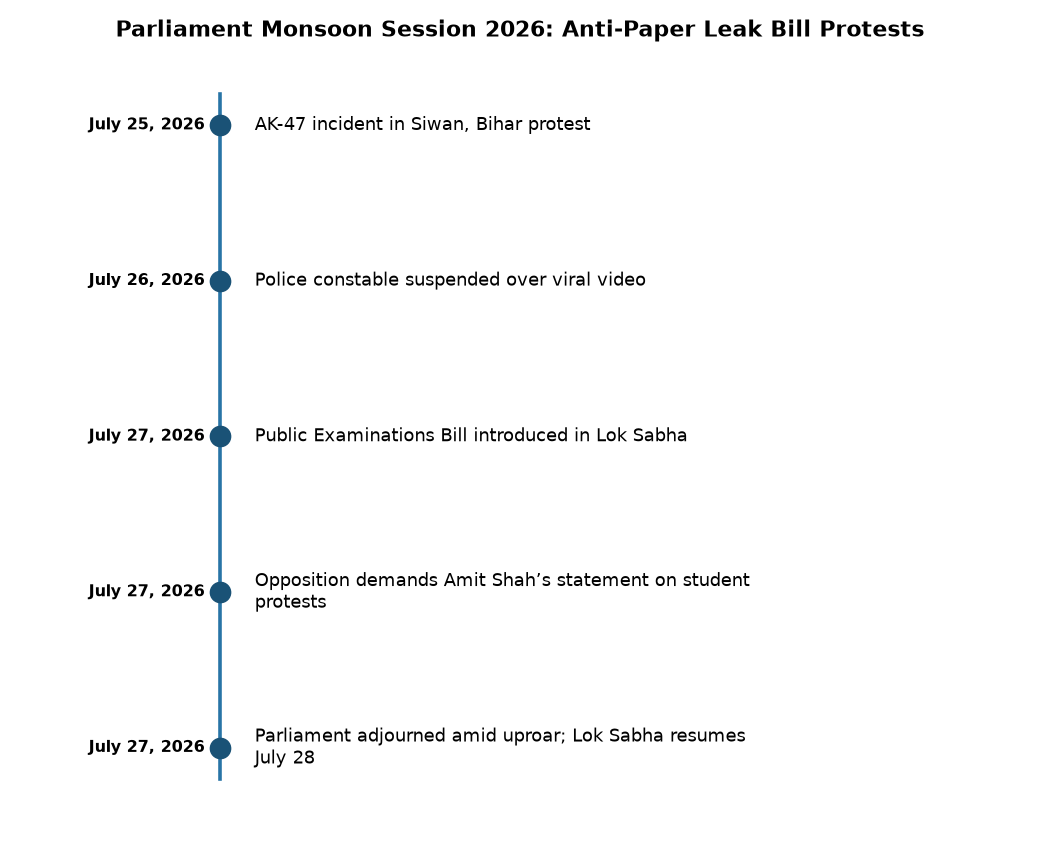
The Monsoon Session of Parliament has witnessed intense legislative and political turbulence surrounding the introduction of the Public Examinations (Prevention of Unfair Means) Amendment Bill, 2026. The Bill seeks to amend the Public Examinations (Prevention of Unfair Means) Act, 2024, by introducing stricter penalties for examination malpractice, including organised paper leaks, and establishing Special Fast Track Courts for expeditious disposal of such cases. The Opposition’s vociferous protests, citing alleged police excesses during student agitations and broader concerns over institutional accountability, have delayed substantive debate on the Bill. Concurrently, judicial intervention by the Chief Justice of India (CJI) underscores the judiciary’s role in safeguarding constitutional rights amid perceived executive overreach and systemic failures.
Background
- The Public Examinations (Prevention of Unfair Means) Act, 2024, was enacted to address the growing menace of paper leaks and malpractices in competitive examinations conducted by bodies such as the Union Public Service Commission (UPSC), National Testing Agency (NTA), and state-level public service commissions.
- Examination malpractice in India has escalated in recent years, with high-profile cases involving NEET-UG, JEE Main, UGC-NET, and state-level civil service examinations being widely reported, eroding public trust in the integrity of these assessments.
- The 2024 Act introduced penalties including imprisonment up to 10 years and fines up to ₹1 crore for organised examination-related offences, alongside provisions for setting up Special Courts for speedy trials.
- The 2026 Amendment Bill proposes to further strengthen the 2024 Act by increasing minimum punishments for organised crimes from five to seven years and extending the scope of offences to include digital and technological means of malpractice.
- Student protests against alleged police brutality during agitations in states like Assam, West Bengal, and Bihar have intensified political scrutiny over the Bill’s provisions and their implementation.
- The judiciary’s intervention, exemplified by the CJI’s ultimatum to the Centre, reflects concerns over the balance between law enforcement and constitutional rights, particularly the right to peaceful protest under Article 19(1)(a).
What is the Public Examinations (Prevention of Unfair Means) Amendment Bill, 2026?
- The Bill is an amendment to the Public Examinations (Prevention of Unfair Means) Act, 2024, aimed at strengthening the legal framework against examination malpractice and paper leaks in competitive examinations.
- It proposes to increase the minimum punishment for organised examination-related crimes from five years to seven years, with imprisonment up to 10 years and fines up to ₹10 crore for organised offences.
- For individuals found guilty, the imprisonment is proposed to be increased to a minimum of five years, extendable up to 10 years, along with a fine of up to Rs 50 lakh.
- The Bill mandates the establishment of Special Fast Track Courts to ensure expeditious trials, addressing delays in the justice delivery system that have historically undermined deterrence.
- It expands the definition of ‘unfair means’ to include digital and technological malpractices, such as hacking, impersonation, and use of unauthorised devices or software during examinations.
- The legislation seeks to cover all public examinations conducted by the Union, state governments, or any authority established under a statute, including UPSC, NTA, SSC, and state public service commissions.
- The Bill includes provisions for inter-state cooperation and data-sharing mechanisms to track and prevent organised paper leaks and malpractice networks.
Key Features
| Feature | Significance |
|---|---|
| Public Examinations (Prevention of Unfair Means) Amendment Bill, 2026 | Introduces stricter penalties for organised examination-related malpractice, including imprisonment up to 10 years and fines up to ₹10 crore, to deter paper leaks and malpractices. |
| Special Fast Track Courts | Proposed to expedite trials in examination-related offences, ensuring timely justice and reducing pendency of cases. |
| Increased Minimum Punishment | Raises the minimum imprisonment for organised crime from 5 to 7 years and for individuals from 5 to 10 years, with fines up to ₹50 lakh, to enhance deterrence. |
| Parliamentary Disruptions | Opposition protests over alleged police action against students and use of force (e.g., AK-47 incident in Siwan) highlight tensions between governance and youth aspirations. |
| Chief Justice of India (CJI) Ultimatum | CJI’s warning to the Centre to address student protests or risk judicial intervention underscores the judiciary’s role in safeguarding constitutional rights during governance crises. |
Why it Matters
Governance and Rule of Law
- The Bill seeks to strengthen rule-based examinations, a critical governance function, by criminalising malpractices that undermine meritocracy and public trust in institutions.
- Fast-track courts address judicial delays, a systemic challenge in delivering timely justice, particularly in high-stakes cases like paper leaks.
- The CJI’s ultimatum reflects the judiciary’s constitutional duty to intervene when executive actions or inactions violate fundamental rights of citizens, especially vulnerable groups like students.
Social and Ethical
- Examination malpractices disproportionately affect marginalised students, exacerbating socio-economic inequalities by distorting merit-based opportunities.
- Police action against student protests, such as the alleged use of firearms in Siwan, raises ethical concerns about proportionality and human rights violations during law enforcement.
Economic
- Paper leaks and malpractices in competitive examinations disrupt human capital development, a critical driver of India’s demographic dividend and economic growth.
- Stricter penalties may reduce financial losses to coaching institutes and candidates from malpractices, promoting a more equitable and efficient education ecosystem.
Judicial
- The CJI’s intervention signals judicial activism in governance issues, particularly when legislative or executive actions fail to address public grievances promptly.
- Fast-track courts align with judicial reforms aimed at reducing pendency, a persistent challenge in India’s judicial system.
Challenges
1. Political Polarisation in Parliament
- Opposition disruptions delay legislative processes, undermining parliamentary efficiency and delaying critical reforms like the anti-paper leak Bill.
- Allegations of deliberate obstruction by opposition parties reflect deeper political tensions, complicating consensus-building on governance issues.
UPSC Link: GS-II: Parliament and State Legislatures
2. Police Brutality and Public Trust
- Alleged use of excessive force (e.g., AK-47 incident) by police against student protesters erodes public trust in law enforcement and fuels further unrest.
- Lack of transparency in police inquiries into such incidents exacerbates perceptions of institutional bias and impunity.
UPSC Link: GS-II: Functions and Responsibilities of the Union and the States
3. Judicial Overreach vs. Separation of Powers
- CJI’s ultimatum raises questions about the judiciary’s role in governance, particularly when it intervenes in executive or legislative matters without explicit constitutional mandate.
- Balancing judicial activism with the principle of separation of powers is essential to maintain institutional harmony and democratic accountability.
UPSC Link: GS-II: Judiciary
4. Implementation and Enforcement Gaps
- Even with stricter penalties, enforcement remains a challenge due to limited institutional capacity, corruption, and lack of coordination among agencies.
- Fast-track courts require adequate infrastructure, trained judges, and resources to function effectively, posing logistical hurdles.
UPSC Link: GS-II: Government Policies and Interventions
5. Youth Disillusionment and Social Unrest
- Systemic issues like paper leaks and police brutality fuel youth disillusionment, potentially leading to long-term social unrest and erosion of faith in democratic institutions.
- Addressing these grievances requires holistic reforms in governance, education, and law enforcement to restore confidence among the youth.
UPSC Link: GS-II: Issues Relating to Development and Management of Social Sector/Services relating to Education
Challenges — UPSC Perspective
| Issue | Concern |
|---|---|
| Parliamentary Disruptions | Delays in legislative processes and reforms due to opposition protests, undermining governance efficiency. |
| Police Action Against Protesters | Alleged use of excessive force and lack of transparency in inquiries erode public trust in law enforcement. |
| Judicial Intervention in Governance | CJI’s ultimatum raises concerns about judicial overreach and its impact on the separation of powers. |
| Enforcement of Anti-Paper Leak Laws | Limited institutional capacity and corruption may hinder effective implementation of stricter penalties. |
| Youth Disillusionment | Systemic malpractices and police brutality fuel social unrest and erode faith in democratic institutions among the youth. |
| Fast-Track Courts’ Feasibility | Inadequate infrastructure and resources may impede the functioning of proposed fast-track courts. |
Way Forward
- Constitute a multi-stakeholder committee comprising representatives from the Ministry of Education, Home Affairs, judiciary, and student bodies to draft a comprehensive national policy on examination reforms, including paper leak prevention and grievance redressal mechanisms.
- Ensure transparency in police inquiries into incidents of alleged brutality, such as the Siwan AK-47 case, by involving independent oversight bodies and publishing detailed reports.
- Allocate dedicated funds and resources for the establishment and operationalisation of Special Fast Track Courts, including training for judges and administrative staff to handle examination-related cases efficiently.
- Launch a nationwide awareness campaign to educate students, parents, and institutions about the legal consequences of examination malpractices and the importance of ethical conduct in examinations.
- Strengthen coordination between central and state agencies to investigate and prosecute organised paper leaks and malpractices, leveraging technology for real-time monitoring and evidence collection.
- Establish a grievance redressal mechanism for students, including a toll-free helpline and online portal, to report malpractices or police misconduct, ensuring timely resolution and accountability.
- Encourage state governments to adopt model guidelines for police conduct during protests, emphasising proportionality, restraint, and respect for human rights to prevent escalation of tensions.
- Promote research and innovation in examination security, such as blockchain-based certification and AI-driven monitoring, to deter malpractices and enhance the integrity of competitive examinations.
UPSC Value Addition
Keywords for Mains Answer-Writing
Public Examinations (Prevention of Unfair Means) Amendment Bill, 2026 · examination malpractice · paper leak · Special Fast Track Courts · organised crime in examinations · youth and student protests · Parliamentary disruption · Constitutional provisions for legislative procedure · Union Home Minister statement · right to protest · Rule of Law · Judicial activism in governance
Constitutional & Policy Linkages
- Article 14: Equality before law and equal protection of laws — Ensures fair treatment of all candidates in examinations, free from discrimination or malpractice.
- Article 21: Right to life and personal liberty — Protects students from excessive police action and ensures due process in legal proceedings.
- Article 19(1)(a): Freedom of speech and expression — Balances the right to protest with the need for lawful conduct and public order.
- Article 32: Right to constitutional remedies — Empowers the judiciary to intervene when fundamental rights are violated, as seen in the CJI’s ultimatum.
Concept Flow
Student protests over examination malpractices and police action → Opposition disruption in Parliament → Introduction of Public Examinations (Prevention of Unfair Means) Amendment Bill, 2026 → Allegations of police brutality (e.g., Siwan AK-47 incident) → CJI’s ultimatum to Centre → Parliamentary adjournments and delays → Enforcement challenges for the Bill → Youth disillusionment and social unrest → Need for multi-stakeholder reforms in governance, education, and law enforcement.
Prelims Practice Questions
Q1. Which of the following is NOT a provision of the Public Examinations (Prevention of Unfair Means) Amendment Bill, 2026?
- A. Imprisonment up to 10 years for organised examination-related offences
- B. Fine up to ₹10 crore for organised examination-related offences
- C. Establishment of Special Fast Track Courts for examination malpractice cases
- D. Mandatory suspension of all police officers involved in student protests
Answer: D. Mandatory suspension of all police officers involved in student protests — The Bill proposes imprisonment and fines for examination malpractice but does not mandate suspension of police officers. Suspension is a disciplinary action, not a legislative provision.
Q2. Under which Article of the Constitution does Parliament derive the power to legislate on examination malpractice?
- A. Article 246 (7th Schedule, Union List)
- B. Article 324
- C. Article 300A
- D. Article 21
Answer: A. Article 246 (7th Schedule, Union List) — Parliament’s power to legislate on matters like examination malpractice is derived from the Union List (Entry 66) under Article 246 of the Constitution.
Q3. What is the primary objective of the Public Examinations (Prevention of Unfair Means) Amendment Bill, 2026?
- A. To regulate private coaching institutions
- B. To prevent and penalise examination malpractice and paper leaks
- C. To mandate uniform syllabus across all competitive examinations
- D. To increase the number of government-conducted examinations
Answer: B. To prevent and penalise examination malpractice and paper leaks — The Bill aims to prevent and penalise examination malpractice, including paper leaks, by introducing stricter punishments and procedural reforms.
Mains Practice Question
✍ Examine the constitutional and ethical dimensions of the Public Examinations (Prevention of Unfair Means) Amendment Bill, 2026. How does the Bill address the challenges posed by examination malpractice, and what are its implications for the right to protest and rule of law in India?
Approach: The response should analyse the Bill’s provisions in the context of constitutional provisions (Article 14, 19, 21, and 246), judicial precedents on legislative competence, and ethical considerations such as fairness and accountability. Discuss the balance between preventing malpractice and safeguarding democratic rights like protest, while also evaluating the role of Special Fast Track Courts in ensuring timely justice. Conclude with a critical assessment of the Bill’s potential effectiveness and limitations.
Source: Times of India
Generated by AanyaAi for educational purpose.


No Comments