


11 Aug Parliament Panel Slams Delays in SC Scholarships & OBC Coaching Scheme Utilisation
✎ Parliamentary standing committees act as institutional watchdogs, scrutinising the implementation of social welfare schemes to ensure timely disbursement, efficient utilisation, and equitable outcomes for marginalised communities.
Subject Relevance — Where This Topic Fits
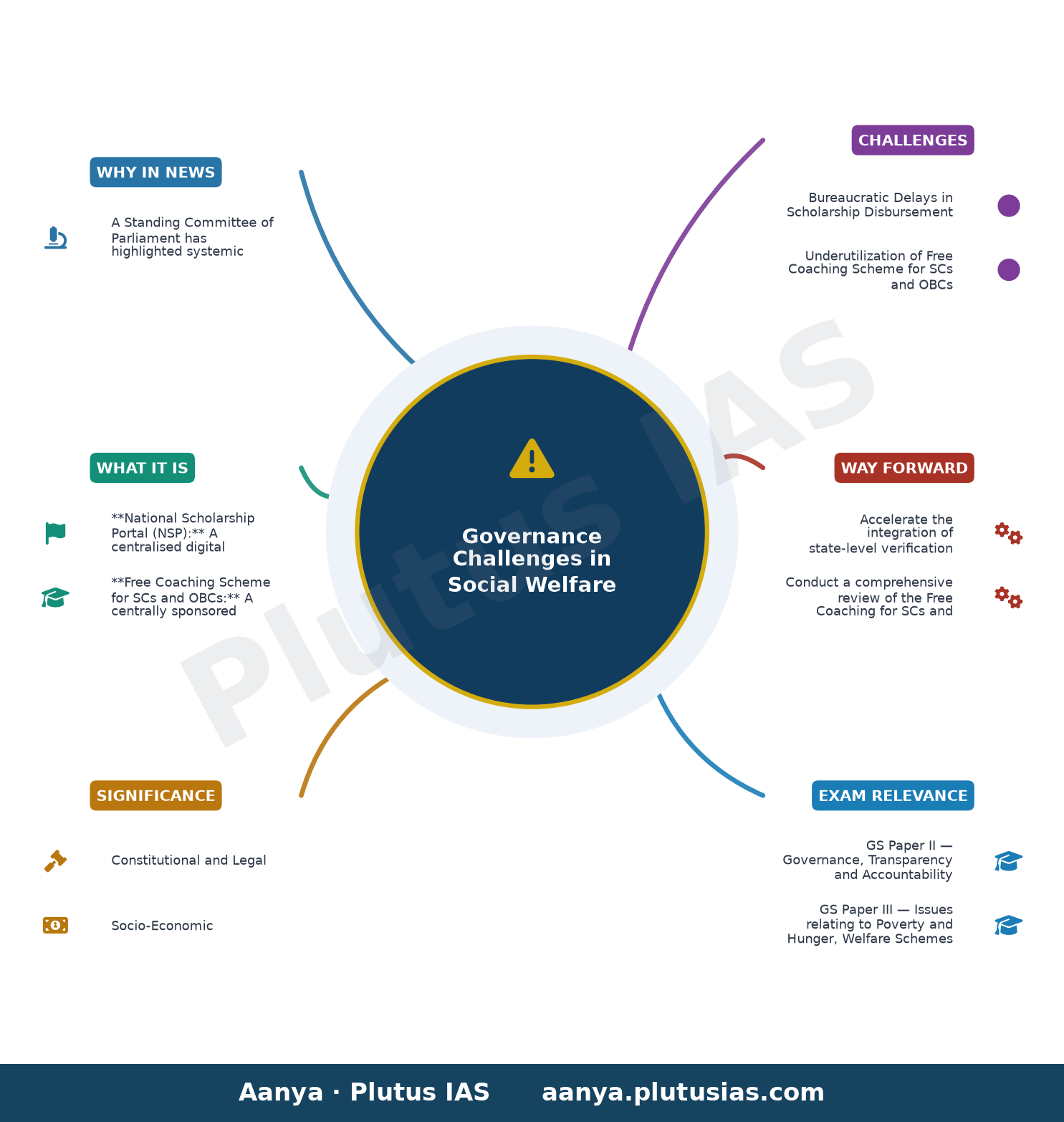
- GS Paper II — Governance, Transparency and Accountability | GS Paper III — Issues relating to Poverty and Hunger, Welfare Schemes for Vulnerable Sections
- Prelims: Scheduled Castes and Scheduled Tribes (Prevention of Atrocities) Act, 1989, National Scholarship Portal (NSP), Free Coaching Scheme for SCs and OBCs, Minority Welfare Schemes, Standing Committee on Social Justice and Empowerment
- Essay: The efficacy of welfare schemes in India: Challenges of implementation and accountability, Role of parliamentary committees in ensuring good governance
Quick Revision: Parliamentary standing committees act as institutional watchdogs, scrutinising the implementation of social welfare schemes to ensure timely disbursement, efficient utilisation, and equitable outcomes for marginalised communities.
Why is this in the news?
A Standing Committee of Parliament has highlighted systemic delays and underutilisation in key social welfare schemes targeting Scheduled Castes (SCs), Other Backward Classes (OBCs), and minority communities. The observations underscore persistent governance gaps in disbursement mechanisms, monitoring frameworks, and infrastructure development, raising concerns about equity and inclusion in India’s education and social protection architecture.
Background
- The Constitution of India mandates affirmative action for SCs, OBCs, and minority communities under Articles 15(4), 16(4), 46, and 340, among others, to address historical disadvantages and promote social justice.
- The National Scholarship Portal (NSP) was launched in 2015 to streamline the disbursement of scholarships for SC, ST, OBC, and minority students, reducing leakages and delays through direct benefit transfer (DBT).
- The Free Coaching Scheme for SCs and OBCs, launched in 2014, aims to provide quality coaching to economically disadvantaged students for competitive examinations, including civil services and engineering/medical entrance tests.
- Minority welfare schemes, including infrastructure development in minority-concentrated areas (e.g., Maulana Azad Education Foundation initiatives), seek to address educational disparities and promote inclusive growth.
- Parliamentary standing committees play a critical role in scrutinising government schemes, ensuring accountability, and recommending corrective measures through reports to Parliament.
- The Scheduled Castes and Scheduled Tribes (Prevention of Atrocities) Act, 1989, provides legal safeguards against discrimination and violence, with mechanisms for timely redressal and rehabilitation.
What are the key schemes and mechanisms under scrutiny?
- **National Scholarship Portal (NSP):** A centralised digital platform for disbursing scholarships to SC, ST, OBC, and minority students, designed to reduce delays and ensure transparency through DBT.
- **Free Coaching Scheme for SCs and OBCs:** A centrally sponsored initiative to provide free coaching to economically weaker sections of SC and OBC communities for competitive examinations, with a target of 3,500 beneficiaries annually.
- **Minority Welfare Schemes:** Programmes focused on improving educational infrastructure, teacher training, and access to quality education in minority-concentrated areas, including schemes under the Ministry of Minority Affairs.
- **Scheduled Castes and Scheduled Tribes (Prevention of Atrocities) Act, 1989:** A legal framework to prevent atrocities against SCs and STs, with provisions for special courts, relief and rehabilitation, and monitoring mechanisms.
- The **Standing Committee on Social Justice and Empowerment** is a parliamentary body tasked with examining the functioning of ministries dealing with social justice, welfare, and empowerment, including the Ministry of Social Justice and Empowerment and the Ministry of Minority Affairs.
- The **Maulana Azad Education Foundation (MAEF)** implements minority-focused educational schemes, including infrastructure development and scholarships, with a mandate to promote inclusive education.
- The **Direct Benefit Transfer (DBT) mechanism** is a cornerstone of welfare delivery, ensuring that benefits reach intended beneficiaries without intermediaries, thereby reducing delays and leakages.
Key Features
| Feature | Significance |
|---|---|
| Scheduled Caste (SC) Scholarships | Provides financial assistance to SC students to reduce dropout rates and enhance educational attainment, aligning with constitutional commitments under Article 46 and Directive Principles of State Policy (DPSP). |
| Free Coaching for SCs and OBCs Scheme | Aims to bridge socio-economic disparities by enabling disadvantaged students to access competitive exam preparation, thereby improving representation in higher education and public services. |
| Minority Welfare Schemes | Focuses on infrastructure development and educational facilities in minority-concentrated areas to ensure equitable access to quality education and socio-economic inclusion. |
| National Scholarship Portal (NSP) | Centralized digital platform for scholarship disbursement, intended to streamline processes, reduce delays, and improve transparency in fund allocation. |
| Standing Committee on Social Justice and Empowerment | Parliamentary body tasked with scrutinizing government schemes for marginalized communities, ensuring accountability and recommending corrective measures. |
Why it Matters
Constitutional and Legal
- The SC scholarships and minority welfare schemes are grounded in constitutional provisions such as Article 15(4) (special provisions for socially and educationally backward classes) and Article 46 (promotion of educational and economic interests of weaker sections).
- The Scheduled Castes and the Scheduled Tribes (Prevention of Atrocities) Act, 1989, mandates protective measures for SCs, including educational support, though its implementation is scrutinized for delays.
- The Right to Education (RTE) Act, 2009, indirectly supports such schemes by ensuring inclusive education, though its scope is broader and not limited to marginalized groups.
Socio-Economic
- Delayed scholarship disbursements exacerbate financial burdens on SC families, increasing the risk of student dropouts and perpetuating intergenerational poverty.
- Poor utilisation of the Free Coaching Scheme for SCs and OBCs undermines efforts to create a level playing field in competitive examinations, limiting upward mobility for economically disadvantaged groups.
- Gaps in minority welfare infrastructure perpetuate educational inequities, hindering social cohesion and economic participation of minority communities.
Administrative and Governance
- The National Scholarship Portal (NSP) was designed to reduce bureaucratic delays, but state-level verification bottlenecks persist, defeating the purpose of centralization.
- Weak monitoring mechanisms for minority-development projects and atrocity prevention schemes indicate systemic gaps in governance and accountability.
- Low financial utilisation of welfare schemes reflects either lack of awareness among beneficiaries, administrative inefficiencies, or misalignment between policy intent and ground-level implementation.
Educational Equity
- These schemes are critical for achieving Sustainable Development Goal 4 (Quality Education) by ensuring no student is left behind due to socio-economic barriers.
- Improving access to coaching for competitive exams can diversify representation in civil services and other elite institutions, addressing historical underrepresentation of SCs and OBCs.
- Strengthening minority educational infrastructure supports inclusive growth and reduces regional disparities in human capital development.
Challenges
1. Bureaucratic Delays in Scholarship Disbursement
- States take months to a year to complete verification and formalities, delaying scholarship disbursements beyond the academic year in which they are due.
- The National Scholarship Portal (NSP) opening in June exacerbates delays, as states require additional time for processing, defeating the portal’s intended efficiency.
- Beneficiaries, particularly from economically weaker sections, face financial hardship due to these delays, increasing dropout risks.
UPSC Link: Governance/Challenges in Public Service Delivery
2. Underutilization of Free Coaching Scheme for SCs and OBCs
- Target beneficiaries (3,500 in 2023-24) were met at only 6.4%, improving marginally to 61% in 2024-25 but dropping to 12.3% in 2025-26.
- Financial utilisation remains critically low (16.5% in 2023-24, 50.5% in 2024-25, and 35.6% in 2025-26), indicating systemic inefficiencies.
- Possible reasons include lack of awareness, cumbersome application processes, or insufficient infrastructure for coaching centres.
UPSC Link: Governance/Implementation Gaps in Welfare Schemes
3. Gaps in Minority Welfare Infrastructure
- Parliamentary panel highlighted inadequate monitoring of minority-development projects, leading to suboptimal utilisation of allocated funds.
- Infrastructure gaps in educational facilities in minority-concentrated areas perpetuate educational inequities and limit socio-economic mobility.
- Weak monitoring mechanisms hinder the identification of bottlenecks and the implementation of corrective measures.
UPSC Link: Governance/Monitoring and Evaluation of Development Schemes
4. Slow Rollout of Atrocity Prevention Mechanisms
- The Standing Committee noted delays in implementing mechanisms to protect SCs from atrocities, despite statutory mandates under the SC/ST (Prevention of Atrocities) Act, 1989.
- Delays in such mechanisms undermine the deterrent effect of the law and fail to provide timely justice to victims.
- Inadequate state-level coordination and resource allocation contribute to these delays.
UPSC Link: Constitutional and Legal/Protection of Marginalized Groups
5. Central-State Coordination Failures
- The Centre’s reliance on state-level verification for scholarship disbursement creates bottlenecks, despite the NSP’s centralised design.
- Poor utilisation of centrally sponsored schemes (CSS) for SCs, OBCs, and minorities reflects weak inter-governmental coordination and accountability.
- Lack of standardized processes across states exacerbates disparities in implementation quality.
UPSC Link: Federalism/Coordination Between Centre and States
Challenges — UPSC Perspective
| Issue | Concern |
|---|---|
| Delayed SC Scholarships | Financial hardship for beneficiaries, increased dropout rates, and erosion of trust in government schemes. |
| Low Utilisation of Free Coaching Scheme | Limited access to competitive exam preparation, perpetuating socio-economic disparities in higher education and public services. |
| Poor Monitoring of Minority Welfare Projects | Suboptimal fund utilisation, inadequate infrastructure, and lack of accountability in minority-concentrated areas. |
| Slow Implementation of Atrocity Prevention Mechanisms | Failure to provide timely justice, undermining deterrence and victim protection under the SC/ST Act. |
| Central-State Coordination Gaps | Bureaucratic bottlenecks, inconsistent implementation, and inefficiencies in centrally sponsored schemes. |
Government Initiatives — Must-Memorise for Prelims
- Pre-Matric Scholarship for SC Students
- Post-Matric Scholarship for SC Students
- Free Coaching for SCs and OBCs Scheme
Way Forward
- Accelerate the integration of state-level verification processes with the National Scholarship Portal (NSP) to reduce delays, possibly through automated verification systems and real-time tracking.
- Conduct a comprehensive review of the Free Coaching for SCs and OBCs Scheme to identify bottlenecks in implementation, including awareness campaigns, streamlined application processes, and increased infrastructure for coaching centres.
- Strengthen monitoring mechanisms for minority welfare projects by introducing third-party audits, geo-tagging of assets, and digital dashboards for real-time progress tracking.
- Fast-track the implementation of atrocity prevention mechanisms under the SC/ST (Prevention of Atrocities) Act by setting strict timelines for state-level action and establishing dedicated fast-track courts.
- Enhance inter-governmental coordination by holding regular review meetings between the Centre and states, with clear accountability frameworks for scheme implementation.
- Expand the scope of the NSP to include coaching schemes, ensuring seamless disbursement of funds and reducing administrative layers.
- Introduce performance-based incentives for state governments to improve utilisation rates of centrally sponsored schemes, while penalizing non-compliance.
- Conduct periodic impact assessments of these schemes to measure outcomes such as reduction in dropout rates, improvement in competitive exam success rates, and socio-economic mobility of beneficiaries.
UPSC Value Addition
Keywords for Mains Answer-Writing
Scheduled Castes and Scheduled Tribes (Prevention of Atrocities) Act, 1989 · National Scholarship Portal (NSP) · Free Coaching Scheme for SCs and OBCs · Standing Committee on Social Justice and Empowerment · Social Justice and Empowerment Ministry · Minority Welfare Schemes · Atrocities against SCs · Education of Marginalised Sections · Governance and Implementation Gaps · Public Policy and Monitoring Mechanisms
Constitutional & Policy Linkages
- Article 15(4) – Special provisions for socially and educationally backward classes
- Article 46 – Promotion of educational and economic interests of weaker sections
Concept Flow
Inadequate state-level verification processes → Delays in SC scholarship disbursement → Financial hardship for beneficiaries → Increased dropout rates → Perpetuation of socio-economic disparities. → Low awareness and administrative inefficiencies → Poor utilisation of Free Coaching Scheme → Limited access to competitive exam preparation → Underrepresentation in higher education and public services. → Weak monitoring mechanisms → Suboptimal fund utilisation in minority welfare projects → Inadequate infrastructure in minority-concentrated areas → Educational inequities and social exclusion. → Slow implementation of atrocity prevention mechanisms → Failure to provide timely justice → Erosion of deterrent effect of SC/ST Act → Continued vulnerability of SC communities. → Central-state coordination gaps → Bureaucratic bottlenecks in NSP and CSS schemes → Inconsistent implementation across states → Inequitable access to welfare benefits. → Persistent delays and underutilization → Loss of public trust in government schemes → Reduced participation of marginalized groups → Widening socio-economic gaps.
Prelims Practice Questions
Q1. Consider the following statements regarding the National Scholarship Portal (NSP):
1. The NSP is a centralised platform for disbursing scholarships to students across India.
2. The portal opens in June every year, and states are required to complete verification within a specified timeline.
3. The NSP is exclusively for Scheduled Caste (SC) and Scheduled Tribe (ST) students.
4. Delays in scholarship disbursement are attributed to the time taken by states for verification and other formalities.
How many of the above statements are correct?
- Only one
- Only two
- Only three
- All four
Answer: All four — Statements 1, 2, and 4 are correct. Statement 3 is incorrect as the NSP covers multiple categories including SC, ST, OBC, and minority students.
Q2. Assertion (A): The Free Coaching Scheme for SCs and OBCs aims to provide financial assistance to economically disadvantaged students for competitive examination preparation.
Reason (R): The scheme has consistently achieved high utilisation of its allocated budget in recent years.
Options:
A. Both A and R are true, and R is the correct explanation of A.
B. Both A and R are true, but R is not the correct explanation of A.
C. A is true, but R is false.
D. A is false, but R is true.
Answer: ? — Assertion (A) is true as the scheme aims to assist SC and OBC students in competitive exam preparation. Reason (R) is false because the scheme has consistently underutilised its allocated budget, as highlighted by the Standing Committee.
Q3. Match the following schemes with their respective ministries:
Column I (Scheme) | Column II (Ministry)
1. Free Coaching for SCs and OBCs | A. Ministry of Minority Affairs
2. Protection of SCs from Atrocities | B. Ministry of Social Justice and Empowerment
3. Development of Minority Concentration Areas | C. Ministry of Education
Options:
A. 1-B, 2-B, 3-A
B. 1-C, 2-B, 3-A
C. 1-B, 2-A, 3-C
D. 1-A, 2-B, 3-C
Answer: ? — 1. Free Coaching for SCs and OBCs is under the Ministry of Social Justice and Empowerment (B). 2. Protection of SCs from Atrocities is also under the same ministry (B). 3. Development of Minority Concentration Areas is under the Ministry of Minority Affairs (A).
Mains Practice Question
✍ The Standing Committee on Social Justice and Empowerment has highlighted significant implementation gaps in welfare schemes targeting marginalised sections, including delays in scholarship disbursement and poor utilisation of the Free Coaching Scheme for SCs and OBCs. Critically examine the structural and administrative challenges contributing to these gaps. Also, suggest measures to enhance the efficacy of these schemes. (15 Marks)
Approach: MODEL-ANSWER SKELETON:
1. **Introduction (2 Marks)**: Briefly introduce the Scheduled Castes and Scheduled Tribes (Prevention of Atrocities) Act, 1989, and the constitutional provisions (Articles 15(4), 16(4), 46) that mandate affirmative action for marginalised sections.
2. **Structural Challenges (5 Marks)**:
– **Federalism and Cooperative Federalism**: Explain the role of the National Scholarship Portal (NSP) and the Centre-State coordination required for timely disbursement. Highlight delays due to state-level verification processes and the lack of a unified timeline.
– **Budgetary and Utilisation Gaps**: Discuss the underutilisation of the Free Coaching Scheme for SCs and OBCs, citing the Standing Committee’s observations on financial and beneficiary shortfalls (e.g., 6.4% utilisation in 2023-24).
– **Monitoring and Accountability**: Critique the absence of robust monitoring mechanisms for minority welfare schemes and the slow rollout of atrocity prevention measures under the SC/ST Act.
3. **Administrative Bottlenecks (4 Marks)**:
– **Bureaucratic Delays**: Explain how multi-layered approval processes and lack of inter-departmental coordination exacerbate delays.
– **Data and Digital Divide**: Highlight the digital divide in rural areas and the lack of awareness among beneficiaries, leading to poor utilisation.
– **Resource Constraints**: Discuss the limited capacity of implementing agencies and the need for capacity-building.
4. **Measures for Efficacy (4 Marks)**:
– **Strengthening NSP and Digital Infrastructure**: Propose a unified timeline for state-level verification, integration with Aadhaar for real-time verification, and a grievance redressal mechanism.
– **Incentivising Utilisation**: Suggest performance-based funding for states and stricter monitoring of budget utilisation.
– **Community Engagement**: Recommend partnerships with civil society organisations for awareness campaigns and last-mile delivery.
– **Legal and Institutional Reforms**: Advocate for a dedicated cadre of officers for scheme implementation and periodic reviews of the SC/ST Act’s enforcement.
5. **Conclusion (2 Marks)**: Summarise the need for a multi-pronged approach combining structural reforms, administrative efficiency, and community participation to ensure inclusive development.
Source: Hindustan Times
Generated by AanyaAi for educational purpose.

- Rajasthan Panchayati Raj Elections: New Rules, Fines & Disqualification - September 28, 2026
- सेना प्रमुख का बड़ा बयान: जीत जमीन से ही तय होती है, तकनीक नहीं बदल सकती युद्ध की प्रकृति - September 28, 2026
- UPSC Alert: Government Cracks Down on Patwaris for SVAMITVA Scheme Refusals - September 28, 2026

No Comments