


12 Aug Parliamentary Panel’s 392nd Report: Next-Gen Bus Mobility Vision for UPSC 2026
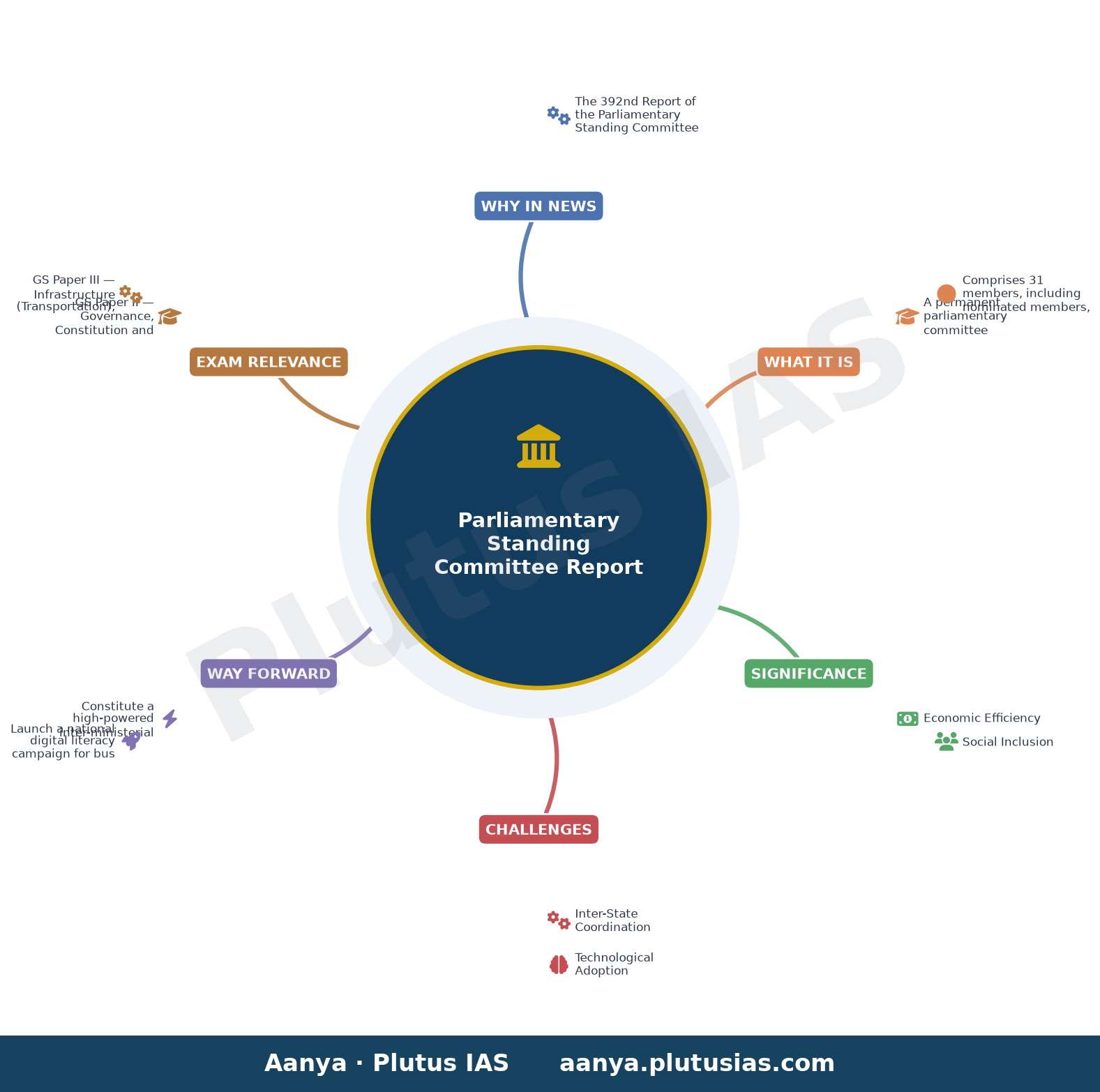
✎ The 392nd Report of the Parliamentary Standing Committee prioritises digital integration, safety reforms, and electrification in India’s bus transport sector to align with sustainable mobility goals and enhance passenger…
Subject Relevance — Where This Topic Fits
- GS Paper II — Governance, Constitution and Polity (Parliamentary Committees) | GS Paper III — Infrastructure (Transportation), Economic Development (Public-Private Partnerships), Environment and Sustainable Development
- Prelims: Parliamentary Standing Committee, Public Accounts Committee, Bharat Stage (BS) VI norms, FASTag, National Green Hydrogen Mission, Gati Shakti National Master Plan, National Urban Transport Policy, Buses4Work initiative, National Common Mobility Card (NCMC), Vehicle Scrappage Policy
- Essay: Role of parliamentary committees in policy formulation and oversight, Sustainable urban mobility and climate resilience
Quick Revision: The 392nd Report of the Parliamentary Standing Committee prioritises digital integration, safety reforms, and electrification in India’s bus transport sector to align with sustainable mobility goals and enhance passenger experience.
Why is this in the news?
The 392nd Report of the Parliamentary Standing Committee on Transport, Tourism and Culture, titled ‘Enabling Inclusive, Digital and Sustainable Bus Transport: Policy, Regulation and Public-Private Partnerships for Next-Generation Mobility’, was presented on 11 August 2026. The report, adopted on 6 August 2026, outlines critical recommendations to modernise India’s bus transport ecosystem through digital integration, regulatory reforms, and sustainable transition strategies. This development is significant as it addresses long-standing inefficiencies in inter-state bus operations, safety standards, and infrastructure while aligning with national goals of decarbonisation and inclusive mobility.
Background
- Bus transport in India, the primary mode of inter-city and intra-city mobility, serves over 75% of the country’s transport demand but suffers from fragmented regulatory frameworks, outdated infrastructure, and safety concerns.
- The Ministry of Road Transport and Highways (MoRTH) has historically regulated bus operations under the Motor Vehicles Act, 1988, with state-level agencies issuing permits, leading to inconsistencies in service quality and enforcement.
- India’s National Urban Transport Policy (2014) and the Gati Shakti National Master Plan (2021) emphasise multi-modal integration, but bus transport remains under-prioritised in national logistics and mobility plans.
- The Vehicle Scrappage Policy (2021) and Bharat Stage (BS) VI emission norms have accelerated the phasing out of older, polluting buses, necessitating structured transition mechanisms for fleet modernisation.
- Digital public infrastructure initiatives such as FASTag, National Common Mobility Card (NCMC), and the ‘One Nation, One Mobility Card’ aim to integrate transport services, but their application in bus transport remains uneven.
- The COVID-19 pandemic disrupted bus operations, highlighting vulnerabilities in service resilience and the need for automated, contactless systems to ensure continuity.
What is the Parliamentary Standing Committee on Transport, Tourism and Culture?
- A permanent parliamentary committee constituted under the Rules of Procedure of the Rajya Sabha to examine the functioning of the Ministry of Road Transport and Highways, Ministry of Tourism, and Ministry of Culture.
- Comprises 31 members, including nominated members, with a tenure aligned to the Rajya Sabha’s term, ensuring continuity in oversight.
- Functions include scrutiny of budgetary allocations, legislative proposals, and administrative performance, with the power to summon officials and stakeholders.
- Reports are tabled in Parliament and are non-binding but carry significant weight in policy formulation due to their evidence-based recommendations.
- The 392nd Report is the latest in a series addressing transport sector reforms, following earlier reports on road safety, electric mobility, and public transport integration.
- The report aligns with the Sustainable Development Goals (SDG 11: Sustainable Cities and Communities) and India’s commitments under the Paris Agreement to reduce transport emissions.
Key Features
| Feature | Significance |
|---|---|
| All-India Passenger Permit (Replacement of Tourist Permit) | Standardises inter-state bus operations with electronic tracking, reduces border checkpoints, and simplifies insurance claims for injured passengers. |
| National Bus Terminal Authority | Decouples terminal ownership from bus operations, ensures non-discriminatory access, and mandates a national code for terminal standards within one year. |
| National Bus Digital Grid | Enables real-time tracking, integrated booking, and crowd-sourced rating systems for buses and terminals, with GIS-based risk mapping for route optimisation. |
| Operator-Centric Safety Framework | Mandates automated fitness testing, retrofitting of sleeper/school buses, and emergency alert systems to enforce life-safety standards across bus fleets. |
| Fleet Transition Compact for Electric Buses | Facilitates phased adoption of electric buses via scrapping incentives, bulk procurement, and regional manufacturing clusters for charging infrastructure. |
| Women-Operated Bus Services | Promotes gender-inclusive employment in bus operations, standardises bus amenities (e.g., toilets), and implements alert systems for passenger safety. |
Why it Matters
Economic Efficiency
- Reduces transaction costs in inter-state bus operations through standardised permits and digital tracking, enhancing logistics competitiveness.
- Lowers maintenance expenses via bulk procurement of buses and shared charging infrastructure for electric fleets.
- Improves asset utilisation by decoupling terminal ownership from bus operations, enabling private sector participation in terminal management.
Social Inclusion
- Promotes gender parity in bus operations through targeted employment programmes for women drivers and staff.
- Ensures universal access to bus services via non-discriminatory terminal access frameworks and standardised bus-stop amenities.
- Enhances passenger safety through mandatory retrofitting of buses, emergency alert systems, and real-time monitoring.
Environmental Sustainability
- Accelerates transition to electric buses via scrapping incentives and regional manufacturing clusters, reducing urban air pollution.
- Mandates standardised bus-stop designs to optimise energy use in terminal operations.
- Introduces GIS-based risk mapping for route optimisation, reducing fuel consumption and emissions.
Governance and Regulation
- Strengthens regulatory oversight through automated fitness testing, real-time tracking, and operator safety ratings.
- Establishes a dedicated terminal authority to streamline terminal management and reduce bureaucratic delays.
- Enhances transparency via crowd-sourced rating systems and public reporting of bus and terminal conditions.
Technological Integration
- Leverages digital public infrastructure (e.g., FASTag, GIS, CVIGIL) for seamless inter-state bus operations and passenger safety.
- Integrates bus operations with railway systems for multi-modal connectivity and unified booking platforms.
- Uses real-time data analytics for predictive maintenance and route optimisation, improving service reliability.
Challenges
1. Inter-State Coordination
- Divergent state-level regulations on permits, taxes, and terminal operations may impede uniform implementation of the All-India Passenger Permit.
- Coordination between multiple agencies (e.g., road transport ministries, state governments, insurance regulators) required for seamless digital tracking and claims settlement.
UPSC Link: Federalism (GS-II)
2. Technological Adoption
- Low digital literacy among operators and passengers may limit uptake of real-time tracking, integrated booking, and crowd-sourced rating systems.
- High initial costs for retrofitting buses with safety features and deploying GIS-based monitoring systems.
UPSC Link: Digital Infrastructure (GS-III)
3. Financial Viability
- High upfront costs for electric bus adoption, including procurement, charging infrastructure, and battery recycling, may deter private operators.
- Revenue losses from reduced border checkpoints and streamlined permit processes may impact state finances reliant on transit taxes.
UPSC Link: Public-Private Partnerships (GS-II)
4. Safety and Compliance
- Resistance from operators to mandatory retrofitting and automated fitness testing due to cost and operational disruptions.
- Ensuring universal compliance with emergency alert systems and safety standards across diverse bus fleets.
UPSC Link: Road Safety (GS-III)
5. Gender Inclusion Barriers
- Cultural and social barriers may limit participation of women in bus operations, particularly in rural and conservative regions.
- Inadequate infrastructure (e.g., safe restrooms, harassment-free work environments) for women employees in terminal operations.
UPSC Link: Gender Mainstreaming (GS-II)
6. Regulatory Fragmentation
- Overlapping mandates of multiple authorities (e.g., Ministry of Road Transport, state transport departments, municipal bodies) may lead to regulatory conflicts.
- Lack of standardised data-sharing protocols between states and agencies for seamless digital integration.
UPSC Link: Administrative Reforms (GS-II)
Challenges — UPSC Perspective
| Issue | Concern |
|---|---|
| Permit Standardisation | State-level divergences in permit issuance and enforcement may undermine the All-India Passenger Permit system. |
| Digital Divide | Limited digital literacy among operators and passengers could hinder adoption of real-time tracking and integrated booking systems. |
| Cost of Transition | High capital expenditure for electric buses, retrofitting, and charging infrastructure may deter private operators. |
| Safety Compliance | Resistance from operators to mandatory retrofitting and automated fitness testing due to cost and operational challenges. |
| Inter-Agency Coordination | Fragmented mandates of multiple authorities may lead to delays in implementation and regulatory conflicts. |
| Gender Inclusion | Cultural and social barriers may limit participation of women in bus operations and terminal management. |
Government Initiatives — Must-Memorise for Prelims
- FASTag System (Electronic Toll Collection)
Way Forward
- Constitute a high-powered inter-ministerial task force to harmonise state-level regulations for the All-India Passenger Permit within six months.
- Launch a national digital literacy campaign for bus operators and passengers to ensure smooth adoption of real-time tracking and integrated booking systems.
- Establish a dedicated fund under the National Clean Air Programme (NCAP) to subsidise retrofitting of sleeper and school buses with safety features.
- Develop a phased rollout plan for electric buses, prioritising high-density corridors and urban areas with existing charging infrastructure.
- Mandate gender-sensitive terminal design standards, including safe restrooms and harassment-free work environments, in collaboration with the Ministry of Women and Child Development.
- Create a unified data-sharing protocol between state transport departments, insurance regulators, and digital platforms to streamline permit issuance and claims settlement.
- Pilot a ‘Women-Operated Bus Services’ programme in select districts with high gender disparity in employment, leveraging CSR funds and state partnerships.
- Establish regional manufacturing clusters for electric buses and batteries, aligned with the PLI scheme for auto components, to reduce import dependency.
UPSC Value Addition
Keywords for Mains Answer-Writing
Parliamentary Standing Committee on Transport, Tourism and Culture · Inclusive, Digital and Sustainable Bus Transport · National Bus Digital Grid · All-India Passenger Permit · National Bus Terminal Authority · Public-Private Partnership in Mobility · Electronic Toll Collection (ETC) and FASTag · Electric Bus Transition Framework · Women-operated Bus Services · Safety Standards for Passenger Buses · Regulatory and Policy Framework for Bus Transport · Geospatial and Real-Time Tracking Systems
Concept Flow
Inter-state bus operations → Fragmented permits and regulations → High transaction costs and safety risks → Proposal for All-India Passenger Permit and National Digital Grid → Bus terminal ownership tied to operations → Inefficient asset utilisation → Proposal for National Bus Terminal Authority to decouple ownership and management → Dependence on fossil-fuel buses → High emissions and operating costs → Proposal for Fleet Transition Compact to accelerate electric bus adoption → Low women participation in bus operations → Gender inequality in employment → Proposal for women-operated bus services and gender-sensitive terminal design → Lack of real-time monitoring → Passenger safety risks → Proposal for National Bus Digital Grid with GIS-based risk mapping and emergency alert systems → Regulatory fragmentation across states → Delays in implementation → Proposal for inter-ministerial task force to harmonise regulations → Digital divide among operators → Low adoption of tracking systems → Proposal for national digital literacy campaign and operator training programmes
Prelims Practice Questions
Q1. Consider the following statements regarding the Parliamentary Standing Committee on Transport, Tourism and Culture:
1. The 392nd report focuses on enabling inclusive, digital, and sustainable bus transport.
2. The report recommends the establishment of a National Bus Terminal Authority modeled on the Airport Authority of India.
3. The report proposes the replacement of All-India Tourist Permits with All-India Passenger Permits within one year.
4. The report mandates the immediate electrification of all interstate bus fleets.
How many of the above statements are correct?
- Only one
- Only two
- Only three
- All
Answer: Only three — Statements 1, 2, and 3 are correct as per the report. Statement 4 is incorrect; the report proposes a phased transition to electric buses, not immediate electrification.
Q2. Assertion (A): The Parliamentary Standing Committee recommends the use of FASTag and electronic vehicle location data for implementing All-India Passenger Permits.
Reason (R): FASTag and electronic tracking ensure seamless monitoring and enforcement of permit conditions across state borders.
Options:
A. Both A and R are true, and R is the correct explanation of A.
B. Both A and R are true, but R is NOT the correct explanation of A.
C. A is true, but R is false.
D. A is false, but R is true.
Answer: ? — Both A and R are true, and R correctly explains A, as electronic tracking is proposed to ensure compliance with permit conditions.
Q3. Match the following recommendations of the 392nd report of the Parliamentary Standing Committee on Transport, Tourism and Culture with their respective timelines:
Column I (Recommendation) | Column II (Timeline)
————————–|———————-
A. Notification of interoperability standards for National Bus Digital Grid | 1. Six months
B. Implementation of emergency warning systems for operators | 2. One year
C. Phased participation of commercial permit holders in digital systems | 3. Six months
D. Preparation of a National Code for bus terminals | 4. One year
Options:
A. A-1, B-2, C-3, D-4
B. A-2, B-1, C-3, D-4
C. A-1, B-4, C-2, D-3
D. A-4, B-2, C-1, D-3
Answer: ? — A matches with 1 (six months), B matches with 2 (one year), C matches with 3 (six months), and D matches with 4 (one year).
Mains Practice Question
✍ The Parliamentary Standing Committee on Transport, Tourism and Culture, in its 392nd report, has proposed a transformative framework for bus transport in India, emphasizing inclusivity, digitalization, and sustainability. Critically analyse the key recommendations of the report, including the National Bus Digital Grid, the National Bus Terminal Authority, and the phased transition to electric buses. Also, examine the challenges in implementing these recommendations and suggest measures to ensure their effective execution. (15 Marks)
Approach: MODEL-ANSWER SKELETON:
1. Introduction (2 marks):
– Context: Growing demand for inclusive, digital, and sustainable bus transport in India.
– Purpose of the 392nd report: To enable next-generation mobility through policy, regulation, and PPP.
2. Key Recommendations (6 marks):
– National Bus Digital Grid: Interoperability standards, real-time tracking, integrated booking, GIS-based risk mapping, and phased participation of commercial operators (6 months-1 year timeline).
– National Bus Terminal Authority: Separation of terminal ownership from operations, adoption of non-discriminatory access frameworks, and preparation of a National Code for bus terminals (1 year timeline).
– Phased transition to electric buses: Scrap-and-lease models, regional manufacturing clusters, and end-of-life frameworks for electric buses and batteries (1 year timeline).
– Safety and inclusivity: Emergency warning systems, women-operated services, and standardization of bus body codes.
3. Challenges in Implementation (4 marks):
– Regulatory fragmentation: Need for coordination among states for permit harmonization and digital integration.
– Financial constraints: High capital costs for electrification and digital infrastructure.
– Operational hurdles: Resistance from traditional operators, lack of skilled workforce, and uneven charging infrastructure.
– Data privacy and cybersecurity: Risks associated with real-time tracking and digital permit databases.
4. Measures for Effective Execution (3 marks):
– Strengthening institutional mechanisms: Empowering the proposed National Bus Terminal Authority and digital grid regulators.
– Incentivizing PPP: Tax breaks, viability gap funding, and risk-sharing models for private participation.
– Capacity building: Training programs for operators, drivers, and maintenance staff.
– Public awareness: Campaigns to promote acceptance of digital and electric bus services.
Balance of views: Acknowledge the potential of the recommendations to revolutionize bus transport while highlighting the need for political will, inter-state cooperation, and sustained funding.
Source: PIB (Press Information Bureau)
Generated by AanyaAi for educational purpose.

- Chhattisgarh Warns: AI-Generated Obscene Images on Social Media is Cyber Crime - August 12, 2026
- अनुसूचित जाति के छात्रों को विदेशी शिक्षा: राष्ट्रीय विदेशी छात्रवृत्ति योजना में सुधार - August 12, 2026
- UPSC Alert: 580 SC Students Benefit from National Overseas Scholarship Scheme (2019-26) - August 12, 2026

No Comments