


09 Aug Pawan Kalyan Hails ₹4,597 Crore Tax Devolution for Andhra Pradesh
✎ Tax devolution, as recommended by the Finance Commission, is a constitutional mechanism for redistributing Union tax revenues to states, enabling them to finance development and welfare initiatives while upholding fiscal…
Subject Relevance — Where This Topic Fits
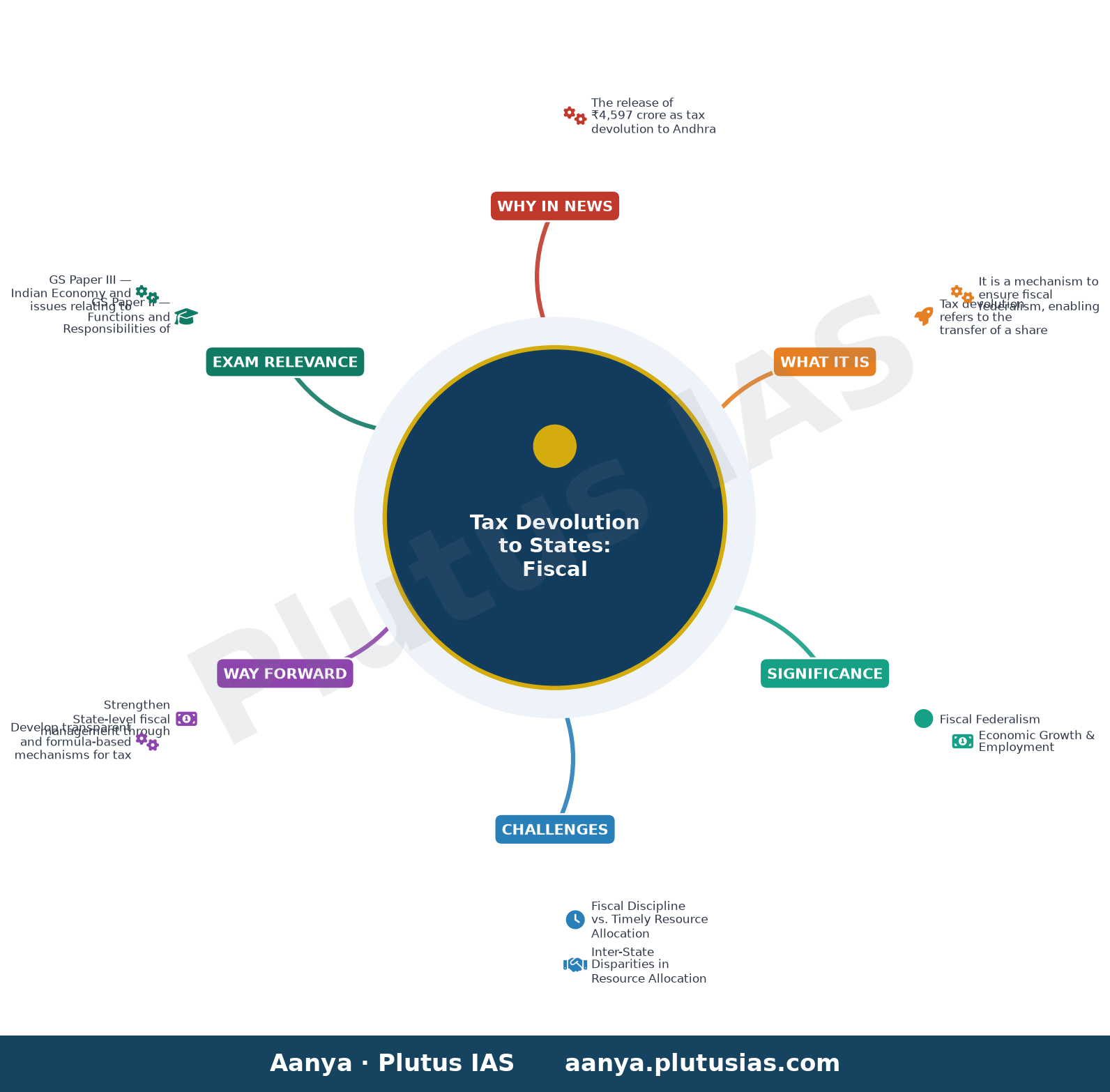
- GS Paper II — Functions and Responsibilities of the Union and the States, Issues and Challenges Pertaining to the Federal Structure, Devolution of Powers and Finances up to Local Levels and Challenges Therein | GS Paper III — Indian Economy and issues relating to Planning, Mobilisation of Resources, Growth, Development and Employment
- Prelims: Tax Devolution, Finance Commission, Article 279A, GST Council, Cooperative Federalism, Centrally Sponsored Schemes, Fiscal Deficit, Revenue Deficit, Public Accounts Committee
- Essay: Cooperative Federalism in India: Balancing Unity and Diversity, Fiscal Federalism and Inclusive Development: The Role of Centre-State Financial Relations
Quick Revision: Tax devolution, as recommended by the Finance Commission, is a constitutional mechanism for redistributing Union tax revenues to states, enabling them to finance development and welfare initiatives while upholding fiscal federalism.
Why is this in the news?
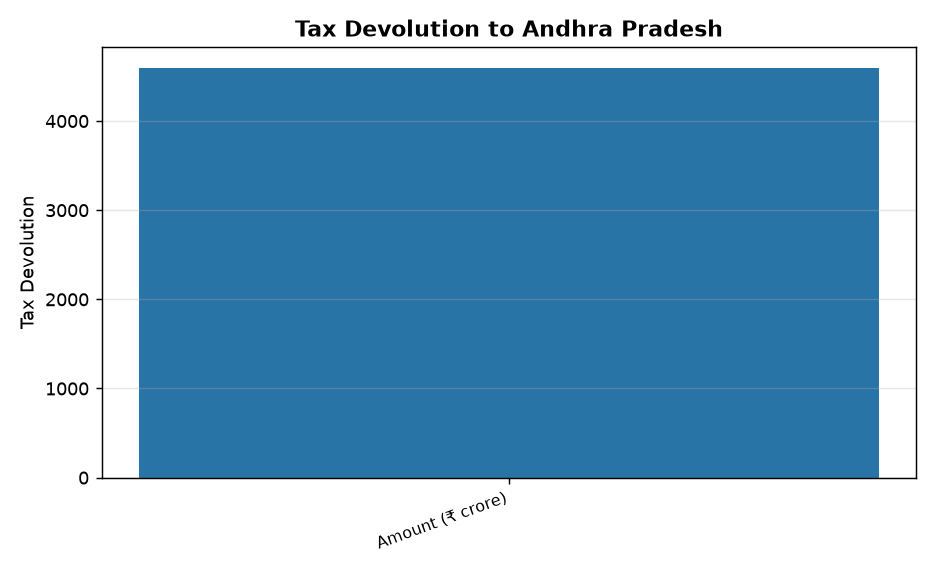
The release of ₹4,597 crore as tax devolution to Andhra Pradesh by the Union Government, acknowledged by Deputy Chief Minister K. Pawan Kalyan, underscores the significance of timely fiscal transfers in supporting state-level development initiatives. This advance instalment, part of a larger ₹1,09,019 crore release to all states, reflects the Centre’s emphasis on cooperative federalism and accelerating capital expenditure to bolster infrastructure, welfare delivery, and economic growth.
Background
- The Finance Commission, a constitutional body, recommends the distribution of tax revenues between the Union and the States, as well as among the States themselves, to ensure fiscal equity and balanced development.
- Tax devolution is a critical component of India’s fiscal federalism, enabling states to finance their development priorities, including infrastructure, health, education, and rural development.
- The Goods and Services Tax (GST) regime, implemented in 2017, replaced multiple indirect taxes with a single tax, but the compensation cess mechanism and the need for fiscal transfers to states remain pivotal to maintain revenue stability.
- The 15th Finance Commission (2021-26) recommended a vertical devolution of 41% of the divisible pool of taxes to states, with additional grants for local bodies and specific purposes.
- Advance releases of tax devolution ahead of the usual schedule are a recent innovation aimed at providing states with timely financial resources to expedite development projects and mitigate the impact of delayed fund flows.
- Andhra Pradesh, post-bifurcation in 2014, has faced fiscal challenges due to the loss of Hyderabad as its capital and the need for significant investments in infrastructure and welfare schemes.
What is Tax Devolution?
- Tax devolution refers to the transfer of a share of the Union Government’s tax revenue to state governments, as recommended by the Finance Commission under Article 270 and 280 of the Constitution.
- It is a mechanism to ensure fiscal federalism, enabling states to fund their developmental and welfare programmes without over-reliance on borrowing or centralised allocations.
- The Finance Commission determines the vertical share (percentage of the divisible pool) and horizontal distribution (among states based on criteria like population, income distance, and area).
- Tax devolution is distinct from grants-in-aid, which are discretionary transfers for specific purposes, such as Centrally Sponsored Schemes (CSS) or Finance Commission grants.
- The divisible pool consists of net proceeds of all taxes collected by the Union, excluding cess and surcharges, which are retained by the Centre but shared with states under certain conditions.
- Advance releases of tax devolution are a proactive measure to address liquidity constraints faced by states, particularly during economic downturns or when revenue collections are delayed.
- The 15th Finance Commission recommended a 41% vertical devolution, with additional grants for health, education, and local governments, aiming to balance equity and efficiency in resource distribution.
- Tax devolution plays a pivotal role in reducing vertical and horizontal fiscal imbalances, ensuring that states have the fiscal space to meet their constitutional obligations and developmental goals.
Key Features
| Feature | Significance |
|---|---|
| Advance release of tax devolution | Provides States with timely financial resources, enabling accelerated capital expenditure and infrastructure development. |
| ₹4,597 crore devolution to Andhra Pradesh | Strengthens fiscal capacity for infrastructure expansion, agriculture, irrigation, education, and healthcare in the State. |
| ₹1,09,019 crore advance devolution to States | Aims to equip States with early financial resources to fast-track development and welfare delivery. |
| Cooperative federalism emphasis | Demonstrates Centre’s commitment to fiscal autonomy for States, fostering trust and collaboration in governance. |
| Transformative impact on Viksit Bharat | Accelerates economic growth, employment generation, and rural-urban transformation through timely resource allocation. |
Why it Matters
Fiscal Federalism
- The advance release of tax devolution underscores the Centre’s adherence to fiscal federalism, ensuring States receive their due share of resources without delay.
- Enhances State-level fiscal autonomy, allowing Andhra Pradesh to prioritise developmental projects aligned with local needs.
- Promotes equitable resource distribution, reducing inter-state disparities in development and welfare outcomes.
Economic Growth & Employment
- Timely infusion of funds accelerates capital expenditure, stimulating economic activity and job creation across sectors.
- Supports infrastructure development, which is a critical driver of long-term economic growth and competitiveness.
- Enables States to invest in agriculture, education, and healthcare, fostering human capital development and productivity.
Welfare Delivery & Governance
- Advance devolution ensures States can implement welfare schemes without fiscal constraints, improving service delivery.
- Strengthens cooperative federalism by aligning Centre-State priorities, reducing bureaucratic delays in fund utilisation.
- Facilitates data-driven policymaking by enabling States to allocate resources based on real-time developmental needs.
Viksit Bharat Vision
- The decision aligns with the national goal of achieving a developed India by 2047, leveraging State-level initiatives for inclusive growth.
- Demonstrates Centre’s commitment to decentralised governance, empowering States to drive localised development.
- Creates a multiplier effect by boosting private investment through improved infrastructure and governance.
Challenges
1. Fiscal Discipline vs. Timely Resource Allocation
- Balancing the need for early fund release with fiscal prudence to avoid revenue shortfalls in subsequent quarters.
- Ensuring States utilise funds efficiently without diverting them to non-developmental expenditures.
UPSC Link: GS-II: Fiscal Policy & Federalism
2. Inter-State Disparities in Resource Allocation
- Variations in tax devolution across States may exacerbate existing inequalities in development and welfare.
- Need for a transparent and formula-based allocation mechanism to ensure fair distribution.
UPSC Link: GS-II: Centre-State Relations
3. Bureaucratic Delays in Fund Utilisation
- Risk of slow disbursement and utilisation of funds due to procedural bottlenecks in State administrations.
- Requirement for streamlined monitoring mechanisms to track expenditure and outcomes.
UPSC Link: GS-II: Public Administration
4. Political Economy of Fiscal Transfers
- Potential for political interference in fund allocation and utilisation, undermining developmental objectives.
- Need for independent audits and performance-based incentives to ensure accountability.
UPSC Link: GS-II: Governance
Challenges — UPSC Perspective
| Issue | Concern |
|---|---|
| Revenue Shortfalls | Risk of Centre facing fiscal constraints due to early devolution, impacting other welfare schemes. |
| State Capacity Gaps | Limited administrative and technical capacity in States to utilise funds effectively. |
| Monitoring & Evaluation | Lack of robust mechanisms to assess the impact of devolved funds on developmental outcomes. |
| Political Accountability | Ensuring funds are used for intended purposes without diversion to populist schemes. |
| Inter-State Equity | Addressing disparities in tax devolution to ensure balanced regional development. |
Way Forward
- Strengthen State-level fiscal management through capacity-building initiatives for efficient fund utilisation.
- Develop transparent and formula-based mechanisms for tax devolution to ensure inter-state equity.
- Establish real-time monitoring systems to track fund utilisation and measure developmental outcomes.
- Encourage Centre-State collaboration in project planning to align devolved funds with national and State priorities.
- Promote data-driven policymaking by leveraging technology for evidence-based resource allocation.
- Enhance transparency in fund disbursement through public dashboards and regular audits.
- Foster public-private partnerships to maximise the impact of infrastructure investments funded by devolved resources.
UPSC Value Addition
Keywords for Mains Answer-Writing
Cooperative federalism · Tax Devolution to States · Finance Commission · Fiscal Federalism in India · Union-State Financial Relations · Viksit Bharat Mission · Capital Expenditure Acceleration · Advance Tax Devolution · NITI Aayog’s Role in Development · Andhra Pradesh Fiscal Support · 15th Finance Commission Recommendations · Article 270 of the Constitution · Goods and Services Tax (GST) Compensation
Constitutional & Policy Linkages
- {‘Article 279A’: “GST Council’s role in tax devolution and fiscal federalism.”}
- {‘Article 280’: “Finance Commission’s mandate in determining tax devolution to States.”}
- {‘Article 293’: ‘Borrowing powers of States and Centre-State financial relations.’}
Concept Flow
Centre’s tax revenue collection → Constitutionally mandated devolution to States (Article 280) → Advance release of funds → State-level fiscal autonomy → Infrastructure development → Economic growth and employment → Viksit Bharat vision.
Prelims Practice Questions
Q1. Consider the following statements regarding the Finance Commission of India:
1. It is a constitutional body constituted under Article 280 of the Constitution.
2. It recommends the distribution of taxes between the Union and the States.
3. The recommendations of the Finance Commission are binding on the Union Government.
4. The Finance Commission is chaired by the Union Finance Minister.
How many of the above statements are correct?
- Only one
- Only two
- Only three
- All
Answer: Only three — Statements 1 and 2 are correct. The Finance Commission is indeed a constitutional body under Article 280 and recommends tax distribution. Statement 3 is incorrect as its recommendations are advisory, not binding. Statement 4 is incorrect as the Chairperson is appointed by the President, not necessarily the Finance Minister.
Q2. Assertion (A): The Goods and Services Tax (GST) has reduced the fiscal autonomy of States in India.
Reason (R): GST subsumed several State taxes, limiting their ability to levy independent taxes.
In the context of the above two statements, which one of the following is correct?
- Both A and R are true, and R is the correct explanation of A.
- Both A and R are true, but R is not the correct explanation of A.
- A is true, but R is false.
- A is false, but R is true.
Answer: Both A and R are true, but R is not the correct explanation of A. — Assertion (A) is true as GST has reduced State fiscal autonomy by subsuming multiple taxes. Reason (R) correctly explains this by stating that GST limited independent tax levying powers of States. Thus, both statements are true, and R is the correct explanation of A.
Q3. Which of the following is NOT a function of the NITI Aayog?
- Allocating funds to States for developmental projects
- Recommending tax devolution to States
- Promoting cooperative federalism
- Facilitating inter-State coordination
Answer: Recommending tax devolution to States — Allocating funds to States for developmental projects is not a direct function of NITI Aayog. The Finance Commission and Union Government handle tax devolution, while NITI Aayog focuses on policy recommendations and coordination.
Mains Practice Question
✍ The Union Government’s decision to release an advance instalment of ₹1,09,019 crore to States as tax devolution ahead of schedule represents a transformative shift in India’s fiscal federalism. Critically examine the implications of this measure for cooperative federalism, State autonomy, and the pursuit of Viksit Bharat. (15 Marks)
Approach: MODEL-ANSWER SKELETON:
1. Define tax devolution and cooperative federalism under the Indian Constitution (Article 270, 15th Finance Commission recommendations).
2. Explain the significance of advance tax devolution: timeliness, fiscal space for States, and acceleration of capital expenditure.
3. Discuss the balance between Union oversight and State autonomy: Does it enhance or constrain fiscal federalism?
4. Link to Viksit Bharat: How does this measure align with the goal of inclusive growth and infrastructure development?
5. Critique: Potential drawbacks such as increased Union control, fiscal dependency, or bypassing constitutional mechanisms.
6. Conclude with a balanced view: Whether this is a visionary step or a temporary measure with long-term risks.
Source: The Hindu
Generated by AanyaAi for educational purpose.

- विधायकों की चुप्पी को न्यायालय कैसे मान सकता है शून्य? मद्रास हाईकोर्ट का महत्वपूर्ण फैसला - September 23, 2026
- वायुसेना को मिला बड़ा हथियार: ₹811 करोड़ के 160 स्मार्ट एंटी-एयरफील्ड वेपन समझौता - September 23, 2026
- UPSC Exam Alert: Defence Ministry signs ₹811 Crore SAT-SAAW deal for IAF - September 23, 2026

No Comments