


08 Sep PIL After Satya Niketan Hostel Collapse Demands Delhi Hostel Policy
✎ A robust Hostel Development Policy must integrate institutional accountability, safety standards, and equitable distribution to address the systemic gaps in student accommodation infrastructure.
Subject Relevance — Where This Topic Fits
- GS Paper II — Governance, Administration and Challenges | GS Paper III — Infrastructure and Urban Development | GS Paper IV — Ethical Governance and Public Accountability
- Prelims: Hostel Accommodation Policy, Public Interest Litigation (PIL), Delhi University (DU), Municipal Corporation of Delhi (MCD), Building Byelaws and Safety Regulations, University Grants Commission (UGC), National Students’ Union of India (NSUI), Unitary Residential University, Interim Mandamus, Delhi High Court
- Essay: The Role of Institutions in Ensuring Public Safety: A Case Study of Student Hostels in Delhi, Balancing Urbanisation and Student Welfare: Challenges in Regulatory Oversight
Quick Revision: A robust Hostel Development Policy must integrate institutional accountability, safety standards, and equitable distribution to address the systemic gaps in student accommodation infrastructure.
Why is this in the news?
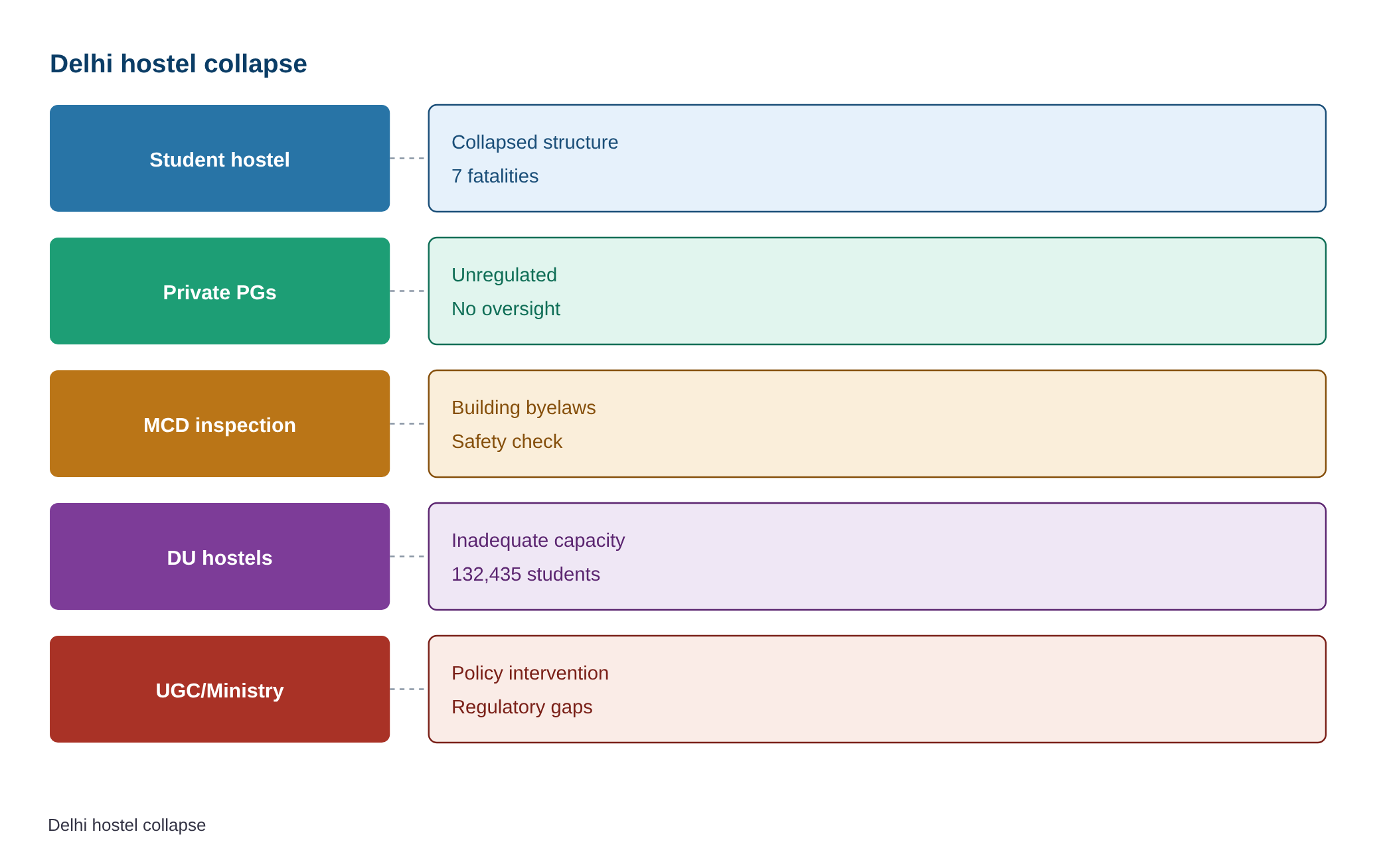
The collapse of the Satya Niketan hostel in Delhi, resulting in seven fatalities, has spotlighted systemic deficiencies in the regulation, provision, and safety of student hostel infrastructure in the National Capital Territory. The incident has triggered a Public Interest Litigation (PIL) in the Delhi High Court, seeking a comprehensive hostel development policy to address the acute shortage of institutional hostel facilities for students, particularly those enrolled in Delhi University. The judicial observations during the hearing have underscored the shared responsibility of educational institutions, municipal authorities, and regulatory bodies in ensuring the safety and adequacy of student accommodation.
Background
- Delhi University (DU), established in 1922, was envisaged as a ‘unitary, teaching and residential university’, with hostel facilities integral to its institutional mandate.
- The university’s student population has surged from 750 at inception to approximately 132,435 in regular courses, far outpacing the expansion of institutional hostel capacity.
- The Satya Niketan hostel collapse on [specific date not provided] resulted in seven fatalities, highlighting the risks associated with privately operated hostels and Paying Guest (PG) accommodations due to inadequate regulatory oversight.
- The Municipal Corporation of Delhi (MCD) has been directed by the Delhi High Court to inspect all buildings housing PGs and hostels within a week to verify compliance with building byelaws and safety regulations.
- The University Grants Commission (UGC) and the Ministry of Education are among the stakeholders identified for intervention to address the systemic gaps in hostel infrastructure.
- Judicial observations have emphasised that the shortage of university and government hostels forces students into potentially unsafe private accommodations, necessitating urgent policy intervention.
What constitutes a ‘Hostel Development Policy’ and why is it critical?
- A Hostel Development Policy is a statutory or institutional framework that mandates the provision, regulation, and periodic audit of hostel infrastructure for students, particularly in educational institutions.
- Such a policy typically includes provisions for the construction, expansion, and maintenance of hostels within or adjacent to university campuses, as well as the establishment of cluster hostels for institutions with land constraints.
- The policy would outline safety standards, including structural integrity, fire safety, sanitation, and emergency evacuation protocols, to mitigate risks such as building collapses.
- It would also address the equitable distribution of hostel facilities across gender, socioeconomic backgrounds, and academic disciplines to ensure inclusivity.
- Regulatory oversight under such a policy would involve periodic inspections by municipal and university authorities to ensure compliance with building byelaws and safety regulations.
- The policy would integrate with broader urban development and housing policies to ensure that hostel infrastructure is aligned with the growing demand for student accommodation in urban centres.
- Institutional accountability mechanisms, such as grievance redressal and penalties for non-compliance, would be essential components of an effective hostel development policy.
- The absence of a comprehensive hostel development policy exacerbates the reliance on unregulated private hostels and PG accommodations, which often lack adherence to safety and quality standards.
Key Features
| Feature | Significance |
|---|---|
| Public Interest Litigation (PIL) filing | Institutes judicial oversight on executive inaction regarding hostel infrastructure deficits. |
| Delhi High Court observations | Highlights systemic failure in regulating private PG accommodations and hostel provisioning. |
| MCD inspection mandate | Directs civic body to audit compliance with building byelaws in PG/hostel structures. |
| DU’s ‘residential university’ mandate | Exposes gap between institutional vision and ground-level implementation of hostel facilities. |
| Cluster/Common hostel proposal | Proposes shared infrastructure solutions to mitigate land constraints in individual colleges. |
Why it Matters
Governance & Policy
- Exposes regulatory lacunae in Delhi’s student housing ecosystem, where private PGs operate without adequate oversight.
- Highlights the judiciary’s role in directing executive action on public welfare infrastructure deficits.
- Underscores the need for a time-bound, university-wide hostel policy to align with DU’s ‘residential university’ mandate.
Public Health & Safety
- Demonstrates the human cost of unregulated private accommodations, evidenced by the Satya Niketan hostel collapse.
- Raises concerns about structural safety and compliance with building codes in student housing.
- Emphasises the urgency of preventive measures to avert future disasters in densely populated urban centres.
Economic Implications
- Student migration to unsafe private accommodations reflects a market failure in hostel provisioning, distorting housing demand.
- Potential long-term impact on Delhi’s reputation as an educational hub due to inadequate student welfare infrastructure.
- Opportunity cost of underutilised land within DU campuses for hostel construction.
Challenges
1. Regulatory Fragmentation
- Overlapping jurisdictions of Delhi government, MCD, DU, and UGC create accountability gaps in hostel regulation.
- Absence of a unified policy framework for student housing across educational institutions.
- Inadequate enforcement of existing building byelaws in private PGs and hostels.
UPSC Link: GS2: Functions and responsibilities of the Union and the States
2. Infrastructure Deficit
- Chronic shortage of hostel beds (DU’s 1,32,435 students vs. negligible institutional hostel capacity).
- Land constraints in urban campuses hinder expansion of hostel facilities.
- Dependence on private PGs, often unregulated, as a stopgap solution.
UPSC Link: GS2: Government policies and interventions for development in various sectors
3. Judicial-Executive Interface
- Judicial reluctance to issue interim directives without clear legal thresholds for hostel policy mandates.
- Risk of judicial overreach in policy formulation, encroaching on executive domain.
- Need for judicial restraint while ensuring public welfare is not compromised.
UPSC Link: GS2: Separation of powers between various organs
4. Urban Planning & Safety
- Urbanisation pressure in Delhi exacerbates housing shortages, including for students.
- Lack of integrated urban planning for student-specific infrastructure.
- Structural vulnerabilities in aged buildings repurposed as student accommodations.
UPSC Link: GS1: Urbanisation, their problems and their remedies
Challenges — UPSC Perspective
| Issue | Concern |
|---|---|
| Accountability gaps | No single authority responsible for end-to-end regulation of student housing. |
| Building safety violations | Private PGs/hostels operate without mandatory structural audits or compliance checks. |
| Land scarcity in urban campuses | Institutional expansion constrained by limited available space. |
| Policy vacuum | Absence of a statutory framework governing hostel provisioning in universities. |
| Judicial ambiguity | Uncertainty over courts’ role in directing policy implementation. |
Way Forward
- Delhi government and DU must collaborate to draft a **university-wide hostel policy** with phased construction targets.
- MCD should expedite structural audits of all PGs/hostels and enforce penalties for violations of building byelaws.
- DU should prioritise utilisation of available land within campuses for hostel construction, even if shared across colleges.
- UGC and Ministry of Education should issue **model guidelines** for state governments to regulate student housing.
- Establish a **multi-stakeholder task force** (DU, MCD, Delhi government, student representatives) to monitor progress.
- Introduce **mandatory hostel accommodation quotas** for colleges based on student intake and local housing availability.
- Promote **public-private partnerships** for cluster hostels in high-density student areas.
- Conduct an **annual audit** of hostel capacity vs. student demand, with transparency in reporting.
UPSC Value Addition
Keywords for Mains Answer-Writing
Delhi University hostel policy · Public Interest Litigation (PIL) in India · Right to Education and Housing · Urban housing regulations and safety · Institutional accountability in higher education · Delhi High Court jurisdiction · University Grants Commission (UGC) guidelines · Hostel accommodation for students · Building safety and structural integrity · Constitutional remedies for governance failures
Constitutional & Policy Linkages
- [‘Article 21 (Right to Life and Personal Liberty)’, ‘Ensures safety in student housing as part of welfare state obligations.’]
- [‘Article 41 (Right to Work, Education, and Public Assistance)’, ‘Directs state to provide adequate housing for vulnerable groups like students.’]
- [‘Article 46 (Promotion of Educational and Economic Interests of SCs/STs)’, ‘Implicit obligation to ensure equitable access to safe housing for all students.’]
Concept Flow
Urbanisation and educational expansion → Increased student population in Delhi → Inadequate institutional hostel capacity → Reliance on private PGs/hostels → Regulatory gaps and lack of enforcement → Unsafe accommodations (e.g., Satya Niketan collapse) → Judicial intervention via PIL → Highlighting systemic failures → Executive inaction → Need for policy reform and infrastructure development → Policy formulation → Hostel development as part of DU’s ‘residential university’ mandate → Implementation and monitoring → Ensuring accountability and safety standards
Prelims Practice Questions
Q1. Consider the following statements regarding the jurisdiction of the Delhi High Court under the Constitution of India:
1. The Delhi High Court has original jurisdiction over disputes arising from the National Capital Territory of Delhi.
2. The Delhi High Court can issue writs under Article 226 for enforcing fundamental rights.
3. The Delhi High Court’s jurisdiction extends to the entire Union Territory of Delhi, including areas under the administrative control of the Lieutenant Governor.
How many of the above statements are correct?
- Only one
- Only two
- All three
- None
Answer: All three — Statements 1 and 2 are correct. Statement 3 is incorrect as the Delhi High Court’s jurisdiction is limited to the National Capital Territory of Delhi, which is administered by the Lieutenant Governor, but its writ jurisdiction under Article 226 is not absolute over all Union Territory areas.
Q2. Assertion (A): The University Grants Commission (UGC) is empowered to frame regulations for the establishment and maintenance of hostels by universities in India.
Reason (R): The UGC derives its authority from the University Grants Commission Act, 1956, which empowers it to ensure the maintenance of standards in higher education institutions, including residential facilities.
Options:
A. Both A and R are true, and R is the correct explanation of A.
B. Both A and R are true, but R is not the correct explanation of A.
C. A is true, but R is false.
D. A is false, but R is true.
Answer: ? — Both Assertion (A) and Reason (R) are true, and the UGC’s authority under the University Grants Commission Act, 1956, includes framing regulations for hostel facilities to maintain standards in higher education.
Q3. Match the following constitutional provisions with their respective areas of application:
Column I (Provision) | Column II (Area of Application)
1. Article 21 | A. Right to constitutional remedies
2. Article 14 | B. Right to life and personal liberty
3. Article 32 | C. Equality before law
4. Article 19(1)(g) | D. Freedom to practise any profession
Options:
A. 1-B, 2-C, 3-A, 4-D
B. 1-A, 2-B, 3-C, 4-D
C. 1-D, 2-A, 3-B, 4-C
D. 1-C, 2-D, 3-A, 4-B
Answer: ? — The correct match is: Article 21 (Right to life and personal liberty), Article 14 (Equality before law), Article 32 (Right to constitutional remedies), and Article 19(1)(g) (Freedom to practise any profession).
Mains Practice Question
✍ The absence of a comprehensive hostel policy for students in higher educational institutions, particularly in metropolitan cities like Delhi, has led to recurring tragedies such as the Satya Niketan hostel collapse. Critically examine the constitutional and statutory framework governing student housing in India, and analyse the role of universities, regulatory bodies, and judicial institutions in addressing this governance deficit. (15 Marks)
Approach: MODEL-ANSWER SKELETON:
1. **Constitutional and Legal Framework** (4 Marks):
– **Right to Education (Article 21A)** and **Right to Life (Article 21)**: Link to the state’s obligation to ensure safe and adequate housing for students.
– **Directive Principles of State Policy (Article 38, 41, 46)**: Emphasise the state’s responsibility to provide housing and welfare for weaker sections, including students.
– **University Grants Commission (UGC) Regulations**: Highlight the UGC’s role in framing guidelines for hostel facilities under the UGC Act, 1956, and the lack of enforceable standards.
2. **Institutional Responsibilities** (5 Marks):
– **Universities (e.g., Delhi University)**: Examine their statutory obligations under their founding charters (e.g., DU’s claim as a ‘residential university’) and the failure to expand hostel infrastructure despite exponential student growth.
– **Regulatory Bodies (UGC, AICTE)**: Critique their limited role in enforcing hostel safety norms and the absence of a national hostel policy.
– **Local Authorities (MCD, Delhi Government)**: Discuss their failure to regulate private PGs and hostels, including building safety compliance under the Delhi Municipal Corporation Act and the National Building Code.
3. **Judicial Interventions and PILs** (3 Marks):
– **Writ Jurisdiction (Article 226)**: Analyse the Delhi High Court’s observations in the Satya Niketan case and the potential of PILs to enforce accountability.
– **Judicial Activism vs. Separation of Powers**: Discuss the limits of judicial intervention in policy formulation (e.g., the court’s reluctance to issue interim mandamus).
4. **Comparative Governance Deficits** (2 Marks):
– Contrast with successful models (e.g., IITs/IIMs hostel policies) or international practices (e.g., UK’s student accommodation regulations).
5. **Way Forward** (1 Mark):
– Propose a **time-bound hostel development policy** under the UGC, mandating hostel facilities in universities with phased expansion, and strengthening local authority oversight with strict penalties for violations.
Source: The Indian Express
Generated by AanyaAi for educational purpose.
Related guides on our sites
- Best PSIR optional coaching in delhi
- Best PSIR optional coaching in delhi for UPSC
- Anthropology VS PSIR
- Best PSIR optional coaching online

- ‘मेरा भारत’ अभियान: ग्रामीण युवाओं ने नशामुक्त समाज के लिए खेल और सेवा का संगम किया - October 24, 2026
- Forex Rule Confusion Delays Service Payments: RBI Clarification Needed - October 24, 2026
- माई भारत अभियान: ग्राम सेवा एवं खेल दिवस के तहत गांवों में Nasha Mukt Yuva Abhiyan - October 24, 2026

No Comments