


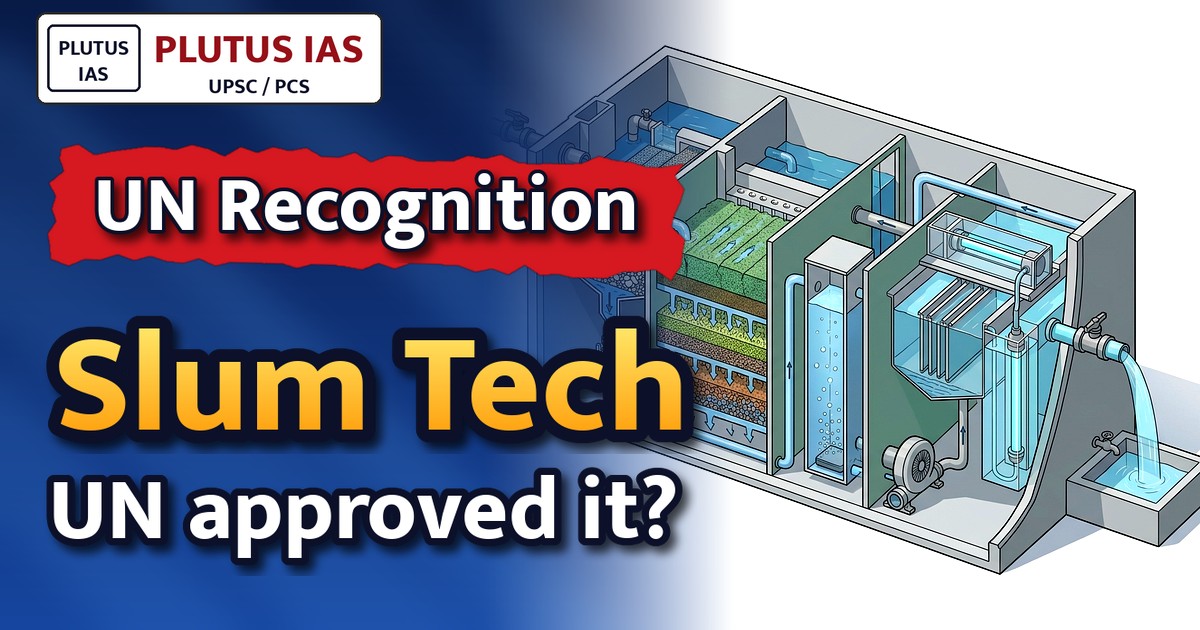
28 Sep Piyush’s Mumbai Slum Inspired Tech Wins UN Recognition for UPSC Aspirants
✎ Decentralised Modular Wastewater Treatment Systems (DEWATS) are low-cost, scalable solutions that treat sewage at source, reducing pollution and public health risks while aligning with SDG 6.
Subject Relevance — Where This Topic Fits
- GS Paper II — International Relations (UN and Multilateral Development Frameworks) | GS Paper III — Environment, Ecology, Bio-diversity and Climate Change (Water Pollution and Wastewater Treatment)
- Prelims: Swachh Bharat Mission 2.0, National Urban Sanitation Policy, SDG 6 (Clean Water and Sanitation), Decentralised Wastewater Treatment Systems (DEWATS), Atal Mission for Rejuvenation and Urban Transformation (AMRUT)
- Essay: Technological Innovation as a Catalyst for Social Transformation, Sustainable Development Goals: India’s Progress and Challenges
Quick Revision: Decentralised Modular Wastewater Treatment Systems (DEWATS) are low-cost, scalable solutions that treat sewage at source, reducing pollution and public health risks while aligning with SDG 6.
Why is this in the news?
A 20-year-old innovator from Madhubani, Bihar, developed a low-cost, modular wastewater treatment system inspired by the sanitation challenges observed in Mumbai’s slums. The technology has been recognised by the United Nations Development Programme (UNDP), highlighting its potential for scalable, decentralised water purification solutions in resource-constrained settings. This development underscores the intersection of grassroots innovation, public health, and international development frameworks.
Background
- India generates approximately 1,800 crore litres of wastewater daily, with only 20–30% undergoing treatment, leading to severe water pollution and public health risks such as waterborne diseases.
- The National Urban Sanitation Policy (2008) and subsequent initiatives like Swachh Bharat Mission 2.0 and AMRUT emphasise the need for sustainable urban sanitation and wastewater management.
- The United Nations Sustainable Development Goal 6 (SDG 6) mandates universal access to safe drinking water and sanitation, including improved wastewater management by 2030.
- Decentralised Wastewater Treatment Systems (DEWATS) are emerging as viable alternatives to large-scale, capital-intensive treatment plants, particularly in peri-urban and slum areas.
- Technological innovations in water purification have gained prominence in India, with startups and individuals contributing to low-cost, scalable solutions for underserved communities.
What is a Decentralised Modular Wastewater Treatment System?
- A decentralised modular wastewater treatment system is a small-scale, locally deployable unit designed to treat sewage and greywater at or near the source of generation, eliminating the need for extensive sewerage networks.
- These systems utilise physical, biological, and chemical processes—without harmful chemical dosing—to remove contaminants, pathogens, and organic matter from wastewater.
- Modularity allows for customisation based on the volume of wastewater, land availability, and local environmental conditions, making them adaptable to diverse settings such as slums, rural areas, and small industries.
- The technology developed by the innovator employs a low-cost, energy-efficient design, reducing the capital expenditure for wastewater treatment from ₹20 lakh (traditional systems) to ₹5–7 lakh.
- Such systems contribute to public health by mitigating the spread of waterborne diseases (e.g., cholera, dengue, malaria) linked to untreated wastewater in densely populated areas.
- The recognition by UNDP aligns with global efforts to promote affordable and innovative technologies under the United Nations Technology Bank for Least Developed Countries.
- Decentralised systems also support water reuse and recycling, reducing pressure on freshwater resources and promoting circular economy principles in water management.
Key Features
| Feature | Significance |
|---|---|
| Decentralised and modular wastewater treatment system | Enables scalable, on-site purification without large infrastructure, reducing dependency on centralised sewage systems |
| Chemical-free purification process | Eliminates secondary pollution risks from residual chemicals, aligning with sustainable development goals |
| Cost reduction from ₹20–25 lakh to ₹5–7 lakh | Makes advanced wastewater treatment accessible to small and medium industries, enhancing financial viability |
| Modular design adaptable to varying waste volumes | Allows incremental scaling based on local demand, improving resource efficiency |
| Recognition by UNDP under its Wastewater Management Initiative | Validates technological innovation in addressing SDG 6 (Clean Water and Sanitation) targets |
Why it Matters
Environmental Impact
- Addresses critical gap in India’s wastewater treatment capacity, where only 20–30% of 1,800 crore litres of daily effluent is treated, reducing waterborne disease transmission in urban slums
- Promotes circular economy by enabling reuse of treated water in non-potable applications, conserving freshwater resources
Technological Innovation
- Demonstrates grassroots-level engineering solutions to complex urban challenges, bypassing traditional academic pathways via experiential learning
- Leverages low-cost, locally repairable components to ensure sustainability in resource-constrained settings
Policy Relevance
- Aligns with India’s National Urban Sanitation Policy (2008) and Jal Jeevan Mission’s ‘Greywater Management’ guidelines
- Supports implementation of Swachh Bharat Mission 2.0’s focus on faecal sludge and septage management in peri-urban areas
Socio-Economic Upliftment
- Reduces healthcare burden on marginalised communities by mitigating vector-borne diseases linked to stagnant wastewater
- Creates opportunities for local entrepreneurship in wastewater management, aligning with ‘Atmanirbhar Bharat’ principles
Challenges
1. Scalability and Standardisation
- Lack of uniform technical standards for decentralised systems may hinder widespread adoption across diverse urban contexts
- Regulatory ambiguity in certification of non-conventional treatment technologies delays deployment in municipal projects
UPSC Link: GS-III: Urbanisation
2. Financial Sustainability
- High initial capital expenditure for small enterprises despite cost reduction, requiring innovative financing models (e.g., blended finance)
- Absence of clear revenue streams for operators post-installation, limiting long-term viability
UPSC Link: GS-III: Resource Mobilisation
3. Public Acceptance and Behavioural Change
- Skepticism towards non-conventional systems due to entrenched reliance on conventional sewage networks
- Need for community engagement to ensure proper operation and maintenance of decentralised units
UPSC Link: GS-II: Governance
4. Technical and Operational Constraints
- Vulnerability to extreme weather events disrupting modular systems in flood-prone areas
- Limited local technical expertise for repair and maintenance, necessitating capacity-building programmes
UPSC Link: GS-III: Science & Tech
5. Data and Monitoring Gaps
- Absence of real-time performance monitoring frameworks for decentralised systems, impeding evidence-based policymaking
- Inadequate integration with existing urban water management databases
UPSC Link: GS-III: Disaster Management
Challenges — UPSC Perspective
| Issue | Concern |
|---|---|
| Regulatory hurdles | Non-recognition of decentralised systems in municipal wastewater bye-laws |
| Skill deficit | Shortage of trained personnel for installation and maintenance |
| Financing gaps | Limited access to credit for small entrepreneurs in wastewater sector |
| Public health risks | Potential for untreated effluent reuse in agriculture without safeguards |
| Climate vulnerability | Sensitivity of modular systems to seasonal variations in waste composition |
Way Forward
- Establish a national certification framework for decentralised wastewater treatment technologies under the Ministry of Housing and Urban Affairs
- Integrate the system into Smart Cities Mission’s ‘Water Plus’ framework to incentivise adoption in model urban areas
- Launch a credit-linked subsidy scheme for MSMEs adopting low-cost treatment systems, in collaboration with NABARD
- Develop a national-level technical training programme for local operators, in partnership with IITs and state pollution control boards
- Create a real-time monitoring portal for decentralised systems, linked to the Jal Jeevan Mission’s dashboard
- Amend municipal bye-laws to mandate decentralised treatment for new constructions in notified slum areas
- Facilitate PPP models for large-scale deployment, with performance-based contracts for private operators
UPSC Value Addition
Keywords for Mains Answer-Writing
Sustainable Development Goals · Urban sanitation · Wastewater treatment technologies · Decentralised water management · United Nations Development Programme · Public health engineering · Innovation in water purification · Urban poverty and slums · SDG 6 (Clean Water and Sanitation) · Affordable technological solutions · Modular water treatment systems · Decentralised governance · Low-cost interventions · UN recognition of grassroots innovations
Concept Flow
Observation of urban slum conditions → Identification of wastewater management gap → Grassroots innovation in treatment technology → UNDP recognition under SDG 6 → Scalability challenges → Policy integration needs → Institutional capacity building → Sustainable urban sanitation
Prelims Practice Questions
Q1. Consider the following statements regarding wastewater treatment in India:
1. India generates approximately 1800 crore litres of wastewater daily.
2. Only 20-30% of this wastewater undergoes treatment before disposal.
3. The traditional wastewater treatment systems for small industries cost around ₹20 lakh.
4. Decentralised wastewater treatment systems typically require chemical dosing for effective purification.
How many of the above statements are correct?
- Only one
- Only two
- Only three
- All four
Answer: Only three — Statements 1, 2, and 3 are correct. Statement 4 is incorrect because the decentralised system developed by Piyush Jhajharia does not rely on chemical dosing.
Q2. Assertion (A): The United Nations Development Programme (UNDP) recognises grassroots innovations that align with Sustainable Development Goals (SDGs).
Reason (R): The UNDP primarily focuses on funding large-scale infrastructure projects rather than small-scale technological solutions.
In the context of the above statements, which of the following is correct?
- Both A and R are true, and R is the correct explanation of A
- Both A and R are true, but R is not the correct explanation of A
- A is true, but R is false
- A is false, but R is true
Answer: A is true, but R is false — Assertion (A) is true as UNDP recognises grassroots innovations aligned with SDGs. Reason (R) is false because UNDP actively supports small-scale, decentralised solutions alongside large projects.
Q3. Match the following Sustainable Development Goals (SDGs) with their corresponding targets:
Column I (SDG) Column II (Target)
A. SDG 6 (Clean Water and Sanitation) 1. Ensure access to affordable, reliable, sustainable and modern energy for all
B. SDG 7 (Affordable and Clean Energy) 2. Ensure availability and sustainable management of water and sanitation for all
C. SDG 11 (Sustainable Cities and Communities) 3. Ensure inclusive and sustainable urbanisation and capacity for participatory, integrated and sustainable human settlement planning
D. SDG 12 (Responsible Consumption and Production) 4. Ensure sustainable consumption and production patterns
Select the correct match:
- A-2, B-1, C-3, D-4
- A-1, B-2, C-3, D-4
- A-3, B-1, C-2, D-4
- A-4, B-2, C-1, D-3
Answer: A-2, B-1, C-3, D-4 — The correct matches are: A-2 (SDG 6 targets water and sanitation), B-1 (SDG 7 targets energy access), C-3 (SDG 11 targets sustainable cities), and D-4 (SDG 12 targets sustainable consumption).
Mains Practice Question
✍ The decentralised and modular wastewater treatment system developed by a grassroots innovator has been recognised by the United Nations Development Programme for its alignment with Sustainable Development Goal 6 (Clean Water and Sanitation). Critically examine the significance of such innovations in addressing India’s urban sanitation challenges. Also, analyse the role of decentralised governance in scaling these solutions effectively. (15 Marks)
Approach: MODEL-ANSWER SKELETON:
1. **Introduction (2 marks)**: Define SDG 6 and its targets, particularly Target 6.3 (improving water quality by reducing pollution, eliminating dumping and minimising release of hazardous chemicals and materials, halving the proportion of untreated wastewater and substantially increasing recycling and safe reuse globally). Highlight the scale of India’s wastewater challenge (1800 crore litres daily, with only 20-30% treated).
2. **Significance of Grassroots Innovations (5 marks)**:
– **Affordability and Accessibility**: Traditional systems cost ₹20 lakh; decentralised systems reduce this to ₹5-7 lakh, making them viable for small industries and communities.
– **Technological Advantages**: Modular design, absence of harmful chemicals, and adaptability to local conditions (e.g., slums, peri-urban areas).
– **Public Health Impact**: Reduces diseases like dengue, malaria, and typhoid by preventing stagnant water.
– **Alignment with SDGs**: Directly contributes to SDG 6.3, SDG 3 (Good Health and Well-being), and SDG 11 (Sustainable Cities and Communities).
– **Case Study**: Reference the innovator’s system and UNDP recognition as a model for scalable solutions.
3. **Role of Decentralised Governance (5 marks)**:
– **Definition and Principles**: Decentralised governance involves localised decision-making, community participation, and adaptive management.
– **Institutional Mechanisms**: Role of Panchayati Raj Institutions (PRIs), Urban Local Bodies (ULBs), and NGOs in implementing and monitoring decentralised systems.
– **Policy Support**: Reference schemes like the Atal Mission for Rejuvenation and Urban Transformation (AMRUT) and Swachh Bharat Mission 2.0, which emphasise community-led sanitation.
– **Challenges**: Fragmented implementation, lack of technical capacity at local levels, and need for convergence between schemes.
– **Best Practices**: Highlight successful models where local bodies partnered with innovators (e.g., community-managed water treatment plants in Kerala or Tamil Nadu).
4. **Critical Analysis and Way Forward (3 marks)**:
– **Limitations**: Scalability concerns, funding gaps, and resistance to adopting new technologies.
– **Policy Recommendations**:
– Strengthen institutional capacity at the local level through training and resource allocation.
– Integrate decentralised systems into urban planning frameworks (e.g., Master Plans, City Development Plans).
– Leverage corporate social responsibility (CSR) funds for pilot projects.
– Promote public-private partnerships (PPPs) for technology transfer and maintenance.
– **Conclusion**: Emphasise that while grassroots innovations provide scalable solutions, their success hinges on robust decentralised governance and multi-stakeholder collaboration.
Source: amarujala.com
Maharashtra PCS (MPSC) — State PCS Practice
Prelims: Which of the following initiatives, inspired by Piyush’s work on improving slum conditions in Mumbai, was recognized by the United Nations Development Programme (UNDP) for its innovative use of technology?
- A. Smart Slum Mapping Project
- B. Digital Slum Rehabilitation Portal
- C. Urban Poverty Alleviation through AI
- D. Mumbai Slum Upgradation Mission
Answer: B. Digital Slum Rehabilitation Portal — The Digital Slum Rehabilitation Portal, developed by Piyush and his team, was recognized by UNDP for leveraging technology to address slum rehabilitation challenges in Mumbai.
Mains: Discuss the role of technology in addressing urban poverty and slum rehabilitation in Maharashtra. Analyze how initiatives like the Digital Slum Rehabilitation Portal can be scaled up to benefit other cities in the state, while ensuring inclusivity and sustainability. (250 words)
Generated by AanyaAi for educational purpose.
Related guides on our sites
- Current affairs for upsc 2026
- Best PSIR optional coaching for upsc
- Best PSIR optional teacher for upsc
- Best teacher of PSIR optional for upsc

- Piyush’s Mumbai Slum Inspired Tech Wins UN Recognition for UPSC Aspirants - September 28, 2026
- हिमाचल पंचायतों को मिली बड़ी राहत: 3 लाख तक फर्नीचर खरीदने की अनुमति - September 28, 2026
- UPSC Alert: Microplastic Pollution Found in Himachal’s Uhl River Study - September 28, 2026

No Comments