


25 Sep PLI Scheme Boosts India’s Bulk Drug Manufacturing for Self-Reliance
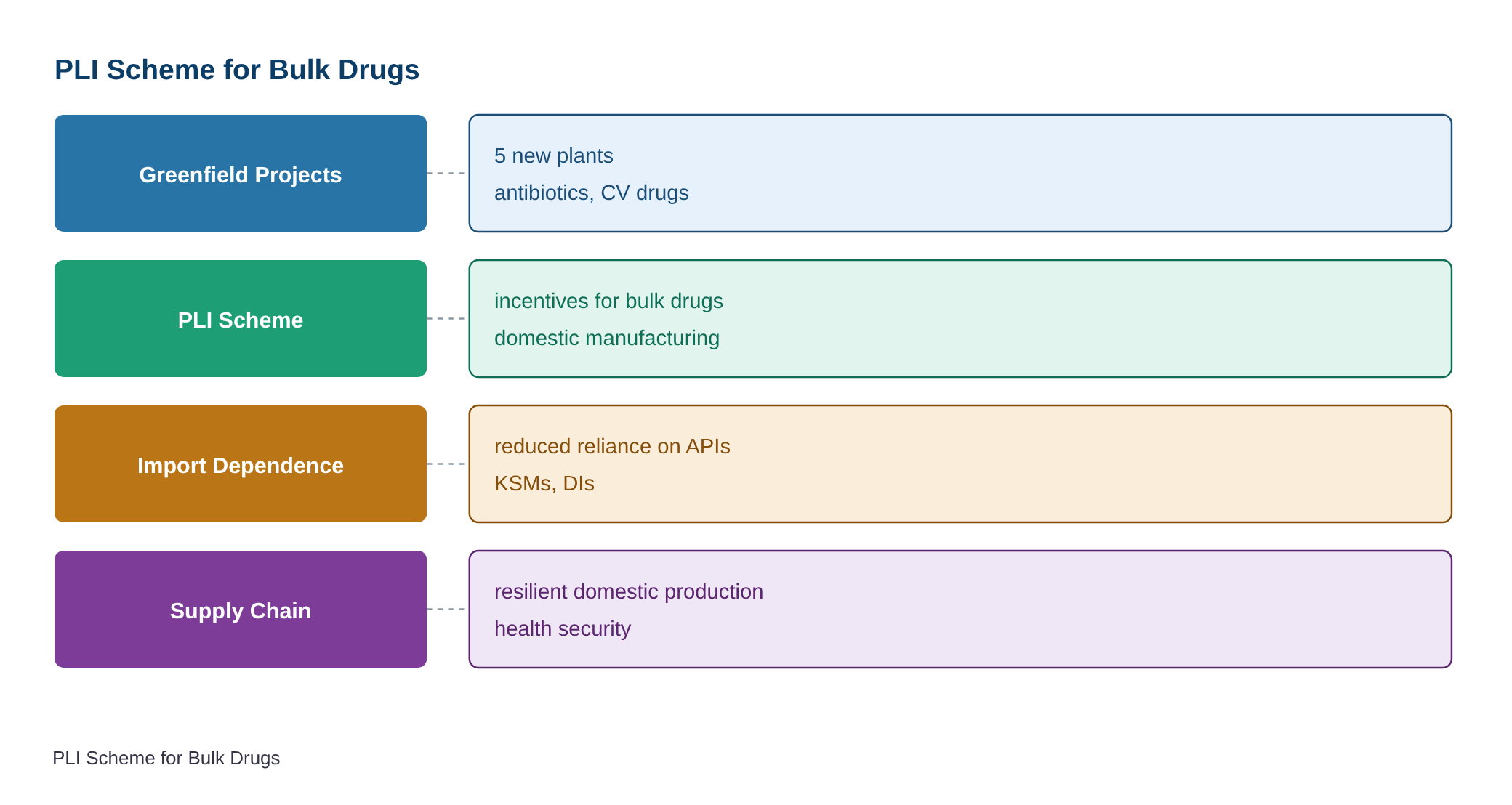
✎ The PLI Scheme for Bulk Drugs incentivises domestic manufacturing of 41 critical pharmaceutical inputs through production-linked subsidies, reducing import dependency and enhancing supply chain resilience.
Subject Relevance — Where This Topic Fits
- GS Paper II — Governance, Administration and Challenges | GS Paper III — Indian Economy and Issues Relating to Planning, Mobilisation of Resources, Growth, Development and Employment
- Prelims: Production-Linked Incentive (PLI) Scheme, Active Pharmaceutical Ingredients (APIs), Key Starting Materials (KSMs), Drug Intermediates (DIs), Supply Chain Resilience, Atmanirbhar Bharat, Pharmaceutical Policy 2020, FDI in Pharmaceuticals, Export Promotion Council for Pharmaceuticals (Pharmexcil)
- Essay: India’s pharmaceutical sector: From self-reliance to global leadership, Balancing trade-offs in industrial policy: Incentives vs. market efficiency
Quick Revision: The PLI Scheme for Bulk Drugs incentivises domestic manufacturing of 41 critical pharmaceutical inputs through production-linked subsidies, reducing import dependency and enhancing supply chain resilience.
Why is this in the news?
The Press Information Bureau (PIB) released a detailed update on 25 September 2026 highlighting the operationalisation of five greenfield projects under the Production-Linked Incentive (PLI) Scheme for Bulk Drugs. These projects, spanning antibiotics, cardiovascular medications, and antipyretics, mark significant strides in reducing India’s import dependence on critical Active Pharmaceutical Ingredients (APIs), Key Starting Materials (KSMs), and Drug Intermediates (DIs), thereby enhancing the resilience of India’s pharmaceutical supply chain.
Background
- The Indian pharmaceutical industry is the world’s third-largest by volume and contributes significantly to global medicine supply, yet it remains heavily dependent on imports for critical APIs, KSMs, and DIs, particularly from China.
- The COVID-19 pandemic exposed vulnerabilities in global supply chains, prompting India to prioritise domestic manufacturing of essential pharmaceutical inputs under the Atmanirbhar Bharat initiative.
- The scheme aims to reduce import dependency, enhance export competitiveness, and strengthen India’s position as a global pharmaceutical hub.
What is the Production-Linked Incentive (PLI) Scheme for Bulk Drugs?
- The PLI Scheme for Bulk Drugs is a central sector scheme designed to incentivise large-scale domestic manufacturing of Active Pharmaceutical Ingredients (APIs), Key Starting Materials (KSMs), and Drug Intermediates (DIs) through financial incentives linked to production volumes.
- It covers 41 identified bulk drugs, including essential antibiotics (e.g., Penicillin G, Amoxicillin), cardiovascular APIs (e.g., Telmisartan, Olmesartan), and antipyretics (e.g., Paracetamol), which are critical for domestic consumption and export.
- The scheme aims to attract investments in greenfield projects, modernise existing facilities, and promote backward integration to reduce import dependency.
- By enhancing domestic manufacturing capacity, the scheme seeks to improve supply chain resilience, ensure price stability, and mitigate risks associated with global supply disruptions.
Key Features
| Feature | Significance |
|---|---|
| Production-Linked Incentive (PLI) Scheme for Bulk Drugs | Aims to reduce India’s import dependence on Key Starting Materials (KSMs), Drug Intermediates (DIs), and Active Pharmaceutical Ingredients (APIs) by incentivizing domestic manufacturing of critical pharmaceutical inputs. |
| Greenfield Projects under PLI | Five new manufacturing facilities established across Andhra Pradesh, Himachal Pradesh, and Gujarat, enhancing domestic production capacity and diversifying the pharmaceutical supply chain. |
| Penicillin G Manufacturing Facility (Auribindo Pharma) | Established in Kakinada SEZ (Andhra Pradesh) with an annual capacity of 15,000 metric tonnes, reducing import reliance for a critical antibiotic intermediate and generating 2,353 direct jobs. |
| Clavulanic Acid Facility (Kinvan Pvt Ltd) | First fermentation-based manufacturing unit in India for potassium clavulanate (Himachal Pradesh), supporting antibiotic efficacy against resistant bacteria and reducing import dependency. |
| Sulphadiazine, Telmisartan, and Olmesartan Plants (Virchow Laboratories) | Developed indigenous manufacturing technology, reducing import dependency for these APIs by 73% since 2022 and strengthening domestic cardiovascular drug production. |
| Para-Amino Phenol (PAP) Plant (Meghmani LLP) | Gujarat-based facility with 13,500 metric tonnes annual capacity, enabling large-scale domestic production of PAP—a critical input for paracetamol, thus reducing import reliance. |
Why it Matters
Economic Resilience and Self-Reliance
- Reduces India’s pharmaceutical import bill by enhancing domestic production of KSMs, DIs, and APIs, particularly in antibiotics, cardiovascular drugs, and analgesics.
- Mitigates supply chain vulnerabilities exposed during global disruptions (e.g., COVID-19 pandemic), ensuring uninterrupted availability of essential medicines.
- Boosts local employment generation (e.g., 2,353 direct jobs at Auribindo Pharma’s facility) and stimulates ancillary industries through backward integration.
- Encourages investment in high-technology fermentation and chemical synthesis processes, fostering innovation in India’s pharmaceutical sector.
Strategic Health Security
- Strengthens India’s position as a global pharmaceutical hub by reducing reliance on imported critical inputs, particularly for antibiotics and cardiovascular drugs.
- Enhances resilience against geopolitical supply chain disruptions and price volatility in global API markets.
- Supports the ‘Atmanirbhar Bharat’ initiative by promoting indigenous manufacturing capabilities in high-demand therapeutic segments.
- Contributes to India’s goal of achieving self-sufficiency in essential drug production, aligning with the National Health Policy 2017 objectives.
Industrial and Regional Development
- Promotes balanced regional growth by establishing manufacturing hubs in states like Andhra Pradesh, Himachal Pradesh, and Gujarat, leveraging local infrastructure and workforce.
- Encourages private sector participation in high-value pharmaceutical manufacturing, diversifying India’s industrial base beyond generic drug production.
- Facilitates technology transfer and skill development in fermentation-based and chemical synthesis processes, enhancing India’s technical capabilities.
Policy and Regulatory Framework
- Demonstrates the effectiveness of targeted production-linked incentives in achieving sectoral transformation within a defined timeframe.
- Aligns with the Department of Pharmaceuticals’ ‘Pharma Vision 2030’ to position India as a leader in high-quality, affordable pharmaceuticals.
- Supports compliance with global Good Manufacturing Practices (GMP) and quality standards, enhancing India’s export competitiveness.
Challenges
1. High Capital and Technology Barriers
- Establishing fermentation-based and high-purity chemical synthesis facilities requires significant upfront investment (e.g., ₹2,270.05 crore for Auribindo Pharma’s project).
- Access to advanced bioreactors, purification systems, and compliance with international quality standards demands technological expertise and R&D investment.
- Small and medium enterprises (SMEs) may struggle to meet eligibility criteria for PLI incentives due to high capital requirements.
UPSC Link: GS3: Industrial Policy
2. Supply Chain and Raw Material Dependencies
- Despite reducing API import dependence, certain critical raw materials (e.g., fermentation media, enzymes) may still rely on imports, creating residual vulnerabilities.
- Fluctuations in global prices of key inputs (e.g., glucose, corn steep liquor) can impact production costs and profitability.
- Logistical challenges in transporting bulk chemicals and intermediates across states may affect operational efficiency.
UPSC Link: GS3: Supply Chain Management
3. Regulatory and Compliance Hurdles
- Stringent environmental regulations (e.g., effluent treatment, emissions control) for fermentation-based facilities increase compliance costs.
- Delays in obtaining environmental clearances or land approvals can stall project timelines, as seen in some greenfield initiatives.
- Ensuring consistent adherence to Good Manufacturing Practices (GMP) and international standards (e.g., USFDA, EMA) requires continuous monitoring.
UPSC Link: GS2: Regulatory Framework
4. Market and Demand Volatility
- Overcapacity in certain API segments (e.g., paracetamol) may lead to price wars, reducing profitability for new entrants.
- Fluctuations in domestic and global demand for antibiotics and cardiovascular drugs can impact revenue stability.
- Competition from established global API manufacturers (e.g., China, Europe) may pressure pricing and market share.
UPSC Link: GS3: Market Dynamics
5. Skill Gaps and Workforce Development
- Limited availability of skilled labor in fermentation technology, chemical engineering, and quality control poses a bottleneck for scaling up operations.
- Existing vocational training programs may not adequately address the specialized skills required for high-tech pharmaceutical manufacturing.
- Retention of trained personnel is challenging due to competition from multinational corporations and higher-paying roles in other sectors.
UPSC Link: GS1: Human Resource Development
Challenges — UPSC Perspective
| Issue | Concern |
|---|---|
| High Capital Requirements | Limits participation of SMEs and startups in high-tech pharmaceutical manufacturing. |
| Import Dependence for Raw Materials | Residual reliance on imported fermentation media, enzymes, and solvents creates supply chain vulnerabilities. |
| Regulatory Delays | Environmental clearances and land approvals can delay project timelines, increasing costs. |
| Market Overcapacity | Risk of price wars and reduced profitability due to excess production capacity in certain API segments. |
| Skill Shortages | Lack of specialized workforce in fermentation technology and quality control hinders operational efficiency. |
| Global Competition | Pressure from established API manufacturers (e.g., China) may impact market share and pricing. |
Government Initiatives — Must-Memorise for Prelims
- Atmanirbhar Bharat Abhiyaan (Self-Reliant India Mission)
Way Forward
- Enhance access to low-interest credit and venture capital for SMEs to participate in high-tech pharmaceutical manufacturing under the PLI scheme.
- Strengthen R&D collaboration between industry and institutions (e.g., CSIR, IITs) to develop indigenous fermentation technologies and reduce import reliance on raw materials.
- Streamline environmental and land clearance processes through single-window clearance systems to expedite project implementation.
- Expand vocational training programs in fermentation technology, chemical engineering, and quality control to address skill gaps in the pharmaceutical sector.
- Promote export-oriented manufacturing by aligning domestic production with global quality standards (e.g., USFDA, EMA) to enhance competitiveness in international markets.
- Establish a dedicated fund for retrofitting and upgrading existing manufacturing facilities to meet GMP and environmental compliance requirements.
- Encourage public-private partnerships (PPPs) to develop shared infrastructure (e.g., effluent treatment plants, logistics hubs) for bulk drug manufacturing clusters.
- Monitor and mitigate market overcapacity risks by aligning production incentives with actual demand trends and global supply chain dynamics.
UPSC Value Addition
Keywords for Mains Answer-Writing
Production-Linked Incentive (PLI) Scheme · Active Pharmaceutical Ingredients (APIs) · Key Starting Materials (KSM) · Drug Intermediates (DI) · Pharmaceutical Manufacturing · Supply Chain Resilience · Import Substitution · Domestic Value Addition · Antibiotic Production · Health Security · Fermentation-Based APIs · Penicillin G · Clavulanic Acid · Paracetamol Synthesis · Pharma PLI Scheme 2021 · Atmanirbhar Bharat · Greenfield Projects · Strategic Pharmaceutical Raw Materials · National Pharmaceutical Pricing Authority (NPPA) · FDI in Pharmaceutical Sector
Concept Flow
Global Supply Chain Disruptions → Recognition of India’s Import Dependence on APIs/KSMs → Formulation of PLI Scheme for Bulk Drugs → Incentivization of Domestic Manufacturing → Establishment of Greenfield Projects → Enhanced Domestic Production Capacity → Reduced Import Reliance → Strengthened Pharmaceutical Supply Chain Resilience → Improved Health Security and Economic Self-Reliance
Prelims Practice Questions
Q1. Consider the following statements regarding the Production-Linked Incentive (PLI) Scheme for Pharmaceuticals:
1. The PLI Scheme for Pharmaceuticals aims to enhance domestic manufacturing of Key Starting Materials (KSM), Drug Intermediates (DI), and Active Pharmaceutical Ingredients (APIs).
2. The scheme provides financial incentives linked to incremental sales of eligible products over a period of five years.
3. The scheme is implemented by the Ministry of Chemicals and Fertilizers, Government of India.
How many of the above statements are correct?
- Only one
- Only two
- All three
- None
Answer: All three — Statements 1 and 2 are correct. Statement 3 is incorrect as the PLI Scheme for Pharmaceuticals is implemented by the Department of Pharmaceuticals under the Ministry of Chemicals and Fertilizers, not the Ministry of Chemicals and Fertilizers directly.
Q2. Assertion (A): The production of Penicillin G in India has resumed after nearly three decades due to the PLI Scheme for Pharmaceuticals.
Reason (R): The PLI Scheme provides financial incentives for setting up greenfield projects in the pharmaceutical sector, which includes fermentation-based API manufacturing.
Select the correct code:
A. Both A and R are true, and R is the correct explanation of A.
B. Both A and R are true, but R is not the correct explanation of A.
C. A is true, but R is false.
D. A is false, but R is true.
- A
- B
- C
- D
Answer: A — Both Assertion (A) and Reason (R) are true, and Reason (R) correctly explains Assertion (A). The PLI Scheme incentivizes greenfield projects, including fermentation-based API manufacturing, which led to the resumption of Penicillin G production in India.
Q3. Match the following pharmaceutical compounds with their respective manufacturing facilities established under the PLI Scheme:
Column I (Compound) Column II (Facility Location)
A. Penicillin G 1. Nalagarh, Himachal Pradesh
B. Clavulanic Acid 2. Kakinda SEZ, Andhra Pradesh
C. Sulphadiazine 3. Padayabhimavaram, Andhra Pradesh
D. Para Amino Phenol (PAP) 4. Dahej, Gujarat
Select the correct match:
A. A-2, B-1, C-3, D-4
B. A-1, B-2, C-3, D-4
C. A-3, B-4, C-1, D-2
D. A-4, B-3, C-2, D-1
- A
- B
- C
- D
Answer: A — Correct matches are: A-2 (Penicillin G facility in Kakinda SEZ, Andhra Pradesh), B-1 (Clavulanic Acid facility in Nalagarh, Himachal Pradesh), C-3 (Sulphadiazine facility in Padayabhimavaram, Andhra Pradesh), D-4 (PAP facility in Dahej, Gujarat).
Mains Practice Question
✍ The Production-Linked Incentive (PLI) Scheme for Pharmaceuticals represents a strategic intervention to reduce India’s import dependence in critical pharmaceutical raw materials. Critically examine the scheme’s objectives, implementation mechanisms, and its potential to enhance India’s pharmaceutical supply chain resilience. Also, assess the challenges in achieving self-reliance in Active Pharmaceutical Ingredients (APIs) despite such incentives. (15 Marks)
Approach: Objective of the PLI Scheme: Enhance domestic manufacturing of KSMs, DIs, and APIs; reduce import dependence; strengthen supply chain resilience; promote greenfield projects; and incentivize fermentation-based API production. Cite the scheme’s financial outlay (₹15,000 crore) and its duration (5 years). Implementation Mechanisms: Financial incentives linked to incremental sales; selection of beneficiaries through a transparent bidding process; focus on greenfield projects; and emphasis on backward integration. Mention the role of the Department of Pharmaceuticals and NPPA in monitoring and implementation. Achievements and Case Studies: Highlight specific projects under the scheme, such as Penicillin G production in Andhra Pradesh (₹2,270.05 crore investment, 15,000 MT capacity), Clavulanic Acid in Himachal Pradesh (₹504.68 crore investment), and Para Amino Phenol in Gujarat (₹60.46 crore investment). Discuss the employment generation and cumulative production figures. Supply Chain Resilience: Explain how the scheme addresses vulnerabilities in India’s pharmaceutical supply chain, particularly during global disruptions (e.g., COVID-19). Discuss the reduction in import dependence for critical APIs like Penicillin G and Paracetamol. Challenges in Achieving Self-Reliance: High capital costs and long gestation periods for API manufacturing; competition from low-cost producers in China and other countries; regulatory hurdles and compliance with international standards; and the need for continuous R&D and innovation. Way Forward: Strengthen R&D in API manufacturing; promote public-private partnerships; enhance skill development in pharmaceutical sciences; and align with global quality standards (e.g., WHO-GMP, USFDA). Discuss the role of the Atmanirbhar Bharat initiative in complementing the PLI Scheme.
Source: PIB (Press Information Bureau)
Generated by AanyaAi for educational purpose.
Related guides on our sites
- Anthropology VS PSIR
- Best PSIR optional coaching
- Best PSIR optional coaching online
- Best PSIR optional teacher

- यूक्रेन का रोबोट सेना अभियान: युद्ध में मानव हानि कम करने की रणनीति - September 27, 2026
- Ukraine’s ‘Army of Robots’: A Game-Changer for UPSC Mains 2026 Polity & Governance - September 27, 2026
- रूस ने भारत-ब्राजील को दिया UNSC स्थायी सदस्यता का समर्थन, जर्मनी-जापान विरोध में - September 27, 2026

No Comments