


21 Jul PLI Scheme for Auto & Battery Sectors: Key Facts for UPSC 2026
Subject Relevance — Where This Topic Fits
- GS Paper II — Government Policies and Interventions for Development in various sectors | GS Paper III — Indian Economy and Issues relating to Planning, Mobilization of Resources, Growth, Development and Employment | GS Paper III — Infrastructure: Energy, Ports, Roads, Airports, Railways etc.
- Prelims: Production-Linked Incentive (PLI) Scheme, Advanced Automotive Products (AAT), Advanced Chemistry Cell (ACC) Battery Storage Programme, National Programme on Advanced Chemistry Cell (ACC) Battery Storage, Union Budget Allocations for PLI Schemes, Ministry of Heavy Industries, Gigafactory, Battery Swapping Policy, FAME India Scheme, Atmanirbhar Bharat
- Essay: India’s Manufacturing Renaissance: The Role of PLI Schemes in Achieving Self-Reliance, Energy Transition and Industrial Policy: Balancing Growth with Sustainability in India
Quick Revision: The PLI-Auto and PLI-ACC schemes are strategic interventions to transform India into a global manufacturing hub for advanced automotive products and battery storage, with cumulative investments of ₹44,326 crore and ₹5,180 crore respectively, and significant employment generation potential.
Why is this in the news?
The Ministry of Heavy Industries, Government of India, has provided an update on the implementation status of the Production-Linked Incentive (PLI) schemes for the automobile and auto components sector (PLI-Auto) and the Advanced Chemistry Cell (ACC) battery storage programme (PLI-ACC). As of 31 March 2026, PLI-Auto has achieved cumulative investments of ₹44,326 crore, generated 67,820 jobs, and disbursed ₹2,386.36 crore in incentives, while PLI-ACC has facilitated ₹5,180 crore in investments and 1,277 jobs despite no disbursement of incentives to date. These figures underscore the schemes’ role in enhancing India’s manufacturing capabilities and advancing its energy storage infrastructure.
Background
- The PLI scheme for the automobile and auto components sector was approved on 23 September 2021 with a budgetary outlay of ₹25,938 crore to upgrade India’s manufacturing capabilities for advanced automotive products (AAT).
- The PLI-ACC scheme, part of the National Programme on Advanced Chemistry Cell (ACC) Battery Storage, was approved in May 2021 with a budgetary allocation of ₹18,100 crore to establish a 50 GW battery storage manufacturing ecosystem in India.
- India’s automotive sector contributes ~7.1% to the country’s GDP and employs over 3.7 crore people, making it a critical pillar of the manufacturing economy.
- The global shift toward electric mobility and energy storage presents India with an opportunity to emerge as a hub for advanced automotive and battery manufacturing, aligning with the ‘Make in India’ and ‘Atmanirbhar Bharat’ initiatives.
- The PLI schemes are designed to incentivise large-scale domestic manufacturing, reduce import dependence, and foster innovation in high-technology sectors.
What are the Production-Linked Incentive (PLI) Schemes for Automobile, Auto Components, and Advanced Battery Storage?
- The PLI-Auto scheme is a central sector scheme aimed at incentivising the manufacturing of advanced automotive products, including electric vehicles (EVs), hydrogen fuel cell vehicles, and components such as batteries, motors, and power electronics.
- The PLI-ACC scheme focuses on establishing a domestic ecosystem for advanced chemistry cell (ACC) battery manufacturing, critical for EVs, renewable energy storage, and grid stabilisation.
- Under PLI-ACC, incentives are linked to the production of ACC batteries, subject to a ceiling of ₹18,100 crore.
- The scheme aims to reduce India’s import dependence in battery storage from ~90% to below 50% by 2030, aligning with the National Mission on Transformative Mobility and Battery Storage.
Key Features
| Feature | Significance |
|---|---|
| Budgetary Allocation for PLI-Auto Scheme | A total outlay of ₹25,938 crore for the PLI-Auto scheme underscores the government’s commitment to enhancing India’s advanced automotive manufacturing capabilities, aligning with the vision of ‘Atmanirbhar Bharat’. |
| Cumulative Investment under PLI-Auto | ₹44,326 crore invested by March 2026, demonstrating robust private sector participation and confidence in India’s automotive ecosystem. |
| Employment Generation under PLI-Auto | 67,820 direct jobs created, contributing to employment generation in labour-intensive manufacturing sectors. |
| PLI-ACC Scheme for Battery Storage | A ₹18,100 crore outlay for 50 GW battery storage capacity under the National Programme on Advanced Chemistry Cell (ACC) Battery Storage, critical for India’s energy transition and EV ecosystem. |
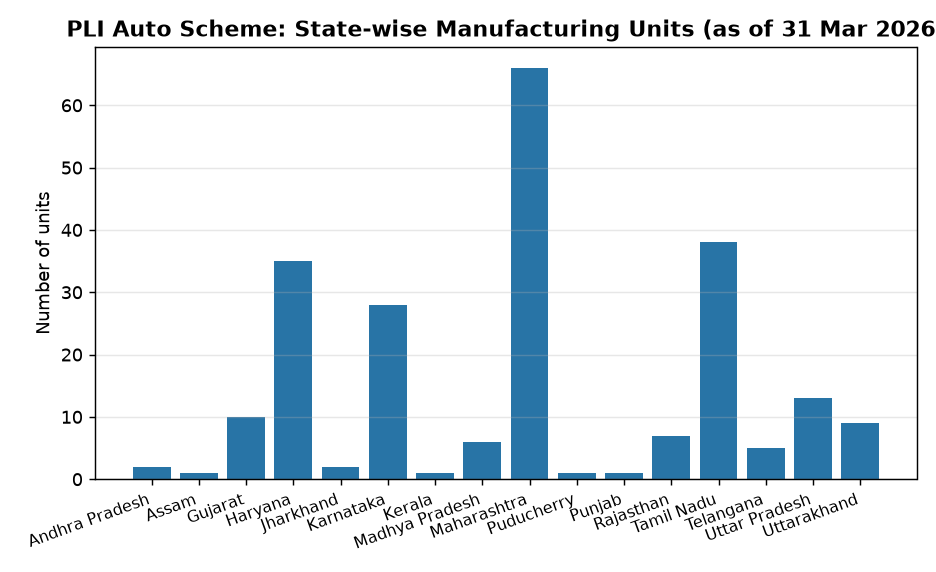
| State-wise Distribution of PLI-Auto Units | Concentration of manufacturing units in Maharashtra (66), Tamil Nadu (38), and Haryana (35) reflects existing industrial corridors and logistics advantages, while newer states like Assam and Puducherry also participate. |
Why it Matters
Economic Growth and Industrialisation
- PLI schemes are designed to stimulate domestic manufacturing, reduce import dependence, and position India as a global hub for advanced automotive and battery storage technologies.
- The schemes incentivise capital-intensive investments, fostering economies of scale and enhancing India’s export competitiveness in high-value automotive components and batteries.
- Direct and indirect employment generation addresses structural unemployment and supports skill development in the automotive and energy sectors.
Strategic Autonomy and Supply Chain Resilience
- Reducing reliance on imported automotive components and battery cells enhances India’s strategic autonomy in critical sectors, particularly for electric vehicles (EVs) and renewable energy integration.
- Diversification of manufacturing across states mitigates regional imbalances and strengthens supply chain resilience against global disruptions.
- Development of domestic battery storage capacity is pivotal for India’s energy security and transition to a low-carbon economy.
Alignment with National Missions
- The PLI-Auto scheme complements the Faster Adoption and Manufacturing of Hybrid and Electric Vehicles (FAME-II) scheme, accelerating India’s EV adoption trajectory.
- The PLI-ACC scheme supports the National Mission on Transformative Mobility and Battery Storage, a key pillar of India’s climate action and decarbonisation strategy.
- Integration with the Production Linked Incentive (PLI) scheme for electronics and other sectors reinforces India’s broader industrial policy framework.
Technological Advancement and Innovation
- Incentivising advanced automotive products (AAT) promotes R&D in electric mobility, hydrogen fuel cells, and autonomous vehicle technologies.
- Battery storage incentives drive innovation in energy-dense, cost-effective storage solutions, essential for grid stability and renewable energy integration.
Challenges
1. Implementation Lag in PLI-ACC Scheme
- As of May 2026, no beneficiary company has claimed incentives under the PLI-ACC scheme, indicating potential bottlenecks in project execution, regulatory clearances, or market readiness.
- The ₹5,180 crore investment and 1,277 jobs created fall short of the scheme’s potential, suggesting delays in scaling up manufacturing capacities.
UPSC Link: GS3: Energy, Infrastructure
2. Regional Disparities in PLI-Auto Distribution
- Concentration of units in Maharashtra, Tamil Nadu, and Haryana exacerbates regional industrial imbalances, leaving hinterland states like Jharkhand and Assam with limited participation.
- Lack of robust infrastructure in aspirational districts may deter investments, necessitating targeted policy interventions.
UPSC Link: GS1: Indian Society, GS2: Federalism
3. Global Competition and Export Barriers
- India faces stiff competition from China, South Korea, and Europe in automotive and battery manufacturing, requiring continuous innovation and cost competitiveness.
- Non-tariff barriers, such as stringent quality standards in export markets, may hinder India’s ability to penetrate global supply chains.
UPSC Link: GS3: External Sector
4. Skill Mismatch and Labour Productivity
- Rapid technological advancements in EVs and battery storage demand a workforce with specialised skills, posing challenges in upskilling and reskilling existing labour.
- Low productivity in traditional automotive clusters may impede the transition to high-tech manufacturing.
UPSC Link: GS3: Employment
Challenges — UPSC Perspective
| Issue | Concern |
|---|---|
| Delayed Incentive Claims in PLI-ACC | Potential regulatory or procedural hurdles slowing project implementation. |
| Regional Concentration of PLI-Auto Units | Limited participation from hinterland states, exacerbating regional disparities. |
| High Capital Intensity and Financing Risks | Large upfront investments may deter MSMEs and new entrants, limiting sectoral inclusivity. |
| Technological Obsolescence Risk | Rapid global advancements in battery and automotive tech may render current investments obsolete without continuous R&D. |
| Infrastructure Bottlenecks | Inadequate logistics, power, and land availability in certain states may delay project commissioning. |
| Export Market Access Challenges | Non-tariff barriers and global competition may restrict India’s share in high-value automotive and battery markets. |
Government Initiatives — Must-Memorise for Prelims
- Production Linked Incentive (PLI) Scheme for Automobile and Auto Components (PLI-Auto)
- Production Linked Incentive (PLI) Scheme for Advanced Chemistry Cell (ACC) Battery Storage (PLI-ACC)
- Faster Adoption and Manufacturing of Hybrid and Electric Vehicles (FAME-II) Scheme
- National Mission on Transformative Mobility and Battery Storage
Way Forward
- Accelerate regulatory clearances and single-window approvals for PLI-ACC beneficiaries to expedite project commissioning and incentive claims.
- Introduce targeted incentives for MSMEs and new entrants in battery storage and EV component manufacturing to enhance sectoral inclusivity.
- Strengthen skill development initiatives through partnerships with ITIs, polytechnics, and industry to bridge the gap in specialised labour.
- Develop dedicated industrial corridors in aspirational districts to decentralise manufacturing and reduce regional imbalances.
- Enhance R&D collaboration between industry and academia to foster innovation in next-generation battery and automotive technologies.
- Expand export promotion initiatives, including trade agreements and quality certification support, to improve market access for Indian products.
- Monitor and address infrastructure bottlenecks, particularly in power, logistics, and land availability, to ensure smooth project execution.
- Establish a robust monitoring mechanism to track progress under PLI schemes and identify bottlenecks for timely intervention.
UPSC Value Addition
Keywords for Mains Answer-Writing
Production Linked Incentive (PLI) Scheme · Automobile and Auto Components · Advanced Automotive Technology (AAT) · Advanced Chemistry Cell (ACC) Battery Storage · National Programme on ACC Battery Storage · Manufacturing Capacity Enhancement · Employment Generation in Manufacturing · State-wise Distribution of PLI Units · Fiscal Incentives for Green Energy · Atmanirbhar Bharat · Make in India · Direct Benefit Transfer (DBT) in PLI Schemes
Concept Flow
Government announces PLI schemes (PLI-Auto and PLI-ACC) to incentivise domestic manufacturing of advanced automotive products and battery storage. → Private sector responds with investments in manufacturing units across states, creating direct and indirect employment opportunities. → Regional disparities emerge due to existing industrial corridors and infrastructure gaps, limiting participation from hinterland states. → Implementation challenges, such as regulatory delays and technological obsolescence, hinder the realisation of full potential. → Policy interventions, including skill development and infrastructure upgrades, are required to sustain growth and enhance competitiveness. → Continuous innovation and export promotion are essential to position India as a global leader in automotive and battery manufacturing.
Prelims Practice Questions
Q1. Which of the following statements regarding the PLI scheme for Automobile and Auto Components (PLI-Auto) is/are correct? 1) The scheme was approved on 23 September 2021 with a budget outlay of ₹25,938 crore. 2) As of 31 March 2026, the cumulative investment under the scheme was ₹44,326 crore. 3) The scheme is applicable only to manufacturing units located in Tier-1 cities.
- 1 and 2 only
- 2 and 3 only
- 1 and 3 only
- 1, 2 and 3
Answer: 1 and 2 only — Statement 1 and 2 are correct as per the official data provided by the Ministry of Heavy Industries. Statement 3 is incorrect because the PLI-Auto scheme is an all-India scheme and approved applicants are free to establish units anywhere in the country.
Q2. Under the PLI scheme for Advanced Chemistry Cell (ACC) Battery Storage, which of the following companies has NOT been allocated a capacity of 5 GWh or more?
- Ola Electric Technologies Private Limited
- ACC Energy Storage Private Limited
- Reliance New Energy Battery Storage Limited
- Tata Chemicals Limited
Answer: Tata Chemicals Limited — Ola Electric Technologies Private Limited (20 GWh), ACC Energy Storage Private Limited (5 GWh), and Reliance New Energy Battery Storage Limited (15 GWh) have been allocated capacities of 5 GWh or more. Tata Chemicals Limited is not mentioned in the official data provided.
Q3. As per the latest data, what is the total number of manufacturing units established under the PLI-Auto scheme across all states as of 31 March 2026?
- 185
- 200
- 225
- 250
Answer: 225 — The official data states that a total of 225 manufacturing units have been established under the PLI-Auto scheme across all states as of 31 March 2026.
Mains Practice Question
✍ Critically examine the role of the Production Linked Incentive (PLI) schemes in enhancing India’s manufacturing capabilities in the automobile and battery storage sectors. Discuss the progress, challenges, and policy implications of these schemes in the context of achieving Atmanirbhar Bharat and global competitiveness.
Approach: The answer should begin by defining the PLI schemes and their objectives, particularly focusing on the PLI-Auto and PLI-ACC schemes. Highlight the progress made in terms of investment, employment generation, and state-wise distribution of manufacturing units. Discuss the challenges such as delayed disbursement of incentives, lack of participation from certain sectors, and infrastructure bottlenecks. Conclude by analyzing the policy implications, including the need for streamlined disbursement mechanisms, sector-specific incentives, and alignment with global supply chains to ensure long-term competitiveness and self-reliance.
Source: PIB (Press Information Bureau)
Generated by AanyaAi for educational purpose.

- महाराष्ट्र में त्योहार जुलूसों पर बॉम्बे हाईकोर्ट का बड़ा फैसला: पटाखे, लेजर और संगीत पर रोक - September 24, 2026
- Bombay HC Bans Firecrackers, Music in Maharashtra Processions: Key UPSC Analysis - September 24, 2026
- तमिलनाडु में महिला कर्मचारियों के लिए सवैतनिक माहवारी अवकाश नीति पर HC का आदेश - September 24, 2026

No Comments