


07 Aug PLI Scheme for Bulk Drugs: Boosting India’s API Production & Self-Reliance
✎ The PLI Scheme for Bulk Drugs incentivises domestic production of critical pharmaceutical inputs (APIs, KSMs, DIs) through performance-linked subsidies, reducing import dependence and enhancing India’s pharmaceutical…
Subject Relevance — Where This Topic Fits
- GS Paper II — Government Policies and Interventions for Development in various sectors | GS Paper III — Indian Economy and Issues Relating to Planning, Mobilisation of Resources, Growth, Development and Employment | GS Paper III — Effects of Liberalisation on the Economy, Changes in Industrial Policy and their Effects on Industrial Growth
- Prelims: Production-Linked Incentive (PLI) Scheme, Active Pharmaceutical Ingredients (APIs), Key Starting Materials (KSMs), Drug Intermediates (DI), Atmanirbhar Bharat, Pharmaceutical Promotion Development Scheme (PPDS), National Pharmaceutical Pricing Authority (NPPA)
- Essay: India’s pharmaceutical self-reliance: Balancing global supply chains and domestic capacity, The role of industrial policy in achieving Atmanirbhar Bharat: A case study of the PLI scheme for bulk drugs
Quick Revision: The PLI Scheme for Bulk Drugs incentivises domestic production of critical pharmaceutical inputs (APIs, KSMs, DIs) through performance-linked subsidies, reducing import dependence and enhancing India’s pharmaceutical self-reliance.
Why is this in the news?
On 7 August 2026, the Department of Pharmaceuticals, Government of India, announced the approval of 48 projects under the Production-Linked Incentive (PLI) Scheme for Bulk Drugs, aimed at boosting domestic production of Key Starting Materials (KSMs), Drug Intermediates (DIs), and Active Pharmaceutical Ingredients (APIs). With a sanctioned outlay of ₹6,940 crore, the scheme has disbursed ₹87.70 crore in incentives as of March 2026, while mobilising ₹5,070.45 crore in committed investments, thereby reducing import dependence for critical pharmaceutical inputs.
Background
- The Indian pharmaceutical industry is the third-largest in the world by volume and ranks 13th in value, contributing significantly to global healthcare supply chains.
- India meets approximately 20% of the global demand for generic medicines, yet relies heavily on imports for critical APIs and KSMs, particularly from China, making the sector vulnerable to supply chain disruptions.
- As of March 2026, the scheme has facilitated the creation of production capacity for 28 APIs/KSMs/DIs, with 18 already in commercial production, thereby strengthening India’s pharmaceutical supply chain resilience.
What is the Production-Linked Incentive (PLI) Scheme for Bulk Drugs?
- The PLI Scheme for Bulk Drugs is a government initiative under the Department of Pharmaceuticals, Ministry of Chemicals and Fertilizers, to incentivise domestic manufacturing of critical pharmaceutical inputs such as APIs, KSMs, and DIs.
- The scheme offers financial incentives based on incremental sales and production volumes, with disbursements linked to actual performance over a five-year period, ensuring accountability and efficiency in resource utilisation.
- The scheme aims to attract investments, create employment, and reduce India’s import dependence for critical pharmaceutical inputs, thereby enhancing self-reliance and global competitiveness.
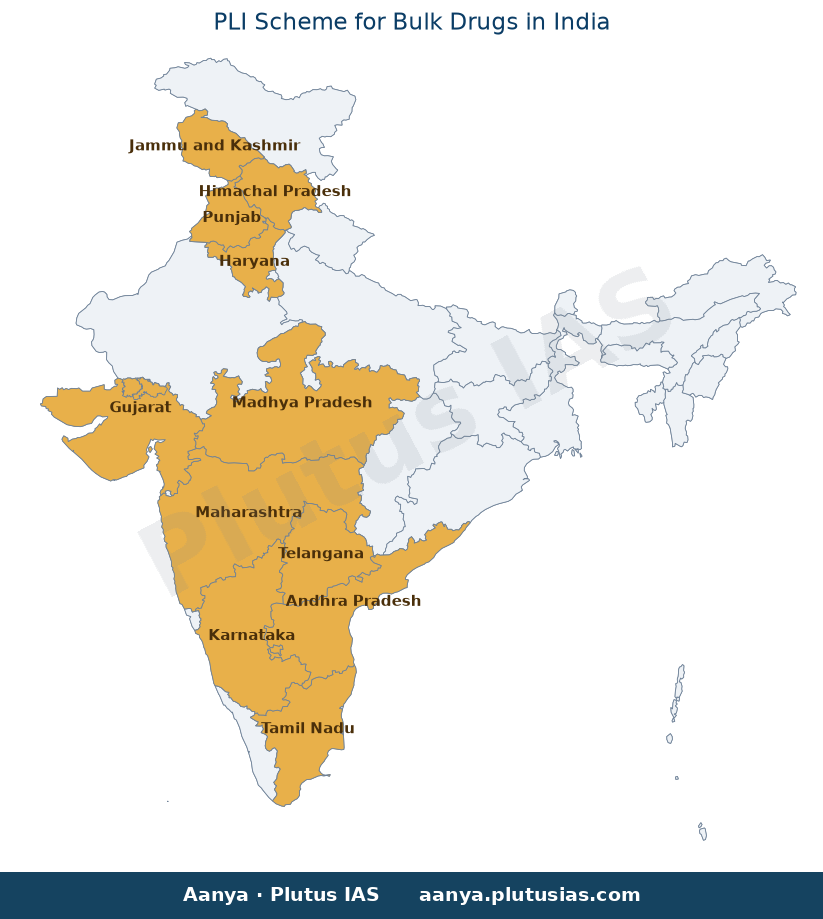
- As of August 2026, 48 projects have been approved across states like Andhra Pradesh, Gujarat, Maharashtra, and Tamil Nadu, with a total sanctioned outlay of ₹6,940 crore and ₹5,070.45 crore already invested.
Key Features
| Feature | Significance |
|---|---|
| Approved outlay of ₹6,940 crore | Demonstrates government’s commitment to reducing import dependence in bulk drugs by incentivising domestic production through fiscal support. |
| 48 projects approved across 8 states | Distributed industrial capacity ensures geographic diversification and reduces regional imbalance in pharmaceutical manufacturing. |
| ₹5,070.45 crore invested vs ₹4,329.95 crore committed | Exceeds target investment, indicating strong private sector confidence in the scheme’s viability. |
| 18 API/KSM/DI products in commercial production | Directly substitutes imports of critical pharmaceutical ingredients, enhancing self-reliance in essential medicines. |
| 10 projects yet to achieve commercial production | Highlights gestation period in bulk drug manufacturing; underscores need for long-term policy stability. |
Why it Matters
Economic
- Reduces pharmaceutical import bill by substituting 18 critical APIs/KSMs, thereby improving India’s trade balance in the healthcare sector.
- Stimulates ancillary industries such as fermentation, chemical synthesis, and packaging, creating employment in labour-intensive segments.
- Attracts FDI and domestic investment in high-tech bulk drug manufacturing, positioning India as a global hub for generic APIs.
Strategic
- Mitigates supply chain vulnerabilities exposed during global crises (e.g., COVID-19), ensuring uninterrupted access to essential medicines.
- Strengthens India’s role in the global pharmaceutical value chain by reducing reliance on China for key bulk drugs.
- Supports the production of life-saving drugs (e.g., artemisinin, lopinavir) critical for public health emergencies.
Industrial Policy
- Aligns with the Production-Linked Incentive (PLI) framework to foster self-reliance (Atmanirbhar Bharat) in strategic sectors.
- Encourages backward integration in the pharmaceutical industry, reducing dependence on imported intermediates.
- Demonstrates India’s shift from a cost-based to a capability-based industrial policy in high-value chemical manufacturing.
Public Health
- Enhances availability of affordable generic medicines by reducing costs associated with imported APIs.
- Supports the production of APIs used in vaccines, antibiotics, and chronic disease management (e.g., telmisartan, dexamethasone).
Challenges
1. High Capital Intensity and Long Gestation Period
- Bulk drug manufacturing requires heavy initial investment in R&D, infrastructure, and regulatory compliance.
- Projects take 3–5 years to achieve commercial production, posing liquidity risks for investors.
- High interest costs and regulatory delays deter small and medium enterprises (SMEs) from participation.
UPSC Link: Economic Development: Industrial Policy
2. Regulatory and Compliance Bottlenecks
- Stringent Good Manufacturing Practices (GMP) and environmental norms increase compliance costs.
- Delays in environmental clearances and land acquisition stall project timelines.
- Differential state-level implementation of industrial policies creates regulatory arbitrage.
UPSC Link: Governance: Regulatory Frameworks
3. Global Competition and Price Pressures
- India competes with China, Europe, and the US in bulk drug production, where China dominates with lower costs.
- Fluctuations in global API prices (e.g., due to geopolitical tensions) impact profitability.
- Overcapacity in certain segments (e.g., penicillin) may lead to price wars and underutilisation of plants.
UPSC Link: International Relations: Trade Dynamics
4. Skilled Labour Shortage
- Highly specialised roles in fermentation and chemical synthesis require advanced technical training.
- Lack of vocational training institutes in pharmaceutical manufacturing hampers skill development.
- Brain drain of skilled workers to multinational corporations or overseas markets exacerbates shortages.
UPSC Link: Human Resource Development: Skill Gaps
5. Environmental and Sustainability Concerns
- Bulk drug manufacturing generates hazardous effluents requiring advanced treatment facilities.
- Carbon-intensive processes (e.g., chemical synthesis) conflict with India’s net-zero commitments.
- Public resistance to new industrial projects due to pollution concerns delays approvals.
UPSC Link: Environment: Sustainable Industrialisation
Challenges — UPSC Perspective
| Issue | Concern |
|---|---|
| High initial investment | Deters SMEs and startups from entering bulk drug manufacturing. |
| Regulatory delays | Increases project gestation period and cost overruns. |
| Global price competition | Undermines profitability against low-cost producers like China. |
| Skilled labour scarcity | Limits operational efficiency and innovation in high-tech manufacturing. |
| Environmental compliance | Raises costs and faces local opposition, delaying project execution. |
Government Initiatives — Must-Memorise for Prelims
- Production-Linked Incentive (PLI) Scheme for Pharmaceuticals (Bulk Drugs)
- Scheme for Promotion of Bulk Drug Parks
Way Forward
- Strengthen state-level single-window clearance systems to expedite approvals for bulk drug projects.
- Expand vocational training programmes in pharmaceutical manufacturing under the Skill India Mission.
- Incentivise R&D in green chemistry and waste-to-wealth technologies to align with sustainability goals.
- Establish dedicated bulk drug parks with shared infrastructure (e.g., effluent treatment, common testing labs) to reduce costs.
- Negotiate long-term supply agreements with global buyers to de-risk price fluctuations and ensure stable demand.
- Enhance credit guarantees and low-interest loans for SMEs to lower entry barriers in bulk drug manufacturing.
- Promote public-private partnerships (PPPs) for technology transfer in fermentation and high-purity chemical synthesis.
- Monitor and publish quarterly progress reports on project timelines to maintain transparency and accountability.
UPSC Value Addition
Keywords for Mains Answer-Writing
Production-Linked Incentive (PLI) Scheme · Bulk Drugs Policy · Active Pharmaceutical Ingredients (APIs) · Key Starting Materials (KSMs) · Pharmaceutical Promotion and Development Scheme · Atmanirbhar Bharat in Pharmaceuticals · Self-reliance in Critical Drugs · Drugs and Cosmetics Act · Pharmaceutical Industry in India · Import Substitution for Essential Medicines · Union Budget Allocations for Pharmaceuticals · National Pharmaceutical Pricing Authority (NPPA) · Make in India for Pharmaceuticals · Chemical and Fertilizers Sector Reforms · Pharma PLI Scheme Implementation Challenges
Concept Flow
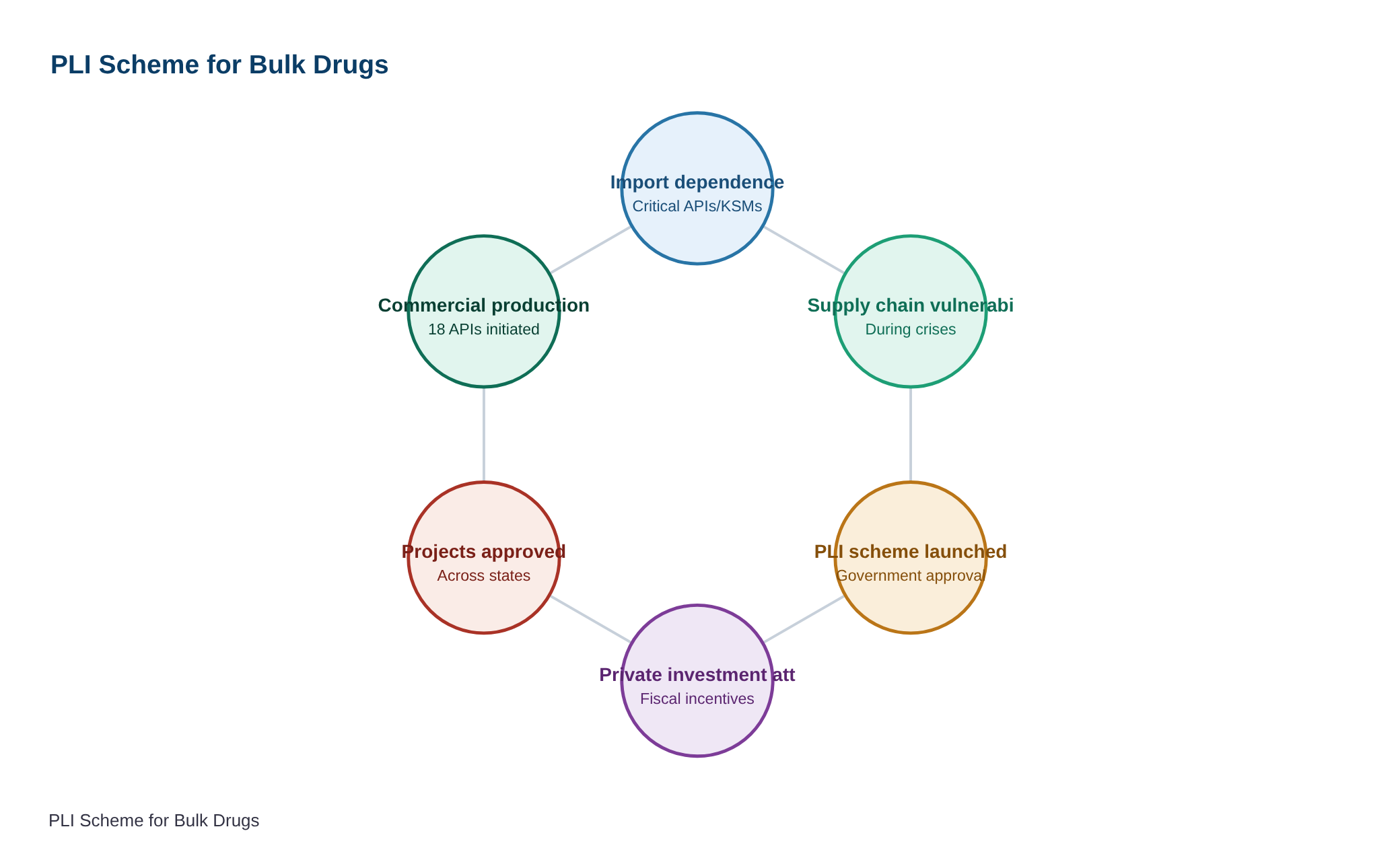
Import dependence on critical APIs/KSMs → Supply chain vulnerabilities during crises → Government launches PLI scheme for bulk drugs → Fiscal incentives attract private investment → Projects approved across states → Commercial production of 18 APIs initiated → Reduction in import bill and enhanced self-reliance.
Prelims Practice Questions
Q1. Consider the following statements regarding the Production-Linked Incentive (PLI) Scheme for Bulk Drugs:
1. The scheme aims to promote domestic production of Key Starting Materials (KSMs), Drug Intermediates (DIs), and Active Pharmaceutical Ingredients (APIs).
2. The scheme provides financial incentives linked to incremental sales of eligible products.
3. The scheme is implemented by the Ministry of Health and Family Welfare.
4. Under the scheme, 48 projects have been approved with a sanctioned outlay of ₹6,940 crore.
How many of the above statements are correct?
- Only one
- Only two
- Only three
- All four
Answer: Only three — Statements 1, 2, and 4 are correct. Statement 3 is incorrect as the scheme is implemented by the Department of Pharmaceuticals under the Ministry of Chemicals and Fertilizers, not the Ministry of Health and Family Welfare.
Q2. Assertion (A): The PLI Scheme for Bulk Drugs aims to reduce India’s dependence on imported Active Pharmaceutical Ingredients (APIs) and Key Starting Materials (KSMs).
Reason (R): The scheme provides production-linked incentives to domestic manufacturers to scale up production of essential pharmaceutical ingredients.
(a) Both A and R are true, and R is the correct explanation of A.
(b) Both A and R are true, but R is not the correct explanation of A.
(c) A is true, but R is false.
(d) A is false, but R is true.
- a
- b
- c
- d
Answer: a — Both Assertion (A) and Reason (R) are true, and Reason (R) correctly explains Assertion (A). The PLI scheme incentivizes domestic production of APIs and KSMs, thereby reducing import dependence.
Q3. Match the following pharmaceutical ingredients with their respective categories under the PLI Scheme for Bulk Drugs:
Column I (Ingredient) Column II (Category)
A. Penicillin G 1. Key Starting Material (KSM)
B. Dexamethasone 2. Drug Intermediate (DI)
C. 7-ACA 3. Active Pharmaceutical Ingredient (API)
D. Cyclohexane Diacetic Acid (CDA) 4. Fermentation-based KSM
Select the correct match:
(a) A-4, B-3, C-1, D-2
(b) A-1, B-3, C-4, D-2
(c) A-4, B-2, C-1, D-3
(d) A-2, B-1, C-3, D-4
- a
- b
- c
- d
Answer: a — A-4 (Penicillin G is a fermentation-based KSM), B-3 (Dexamethasone is an API), C-1 (7-ACA is a KSM), D-2 (Cyclohexane Diacetic Acid is a Drug Intermediate).
Mains Practice Question
✍ Critically examine the role of the Production-Linked Incentive (PLI) Scheme for Bulk Drugs in achieving self-reliance in India’s pharmaceutical sector. How far has the scheme succeeded in reducing import dependence for critical Active Pharmaceutical Ingredients (APIs) and Key Starting Materials (KSMs)? Also, analyse the challenges in its implementation and suggest measures to enhance its effectiveness. (15 Marks)
Approach: MODEL-ANSWER SKELETON:
1. **Introduction (2 Marks)**
– Define the PLI Scheme for Bulk Drugs: A production-linked incentive scheme under the Department of Pharmaceuticals, Ministry of Chemicals and Fertilizers, aimed at boosting domestic manufacturing of APIs, KSMs, and Drug Intermediates.
– Context: India’s pharmaceutical sector is the 3rd largest by volume but heavily dependent on imports for APIs (70% of raw materials imported, primarily from China).
– Objective: Reduce import dependence, enhance self-reliance, and align with the ‘Atmanirbhar Bharat’ initiative.
2. **Role of the Scheme in Achieving Self-Reliance (5 Marks)**
– **Progress Report (Data-Driven)**:
– 48 projects approved with a sanctioned outlay of ₹6,940 crore; ₹5,070.45 crore invested; ₹87.70 crore incentives disbursed by March 2026.
– 28 APIs/KSMs/DIs with production capacity created; 18 APIs (e.g., Penicillin G, Dexamethasone, Atorvastatin) already in production, reducing import dependence.
– State-wise distribution: Highest investments in Andhra Pradesh (₹2,676 crore) and Gujarat (₹407.3 crore), with significant capacity creation in Maharashtra and Telangana.
– **Strategic Impact**:
– Diversification of supply chains: Reduced reliance on China for critical APIs (e.g., Penicillin G, Paracetamol, Antibiotics).
– Enhancement of domestic manufacturing capabilities: Creation of 28 new production capacities.
– Alignment with National Pharmaceutical Policy 2023 and Pharma Vision 2047.
3. **Success in Reducing Import Dependence (3 Marks)**
– **Quantitative Evidence**:
– 18 APIs already in commercial production (e.g., Penicillin G, Dexamethasone, Atorvastatin, Levofloxacin), directly substituting imports.
– Capacity creation for 28 APIs/KSMs/DIs, with 10 yet to achieve commercial production.
– **Qualitative Impact**:
– Strengthened domestic API ecosystem, reducing vulnerability to global supply chain disruptions (e.g., COVID-19, geopolitical tensions).
– Improved price stability and availability of essential medicines.
– **Limitations**:
– Not all approved projects have achieved commercial production (10 out of 28).
– Long gestation periods for API manufacturing (3-5 years for fermentation-based APIs).
– Dependence on imported fermentation technologies for certain APIs (e.g., Penicillin G).
4. **Challenges in Implementation (3 Marks)**
– **Technological and Infrastructure Gaps**:
– Lack of indigenous fermentation technologies for certain APIs (e.g., Penicillin G, Erythromycin).
– High capital expenditure and long payback periods for API manufacturing.
– **Policy and Regulatory Hurdles**:
– Delays in environmental clearances and land acquisition for manufacturing units.
– Complex regulatory framework under the Drugs and Cosmetics Act, 1940, and NPPA pricing controls.
– **Market and Financial Constraints**:
– Price controls under the National Pharmaceutical Pricing Authority (NPPA) limit profitability.
– Competition from low-cost imports (e.g., from China and Europe) despite PLI incentives.
– **Geographical Concentration**:
– Over-reliance on a few states (Andhra Pradesh, Gujarat, Maharashtra) for bulk drug production, leading to regional imbalances.
5. **Measures to Enhance Effectiveness (2 Marks)**
– **Technology Upgradation**:
– Collaborate with CSIR labs (e.g., CSIR-IICT, Hyderabad) and academic institutions for indigenous R&D in fermentation technologies.
– Incentivize technology transfer from global leaders (e.g., DSM, Lonza) to domestic manufacturers.
– **Policy Reforms**:
– Rationalize NPPA pricing controls for bulk drugs to ensure profitability while maintaining affordability.
– Streamline environmental clearances and land acquisition processes under the ‘Single Window Clearance’ mechanism.
– **Financial Incentives**:
– Increase PLI outlay for fermentation-based APIs to offset high capital costs.
– Introduce interest subvention schemes for MSMEs in the pharmaceutical sector.
– **Capacity Building**:
– Establish dedicated API manufacturing clusters in states with high potential (e.g., Himachal Pradesh, Jammu & Kashmir).
– Promote contract manufacturing and public-private partnerships (PPP) for API production.
6. **Conclusion (2 Marks)**
– The PLI Scheme for Bulk Drugs is a critical step toward achieving self-reliance in India’s pharmaceutical sector, with tangible progress in reducing import dependence for key APIs.
– However, challenges in technology, policy, and market dynamics require targeted interventions to ensure long-term success.
– The scheme must be complemented by structural reforms in pricing, regulation, and R&D to create a globally competitive domestic API ecosystem.
Source: PIB (Press Information Bureau)
Generated by AanyaAi for educational purpose.

- महाराष्ट्र में त्योहार जुलूसों पर बॉम्बे हाईकोर्ट का बड़ा फैसला: पटाखे, लेजर और संगीत पर रोक - September 24, 2026
- Bombay HC Bans Firecrackers, Music in Maharashtra Processions: Key UPSC Analysis - September 24, 2026
- तमिलनाडु में महिला कर्मचारियों के लिए सवैतनिक माहवारी अवकाश नीति पर HC का आदेश - September 24, 2026

No Comments