


07 Aug PLI Scheme for Bulk Drugs: Boosting India’s Pharma Self-Reliance in 2026
✎ The PLI Scheme for Bulk Drugs incentivises domestic production of critical pharmaceutical inputs by linking financial incentives to incremental sales, thereby reducing India’s import dependence and strengthening the Atmanirbhar…
Subject Relevance — Where This Topic Fits
- GS Paper II — Government Policies and Interventions for Development in various sectors and issues arising out of their design and implementation | GS Paper III — Indian Economy and issues relating to Planning, Mobilization of Resources, Growth, Development and Employment
- Prelims: Production-Linked Incentive (PLI) Scheme, Active Pharmaceutical Ingredients (APIs), Bulk Drugs, Atmanirbhar Bharat, Pharmaceutical Promotion Development Scheme (PPDS), FDI in Pharmaceutical Sector, Drugs and Cosmetics Act, 1940
- Essay: Pharmaceutical Self-Reliance: A Pillar of India’s Atmanirbhar Vision, Balancing Globalisation and National Security: The Case of India’s Pharmaceutical Supply Chain
Quick Revision: The PLI Scheme for Bulk Drugs incentivises domestic production of critical pharmaceutical inputs by linking financial incentives to incremental sales, thereby reducing India’s import dependence and strengthening the Atmanirbhar Bharat initiative.
Why is this in the news?
The Union Ministry of Chemicals and Fertilizers, in a written reply to the Lok Sabha on 07 August 2026, reported the approval of 48 projects under the Production-Linked Incentive (PLI) Scheme for Bulk Drugs with a sanctioned outlay of ₹6,940 crore. As of March 2026, ₹5,070.45 crore of investment has been realised against a committed ₹4,329.95 crore, and 18 Active Pharmaceutical Ingredients (APIs) have commenced production, reducing import dependency. This initiative is part of India’s broader strategy to achieve self-reliance in critical pharmaceutical inputs.
Background
- The Indian pharmaceutical industry is the third-largest in the world by volume and the fourteenth-largest by value, contributing significantly to global healthcare supply chains.
- India is heavily dependent on imports for key starting materials (KSMs), drug intermediates (DIs), and APIs, with over 70% of bulk drugs sourced from China, exposing the sector to supply chain vulnerabilities.
- The scheme aims to reduce import dependence, enhance domestic manufacturing capacity, and position India as a global hub for pharmaceutical production.
What is the Production-Linked Incentive (PLI) Scheme for Bulk Drugs?
- The PLI Scheme for Bulk Drugs is a financial incentive mechanism introduced by the Government of India to boost domestic production of Key Starting Materials (KSMs), Drug Intermediates (DIs), and Active Pharmaceutical Ingredients (APIs).
- Eligible applicants include manufacturers of KSMs, DIs, and APIs listed under the scheme’s product list, with a minimum investment threshold and capacity addition requirements.
- The scheme’s outlay for bulk drugs is ₹6,940 crore, with incentives disbursed based on verified production and sales data.
- The scheme aims to create an ecosystem for end-to-end manufacturing of pharmaceuticals in India, reducing reliance on imports for critical inputs.
- The scheme prioritises 41 identified products, including penicillin G, dexamethasone, and atorvastatin, to address supply chain vulnerabilities.
- The scheme’s success is measured through metrics such as investment realised, production capacity created, and reduction in import dependency for listed APIs.
Key Features
| Feature | Significance |
|---|---|
| Approved Projects | 48 projects approved under the PLI scheme for bulk drugs, demonstrating government commitment to domestic pharmaceutical manufacturing. |
| Financial Outlay | ₹6,940 crore approved PLI corpus, with ₹87.70 crore disbursed as incentives by March 2026. |
| Investment Mobilisation | ₹5,070.45 crore invested against a committed ₹4,329.95 crore, indicating strong private sector participation. |
| API Production Initiation | 18 APIs (e.g., Penicillin G, Dexamethasone, Atorvastatin) have commenced production, reducing import dependency. |
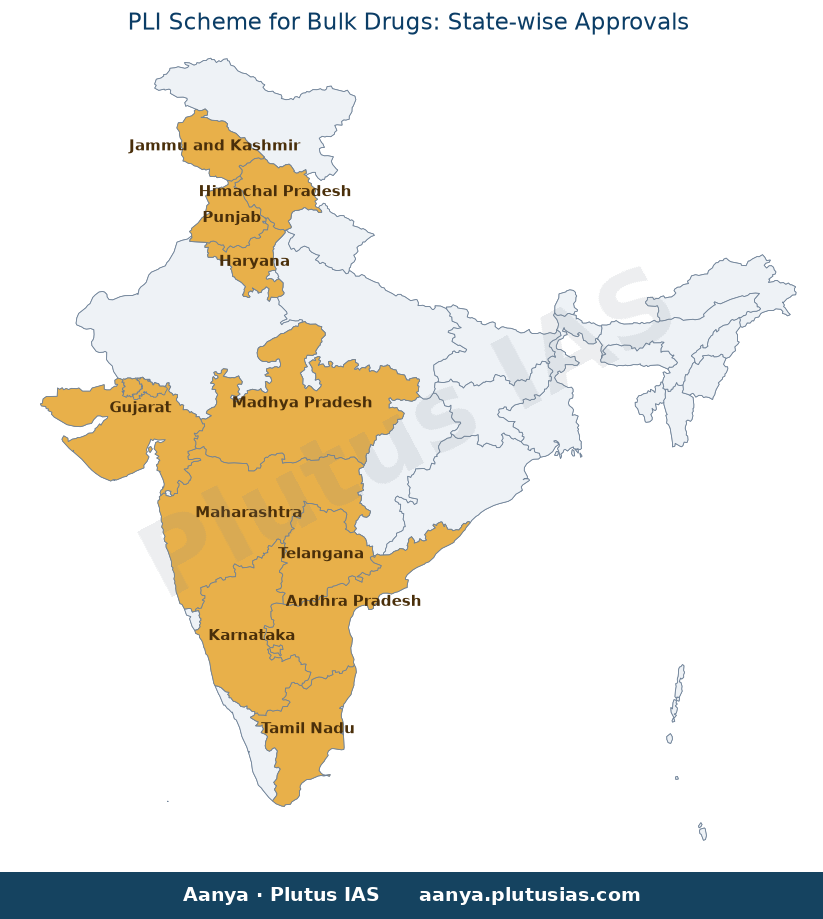
| State-wise Distribution | Concentration of projects in Andhra Pradesh (10), Telangana (13), and Gujarat (8), reflecting regional industrial advantages. |
Why it Matters
Economic Significance
- Reduces import dependency for critical bulk drugs and APIs, saving foreign exchange reserves.
- Enhances domestic pharmaceutical manufacturing capacity, positioning India as a self-reliant hub.
- Stimulates ancillary industries (e.g., packaging, logistics) through backward linkages.
- Generates employment in pharmaceutical manufacturing and allied sectors across states.
- Attracts foreign direct investment (FDI) in high-value chemical synthesis and fermentation processes.
Strategic Significance
- Strengthens India’s pharmaceutical security, particularly for essential medicines and emergency response.
- Reduces vulnerability to global supply chain disruptions (e.g., during pandemics or geopolitical tensions).
- Supports the ‘Atmanirbhar Bharat’ initiative by fostering indigenous production of critical APIs.
- Enhances India’s role in global pharmaceutical supply chains as a reliable producer.
Technological Significance
- Promotes adoption of advanced chemical synthesis and fermentation technologies in domestic industry.
- Encourages R&D in high-value APIs, bridging the gap between bulk drugs and finished formulations.
- Facilitates technology transfer and collaboration between domestic firms and global pharmaceutical giants.
Healthcare Significance
- Ensures stable supply of essential bulk drugs, reducing shortages in domestic healthcare systems.
- Supports the production of life-saving drugs (e.g., antiretrovirals, antibiotics) locally.
- Enhances affordability of medicines by reducing reliance on imported raw materials.
Challenges
1. Supply Chain Bottlenecks
- Dependence on imported key starting materials (KSMs) for some APIs may persist.
- Logistical challenges in transporting bulk drugs and APIs across states.
UPSC Link: GS III – Industrial Policy
2. Quality and Compliance
- Ensuring adherence to Good Manufacturing Practices (GMP) and international standards (e.g., WHO-GMP, USFDA).
- Risk of substandard or spurious bulk drugs entering the supply chain.
UPSC Link: GS II – Health Sector
3. Market Competition
- Global competition from low-cost producers (e.g., China) may undercut domestic manufacturers.
- Price controls and procurement policies may limit profitability for private players.
UPSC Link: GS III – Trade and Commerce
4. Technological Lag
- Limited indigenous capability in high-end chemical synthesis and fermentation processes.
- Need for upskilling workforce in advanced pharmaceutical manufacturing technologies.
UPSC Link: GS III – Science & Tech
5. Regulatory Delays
- Slow approval processes for new projects and incentives disbursement may deter investments.
- Complexity in obtaining environmental clearances for chemical manufacturing units.
UPSC Link: GS II – Governance
6. Regional Disparities
- Concentration of projects in select states (e.g., Andhra Pradesh, Telangana) may widen regional industrial gaps.
- Lack of infrastructure in hinterland states may hinder project execution.
UPSC Link: GS I – Regional Development
Challenges — UPSC Perspective
| Issue | Concern |
|---|---|
| Import Dependency | Continued reliance on imported KSMs/DSIs for some APIs undermines self-reliance goals. |
| Quality Assurance | Risk of substandard bulk drugs due to inadequate testing and certification infrastructure. |
| Cost Competitiveness | High production costs may reduce the price competitiveness of domestically produced APIs. |
| Skilled Manpower | Shortage of trained personnel in advanced pharmaceutical manufacturing and R&D. |
| Infrastructure Gaps | Inadequate logistics and warehousing facilities for bulk drug storage and distribution. |
| Policy Stability | Frequent changes in pharmaceutical policies may create uncertainty for investors. |
Government Initiatives — Must-Memorise for Prelims
- Production-Linked Incentive (PLI) Scheme for Pharmaceuticals (Bulk Drugs)
- Atmanirbhar Bharat Abhiyaan (Pharma Sector Component)
Way Forward
- Strengthen domestic R&D in chemical synthesis and fermentation technologies to reduce import dependency.
- Accelerate disbursement of PLI incentives to ensure timely project execution and investment realization.
- Develop state-specific industrial corridors in hinterland regions to decentralize pharmaceutical manufacturing.
- Enhance collaboration between industry, academia, and research institutions for skill development.
- Streamline regulatory approvals for new projects and environmental clearances to reduce delays.
- Promote public-private partnerships (PPPs) for shared infrastructure (e.g., testing labs, warehouses).
- Incentivize local production of KSMs to reduce reliance on imports for critical inputs.
- Monitor and evaluate project progress rigorously to ensure compliance with production and investment targets.
UPSC Value Addition
Keywords for Mains Answer-Writing
Production-Linked Incentive (PLI) Scheme · Active Pharmaceutical Ingredients (APIs) · Bulk Drugs · Self-reliance in Pharmaceuticals · Atmanirbhar Bharat · Pharmaceutical Promotion and Development Scheme · Critical Key Starting Materials (KSM) · Drug Intermediates (DI) · Import substitution · Pharmaceutical Policy · Union Budget 2021-22 · Department of Pharmaceuticals · National Policy on Pharmaceuticals · Make in India · Pharmaceutical Manufacturing · Healthcare Security · Industrial Policy · Fiscal Incentives for Pharmaceuticals · Regulatory Framework for APIs
Concept Flow
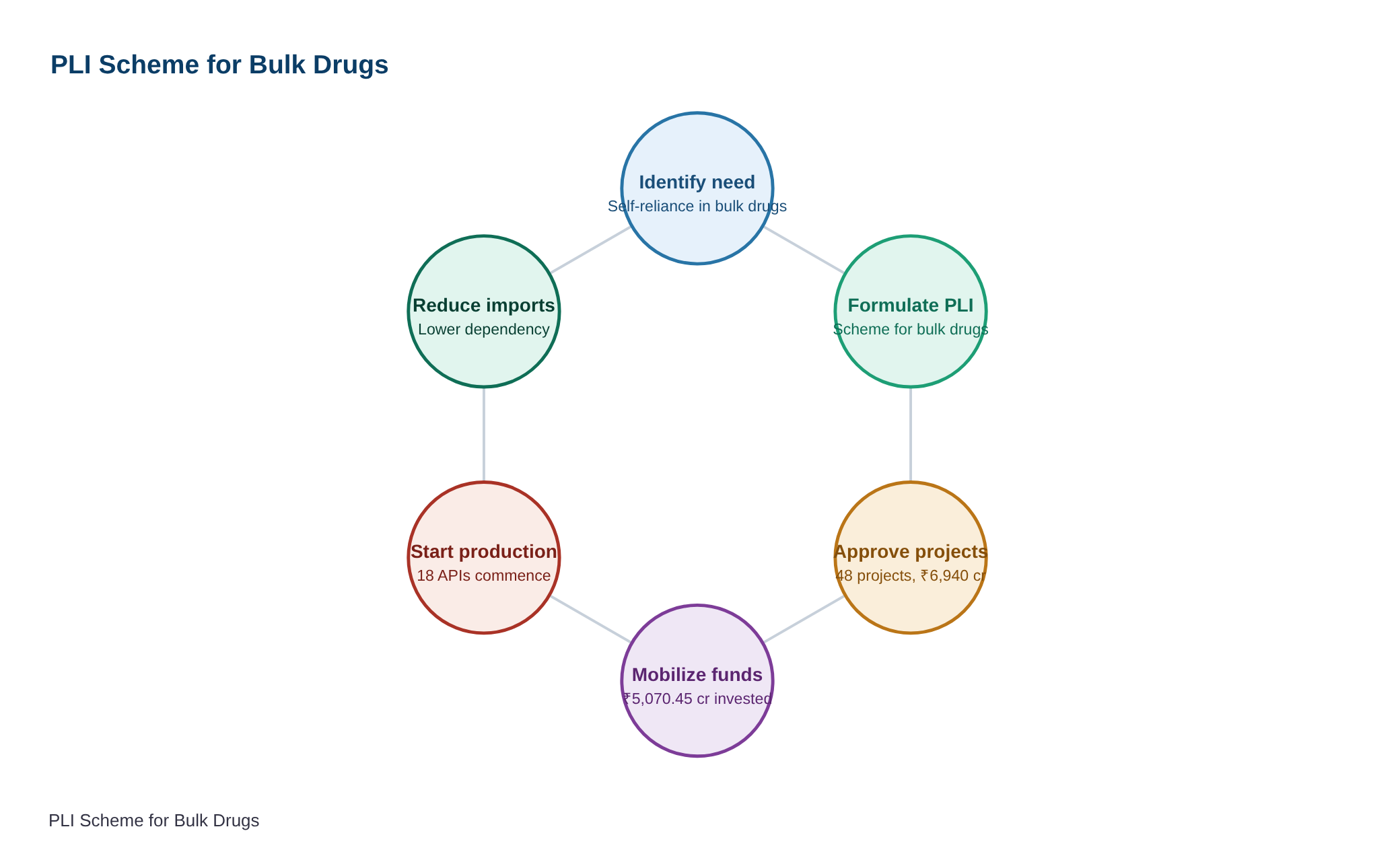
Government identifies strategic need for self-reliance in bulk drugs → Formulation of PLI scheme for bulk drugs → Approval of 48 projects with ₹6,940 crore outlay → Investment mobilization (₹5,070.45 crore) → Commencement of production for 18 APIs → Reduction in import dependency → Strengthening of domestic pharmaceutical supply chain → Enhanced healthcare security and economic growth.
Prelims Practice Questions
Q1. Consider the following statements regarding the Production-Linked Incentive (PLI) Scheme for bulk drugs in India:
1. The scheme aims to promote domestic manufacturing of Active Pharmaceutical Ingredients (APIs) and Key Starting Materials (KSMs).
2. The scheme provides financial incentives linked to incremental sales and investment.
3. The scheme was launched under the aegis of the Ministry of Health and Family Welfare.
4. The scheme has approved 48 projects with a total sanctioned outlay of ₹6,940 crore.
How many of the above statements are correct?
- Only one
- Only two
- Only three
- All four
Answer: All four — Statements 1, 2, and 4 are correct. Statement 3 is incorrect as the PLI Scheme for bulk drugs is administered by the Department of Pharmaceuticals under the Ministry of Chemicals and Fertilizers, not the Ministry of Health and Family Welfare.
Q2. Assertion (A): The PLI Scheme for bulk drugs aims to reduce India’s dependence on imported Active Pharmaceutical Ingredients (APIs).
Reason (R): The scheme provides financial incentives to domestic manufacturers to increase production of APIs and Key Starting Materials (KSMs).
- Both A and R are true, and R is the correct explanation of A.
- Both A and R are true, but R is not the correct explanation of A.
- A is true, but R is false.
- A is false, but R is true.
Answer: Both A and R are true, but R is not the correct explanation of A. — Both the Assertion (A) and Reason (R) are true, and the Reason (R) correctly explains the Assertion (A). The PLI Scheme incentivizes domestic production of APIs and KSMs, thereby reducing reliance on imports.
Q3. Match the following columns related to the PLI Scheme for bulk drugs:
Column I (State) Column II (Approved Projects)
a. Andhra Pradesh 1. 13
b. Gujarat 2. 8
c. Telangana 3. 10
d. Maharashtra 4. 5
- a-3, b-2, c-1, d-4; a-2, b-3, c-1, d-4; a-1, b-4, c-2, d-3; a-4, b-1, c-3, d-2
- answer_key_4
- answer_key_4
- explain_key_4
- format
Answer: a-3, b-2, c-1, d-4; a-2, b-3, c-1, d-4; a-1, b-4, c-2, d-3; a-4, b-1, c-3, d-2 —
Mains Practice Question
✍ Critically examine the significance of the Production-Linked Incentive (PLI) Scheme for bulk drugs in achieving self-reliance in India’s pharmaceutical sector. Also, discuss the challenges faced in its implementation and suggest measures to enhance its effectiveness. (15 Marks)
Approach: MODEL-ANSWER SKELETON:
1. **Introduction (2 marks)**
– Define the PLI Scheme for bulk drugs: A fiscal incentive mechanism under the Department of Pharmaceuticals, Ministry of Chemicals and Fertilizers, to boost domestic manufacturing of APIs, KSMs, and Drug Intermediates (DIs).
– Context: Launched as part of the ‘Atmanirbhar Bharat’ initiative to reduce import dependence, particularly in the wake of global supply chain disruptions during the COVID-19 pandemic.
2. **Significance of the Scheme (5 marks)**
– **Reduction in Import Dependency**: Highlight the import dependence of India’s pharmaceutical sector (e.g., ~70% of APIs are imported, primarily from China). Mention the 18 APIs already in commercial production under the scheme (e.g., Penicillin G, Dexamethasone, Paracetamol).
– **Boost to Domestic Manufacturing**: Cite the approved investment of ₹5,070.45 crore against a committed ₹4,329.95 crore and the creation of production capacity for 28 APIs/KSMs/DIs.
– **Alignment with National Policies**: Link to the National Policy on Pharmaceuticals (2021), Make in India, and the Union Budget 2021-22 allocations.
– **Healthcare Security**: Emphasize the strategic importance of self-reliance in APIs for ensuring uninterrupted drug supply during health crises.
3. **Challenges in Implementation (5 marks)**
– **High Capital Intensity**: APIs production requires significant upfront investment in technology, R&D, and compliance with Good Manufacturing Practices (GMP).
– **Regulatory and Compliance Hurdles**: Stringent quality standards (e.g., WHO-GMP, Schedule M of the Drugs and Cosmetics Act) and delays in approvals.
– **Competition from Imports**: Lower-cost APIs from China and other countries pose a challenge to domestic producers despite incentives.
– **State-wise Disparities**: Uneven distribution of projects (e.g., Andhra Pradesh leads with 10 projects, while states like Haryana and Jammu & Kashmir are still in early stages).
– **Market Dynamics**: Volatile demand for APIs and price fluctuations in the global market.
4. **Measures to Enhance Effectiveness (3 marks)**
– **Strengthening R&D**: Encourage collaboration between industry and institutions like CSIR and NIPER for innovation in API synthesis.
– **Streamlining Approvals**: Simplify regulatory processes and reduce bureaucratic delays in project approvals and clearances.
– **Skill Development**: Invest in skill development programs to create a workforce adept in API manufacturing and quality control.
– **Public-Private Partnerships (PPPs)**: Promote PPP models for setting up common infrastructure facilities (e.g., API parks) to reduce costs.
– **Monitoring and Evaluation**: Establish a robust monitoring mechanism to track progress and address bottlenecks in real-time.
5. **Conclusion (2 marks)**
– Reiterate the strategic importance of the PLI Scheme for bulk drugs in achieving self-reliance.
– Conclude with a balanced view: While the scheme is a step in the right direction, its success hinges on addressing implementation challenges and fostering a conducive ecosystem for pharmaceutical manufacturing in India.
Source: PIB (Press Information Bureau)
Generated by AanyaAi for educational purpose.

- महाराष्ट्र में त्योहार जुलूसों पर बॉम्बे हाईकोर्ट का बड़ा फैसला: पटाखे, लेजर और संगीत पर रोक - September 24, 2026
- Bombay HC Bans Firecrackers, Music in Maharashtra Processions: Key UPSC Analysis - September 24, 2026
- तमिलनाडु में महिला कर्मचारियों के लिए सवैतनिक माहवारी अवकाश नीति पर HC का आदेश - September 24, 2026

No Comments