


07 Aug PLI Scheme for Bulk Drugs: Boosting India’s Pharma Self-Reliance in 2026
✎ The PLI Scheme for Bulk Drugs aims to reduce India’s import dependence on APIs/KSMs by incentivising domestic production through a performance-linked financial mechanism.
Subject Relevance — Where This Topic Fits
- GS Paper II — Government Policies and Interventions for Development in Various Sectors | GS Paper III — Indian Economy and Issues Relating to Planning, Mobilisation of Resources, Growth, Development and Employment
- Prelims: Production-Linked Incentive (PLI) Scheme, Active Pharmaceutical Ingredients (APIs), Key Starting Materials (KSMs), Pharmaceutical Policy, Atmanirbhar Bharat
- Essay: India’s Pharmaceutical Self-Reliance: Balancing Global Competitiveness and Domestic Innovation, Public-Private Partnerships in Healthcare: A Model for Sustainable Development
Quick Revision: The PLI Scheme for Bulk Drugs aims to reduce India’s import dependence on APIs/KSMs by incentivising domestic production through a performance-linked financial mechanism.
Why is this in the news?
The Union Ministry of Chemicals and Fertilizers has approved 48 projects under the Production-Linked Incentive (PLI) Scheme for Bulk Drugs, with a sanctioned outlay of ₹6,940 crore, to reduce India’s dependence on imports of critical Active Pharmaceutical Ingredients (APIs) and Key Starting Materials (KSMs). As of March 2026, ₹5,070.45 crore has been invested against a committed ₹4,329.95 crore, and 18 APIs are already in commercial production, marking a significant stride toward self-reliance in pharmaceutical manufacturing.
Background
- India is the world’s third-largest pharmaceutical market by volume and the 14th largest by value, yet it remains heavily dependent on imports for 70% of its API requirements, particularly from China.
- The COVID-19 pandemic exposed vulnerabilities in global supply chains, prompting the Government of India to prioritise domestic production of critical pharmaceutical inputs under the ‘Atmanirbhar Bharat’ initiative.
- The PLI Scheme for Bulk Drugs has a total outlay of ₹6,940 crore to incentivise domestic manufacturing of 41 identified KSMs/DIs/APIs.
- The scheme aims to enhance India’s export competitiveness in the global pharmaceutical market while ensuring uninterrupted supply of essential medicines.
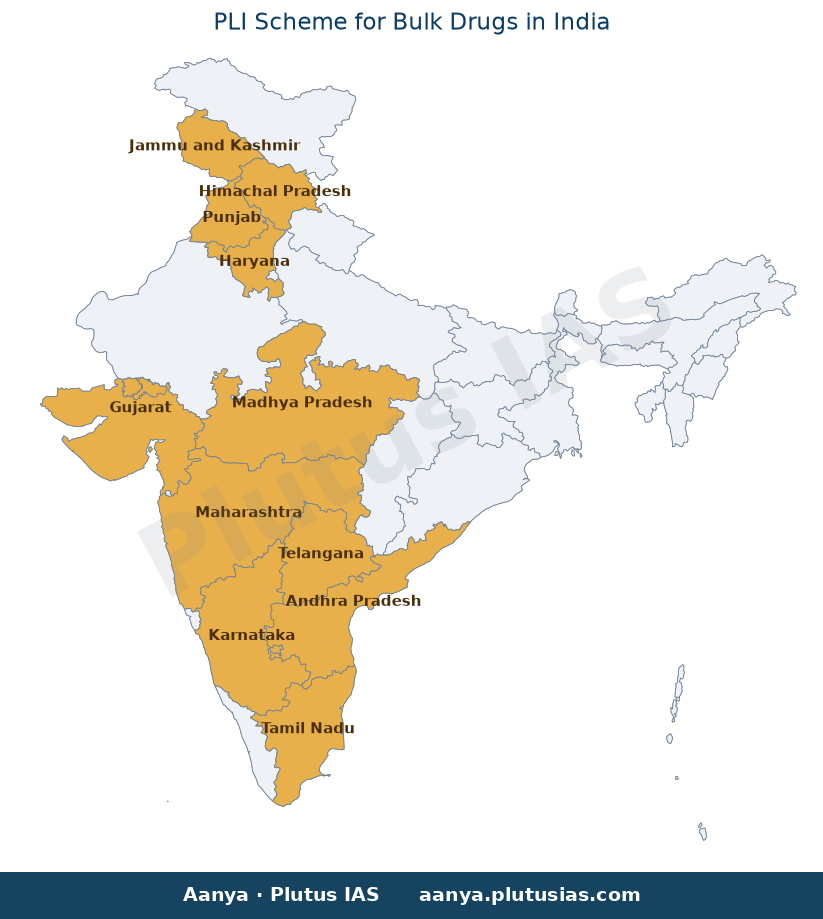
- State-wise data reveals that Andhra Pradesh, Gujarat, and Maharashtra lead in approved projects, reflecting regional industrial strengths in pharmaceutical manufacturing.
- The scheme aligns with the National Pharmaceutical Pricing Policy (NPPP) and the Drug Price Control Order (DPCO) to ensure affordability while promoting self-sufficiency.
What is the Production-Linked Incentive (PLI) Scheme for Bulk Drugs?
- The PLI Scheme for Bulk Drugs is a central sector scheme launched by the Department of Pharmaceuticals, Ministry of Chemicals and Fertilizers, to incentivise the domestic production of critical pharmaceutical inputs such as APIs, KSMs, and Drug Intermediates (DIs).
- The scheme offers financial incentives linked to incremental sales of domestically manufactured bulk drugs, with the quantum of incentives varying based on the type of API/KSM and the level of investment.
- A total of 41 products have been identified for coverage under the scheme, including fermentation-based (e.g., Penicillin G, Erythromycin Thiocyanate (TIOC)), chemical synthesis-based (e.g., Atorvastatin, Dexamethasone).
Key Features
| Feature | Significance |
|---|---|
| Approved Outlay of ₹6,940 crore | Provides financial impetus for domestic bulk-drug manufacturing, reducing import dependency and strengthening pharmaceutical self-reliance. |
| 48 Projects Approved Across 8 States | Diversifies geographical spread of bulk-drug production, ensuring regional economic benefits and supply-chain resilience. |
| ₹5,070.45 crore Investment Mobilised | Exceeds committed ₹4,329.95 crore, indicating strong industry confidence in the PLI scheme’s viability. |
| 18 APIs Already in Production | Directly substitutes imports of critical drugs like Penicillin G, Dexamethasone, and Atorvastatin, enhancing national health security. |
| Production Capacity Creation of 28 APIs/KSMs/DIs | Expands domestic manufacturing base, reducing reliance on foreign suppliers for essential pharmaceutical intermediates. |
| ₹87.70 crore Incentives Disbursed by March 2026 | Demonstrates early-stage implementation success and government commitment to timely disbursement of incentives. |
Why it Matters
Economic Significance
- Enhances India’s position as a global pharmaceutical manufacturing hub by promoting local production of bulk drugs and APIs.
- Reduces foreign exchange outflow by substituting imports of critical pharmaceutical ingredients, estimated at ~$2.5 billion annually.
- Stimulates ancillary industries such as packaging, logistics, and chemical intermediates, creating employment across the value chain.
- Encourages private sector investment in high-risk, high-reward pharmaceutical R&D and manufacturing infrastructure.
Strategic Significance
- Strengthens India’s strategic autonomy in pharmaceuticals, particularly for essential and life-saving drugs during global supply disruptions.
- Mitigates risks associated with geopolitical tensions or trade restrictions affecting API imports from China and other dominant suppliers.
- Supports India’s commitment to the WHO’s Global Action Plan for tackling antimicrobial resistance through domestic production of critical APIs.
- Aligns with the National Pharmaceutical Pricing Authority (NPPA) objectives to ensure affordable and accessible medicines.
Healthcare Significance
- Reduces dependency on imported bulk drugs, ensuring stable supply chains for essential medicines like antibiotics and anti-inflammatory drugs.
- Lowers production costs for generic pharmaceuticals, indirectly benefiting public health programmes such as Ayushman Bharat.
- Enhances India’s capacity to respond to pandemics and health emergencies by ensuring domestic availability of critical APIs.
- Supports the production of high-value drugs like Atorvastatin and Losartan, improving affordability for chronic disease management.
Policy and Governance Significance
- Demonstrates the efficacy of Production-Linked Incentive (PLI) schemes in achieving industrial policy objectives through targeted financial incentives.
- Sets a precedent for sector-specific PLI schemes in other critical sectors like electronics, textiles, and medical devices.
- Enhances transparency and accountability in incentive disbursement through structured monitoring and reporting mechanisms.
- Encourages states to formulate complementary policies for ease of doing business and infrastructure development in pharmaceutical hubs.
Challenges
1. Delayed Commercialisation of Projects
- 10 out of 48 approved projects have not yet achieved commercial production, indicating implementation bottlenecks.
- Reasons include regulatory hurdles, land acquisition delays, and supply chain disruptions in raw material procurement.
- State-wise disparities in project execution highlight the need for targeted state-level interventions.
UPSC Link: GS3: Industrial Policy
2. High Capital Intensity and Risk Aversion
- Bulk-drug manufacturing requires significant upfront investment in plant, machinery, and compliance with Good Manufacturing Practices (GMP).
- Small and medium enterprises (SMEs) face challenges in accessing finance and managing operational risks.
- Long gestation periods for ROI deter private investment despite PLI incentives.
UPSC Link: GS3: Investment Models
3. Regulatory and Compliance Challenges
- Stringent regulatory requirements for API manufacturing, including environmental clearances and drug master file (DMF) submissions.
- Delays in obtaining approvals from the Central Drugs Standard Control Organisation (CDSCO) and state drug authorities.
- Need for harmonisation of state-level policies to streamline approval processes.
UPSC Link: GS2: Regulatory Framework
4. Supply Chain and Raw Material Dependencies
- Heavy reliance on imported chemical intermediates and solvents, which are subject to global price volatility.
- Limited domestic capacity for high-purity chemicals required in API synthesis increases vulnerability to supply chain disruptions.
- Need for backward integration in the pharmaceutical value chain to reduce import dependency.
UPSC Link: GS3: Supply Chain
5. Market Competition and Price Pressures
- Intense competition from low-cost API producers in China and other countries may undermine the competitiveness of domestic manufacturers.
- Price controls under the Drug Price Control Order (DPCO) limit profit margins, affecting the viability of PLI-supported projects.
- Need for differentiation strategies such as quality certifications and niche API production to sustain market share.
UPSC Link: GS3: Market Dynamics
Challenges — UPSC Perspective
| Issue | Concern |
|---|---|
| Regulatory Delays | Prolonged approval processes for environmental and drug manufacturing clearances hinder project timelines. |
| Land Acquisition | Challenges in acquiring land for pharmaceutical parks, particularly in densely populated states like Gujarat and Maharashtra. |
| Financing Gaps | SMEs struggle to secure loans due to high collateral requirements and perceived risks in bulk-drug manufacturing. |
| Raw Material Imports | Dependence on imported chemical intermediates exposes manufacturers to currency fluctuations and trade barriers. |
| Skilled Workforce Shortage | Lack of specialised technical manpower in API synthesis and quality control affects operational efficiency. |
| Infrastructure Bottlenecks | Inadequate logistics and power supply in certain states impede smooth manufacturing operations. |
Government Initiatives — Must-Memorise for Prelims
- Production-Linked Incentive (PLI) Scheme for Pharmaceuticals (Bulk Drugs)
- Pharma Vision 2024 by the Ministry of Chemicals and Fertilizers
- Scheme for Promotion of Bulk Drug Parks
Way Forward
- Accelerate regulatory clearances through a single-window approval mechanism for bulk-drug projects, integrating CDSCO, MoEFCC, and state authorities.
- Establish dedicated pharmaceutical parks with pre-approved infrastructure and utilities to reduce project gestation periods.
- Enhance financing support for SMEs through credit guarantees and lower interest rates, leveraging NABARD and SIDBI schemes.
- Promote R&D in high-value APIs through collaborations with CSIR labs and academic institutions to reduce import dependency.
- Strengthen domestic supply chains by incentivising production of critical chemical intermediates and solvents.
- Develop state-specific action plans for pharmaceutical manufacturing, aligning with the ‘One District, One Product’ initiative.
- Implement a robust monitoring framework to track project progress, disbursement of incentives, and production milestones.
- Facilitate technology transfer and upskilling programmes to address the shortage of specialised workforce in API manufacturing.
UPSC Value Addition
Keywords for Mains Answer-Writing
Production-Linked Incentive (PLI) Scheme for Bulk Drugs · Active Pharmaceutical Ingredients (APIs) · Key Starting Materials (KSM) · Drug Intermediates (DI) · Pharmaceutical manufacturing self-reliance · Atmanirbhar Bharat in pharmaceuticals · Import substitution of bulk drugs · Pharmaceutical Policy 2020 · Chemical and Fertilizers Ministry · India’s pharmaceutical export competitiveness · Drug price control order (DPCO) · National Pharmaceutical Pricing Authority (NPPA) · FDI in pharmaceutical sector
Concept Flow
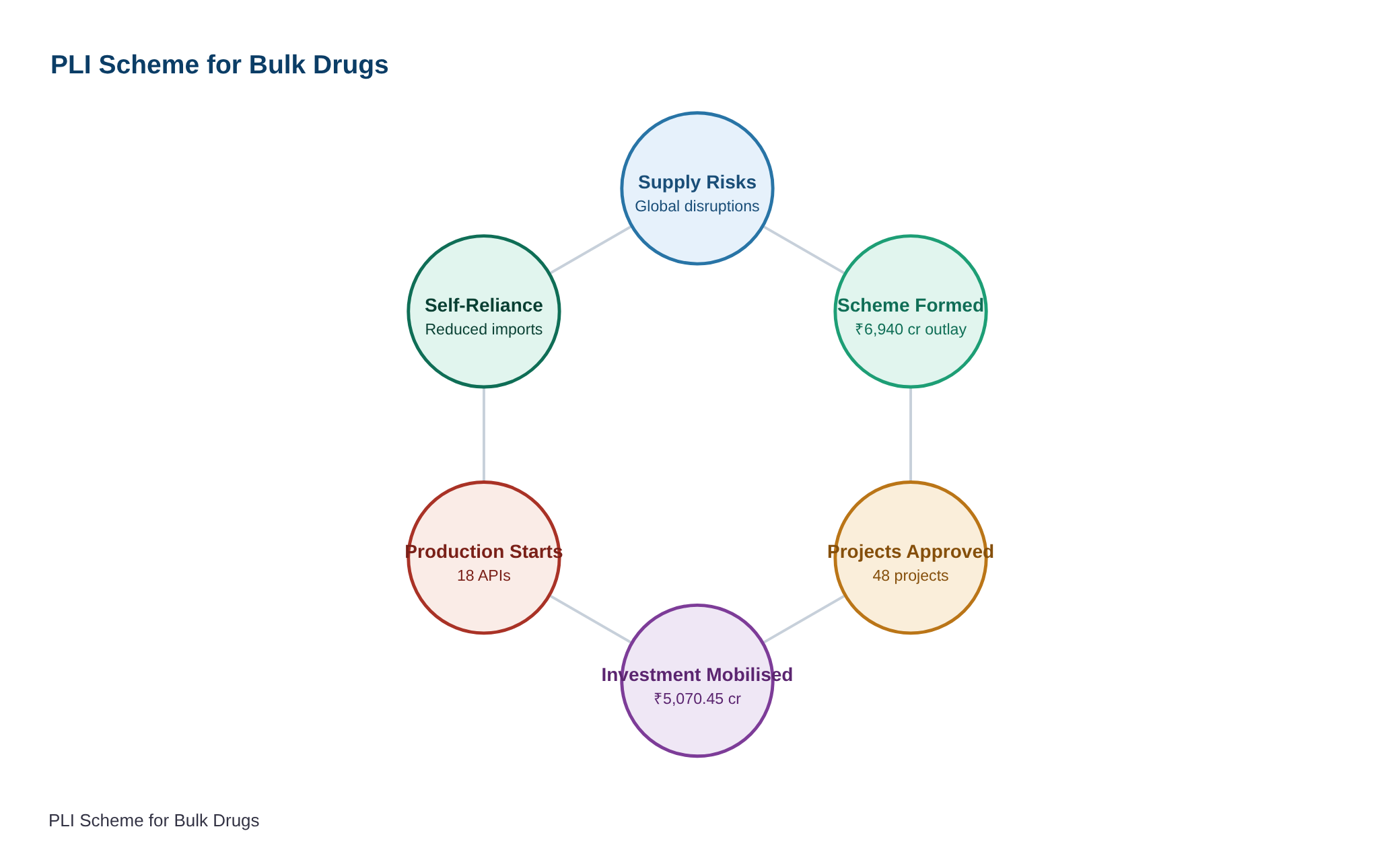
Global Supply Chain Disruptions → Government Recognises Import Dependency Risks → Formulation of PLI Scheme for Bulk Drugs → Approval of 48 Projects with ₹6,940 crore Outlay → Mobilisation of ₹5,070.45 crore Investment → Creation of Production Capacity for 28 APIs → Commencement of Production for 18 APIs → Reduction in Import Dependency → Strengthening of India’s Pharmaceutical Self-Reliance
Prelims Practice Questions
Q1. Consider the following statements regarding the Production-Linked Incentive (PLI) Scheme for Bulk Drugs:
1. The scheme aims to promote domestic production of Active Pharmaceutical Ingredients (APIs) and Key Starting Materials (KSM).
2. The scheme has approved 48 projects with a sanctioned outlay of ₹6,940 crore.
3. The scheme is administered by the Ministry of Health and Family Welfare.
4. The scheme has already led to the creation of production capacity for 28 APIs/KSMs/DIs.
How many of the above statements are correct?
- Only one
- Only two
- Only three
- All four
Answer: All four — Statements 1, 2, and 4 are correct. Statement 3 is incorrect as the scheme is administered by the Ministry of Chemicals and Fertilizers, not the Ministry of Health and Family Welfare.
Q2. Assertion (A): The PLI Scheme for Bulk Drugs is designed to reduce India’s dependence on imported pharmaceutical raw materials.
Reason (R): The scheme provides financial incentives linked to incremental sales and production of domestically manufactured APIs and KSMs.
In the context of the above two statements, which one of the following is correct?
- Both A and R are true and R is the correct explanation of A.
- Both A and R are true but R is not the correct explanation of A.
- A is true but R is false.
- A is false but R is true.
Answer: Both A and R are true but R is not the correct explanation of A. — The PLI Scheme for Bulk Drugs aims to reduce import dependence by incentivizing domestic production of APIs and KSMs. The financial incentives are directly linked to incremental sales and production, making R the correct explanation of A.
Q3. Match the following pharmaceutical compounds with their respective categories under the PLI Scheme for Bulk Drugs:
Column I (Compound) Column II (Category)
A. Penicillin G 1. Fermentation-based KSM
B. Dexamethasone 2. Chemical synthesis-based API
C. Cyclohexane Diacetic Acid (CDA) 3. Fermentation-based API
D. Atorvastatin 4. Chemical synthesis-based KSM
Select the correct match:
- A-1, B-3, C-4, D-2
- A-3, B-1, C-2, D-4
- A-1, B-3, C-2, D-4
- A-3, B-1, C-4, D-2
Answer: A-3, B-1, C-2, D-4 — Penicillin G is a fermentation-based KSM, Dexamethasone is a fermentation-based API, Cyclohexane Diacetic Acid (CDA) is a chemical synthesis-based KSM, and Atorvastatin is a chemical synthesis-based API.
Mains Practice Question
✍ Critically examine the significance of the Production-Linked Incentive (PLI) Scheme for Bulk Drugs in achieving self-reliance in India’s pharmaceutical sector. Also, assess the challenges in its implementation and suggest measures to enhance its efficacy. (15 Marks)
Approach: MODEL-ANSWER SKELETON:
1. **Introduction (2 Marks)**
– Define the PLI Scheme for Bulk Drugs and its objective: to promote domestic production of APIs, KSMs, and Drug Intermediates (DIs) to reduce import dependence.
– Contextualize within the broader framework of Atmanirbhar Bharat and the Pharmaceutical Policy 2020.
2. **Significance of the Scheme (5 Marks)**
– **Reduction in Import Dependence**: Highlight the current import dependence of India for APIs (approx. 60-70% for certain critical drugs) and how the scheme targets key APIs like Penicillin G, Dexamethasone, and Atorvastatin.
– **Boost to Domestic Manufacturing**: Cite the approved outlay (₹6,940 crore), sanctioned projects (48), and investments (₹5,070.45 crore) to illustrate the scale of intervention.
– **Export Competitiveness**: Discuss how increased domestic production can enhance India’s position as the ‘pharmacy of the world’ and reduce vulnerability to global supply chain disruptions.
– **Employment Generation**: Mention the potential for job creation in the pharmaceutical and allied sectors.
– **Alignment with DPCO and NPPA**: Explain how self-reliance in bulk drugs can stabilize drug prices and reduce the burden on the National Pharmaceutical Pricing Authority (NPPA).
3. **Challenges in Implementation (5 Marks)**
– **High Capital Intensity**: APIs and KSMs require sophisticated infrastructure and high initial investments, posing barriers for MSMEs.
– **Regulatory Hurdles**: Delays in environmental clearances, land acquisition, and compliance with Good Manufacturing Practices (GMP).
– **Market Competition**: Dominance of Chinese manufacturers in bulk drug production and price competitiveness.
– **Technology Gaps**: Limited R&D capabilities in India for high-end APIs and KSMs compared to global leaders.
– **State-wise Disparities**: Uneven distribution of projects (e.g., Andhra Pradesh and Gujarat dominate, while states like Haryana and Jammu & Kashmir are in nascent stages).
– **Monitoring and Evaluation**: Ensure transparency in incentive disbursement and avoid misutilization of funds.
4. **Measures to Enhance Efficacy (3 Marks)**
– **Public-Private Partnerships (PPPs)**: Collaborate with research institutions (e.g., CSIR, IITs) and private players to bridge technology gaps.
– **Subsidized Credit and Tax Incentives**: Provide low-interest loans and tax rebates for API manufacturers.
– **Skill Development**: Launch specialized training programs in pharmaceutical chemistry and manufacturing.
– **Streamlining Clearances**: Fast-track environmental and regulatory approvals for approved projects.
– **Incentivize R&D**: Offer additional PLI benefits for indigenous R&D in high-value APIs and KSMs.
– **State-Level Coordination**: Encourage states with low participation (e.g., Haryana, Jammu & Kashmir) through targeted interventions like land subsidies and infrastructure support.
5. **Conclusion (2 Marks)**
– Reiterate the transformative potential of the PLI Scheme for Bulk Drugs in reducing import dependence and achieving self-reliance.
– Emphasize the need for sustained policy support, technological upgradation, and stakeholder collaboration to realize its full benefits.
Source: PIB (Press Information Bureau)
Generated by AanyaAi for educational purpose.

- ग्रीनलैंड समझौता: अमेरिका को मिले अतिरिक्त रक्षा क्षेत्र, जानिए पूरा मामला - September 23, 2026
- US-Greenland Defence Deal: Strategic Implications for UPSC & State PCS - September 23, 2026
- ब्रिक्स कर प्रमुखों की बैठक: कर नियमों में बदलाव में भारत का जोर - September 23, 2026

No Comments