


23 Sep US-Greenland Defence Deal: Strategic Implications for UPSC & State PCS
✎ The US-Denmark-Greenland Defence Agreement formalises expanded US military access in Greenland, strengthens NATO’s Arctic role, and balances sovereignty, self-determination, and environmental concerns while excluding non-NATO…
Subject Relevance — Where This Topic Fits
- GS Paper II — International Relations: Bilateral, regional and global groupings and agreements involving India and/or affecting India’s interests | GS Paper II — International Relations: Effect of policies and politics of developed and developing countries on India’s interests
- Prelims: Arctic Council, NATO, Greenland, Pituffik Space Base, Self-determination, Sovereignty, Territorial integrity, Golden Dome defence system
- Essay: Global strategic realignments in the Arctic and their implications for international governance, The intersection of environmental conservation and military security in polar regions
Quick Revision: The US-Denmark-Greenland Defence Agreement formalises expanded US military access in Greenland, strengthens NATO’s Arctic role, and balances sovereignty, self-determination, and environmental concerns while excluding non-NATO military presence.
Why is this in the news?
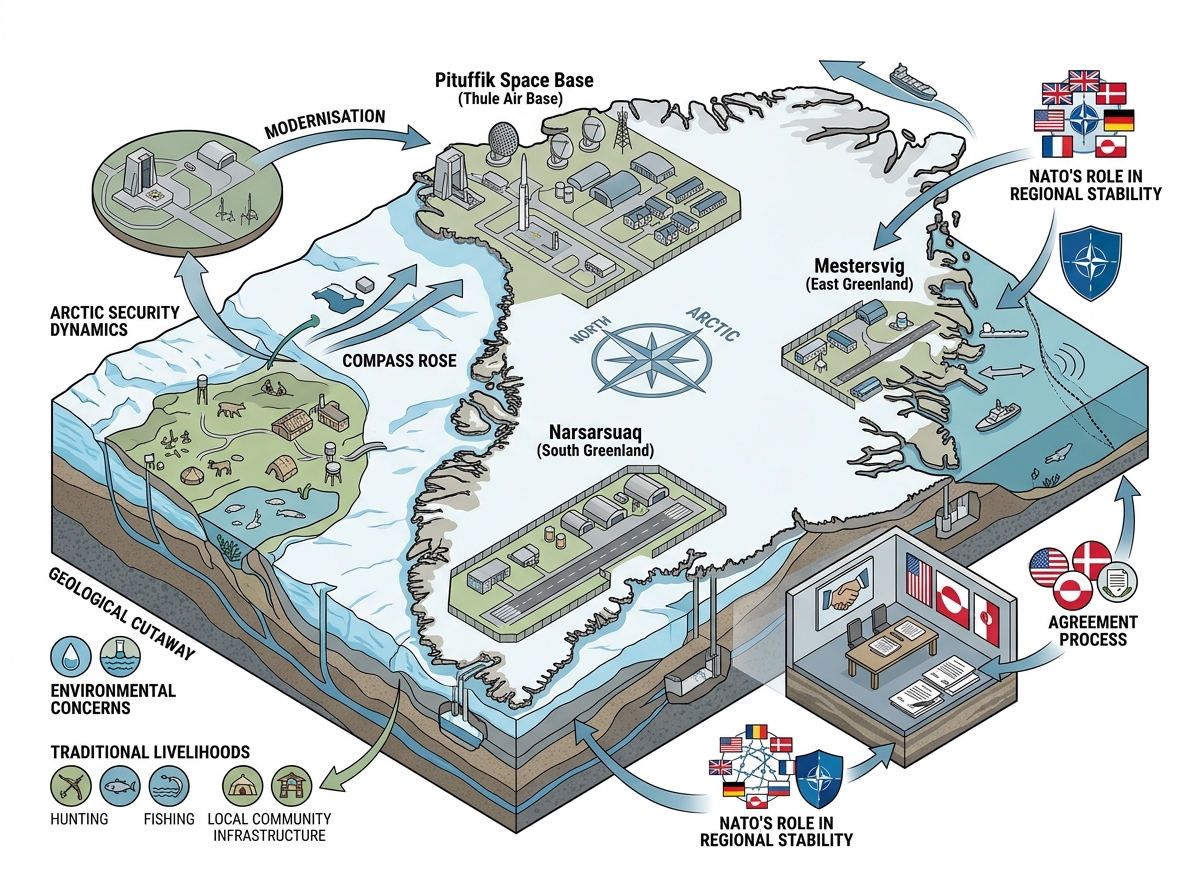
On 23 September 2026, the United States, Denmark, and Greenland signed an agreement formalising expanded US military access and the establishment of additional defence areas in Greenland. This accord is significant as it addresses evolving security dynamics in the Arctic, reaffirms NATO’s role in regional stability, and recognises Greenland’s self-determination while balancing environmental and traditional livelihood concerns. The agreement also introduces new defence infrastructure, including modernisation of the Pituffik Space Base and potential new sites at Narsarsuaq and Mestersvig, underscoring the geostrategic importance of the Arctic.
Background
- The Arctic region has emerged as a critical theatre for global security due to melting ice, opening new trade routes, and exposing vast natural resources, prompting heightened military and strategic interest from major powers.
- Greenland, an autonomous territory within the Kingdom of Denmark, holds a pivotal geographic position in the Arctic, making it a focal point for NATO members and non-NATO states alike.
- The Pituffik Space Base (formerly Thule Air Base) has been a longstanding US military installation in Greenland, primarily used for space surveillance and missile defence, reflecting the island’s strategic value.
- Historically, Greenland’s status has been a subject of diplomatic sensitivity, with Denmark asserting sovereignty while Greenland exercises increasing autonomy under the 2009 Self-Government Act.
- The Arctic Council, an intergovernmental forum promoting cooperation among Arctic states, has emphasised sustainable development and environmental protection, though security concerns have gained prominence in recent years.
- The agreement follows heightened rhetoric regarding Arctic militarisation, including public statements by the US administration about the need to address perceived security gaps in the region.
What is the US-Denmark-Greenland Defence Agreement?
- The agreement is a trilateral pact between the United States, Denmark, and Greenland that formalises expanded US military access and the establishment of additional defence areas in Greenland.
- It permits the US to modernise and expand activities at the Pituffik Space Base in northwest Greenland, a key facility for space surveillance and missile defence.
- The deal authorises the US to set up new defence areas at Narsarsuaq (south) and Mestersvig (east), with provisions to establish further defence areas as deemed necessary.
- The agreement explicitly recognises Denmark’s sovereignty over Greenland and Greenland’s right to self-determination, ensuring alignment with international law and the principles of territorial integrity.
- It mandates that no non-NATO state shall be permitted to establish military installations or maintain a persistent military presence in Greenland, reinforcing NATO’s role in regional security.
- The pact includes a ‘Golden Dome defence system’ component, likely referring to a missile defence or early warning mechanism to protect Greenland, NATO territory, and the North American continent.
- Environmental and traditional livelihood protections are embedded in the agreement, acknowledging the need to safeguard Greenland’s pristine ecosystems and the cultural rights of its indigenous population.
Key Features
| Feature | Significance |
|---|---|
| Expansion of US military presence in Greenland | Enhances US strategic depth in the Arctic, particularly at Pituffik Space Base, Narsarsuaq, and Mestersvig, while aligning with NATO’s evolving security priorities. |
| Recognition of Danish sovereignty over Greenland | Reinforces the principle of territorial integrity under international law, preventing unilateral annexation or military occupation. |
| Right to self-determination for Greenlanders | Acknowledges Greenland’s semi-autonomous status and ensures its people retain autonomy over economic, social, and cultural rights. |
| NATO-centric military access provisions | Restricts non-NATO states from establishing military installations, thereby consolidating NATO’s dominance in Arctic security architecture. |
| Environmental and cultural safeguards | Mandates protection of Greenland’s pristine environment and traditional livelihoods, including hunting and fishing, in line with indigenous rights frameworks. |
| Provision for Greenland’s future independence | Ensures continuity of NATO membership and defence obligations if Greenland attains sovereignty, preventing geopolitical vacuums. |
Why it Matters
Geopolitical
- The agreement reflects the Arctic’s growing militarisation amid climate change-induced accessibility and resource competition, positioning Greenland as a critical node in NATO’s northern flank.
- It signals a shift from historical Danish-US cooperation to a more formalised, multilateral security framework under NATO auspices.
- The deal mitigates potential conflicts by embedding US military expansion within a NATO-compliant structure, reducing unilateralism risks.
- Arctic security dynamics are increasingly shaped by non-Arctic states (e.g., China, Russia), making this agreement a counterbalance to external pressures.
Strategic
- Greenland’s geographic location provides the US with over-the-pole missile defence capabilities, satellite tracking, and undersea access, crucial for monitoring Arctic routes and potential adversarial movements.
- The ‘Golden Dome defence system’ mentioned implies integration with US missile defence networks, enhancing early-warning and interception capabilities.
- Expansion at Pituffik Space Base (formerly Thule Air Base) strengthens US Space Force operations, given Greenland’s proximity to polar orbits.
Legal and Institutional
- The agreement operates within the framework of NATO’s collective defence (Article 5), ensuring mutual security obligations among signatories.
- Denmark’s sovereignty is reaffirmed, preventing legal ambiguities that could arise from unilateral US actions or Greenland’s independence.
- The requirement for parliamentary approval (in Denmark and Greenland) introduces democratic oversight, balancing security imperatives with public accountability.
Environmental and Sociocultural
- Greenland’s fragile ecosystem faces risks from military expansion, necessitating stringent environmental impact assessments and mitigation measures.
- Traditional Inuit livelihoods, including hunting and fishing, are protected under the agreement, aligning with the UN Declaration on the Rights of Indigenous Peoples.
Challenges
1. Sovereignty and Autonomy Concerns
- Greenland’s semi-autonomous status under Denmark may face tensions if US military presence is perceived as encroaching on local governance.
- Future independence movements could strain the agreement’s continuity, especially if NATO membership becomes a contentious issue.
UPSC Link: GS-II: International Relations – Arctic Governance
2. Environmental Risks
- Military activities, including infrastructure expansion and undersea access, pose threats to Greenland’s unique Arctic biodiversity.
- Climate change exacerbates these risks, as melting ice and permafrost may destabilise military installations.
UPSC Link: GS-III: Environment – Arctic Ecosystem Vulnerability
3. Geopolitical Tensions
- The agreement could provoke reactions from non-NATO states (e.g., China, Russia), leading to escalated militarisation in the Arctic.
- Denmark’s NATO allies may face pressure to adopt similar measures, risking a regional arms race.
UPSC Link: GS-II: International Relations – Great Power Rivalry
4. Legal and Diplomatic Complexities
- Ensuring compliance with international law (e.g., UNCLOS, Svalbard Treaty analogies) requires careful negotiation to avoid precedents for unilateral military expansion.
- The agreement’s indefinite duration complicates future renegotiation if geopolitical circumstances change.
UPSC Link: GS-II: International Law – Arctic Governance Frameworks
5. Public Perception and Local Opposition
- Greenlandic communities may resist US military presence due to concerns over cultural erosion, environmental degradation, or perceived foreign domination.
- Denmark’s domestic politics could influence the ratification process, especially if public opinion opposes militarisation.
UPSC Link: GS-II: Governance – Decentralisation and Local Autonomy
Challenges — UPSC Perspective
| Issue | Concern |
|---|---|
| Militarisation of the Arctic | Risk of escalating geopolitical tensions and triggering an arms race among Arctic states. |
| Environmental Degradation | Potential harm to Greenland’s fragile ecosystem due to military activities and infrastructure development. |
| Sovereignty Ambiguities | Uncertainty over Greenland’s future status and its impact on the agreement’s validity. |
| Legal Compliance | Need to align the agreement with international treaties (e.g., UNCLOS, NATO Charter) to avoid conflicts. |
| Local Resistance | Opposition from Greenlandic communities over perceived loss of autonomy or cultural disruption. |
| NATO Unity | Ensuring all members support the agreement to prevent divisions in Arctic security governance. |
Way Forward
- Conduct comprehensive environmental impact assessments (EIAs) in consultation with Greenlandic authorities to mitigate ecological risks.
- Establish a joint Greenland-Denmark-US monitoring committee to oversee military activities and ensure compliance with environmental and cultural safeguards.
- Strengthen NATO’s Arctic Strategy by integrating this agreement into broader collective defence planning, including joint exercises and intelligence-sharing.
- Engage with indigenous communities in Greenland through participatory governance models to address local concerns and build trust.
- Develop a phased military expansion plan with clear timelines and transparency measures to prevent unilateral escalation.
- Collaborate with the Arctic Council to harmonise this agreement with broader regional security and environmental frameworks.
- Incorporate climate resilience into military infrastructure design to account for Arctic warming and permafrost thaw.
- Ensure parliamentary ratification processes in Denmark and Greenland include public consultations to enhance democratic legitimacy.
UPSC Value Addition
Keywords for Mains Answer-Writing
Arctic security governance · NATO’s role in the Arctic · Greenland’s strategic importance · US-Denmark-Greenland defence agreement · Sovereignty and territorial integrity · Self-determination of indigenous peoples · Military base modernisation · Environmental protection in the Arctic · NATO membership and defence obligations · Arctic geopolitics and climate change
Constitutional & Policy Linkages
- Article 5 of the NATO Treaty – Collective Defence Obligations
Concept Flow
Climate change increases Arctic accessibility → US perceives strategic vulnerability → Negotiations for military access in Greenland → Formal agreement signed under NATO framework → Expansion of US military infrastructure → Potential environmental and sovereignty concerns → Implementation with safeguards → Long-term geopolitical implications for Arctic governance
Prelims Practice Questions
Q1. Consider the following statements regarding the recent US-Denmark-Greenland defence agreement:
1. The agreement allows the US to establish military installations in Greenland without NATO membership.
2. The agreement reaffirms the sovereignty and territorial integrity of the Kingdom of Denmark.
3. The agreement permits the US to modernise and expand activities at the Pituffik Space Base in Greenland.
4. The agreement explicitly prohibits the establishment of non-NATO military installations in Greenland.
How many of the above statements are correct?
- Only one
- Only two
- Only three
- All
Answer: Only three — Statements 2, 3, and 4 are correct. Statement 1 is incorrect as the agreement explicitly prohibits non-NATO states from establishing military installations in Greenland.
Q2. Assertion (A): The recent US-Denmark-Greenland defence agreement strengthens NATO’s engagement in the Arctic region.
Reason (R): The agreement includes provisions for joint intelligence gathering, exercises, and planning under NATO’s framework.
Options:
A. Both A and R are true, and R is the correct explanation of A.
B. Both A and R are true, but R is not the correct explanation of A.
C. A is true, but R is false.
D. A is false, but R is true.
- A
- B
- C
- D
Answer: A — Both the assertion and reason are true, and the reason correctly explains the assertion as the agreement explicitly supports stronger NATO engagement in the Arctic.
Q3. Which of the following locations in Greenland is NOT mentioned as a site for the US to establish additional defence areas under the recent agreement?
- Pituffik Space Base
- Narsarsuaq
- Mestersvig
- Thule Air Base
Answer: Thule Air Base — Thule Air Base is not mentioned in the agreement as a site for additional defence areas. The agreement refers to Pituffik Space Base, Narsarsuaq, and Mestersvig.
Mains Practice Question
✍ The recent US-Denmark-Greenland defence agreement reflects evolving Arctic security governance amidst geopolitical and environmental challenges. Critically analyse the provisions of the agreement, its implications for NATO’s role in the Arctic, and the balance it strikes between strategic security and the rights of indigenous peoples. (15 Marks)
Approach: MODEL-ANSWER SKELETON:
1. **Introduction (2 Marks)**: Briefly contextualise the agreement within the broader framework of Arctic geopolitics, highlighting Greenland’s strategic importance due to its geographical location, natural resources, and military significance.
2. **Key Provisions of the Agreement (4 Marks)**:
– Expansion of US military presence in Greenland, including modernisation of Pituffik Space Base and establishment of defence areas at Narsarsuaq and Mestersvig.
– NATO’s strengthened role in the Arctic, including joint intelligence gathering, exercises, and planning.
– Reaffirmation of Denmark’s sovereignty and Greenland’s right to self-determination.
– Prohibition of non-NATO military installations in Greenland.
– Environmental protection and respect for Greenland’s traditional ways of life.
– Future obligations in case of Greenland’s independence.
3. **Implications for NATO’s Role (4 Marks)**:
– Discuss how the agreement enhances NATO’s strategic posture in the Arctic, addressing changing security dynamics.
– Analyse the implications for collective defence under Article 5 of the NATO treaty.
– Examine the balance between NATO’s security objectives and the autonomy of Greenland.
4. **Rights of Indigenous Peoples and Environmental Concerns (3 Marks)**:
– Critically assess the agreement’s provisions on environmental protection and respect for traditional livelihoods (hunting, fishing).
– Discuss the potential tensions between military activities and indigenous rights, referencing frameworks like the UN Declaration on the Rights of Indigenous Peoples (UNDRIP).
5. **Conclusion (2 Marks)**:
– Summarise the agreement’s significance in shaping Arctic governance.
– Offer a balanced view on whether the agreement successfully balances strategic security with the rights of indigenous peoples and environmental sustainability.
Source: orissapost.com
Generated by AanyaAi for educational purpose.
Related guides on our sites
- Current affairs for upsc 2026
- How to prepare for GS paper 1 for UPSC CSE mains exam
- Best UPSC coaching for IFOS exam
- Best mentorship programme for upsc

- US-Greenland Defence Deal: Strategic Implications for UPSC & State PCS - September 23, 2026
- ब्रिक्स कर प्रमुखों की बैठक: कर नियमों में बदलाव में भारत का जोर - September 23, 2026
- Sitharaman Urges BRICS to Strengthen Tax Voice Amid Global Rule Renegotiations - September 23, 2026

No Comments