


07 Aug PLI Scheme for Bulk Drugs: Boosting India’s Pharma Self-Reliance in UPSC 2026
✎ The PLI Scheme for bulk drugs is a ₹6,940 crore initiative to boost domestic production of APIs, KSMs, and DIs, reducing import dependence and strengthening India’s pharmaceutical supply chain.
Subject Relevance — Where This Topic Fits
- GS Paper II — Government Policies and Interventions for Development in various sectors | GS Paper III — Indian Economy and Issues relating to Planning, Mobilization of Resources, Growth, Development and Employment
- Prelims: Production-Linked Incentive (PLI) Scheme, Active Pharmaceutical Ingredients (APIs), Key Starting Materials (KSMs), Drug Intermediates (DIs), Pharmaceutical Policy, Self-reliance in Pharmaceuticals, Atmanirbhar Bharat, FDI in Pharmaceutical Sector
- Essay: The Imperative of Self-Reliance in Critical Sectors: Lessons from India’s Pharmaceutical PLI Scheme, Balancing Global Competitiveness with Domestic Industrialisation: A Case Study of India’s Bulk Drug Policy
Quick Revision: The PLI Scheme for bulk drugs is a ₹6,940 crore initiative to boost domestic production of APIs, KSMs, and DIs, reducing import dependence and strengthening India’s pharmaceutical supply chain.
Why is this in the news?
The Union Government has approved 48 projects under the Production-Linked Incentive (PLI) Scheme for bulk drugs, aimed at boosting domestic production of critical starting materials (KSMs), drug intermediates (DIs), and active pharmaceutical ingredients (APIs). As of March 2026, ₹87.70 crore has been disbursed as incentives, ₹5,070.45 crore invested against a committed ₹4,329.95 crore, and production capacity established for 28 APIs/KSMs/DIs. This initiative is pivotal for reducing import dependence in essential pharmaceuticals and strengthening India’s position in the global pharmaceutical supply chain.
Background
- India is the world’s third-largest pharmaceutical market by volume and a leading exporter of generic medicines, yet it remains heavily dependent on imports for critical APIs and KSMs, particularly from China.
- The COVID-19 pandemic exposed vulnerabilities in global supply chains, prompting the Government of India to prioritise self-reliance in critical sectors, including pharmaceuticals, through schemes like the PLI.
- The PLI Scheme for bulk drugs was notified with a total outlay of ₹6,940 crore to incentivise domestic manufacturing of 41 identified KSMs/DIs/APIs over a five-year period.
- The scheme aligns with the broader ‘Atmanirbhar Bharat’ initiative, which seeks to reduce import dependence and enhance domestic industrial capacity in strategic sectors.
- Prior to the PLI Scheme, India’s pharmaceutical industry relied on imported APIs, with nearly 70% of bulk drugs sourced from China, raising concerns over supply chain disruptions and price volatility.
What is the Production-Linked Incentive (PLI) Scheme for Bulk Drugs?
- The PLI Scheme for bulk drugs is a central sector scheme notified by the Department of Pharmaceuticals, Ministry of Chemicals and Fertilizers, to incentivise domestic manufacturing of critical pharmaceutical inputs such as APIs, KSMs, and DIs.
- The scheme offers financial incentives linked to incremental sales of domestically manufactured products, with the quantum of incentive varying based on the product category and investment made by the applicant.
- The total financial outlay for the scheme is ₹6,940 crore, allocated over a five-year period, with disbursements contingent on meeting specified production and sales targets.
- The scheme covers 41 identified products, including fermentation-based and chemical synthesis-based APIs, KSMs, and DIs, with a focus on reducing import dependence and enhancing self-sufficiency.
- Incentives are disbursed in the form of a percentage of incremental sales, with higher incentives for products with greater import substitution potential or strategic importance.
- The scheme is implemented through a competitive bidding process, where applicants are selected based on their investment commitments, technical capabilities, and proposed production plans.
- As of March 2026, 48 projects have been approved, with investments totalling ₹5,070.45 crore against a committed ₹4,329.95 crore, and production capacity established for 28 products.
- The scheme aims to create an ecosystem for end-to-end manufacturing of pharmaceuticals in India, reducing reliance on imports and enhancing the country’s export competitiveness in the global pharmaceutical market.
Key Features
| Feature | Significance |
|---|---|
| Objective of PLI Scheme for Bulk Drugs | Aims to boost domestic production of Key Starting Materials (KSMs), Drug Intermediates (DIs), and Active Pharmaceutical Ingredients (APIs) to reduce import dependency and enhance self-reliance in critical pharmaceutical inputs. |
| Financial Outlay | Total approved outlay of ₹6,940 crore, with ₹87.70 crore disbursed as incentives by March 2026. |
| Investment Mobilisation | Total committed investment of ₹4,329.95 crore, with actual investment of ₹5,070.45 crore achieved, exceeding targets. |
| Approved Projects and Capacity | 48 projects approved, creating production capacity for 28 APIs/KSMs/DIs, with 10 yet to commence commercial production. |
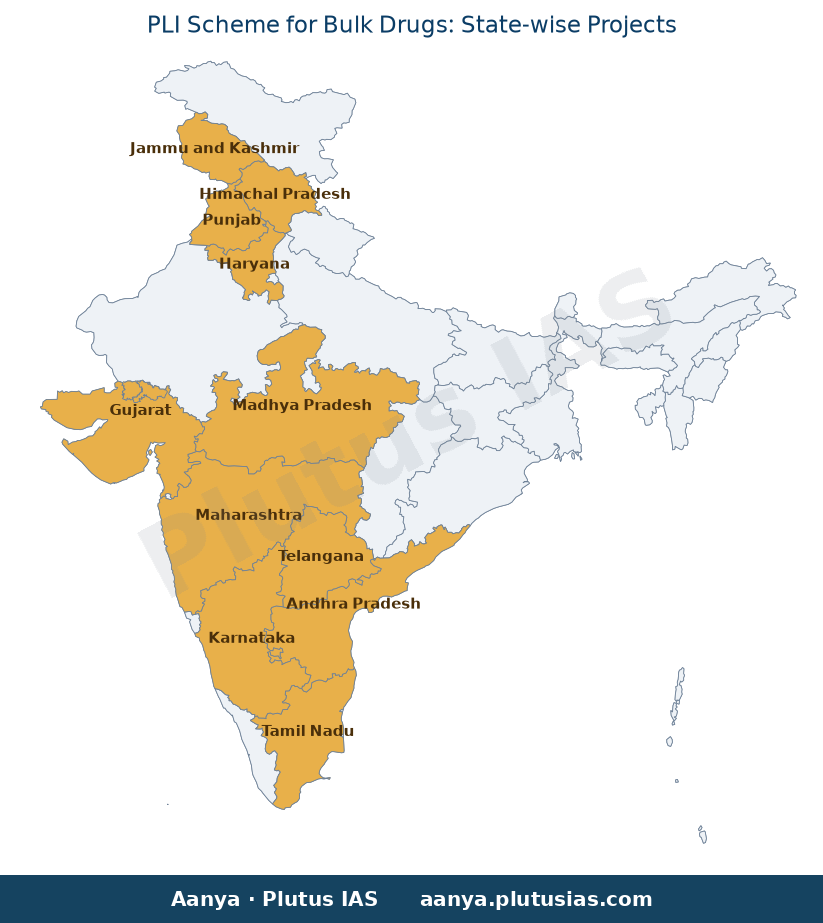
| State-wise Distribution | Projects approved across 8 states (Andhra Pradesh, Gujarat, Haryana, Himachal Pradesh, Jammu & Kashmir, Karnataka, Madhya Pradesh, Maharashtra, Punjab, Tamil Nadu, Telangana), with Andhra Pradesh and Gujarat leading in investment and capacity. |
Why it Matters
Economic Security
- Reduces India’s reliance on imports for critical pharmaceutical inputs, particularly from China, which supplies ~70% of India’s API imports.
- Enhances domestic value addition in the pharmaceutical sector, contributing to GDP growth and employment generation.
- Promotes backward integration in the pharmaceutical value chain, reducing vulnerability to global supply chain disruptions.
Strategic Autonomy
- Strengthens India’s position as a global leader in generic medicines by ensuring uninterrupted supply of essential APIs.
- Supports the ‘Atmanirbhar Bharat’ initiative by fostering self-sufficiency in critical healthcare inputs.
- Mitigates geopolitical risks associated with over-dependence on a single supplier for essential drugs.
Industrial Development
- Encourages investment in high-tech pharmaceutical manufacturing, fostering innovation and R&D in the sector.
- Boosts ancillary industries such as chemical intermediates, packaging, and logistics, creating a multiplier effect on the economy.
- Enhances India’s export competitiveness in pharmaceuticals by improving cost-efficiency and supply chain resilience.
Public Health Impact
- Ensures availability of affordable medicines by reducing production costs through domestic API manufacturing.
- Supports the production of essential drugs like antibiotics, anti-malarials, and cardiovascular medications, improving healthcare access.
- Contributes to the resilience of India’s healthcare system by reducing dependence on volatile global supply chains.
Challenges
1. Technological and R&D Gaps
- Limited indigenous R&D capabilities in high-end API synthesis, particularly for complex molecules.
- Dependence on imported raw materials for some KSMs, despite domestic production of APIs.
- Need for continuous upskilling of the workforce to handle advanced manufacturing processes.
UPSC Link: GS3: Industrial Policy and R&D
2. Infrastructure Bottlenecks
- Inadequate logistics and storage facilities for temperature-sensitive APIs in many states.
- Regulatory delays in environmental clearances for chemical manufacturing units.
- Limited availability of dedicated industrial land parcels in pharmaceutical hubs.
UPSC Link: GS3: Infrastructure and Logistics
3. Market and Policy Risks
- Price volatility in global API markets may affect the viability of domestic production.
- Competition from cheaper imports, particularly from China, could undermine the PLI scheme’s benefits.
- Need for long-term policy stability to sustain investor confidence in the sector.
UPSC Link: GS3: Trade and Investment
4. Environmental and Regulatory Compliance
- Stringent environmental norms for chemical manufacturing pose compliance challenges.
- Lack of harmonised regulatory frameworks across states for pharmaceutical production.
- Risk of penalties and shutdowns due to non-compliance with environmental standards.
UPSC Link: GS3: Environmental Governance
Challenges — UPSC Perspective
| Issue | Concern |
|---|---|
| High Capital Expenditure | Initial investment costs for setting up API manufacturing units are prohibitively high, deterring small and medium enterprises. |
| Skilled Manpower Shortage | Shortage of trained personnel in advanced pharmaceutical manufacturing and quality control. |
| Regulatory Delays | Prolonged approval processes for environmental clearances and drug manufacturing licenses. |
| Supply Chain Disruptions | Dependence on imported raw materials for some KSMs, exposing domestic production to global supply chain risks. |
| Market Competition | Price undercutting by cheaper imports, particularly from China, threatens the economic viability of domestic producers. |
| Technology Transfer Barriers | Limited access to proprietary technologies for high-end API synthesis, hindering domestic innovation. |
Way Forward
- Accelerate disbursement of PLI incentives to ensure timely realization of production targets and investment commitments.
- Strengthen R&D partnerships between industry, academia, and government to develop indigenous technologies for API synthesis.
- Invest in state-of-the-art infrastructure, including dedicated pharmaceutical parks with shared utilities and logistics hubs.
- Streamline regulatory approvals through a single-window clearance mechanism for pharmaceutical manufacturing units.
- Promote skill development programs in collaboration with industry to address the shortage of trained manpower in pharmaceutical manufacturing.
- Enhance market linkages for domestic API producers by facilitating export opportunities and preferential procurement by government agencies.
- Monitor and address supply chain vulnerabilities by diversifying sources of raw materials and promoting backward integration.
- Conduct periodic reviews of the PLI scheme to assess its impact and make necessary adjustments to policy and incentives.
UPSC Value Addition
Keywords for Mains Answer-Writing
Production-Linked Incentive Scheme for Bulk Drugs · Active Pharmaceutical Ingredients (APIs) · Critical Starting Materials (KSM) · Drug Intermediates (DI) · Self-reliance in pharmaceuticals · Atmanirbhar Bharat Mission · Pharmaceutical industry in India · Import substitution in pharmaceuticals · Production-Linked Incentive (PLI) Scheme · Domestic pharmaceutical manufacturing · Pharmaceutical Policy and Schemes · Union Budget and Pharmaceutical Sector
Concept Flow
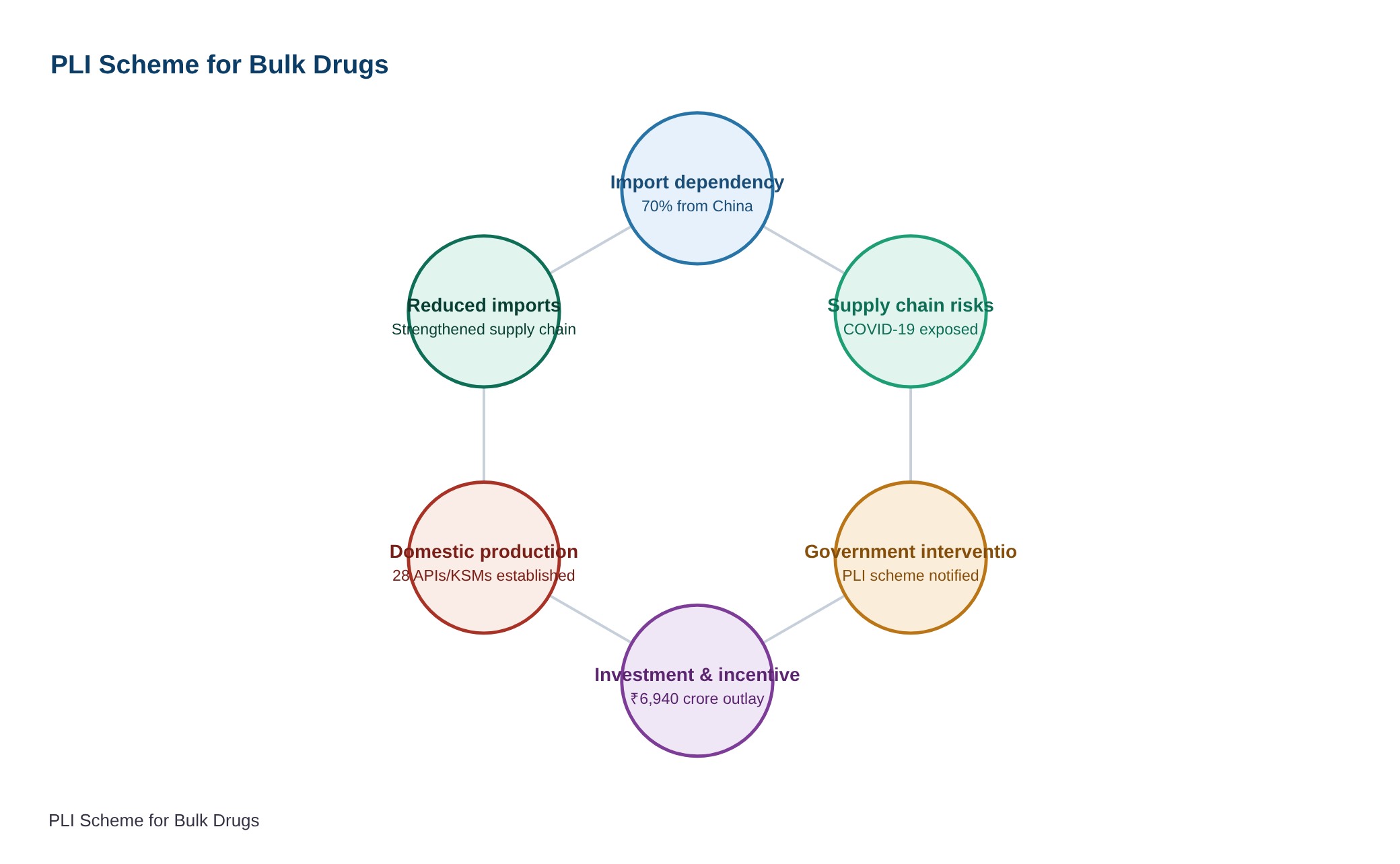
Import dependency on APIs and KSMs → Vulnerability to global supply chain disruptions → Government intervention through PLI scheme → PLI scheme approval → Financial incentives and investment commitments → Establishment of domestic manufacturing units → Domestic production of APIs/KSMs → Reduced import dependency → Enhanced self-reliance in pharmaceutical sector → Increased production capacity → Lower production costs → Improved affordability and availability of medicines → Strengthened pharmaceutical value chain → Boost to ancillary industries → Economic growth and employment generation → Enhanced strategic autonomy → Reduced geopolitical risks → Resilient healthcare system
Prelims Practice Questions
Q1. Consider the following statements regarding the Production-Linked Incentive (PLI) Scheme for Bulk Drugs:
1. The scheme aims to promote domestic production of Active Pharmaceutical Ingredients (APIs).
2. The scheme was notified under the Atmanirbhar Bharat Mission.
3. The scheme provides financial incentives linked to production volumes.
4. The scheme covers only fermentation-based APIs and excludes chemical synthesis-based APIs.
How many of the above statements are correct?
- Only one
- Only two
- Only three
- All four
Answer: Only three — Statements 1, 2, and 3 are correct. Statement 4 is incorrect as the scheme covers both fermentation-based and chemical synthesis-based APIs.
Q2. Assertion (A): The PLI Scheme for Bulk Drugs is designed to reduce India’s dependence on imports of critical pharmaceutical ingredients.
Reason (R): The scheme provides production-linked incentives to domestic manufacturers to scale up production of APIs and KSMs.
Options:
A. Both A and R are true, and R is the correct explanation of A.
B. Both A and R are true, but R is NOT the correct explanation of A.
C. A is true, but R is false.
D. A is false, but R is true.
Answer: ? — Both A and R are true, and R correctly explains A. The scheme’s objective is to enhance domestic production of APIs and KSMs, thereby reducing import dependence.
Q3. Match the following columns:
Column I (Product Category) | Column II (Examples of Products)
————————–|—————————–
A. Fermentation-based KSM | 1. Diclofenac Sodium
B. Chemical synthesis-based KSM | 2. Penicillin G
C. Active Pharmaceutical Ingredient (API) | 3. Clavulanic Acid
D. Drug Intermediate (DI) | 4. Atorvastatin
Options:
A. A-2, B-1, C-4, D-3
B. A-3, B-2, C-1, D-4
C. A-2, B-4, C-1, D-3
D. A-4, B-1, C-3, D-2
Answer: ? — A-2 (Penicillin G is a fermentation-based KSM), B-4 (Atorvastatin is a chemical synthesis-based API), C-1 (Diclofenac Sodium is an API), D-3 (Clavulanic Acid is a drug intermediate).
Mains Practice Question
✍ The Production-Linked Incentive (PLI) Scheme for Bulk Drugs is a critical policy intervention aimed at reducing India’s reliance on imported Active Pharmaceutical Ingredients (APIs) and ensuring self-sufficiency in the pharmaceutical sector. Critically analyse the scheme’s design, implementation challenges, and its potential to achieve the stated objectives. Also, examine the role of state-level initiatives in complementing the central scheme. (15 Marks)
Approach: MODEL-ANSWER SKELETON:
1. **Introduction (2 Marks)**
– Define APIs, KSMs, and DI in the pharmaceutical value chain.
– Contextualise the scheme within the broader Atmanirbhar Bharat Mission and India’s pharmaceutical sector (e.g., India’s status as the ‘pharmacy of the world’ and its import dependence for APIs).
2. **Design of the PLI Scheme for Bulk Drugs (4 Marks)**
– Objectives: Reduce import dependence, enhance domestic production, and promote self-reliance.
– Key features: Production-linked incentives (financial support per unit of production), eligibility criteria (e.g., minimum investment thresholds), and coverage of both fermentation-based and chemical synthesis-based APIs.
– Financial outlay: ₹6,940 crore approved, with ₹87.70 crore disbursed as incentives by March 2026.
– Approved projects: 48 projects across states, with a total committed investment of ₹4,329.95 crore and actual investment of ₹5,070.45 crore.
3. **Implementation Challenges (4 Marks)**
– **State-wise disparities**: Uneven distribution of projects (e.g., Andhra Pradesh with 10 projects vs. Haryana with 1 project).
– **Investment gaps**: Discrepancies between committed and actual investments (e.g., Maharashtra’s high capacity but lower actual production).
– **Time lag**: 10 out of 28 approved products have not yet achieved commercial production.
– **Regulatory and infrastructural bottlenecks**: Land acquisition, environmental clearances, and availability of skilled labour.
– **Market dynamics**: Competition from established global players and price sensitivity in the pharmaceutical market.
4. **Potential to Achieve Objectives (3 Marks)**
– **Short-term gains**: 18 APIs already in production (e.g., Penicillin G, Atorvastatin), reducing import dependence.
– **Long-term sustainability**: Scaling up production capacity (e.g., 28 products with established capacity) and reducing import bills for critical drugs.
– **Economic impact**: Job creation, technological upgradation, and export potential.
– **Limitations**: Dependency on global supply chains for raw materials and the need for continuous policy support.
5. **Role of State-Level Initiatives (2 Marks)**
– **Complementary policies**: State governments can provide infrastructure support, tax incentives, and ease of doing business reforms.
– **Examples**: Gujarat and Maharashtra, with higher investments and production capacities, demonstrate the role of state-level proactiveness.
– **Challenges**: Coordination between central and state agencies, and ensuring equitable distribution of benefits.
6. **Conclusion (2 Marks)**
– Summarise the scheme’s potential and challenges.
– Emphasise the need for a multi-stakeholder approach (central government, state governments, industry, and academia) to ensure long-term success.
– Highlight the importance of monitoring and evaluation mechanisms to track progress and address bottlenecks.
Source: PIB (Press Information Bureau)
Generated by AanyaAi for educational purpose.

- महाराष्ट्र में त्योहार जुलूसों पर बॉम्बे हाईकोर्ट का बड़ा फैसला: पटाखे, लेजर और संगीत पर रोक - September 24, 2026
- Bombay HC Bans Firecrackers, Music in Maharashtra Processions: Key UPSC Analysis - September 24, 2026
- तमिलनाडु में महिला कर्मचारियों के लिए सवैतनिक माहवारी अवकाश नीति पर HC का आदेश - September 24, 2026

No Comments