


07 Aug PLI Scheme for Pharma Sector: Key Facts for UPSC & State PCS 2026
✎ The PLI scheme for pharmaceuticals disburses incentives based on incremental sales of domestically manufactured drugs and bulk drugs, with ₹6,659 crore already released under the main scheme and ₹87.70 crore under the bulk drugs…
Subject Relevance — Where This Topic Fits
- GS Paper III — Indian Economy: Issues relating to growth, development and employment | GS Paper III — Government Budgeting and Fiscal Policy | GS Paper III — Effects of Liberalization on the Economy
- Prelims: Production-Linked Incentive (PLI) Scheme, Pharmaceutical Sector, Drugs and Cosmetics Act, Fermatation-based bulk drugs, Component-linked Incentive (CLI)
- Essay: India’s pharmaceutical sector: A global leader in the making, Role of government incentives in fostering industrial growth and self-reliance
Quick Revision: The PLI scheme for pharmaceuticals disburses incentives based on incremental sales of domestically manufactured drugs and bulk drugs, with ₹6,659 crore already released under the main scheme and ₹87.70 crore under the bulk drugs segment as of March 2026.
Why is this in the news?
The Press Information Bureau (PIB) released an official update on 7 August 2026 regarding the progress of the Production-Linked Incentive (PLI) Scheme for the pharmaceutical sector, highlighting disbursement figures, implementation challenges, and sector-specific constraints such as fermentation-based bulk drug production timelines and regulatory bottlenecks. This development is significant as it reflects the government’s ongoing efforts to enhance domestic pharmaceutical manufacturing capacity and reduce import dependency while addressing ground-level implementation hurdles.
Background
- The PLI scheme was introduced as part of India’s broader Atmanirbhar Bharat initiative to boost domestic manufacturing across key sectors, including pharmaceuticals.
- The scheme aims to incentivize production by offering financial rewards based on incremental sales of domestically manufactured goods, thereby enhancing competitiveness and reducing reliance on imports.
- The pharmaceutical PLI scheme was launched in FY 2022-23 with a total outlay of ₹15,000 crore, targeting both finished formulations and bulk drugs.
- A separate PLI scheme for bulk drugs with an outlay of ₹6,940 crore was also introduced to strengthen the upstream pharmaceutical value chain.
- Implementation challenges in the bulk drug segment include prolonged gestation periods for fermentation-based production, regulatory approval delays, and high utility costs.
What is the Production-Linked Incentive (PLI) Scheme for Pharmaceuticals?
- The PLI scheme for pharmaceuticals is a performance-based incentive mechanism designed to promote domestic manufacturing of drugs and bulk drugs by providing financial incentives linked to incremental sales.
- The scheme covers two primary segments: (i) finished formulations and (ii) bulk drugs, each with dedicated outlays and eligibility criteria.
- Incentives are disbursed based on actual sales of eligible products, ensuring that subsidies are tied to real economic output rather than mere investment commitments.
- The total outlay for the pharmaceutical PLI scheme is ₹15,000 crore, while the bulk drugs segment has an additional ₹6,940 crore allocation.
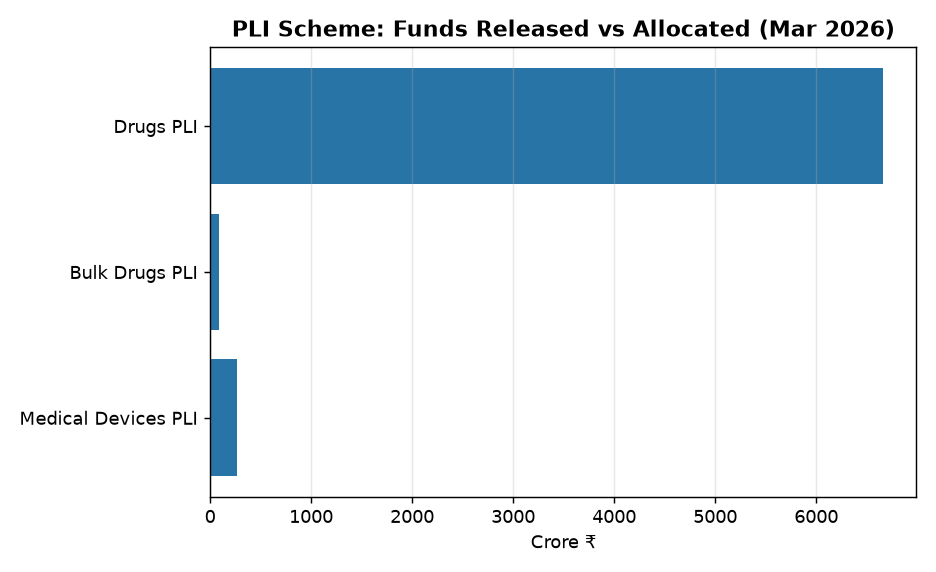
- As of March 2026, ₹6,659 crore has been disbursed under the pharmaceutical PLI scheme, ₹87.70 crore under the bulk drugs PLI scheme, and ₹266.64 crore under the medical devices PLI scheme.
- The scheme prioritizes high-value, critical bulk drugs, including those used in fermentation processes, which are essential for reducing import dependence in essential medicines.
- Implementation challenges include regulatory approvals (e.g., environmental clearances, land acquisition), high utility costs, and the inherent biological constraints of fermentation-based production, which requires living cells and longer production cycles.
Key Features
| Feature | Significance |
|---|---|
| Financial Outlay | The PLI scheme for pharmaceuticals has a total outlay of ₹15,000 crore, with ₹6,659 crore disbursed by March 2026, indicating substantial fiscal commitment to incentivize domestic production. |
| Dual Scheme Structure | The pharmaceutical sector operates under two distinct PLI schemes: one for finished formulations (₹15,000 crore) and another for bulk drugs (₹6,940 crore), reflecting targeted support for different stages of the supply chain. |
| Performance-Based Disbursement | Incentives are linked to actual sales of manufactured products, ensuring fiscal prudence but creating delays in disbursement for projects with prolonged gestation periods. |
| Sector-Specific Focus | The bulk drugs PLI scheme faces unique challenges due to the biological nature of fermentation processes, necessitating tailored policy interventions. |
| Inter-Ministerial Coordination | Implementation involves coordination between the Department of Pharmaceuticals, Ministry of Chemicals and Fertilizers, and state agencies, highlighting the need for streamlined governance. |
Why it Matters
Economic Resilience
- Enhances India’s self-reliance in critical pharmaceutical ingredients, reducing import dependence for bulk drugs and formulations.
- Supports the ‘Atmanirbhar Bharat’ initiative by fostering domestic manufacturing capabilities in a high-value sector.
- Encourages investment in high-technology manufacturing, potentially positioning India as a global hub for pharmaceutical production.
Strategic Autonomy
- Reduces vulnerability to supply chain disruptions in essential medicines, particularly post-pandemic global trade uncertainties.
- Strengthens India’s role in global pharmaceutical value chains, aligning with the ‘Pharma Vision 2024’ goals.
- Mitigates risks associated with geopolitical tensions affecting imports of active pharmaceutical ingredients (APIs).
Industrial Policy Innovation
- Demonstrates India’s adoption of outcome-based incentive models, contrasting with traditional subsidy regimes.
- Showcases the use of production-linked incentives to drive sectoral transformation, a model replicated in other industries like electronics and solar manufacturing.
- Highlights the need for adaptive policy frameworks to address sector-specific bottlenecks, such as biological manufacturing constraints.
Employment Generation
- Stimulates job creation in pharmaceutical manufacturing, R&D, and ancillary industries, particularly in tier-2 and tier-3 cities.
- Promotes skill development in specialized domains like fermentation technology and bioprocess engineering.
Challenges
1. Biological Manufacturing Constraints
- Fermentation-based bulk drug production relies on living cell growth, which is inherently slow and sensitive to environmental conditions.
- Delays in project implementation due to prolonged construction and approval timelines for fermentation facilities.
- High utility costs and regulatory hurdles (e.g., environmental clearances) exacerbate gestation periods.
UPSC Link: GS3: Industrial Policy
2. Fiscal Disbursement Lag
- Performance-linked disbursement mechanisms delay incentive payouts, straining the financial viability of early-stage projects.
- Mismatch between project timelines and fiscal disbursement cycles, particularly for bulk drug manufacturers.
UPSC Link: GS3: Public Finance
3. Land Acquisition and Regulatory Bottlenecks
- Prolonged land acquisition processes and environmental clearances delay project commissioning.
- High compliance costs for industrial units, particularly in states with stringent regulatory frameworks.
UPSC Link: GS2: Governance
4. Competition from Established Markets
- Global competitors (e.g., China, EU) offer lower production costs and faster turnaround times for bulk drugs.
- Risk of domestic manufacturers relocating to countries with more favorable regulatory and fiscal environments.
UPSC Link: GS3: International Trade
5. Technology and R&D Gaps
- Limited domestic capacity in advanced fermentation technologies and bioprocess optimization.
- Dependence on imported machinery and raw materials for high-purity bulk drug production.
UPSC Link: GS3: Science & Technology
Challenges — UPSC Perspective
| Issue | Concern |
|---|---|
| Fermentation-Based Production | Biological processes are slow and sensitive, leading to extended project timelines and higher costs. |
| Regulatory Approvals | Environmental clearances and land acquisition delays hinder timely project implementation. |
| Fiscal Disbursement | Performance-linked incentives create cash-flow gaps for manufacturers during gestation periods. |
| Global Competition | Lower-cost producers in China and Europe pose a threat to domestic market share. |
| Technology Gaps | Insufficient domestic R&D in fermentation technologies limits competitiveness. |
| Utility Costs | High energy and water costs for fermentation-based facilities reduce profit margins. |
Government Initiatives — Must-Memorise for Prelims
- Production-Linked Incentive (PLI) Scheme for Pharmaceuticals (2022-23)
- Production-Linked Incentive (PLI) Scheme for Bulk Drugs (2022-23)
Way Forward
- Streamline environmental clearances and land acquisition processes through single-window clearance mechanisms for fermentation-based projects.
- Introduce partial upfront disbursement of incentives to mitigate cash-flow constraints during project gestation periods.
- Establish dedicated R&D hubs for fermentation technologies in collaboration with academic institutions and private sector partners.
- Enhance fiscal incentives for high-purity bulk drug production to offset utility costs and global competition.
- Promote public-private partnerships to develop shared infrastructure for fermentation-based manufacturing.
- Expand skill development programs in bioprocess engineering and fermentation technology to address talent shortages.
- Monitor and review PLI disbursement mechanisms to align with sector-specific timelines and reduce delays.
- Strengthen India’s position in global pharmaceutical value chains by leveraging PLI outcomes to attract FDI in high-value drug manufacturing.
UPSC Value Addition
Keywords for Mains Answer-Writing
Production-Linked Incentive (PLI) Scheme · Pharmaceutical Sector · Bulk Drugs · Fermentation-based Manufacturing · Land Acquisition Challenges · Environmental Clearances · High Utility Costs · Drugs and Medical Devices · Manufacturing Delays · Production-Linked Incentives for Medical Devices · Department of Pharmaceuticals · Union Budget 2022-23 · Financial Outlay · Incentive Disbursement Mechanism · Regulatory Bottlenecks
Concept Flow
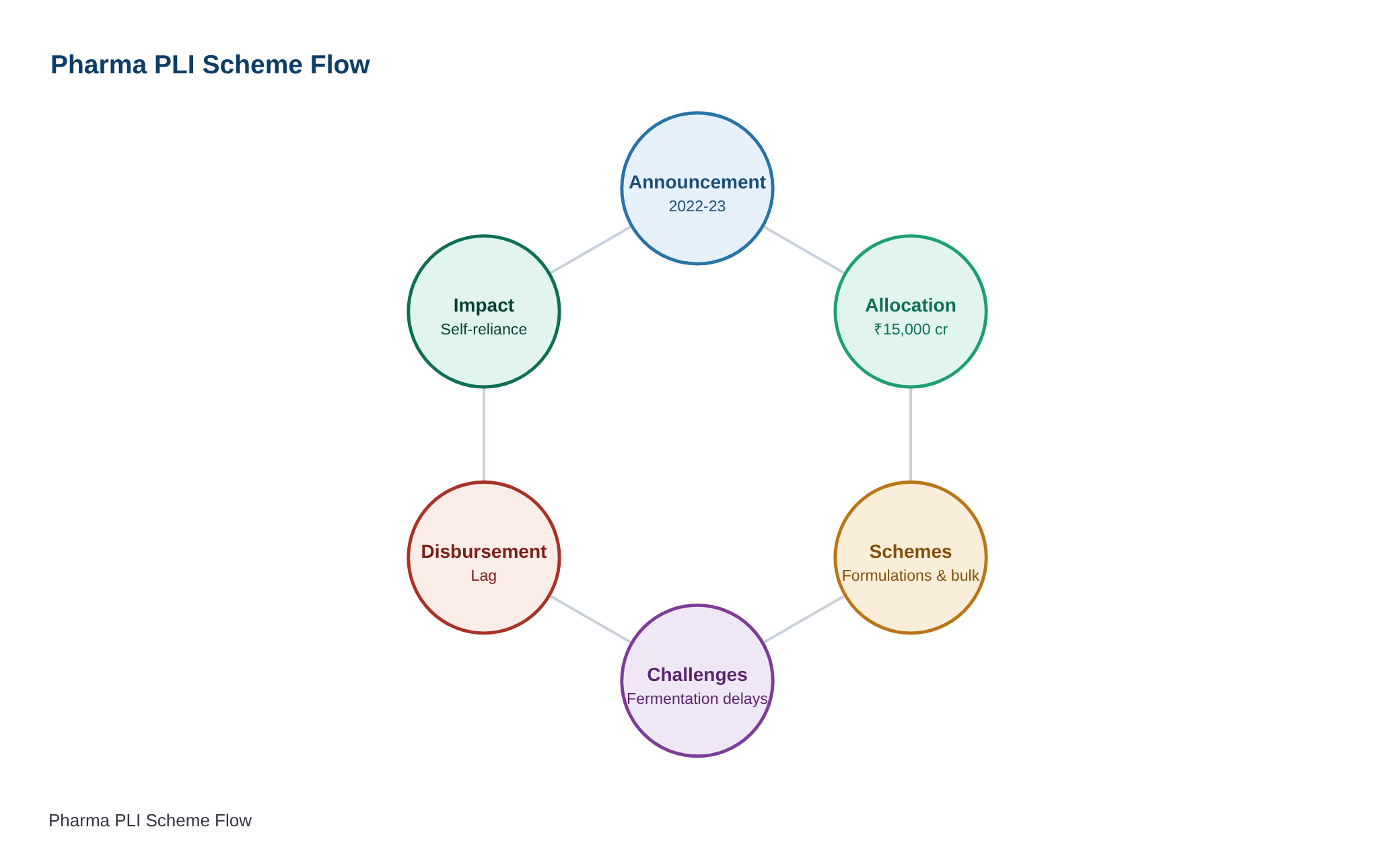
Pharmaceutical PLI Scheme Announcement (2022-23) → Fiscal Outlay Allocation (₹15,000 crore) → Sector-Specific PLI Schemes (Finished Formulations & Bulk Drugs) → Implementation Challenges (Fermentation Delays, Regulatory Bottlenecks) → Fiscal Disbursement Lag → Impact on Domestic Manufacturing & Self-Reliance → Policy Reforms (Way Forward)
Prelims Practice Questions
Q1. Consider the following statements regarding the Production-Linked Incentive (PLI) Scheme for the Pharmaceutical Sector:
1. The PLI Scheme for Pharmaceuticals was launched in the Union Budget 2022-23.
2. The total financial outlay for the PLI Scheme for Pharmaceuticals is ₹15,000 crore.
3. The PLI Scheme for Bulk Drugs has disbursed ₹87.70 crore as incentives by March 2026.
4. The PLI Scheme for Medical Devices has disbursed ₹266.64 crore as incentives by March 2026.
How many of the above statements are correct?
- Only one
- Only two
- Only three
- All four
Answer: All four — Statements 1, 2, and 3 are correct. Statement 4 is incorrect as the PLI Scheme for Medical Devices has disbursed ₹266.64 crore, but this is not part of the Pharmaceutical Sector PLI Scheme.
Q2. Assertion (A): The PLI Scheme for Bulk Drugs faces delays due to challenges such as land acquisition, environmental clearances, and high utility costs.
Reason (R): Fermentation-based manufacturing of bulk drugs relies on the slow growth of living cells, which prolongs the production cycle.
In the context of the above two statements, which one of the following is correct?
- Both A and R are true, and R is the correct explanation of A.
- Both A and R are true, but R is not the correct explanation of A.
- A is true, but R is false.
- A is false, but R is true.
Answer: Both A and R are true, and R is the correct explanation of A. — Both the Assertion (A) and Reason (R) are true, and R correctly explains the delays in the PLI Scheme for Bulk Drugs due to the inherent nature of fermentation-based manufacturing.
Mains Practice Question
✍ Critically analyse the implementation challenges faced by the Production-Linked Incentive (PLI) Scheme for the Pharmaceutical Sector in India. How do these challenges impact the disbursement of incentives and the overall objectives of the scheme? (15 Marks)
Approach: MODEL-ANSWER SKELETON:
1. **Introduction (2 Marks)**: Define the PLI Scheme for Pharmaceuticals and its objectives (e.g., enhancing domestic manufacturing, reducing import dependence, promoting self-reliance in critical drugs). Cite the financial outlay (₹15,000 crore) and the disbursement figures (₹6,659 crore for drugs, ₹87.70 crore for bulk drugs by March 2026).
2. **Implementation Challenges (6 Marks)**:
– **Regulatory and Land Acquisition Bottlenecks**: Highlight delays due to land acquisition, environmental clearances, and utility costs, citing the PIB press release.
– **Technological and Process-Specific Issues**: Explain the inherent delays in fermentation-based bulk drug manufacturing (e.g., reliance on living cells, slow growth rates) and contrast it with chemical synthesis.
– **Incentive Disbursement Mechanism**: Discuss how the scheme ties incentives to sales, leading to delayed disbursements when projects face operational hurdles.
3. **Impact on Objectives (4 Marks)**:
– **Delayed Disbursement**: Explain how delays in incentive disbursement undermine the financial viability of projects and discourage participation.
– **Missed Targets**: Discuss the gap between the financial outlay and actual disbursements, and its implications for domestic manufacturing capacity.
– **Competitive Disadvantage**: Highlight how delays erode India’s competitiveness in the global pharmaceutical market.
4. **Way Forward (3 Marks)**:
– **Streamlining Regulatory Processes**: Propose expedited clearances for pharmaceutical projects (e.g., single-window clearance, fast-track environmental approvals).
– **Financial Support Mechanisms**: Suggest interim financial support or staggered disbursements to mitigate cash-flow issues for manufacturers.
– **Technology Adaptation**: Encourage diversification into non-fermentation-based bulk drug manufacturing or adoption of hybrid models to reduce delays.
Balance of Views: Acknowledge the government’s intent to boost domestic manufacturing while critiquing the structural and procedural gaps that hinder implementation.
Source: PIB (Press Information Bureau)
Generated by AanyaAi for educational purpose.

- महाराष्ट्र में त्योहार जुलूसों पर बॉम्बे हाईकोर्ट का बड़ा फैसला: पटाखे, लेजर और संगीत पर रोक - September 24, 2026
- Bombay HC Bans Firecrackers, Music in Maharashtra Processions: Key UPSC Analysis - September 24, 2026
- तमिलनाडु में महिला कर्मचारियों के लिए सवैतनिक माहवारी अवकाश नीति पर HC का आदेश - September 24, 2026

No Comments