


07 Aug PLI Scheme for Pharma Sector: Progress & Challenges in 2026
✎ The PLI scheme for pharmaceuticals is a performance-linked incentive mechanism with a ₹15,000 crore outlay, designed to reduce India’s import dependence on APIs and bulk drugs by promoting domestic manufacturing through…
Subject Relevance — Where This Topic Fits
- GS Paper III — Indian Economy: Issues relating to Planning, Mobilization of Resources, Growth, Development and Employment | GS Paper III — Effects of Liberalization on the Economy, Changes in Industrial Policy and their Effects on Industrial Growth
- Prelims: Production-Linked Incentive (PLI) Scheme, Pharmaceutical Promotion and Development Scheme (PPDS), Bulk Drugs (Active Pharmaceutical Ingredients – APIs), Fermentation-based manufacturing in pharmaceuticals, Component-Linked Incentive (CLI), Department of Pharmaceuticals (DoP), Union Budget 2022-23 allocations, Make in India, Atmanirbhar Bharat
- Essay: The imperative of self-reliance in critical sectors: A case study of India’s pharmaceutical PLI scheme, Balancing industrial policy with global competitiveness: Lessons from India’s PLI schemes
Quick Revision: The PLI scheme for pharmaceuticals is a performance-linked incentive mechanism with a ₹15,000 crore outlay, designed to reduce India’s import dependence on APIs and bulk drugs by promoting domestic manufacturing through incremental sales-based disbursements.
Why is this in the news?
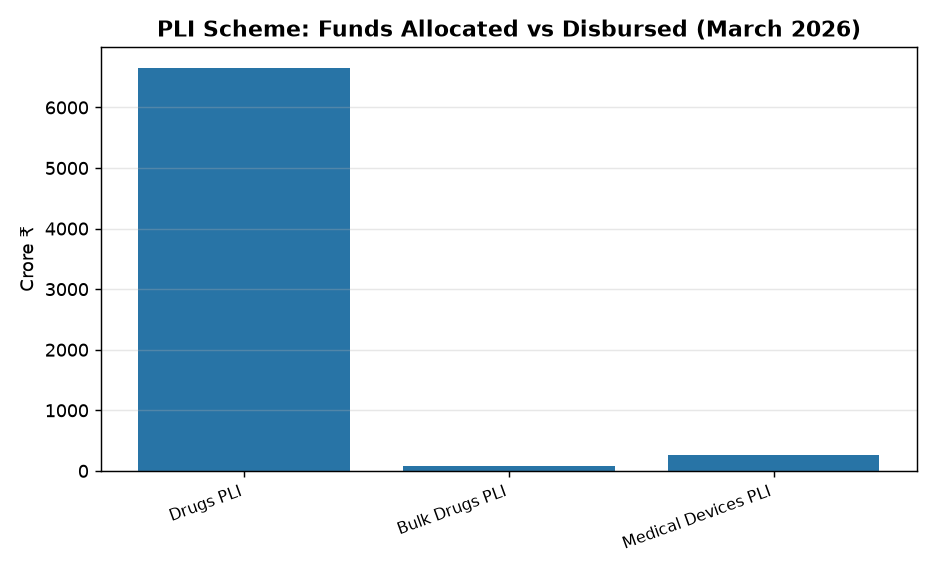
The Press Information Bureau (PIB) released an official update on 7 August 2026 detailing the progress of the Production-Linked Incentive (PLI) Scheme for the pharmaceutical sector, including its sub-schemes for drugs, bulk drugs (APIs), and medical devices. The report highlights the disbursement of ₹6,659 crore under the main PLI scheme for drugs and ₹87.70 crore under the bulk drugs sub-scheme as of March 2026, while also outlining implementation challenges such as regulatory delays and fermentation-based production constraints. This development is significant for UPSC aspirants as it reflects India’s strategic efforts to enhance domestic pharmaceutical manufacturing under the Atmanirbhar Bharat initiative and aligns with broader economic policy questions in the civil services examination.
Background
- The PLI scheme was introduced by the Government of India in 2020 as a strategic intervention to boost domestic manufacturing across key sectors, including pharmaceuticals, electronics, and medical devices.
- The scheme operates alongside other initiatives such as the Pharmaceutical Promotion and Development Scheme (PPDS) and the Promotion of Medical Device Parks Scheme to create a comprehensive ecosystem for pharmaceutical manufacturing.
- India is the world’s third-largest pharmaceutical market by volume and the largest supplier of generic medicines globally, yet it remains heavily reliant on China for key API imports (over 70% for certain categories).
- The scheme’s design incorporates performance-linked incentives, where financial support is disbursed based on incremental sales of domestically manufactured products, ensuring accountability and efficiency.
- The COVID-19 pandemic exposed vulnerabilities in global supply chains, accelerating India’s push for self-reliance in critical sectors, including pharmaceuticals.
What is the Production-Linked Incentive (PLI) Scheme for the Pharmaceutical Sector?
- The PLI scheme for pharmaceuticals is an initiative launched in FY 2022-23 under the Department of Pharmaceuticals (DoP), Ministry of Chemicals and Fertilizers, with a total financial outlay of ₹15,000 crore.
- The scheme incentivizes domestic manufacturing of pharmaceutical products, including formulations, bulk drugs (APIs), and medical devices, by providing financial incentives linked to incremental sales over a base year.
- The scheme is divided into three sub-schemes: (i) PLI Scheme for Pharmaceuticals (formulations), (ii) PLI Scheme for Bulk Drugs (APIs), and (iii) PLI Scheme for Medical Devices, each with distinct eligibility criteria and incentive structures.
- The PLI Scheme for Pharmaceuticals (formulations) aims to promote large-scale manufacturing of high-value generic drugs, patented medicines, and complex generics, with incentives ranging up to 10% of incremental sales for eligible products.
- The PLI Scheme for Bulk Drugs (APIs) targets the production of critical APIs, including fermentation-based drugs, with incentives structured to support high-cost, long-lead-time projects. As of March 2026, only ₹87.70 crore has been disbursed under this sub-scheme due to implementation challenges.
- The PLI Scheme for Medical Devices focuses on high-risk, high-technology devices such as implants, diagnostic equipment, and consumables, with incentives designed to attract investment in niche segments.
- The scheme’s design ensures that incentives are performance-based, disbursed only after sales realization, which has led to delays in fund utilization due to project implementation bottlenecks.
- The scheme aligns with the broader ‘Atmanirbhar Bharat’ (Self-Reliant India) mission and the National Pharmaceutical Policy 2023, which emphasize reducing import dependence and enhancing domestic value addition in the pharmaceutical value chain.
Key Features
| Feature | Significance |
|---|---|
| Financial Outlay of ₹15,000 crore for Pharmaceutical PLI | Aims to incentivize domestic manufacturing, reduce import dependence, and enhance India’s global pharmaceutical competitiveness. |
| Dual PLI Schemes: Drugs & Bulk Drugs | Separate schemes for finished formulations (₹15,000 cr) and bulk drugs (₹6,940 cr) to address distinct production challenges in the value chain. |
| Performance-Linked Disbursement | Incentives released based on actual sales of manufactured products, ensuring accountability and efficiency in fund utilisation. |
| Component-Linked Incentives in Medical Devices | A hybrid model combining PLI with component-specific incentives to attract diverse manufacturing segments. |
| Implementation Delays in Bulk Drug Projects | Challenges such as land acquisition, environmental clearances, and fermentation-based production timelines have slowed project execution. |
Why it Matters
Economic
- Enhances India’s self-reliance in critical pharmaceutical ingredients, reducing import dependency on China and other nations.
- Boosts domestic employment in high-skilled pharmaceutical manufacturing and allied sectors.
- Strengthens India’s position as the ‘pharmacy of the world’ by incentivizing high-value drug production.
- Promotes backward integration in the pharmaceutical value chain, reducing cost pressures on domestic formulators.
Strategic
- Mitigates supply chain vulnerabilities exposed during global crises (e.g., COVID-19 pandemic).
- Supports India’s Atmanirbhar Bharat initiative by fostering indigenous production capabilities.
- Encourages investment in fermentation-based bulk drug manufacturing, a niche with high entry barriers.
- Aligns with the National Pharmaceutical Policy 2023’s objective of achieving self-sufficiency in essential medicines.
Industrial
- Incentivizes large-scale manufacturing of high-cost, low-volume drugs critical for domestic and export markets.
- Facilitates technology transfer and R&D in fermentation-based drug production, a domain dominated by a few global players.
- Promotes clustering of pharmaceutical manufacturing units, enhancing economies of scale and supply chain efficiency.
Challenges
1. Regulatory and Land Acquisition Bottlenecks
- Lengthy environmental clearances and land acquisition processes delay project implementation, particularly for bulk drug units.
- High utility costs (e.g., water, electricity) further strain the financial viability of fermentation-based projects.
- Lack of streamlined single-window clearance mechanisms for pharmaceutical projects exacerbates delays.
UPSC Link: Environmental Impact Assessment (EIA) 2006
2. Technological and Production Constraints
- Fermentation-based bulk drug production relies on slow-growing microbial cultures, leading to extended manufacturing cycles.
- Reliance on imported fermentation strains and high-purity substrates increases production costs.
- Limited domestic capacity in high-end fermentation bioreactors constrains scale-up potential.
UPSC Link: Biotechnology and Industrial Policy
3. Financial Disbursement Lag
- Performance-linked disbursement of incentives creates cash-flow challenges for manufacturers, especially startups.
- Delays in project execution reduce the quantum of sales-linked incentives disbursed, limiting the scheme’s immediate impact.
- Insufficient working capital support for firms awaiting incentive disbursements hampers operational continuity.
UPSC Link: Direct Benefit Transfer (DBT) Mechanism
4. Market and Competitiveness Issues
- Global pharmaceutical markets are highly competitive, with price-sensitive demand limiting profit margins for incentivized products.
- Dependence on bulk drug imports for some formulations undermines the scheme’s objectives of backward integration.
- Limited adoption of PLI incentives by smaller manufacturers due to high compliance and documentation burdens.
UPSC Link: WTO Agreement on Trade-Related Aspects of Intellectual Property Rights (TRIPS)
Challenges — UPSC Perspective
| Issue | Concern |
|---|---|
| Environmental Clearances | Delays in obtaining clearances under the EIA Notification 2006 hinder project timelines. |
| Land Acquisition | Protracted land acquisition processes, especially in industrial corridors, delay project commissioning. |
| Fermentation-Based Production | Biological constraints in microbial growth extend production cycles, increasing time-to-market. |
| Financial Viability | High utility costs and imported inputs erode profit margins, reducing incentive attractiveness. |
| Supply Chain Dependence | Reliance on imported fermentation strains and substrates creates vulnerability to global supply disruptions. |
| Compliance Burden | Complex documentation and reporting requirements deter participation from smaller firms. |
Government Initiatives — Must-Memorise for Prelims
- Production-Linked Incentive (PLI) Scheme for Medical Devices (2020)
- National Pharmaceutical Policy 2023
Way Forward
- Streamline environmental clearances and land acquisition through a dedicated single-window portal for pharmaceutical projects.
- Introduce a partial upfront disbursement mechanism to address cash-flow challenges for manufacturers.
- Expand domestic R&D in fermentation biotechnology to reduce dependence on imported strains and substrates.
- Enhance incentives for fermentation-based bulk drug units to offset higher production costs and timelines.
- Establish industry-academia partnerships to develop cost-effective bioreactor technologies for domestic use.
- Mandate state governments to earmark dedicated industrial land parcels for bulk drug manufacturing.
- Promote clustering of pharmaceutical units in designated industrial corridors to leverage shared infrastructure.
- Conduct periodic reviews of the PLI scheme to identify bottlenecks and adjust incentive structures dynamically.
UPSC Value Addition
Keywords for Mains Answer-Writing
Production Linked Incentive (PLI) Scheme · Pharmaceutical sector · Bulk drugs production · Fermentation-based manufacturing · Land acquisition challenges · Environmental clearances · Component-linked incentives · Industrial policy for pharmaceuticals · Atmanirbhar Bharat initiatives · Subsidy disbursement mechanisms · Supply chain resilience in pharmaceuticals · Public procurement of essential medicines
Concept Flow
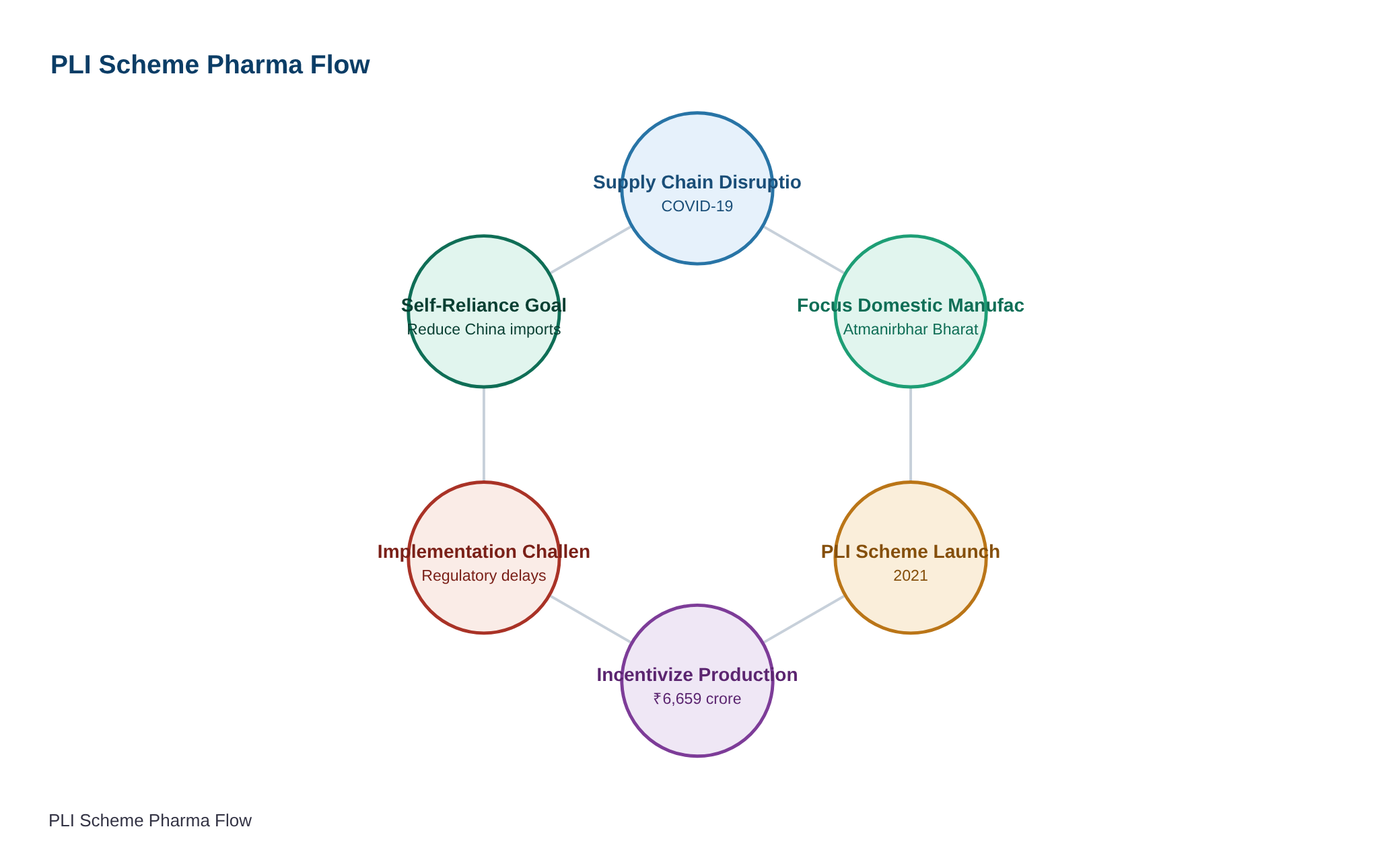
Global pharmaceutical supply chain disruptions (e.g., COVID-19) → Increased focus on domestic manufacturing → Launch of PLI schemes for pharmaceuticals and bulk drugs (2021) → Incentivization of high-value drug production → Implementation challenges (regulatory, technological, financial) → Delays in project execution and incentive disbursement → Impact on self-reliance goals → Need for structural reforms (clearances, R&D, financing) → Policy adjustments to enhance scheme effectiveness.
Prelims Practice Questions
Q1. Consider the following statements regarding the Production Linked Incentive (PLI) Scheme for the pharmaceutical sector:
1. The PLI Scheme for pharmaceuticals was launched in the financial year 2022-23.
2. The total financial outlay for the PLI Scheme for pharmaceuticals is ₹15,000 crore.
3. The PLI Scheme for bulk drugs has disbursed ₹87.70 crore as incentives by March 2026.
4. The PLI Scheme for medical devices follows a component-linked incentive framework exclusively.
How many of the above statements are correct?
- Only one
- Only two
- Only three
- All four
Answer: Only three — Statements 1, 2, and 3 are correct. Statement 4 is incorrect as the PLI Scheme for medical devices does not follow a component-linked incentive framework exclusively; it retains the PLI structure.
Q2. Assertion (A): Fermentation-based bulk drug manufacturing is a time-intensive process due to its reliance on the biological activity of living cells.
Reason (R): Unlike chemical synthesis, fermentation involves the growth of microorganisms, which is inherently slower and dependent on natural processes.
Code:
(A) Both A and R are true, and R is the correct explanation of A.
(B) Both A and R are true, but R is not the correct explanation of A.
(C) A is true, but R is false.
(D) A is false, but R is true.
- A
- B
- C
- D
Answer: A — Both the assertion and reason are true, and the reason correctly explains the assertion. Fermentation-based manufacturing is slower due to the biological growth of microorganisms, unlike chemical synthesis.
Q3. Match the following PLI Schemes with their respective financial outlays:
Column I (PLI Scheme) Column II (Financial Outlay in ₹ Crore)
A. Pharmaceuticals (Drugs) 1. ₹6,940 crore
B. Bulk Drugs 2. ₹15,000 crore
C. Medical Devices 3. Not specified in the given data
Options:
A-1, B-2, C-3
A-2, B-1, C-3
A-3, B-2, C-1
A-3, B-1, C-2
- A-1, B-2, C-3
- A-2, B-1, C-3
- A-3, B-2, C-1
- A-3, B-1, C-2
Answer: A-2, B-1, C-3 — The PLI Scheme for pharmaceuticals (drugs) has a financial outlay of ₹15,000 crore (A-2). The PLI Scheme for bulk drugs has a financial outlay of ₹6,940 crore (B-1). The financial outlay for the PLI Scheme for medical devices is not specified in the given data (C-3).
Mains Practice Question
✍ The Production Linked Incentive (PLI) Scheme for the pharmaceutical sector represents a strategic shift towards self-reliance in critical healthcare manufacturing. Critically examine the efficacy of the PLI Scheme in achieving its objectives, with particular reference to the challenges faced in bulk drug production. (15 Marks)
Approach: MODEL-ANSWER SKELETON:
1. **Introduction (2 Marks)**
– Define the PLI Scheme and its objectives within the pharmaceutical sector.
– Contextualise the scheme within India’s broader ‘Atmanirbhar Bharat’ initiative and the need for self-reliance in critical healthcare manufacturing.
2. **Efficacy of the PLI Scheme (5 Marks)**
– **Achievements**: Highlight the disbursement of ₹6,659 crore for pharmaceuticals and ₹266.64 crore for medical devices by March 2026, demonstrating initial traction.
– **Challenges in Bulk Drug Production**:
– **Biological Constraints**: Fermentation-based bulk drug manufacturing is inherently slower due to the biological growth of microorganisms, unlike chemical synthesis.
– **Regulatory and Logistical Bottlenecks**: Land acquisition delays, environmental clearances, and high utility costs have impeded project implementation.
– **Incentive Disbursement Mechanism**: The scheme disburses incentives based on sales, which delays funding for capital-intensive projects with long gestation periods.
3. **Critical Analysis (5 Marks)**
– **Strengths**: The PLI Scheme has incentivised investment in critical sectors, reducing import dependence for essential medicines.
– **Limitations**:
– The scheme’s focus on sales-linked disbursement may not adequately support projects with high initial capital costs.
– The lack of a component-linked incentive framework for medical devices limits its attractiveness for high-value manufacturing.
– Delays in regulatory approvals undermine the scheme’s effectiveness in achieving rapid self-reliance.
– **Comparative Perspective**: Contrast the PLI Scheme with other industrial policy instruments like the Modified Special Incentive Package Scheme (M-SIPS) for electronics, which adopted a more flexible approach.
4. **Way Forward (3 Marks)**
– **Policy Reforms**: Suggest streamlining regulatory processes (e.g., single-window clearances) and adopting a hybrid incentive model combining PLI with component-linked incentives.
– **Infrastructure Development**: Emphasise the need for dedicated bulk drug parks with shared infrastructure to reduce costs and timelines.
– **Monitoring and Evaluation**: Propose a robust framework to track disbursement efficiency and project timelines, ensuring accountability.
**Balanced Conclusion**: The PLI Scheme is a step in the right direction but requires structural reforms to address biological, regulatory, and financial constraints in bulk drug production.
Source: PIB (Press Information Bureau)
Generated by AanyaAi for educational purpose.

- यूपी में पहली बार तेंदुओं का बधियाकरण: मानव-वन्यजीव संघर्ष रोकेगा अभियान - September 24, 2026
- UP’s Groundbreaking Leopard Sterilization Plan to Curb Human-Wildlife Conflict - September 24, 2026
- महाराष्ट्र में त्योहार जुलूसों पर बॉम्बे हाईकोर्ट का बड़ा फैसला: पटाखे, लेजर और संगीत पर रोक - September 24, 2026

No Comments