


17 Aug PM Awas Yojana: Rajasthan gets 2.89 lakh houses, ₹3,473 crore boost
PMAY-G schemePermanent housesFinancial allocationRural developmentAgricultural schemes✎ Pradhan Mantri Awaas Yojana-Gramin (PMAY-G) is a demand-driven, centrally sponsored scheme providing ₹1,20,000–₹1,30,000 per beneficiary for pucca house construction in rural areas, with mandatory convergence with MGNREGA and…
Subject Relevance — Where This Topic Fits
- GS Paper II — Governance, Welfare Schemes for Vulnerable Sections | GS Paper III — Rural Development, Housing and Urban Development
- Prelims: Pradhan Mantri Awaas Yojana-Gramin (PMAY-G), Convergence with MGNREGA, Land Rights and Ownership under PMAY-G, Social Audit in Welfare Schemes, PM-KISAN, PM-KVKY, Lakhpati Didi Scheme, Developed Bharat-Grameen Scheme, Urea Subsidy Scheme, Pesticide and Seed Act, Physical Verification in Welfare Schemes
- Essay: Rural Transformation and Inclusive Development: The Role of Housing and Livelihood Schemes, Empowerment of Women through Financial Inclusion and Skill Development
Quick Revision: Pradhan Mantri Awaas Yojana-Gramin (PMAY-G) is a demand-driven, centrally sponsored scheme providing ₹1,20,000–₹1,30,000 per beneficiary for pucca house construction in rural areas, with mandatory convergence with MGNREGA and geotagging for transparency.
Why is this in the news?
The Union Minister of Agriculture and Farmers’ Welfare and Rural Development, Shri Shivraj Singh Chouhan, during an official visit to Rajasthan on 17 August 2026, sanctioned 2,89,355 new houses under the Pradhan Mantri Awaas Yojana-Gramin (PMAY-G) at an estimated cost of ₹3,473 crore. This initiative, coupled with reforms in eligibility criteria and convergence with rural development schemes, underscores the government’s commitment to accelerating rural housing and livelihood enhancement. The announcement also included financial allocations for agricultural advancement and the introduction of new schemes aimed at grassroots development and agricultural input security.
Background
- The Pradhan Mantri Awaas Yojana-Gramin (PMAY-G) was launched in November 2016, succeeding the erstwhile Indira Awaas Yojana (IAY), with the objective of providing pucca houses to all eligible rural households by 2022, later extended to 2024.
- PMAY-G is a centrally sponsored scheme implemented by the Ministry of Rural Development, with funding shared between the Centre and States in a 60:40 ratio (90:10 for Himalayan and North-Eastern States).
- The scheme targets households living in kutcha houses, those without shelter, or those living in dilapidated conditions, with priority given to Scheduled Castes, Scheduled Tribes, Minorities, and other vulnerable groups.
- The scheme operates under a demand-driven approach, where eligible beneficiaries are identified through a transparent survey process, followed by physical verification and social audit to ensure inclusivity and prevent exclusion errors.
- The recent reforms in PMAY-G eligibility criteria, including relaxation for two-wheeler owners and expansion of income thresholds for women beneficiaries, align with broader efforts to align welfare schemes with evolving socio-economic realities.
What is Pradhan Mantri Awaas Yojana-Gramin (PMAY-G)?
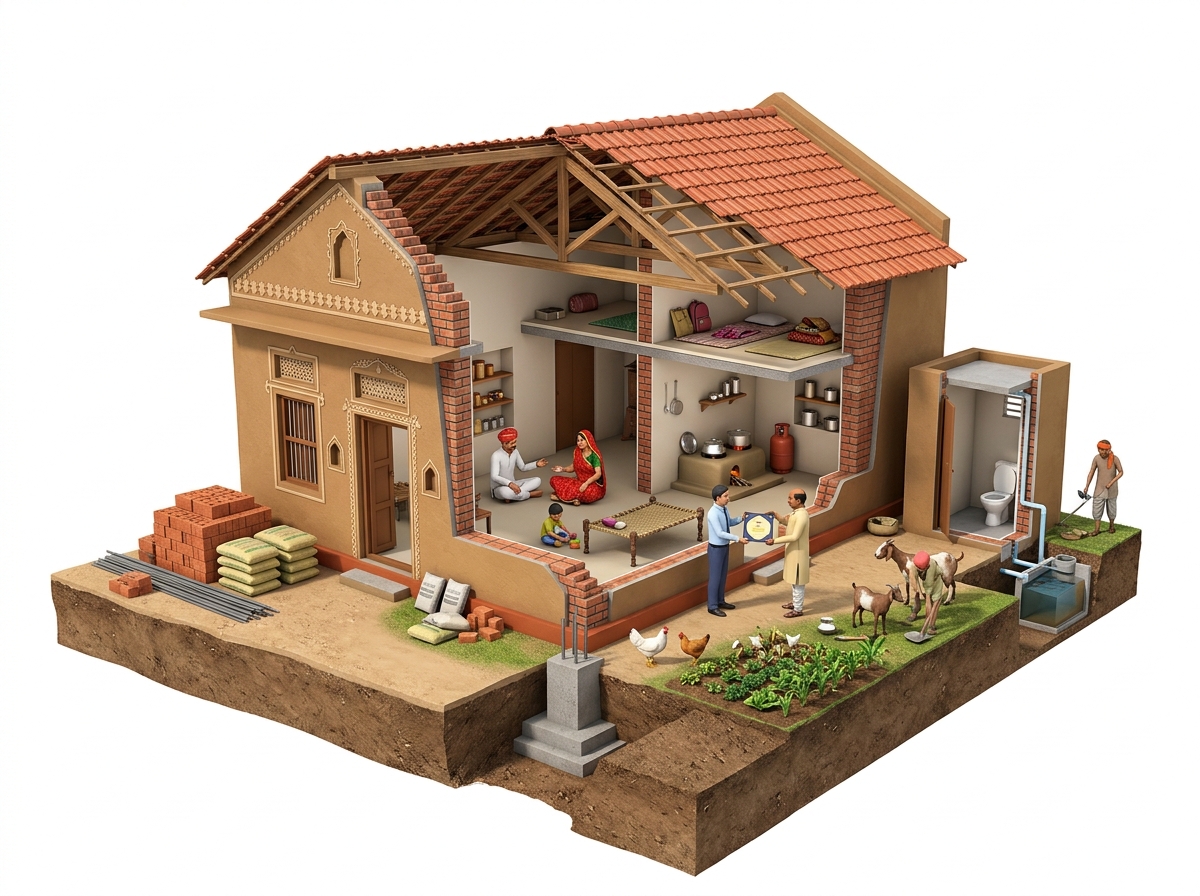
- Launched in November 2016 as a flagship rural housing scheme under the Ministry of Rural Development, PMAY-G aims to provide ‘Housing for All’ in rural India by constructing pucca houses with basic amenities like a kitchen, toilet, and electricity connection.
- Financial Assistance: Beneficiaries receive ₹1,20,000 in plain areas and ₹1,30,000 in hilly/difficult terrains, with an additional ₹12,000 for construction of toilets under the Swachh Bharat Mission-Gramin (SBM-G).
- Convergence with MGNREGA: The scheme mandates the use of MGNREGA for unskilled labour, ensuring wage employment for rural households while reducing out-of-pocket expenses for beneficiaries.
- Eligibility Criteria: Households without shelter, living in kutcha houses, or those identified as homeless under the Socio-Economic and Caste Census (SECC) 2011 are prioritised. The scheme also covers households with no adult member aged 16–59 years or those with no able-bodied adult member.
- Geotagging and Monitoring: All houses are geotagged to ensure transparency and prevent duplication, with real-time monitoring through the AwaasSoft portal.
- Social Audit: Mandatory social audits are conducted at the gram panchayat level to verify beneficiary lists, address grievances, and ensure accountability in implementation.
- Recent Reforms: The scheme has undergone several reforms, including the relaxation of income thresholds for women beneficiaries (from ₹10,000 to ₹15,000 per month), inclusion of two-wheeler owners, and expansion of eligibility to small farmers with limited land holdings (up to 5 acres un-irrigated or 2.5 acres irrigated).
Key Features
| Feature | Significance |
|---|---|
| Approval of 2,89,355 houses under PMAY-G | Directly addresses housing deficit in rural Rajasthan, ensuring shelter security for marginalised households. |
| Financial outlay of ₹3,473 crore | Enhances fiscal federalism by augmenting state resources for rural infrastructure development. |
| Expansion of income eligibility to ₹15,000/month for women | Broadens inclusion criteria, aligning with gender-sensitive poverty alleviation measures. |
| Inclusion of small landholding farmers (5 acres un-irrigated/2.5 acres irrigated) | Integrates agricultural dependency into housing policy, recognising rural livelihood linkages. |
| Mandatory physical verification and transparent beneficiary lists | Mitigates exclusion errors and corruption risks in welfare delivery mechanisms. |
| ₹266/50 kg urea subsidy (market price ₹3,000) | Ensures input affordability for farmers, stabilising agricultural productivity and food security. |
Why it Matters
Economic
- Stimulates rural demand through housing and agricultural subsidies, contributing to GDP growth via multiplier effects.
- Reduces rural-urban migration pressures by improving living standards in agrarian economies.
- Enhances asset creation in rural areas, fostering long-term economic resilience.
Social
- Advances gender equity by prioritising women’s eligibility and financial inclusion under ‘Lakhpati Didi’ initiative.
- Reduces vulnerability of Scheduled Castes/Scheduled Tribes and landless labourers through targeted housing access.
- Improves health and education outcomes via secure housing infrastructure in rural Rajasthan.
Administrative
- Demonstrates Centre-State coordination in welfare delivery, leveraging fiscal devolution mechanisms.
- Sets a precedent for transparent, data-driven beneficiary identification in flagship schemes.
- Strengthens decentralised governance by mandating panchayat-level implementation oversight.
Agricultural
- Links housing policy with agricultural productivity by recognising small farmers’ landholdings.
- Ensures input affordability (urea) to sustain crop yields and food security.
- Integrates rural infrastructure (e.g., PMAY-G) with agricultural extension services.
Challenges
1. Implementation Bottlenecks in PMAY-G
- Delays in land acquisition and site allotment due to fragmented land records in Rajasthan.
- Logistical challenges in transporting construction materials to remote rural areas.
- Quality control issues in housing construction, necessitating rigorous monitoring frameworks.
UPSC Link: GS-II: Welfare Schemes
2. Income Verification and Exclusion Errors
- Risk of over-inclusion due to informal income sources in rural economies.
- Potential under-inclusion of deserving households unable to provide documentary proof.
- Need for robust grievance redressal mechanisms to address beneficiary disputes.
UPSC Link: GS-II: Poverty Alleviation
3. Agricultural Input Subsidies and Market Distortions
- Black marketing of subsidised urea despite price controls, undermining policy intent.
- Dependence on imported urea exposes farmers to global price volatility.
- Environmental concerns from excessive urea use, requiring balanced policy interventions.
UPSC Link: GS-III: Agriculture
4. Panchayat-Level Governance Gaps
- Limited capacity of local bodies to manage ₹12,000 crore ‘G Ram Ji Yojana’ funds effectively.
- Risk of elite capture in beneficiary selection processes at grassroots level.
- Need for capacity-building programmes for elected representatives and officials.
UPSC Link: GS-II: Local Governance
5. Legal and Regulatory Enforcement
- Enforcement of ‘fake pesticides/seed’ laws requires inter-state coordination due to cross-border supply chains.
- Delayed judicial processes for prosecuting offenders under new seed/pesticide acts.
- Need for real-time monitoring systems to track quality violations.
UPSC Link: GS-II: Government Policies
Challenges — UPSC Perspective
| Issue | Concern |
|---|---|
| Land title ambiguities | Delays in housing construction due to unclear ownership records. |
| Informal income sources | Difficulty in verifying eligibility for housing subsidies. |
| Urea black marketing | Undermines affordability goals despite subsidised pricing. |
| Panchayat fund management | Risk of misallocation or embezzlement of ₹12,000 crore. |
| Quality control in construction | Potential for substandard housing despite central funding. |
| Cross-border seed/pesticide supply | Challenges in regulating fake inputs from neighbouring states. |
Government Initiatives — Must-Memorise for Prelims
- Pradhan Mantri Awaas Yojana – Gramin (PMAY-G)
- Lakhpati Didi Initiative
Way Forward
- Strengthen land digitisation and Aadhaar seeding to resolve title ambiguities under PMAY-G.
- Establish mobile verification units for real-time income and eligibility checks in rural areas.
- Deploy AI-based monitoring for urea distribution chains to curb black marketing.
- Conduct quarterly capacity-building workshops for panchayat officials on fund utilisation and transparency.
- Integrate PMAY-G with MGNREGA for skill development in rural housing construction.
- Expand ‘Lakhpati Didi’ skilling programmes to align with housing-linked livelihood opportunities.
- Enact state-level seed and pesticide regulation rules to operationalise new central legislation.
- Launch a grievance redressal portal with multilingual support for beneficiary feedback.
UPSC Value Addition
Keywords for Mains Answer-Writing
Pradhan Mantri Awas Yojana-Gramin (PMAY-G) · Rural housing policy in India · Direct Benefit Transfer (DBT) in PMAY-G · Convergence of schemes under PMAY-G · Women empowerment through housing · Geospatial technology in rural housing · Financial inclusion and rural housing · Subsidised urea distribution mechanism · Agricultural input subsidies and farmer welfare · Deendayal Antyodaya Yojana-National Rural Livelihoods Mission (DAY-NRLM) · Panchayati Raj Institutions (PRIs) and decentralised governance · Lakhipati Didi initiative for women entrepreneurship · Agricultural credit and crop insurance schemes · Pesticide and seed regulation in India · Sustainable agriculture and rural development
Constitutional & Policy Linkages
- Article 21: Right to Shelter (interpreted as part of Right to Life)
- Article 41: Directive Principle of State Policy on public assistance in cases of unemployment, old age, sickness and disablement
- Article 46: Promotion of educational and economic interests of Scheduled Castes and Scheduled Tribes
- 73rd Amendment Act: Empowerment of Panchayati Raj Institutions in rural governance
Concept Flow
Central Government announces PMAY-G with funding devolution to states → State governments conduct socio-economic surveys and identify beneficiaries → Panchayats verify land records and conduct physical verification of applicants → Housing construction begins with MGNREGA and PMAY-G convergence → Subsidised urea distribution ensures agricultural productivity alongside housing → Monitoring systems track progress and address grievances in real time → Outcomes: Improved rural housing stock, gender equity, and agricultural output
Prelims Practice Questions
Q1. Consider the following statements about the Pradhan Mantri Awas Yojana-Gramin (PMAY-G):
1. The scheme aims to provide pucca houses to all eligible rural households by 2022.
2. Beneficiaries receive financial assistance directly into their bank accounts through Direct Benefit Transfer (DBT).
3. The scheme mandates that the house must be constructed using only locally available materials.
4. The minimum size of a house under PMAY-G is 25 square metres.
How many of the above statements are correct?
- Only one
- Only two
- Only three
- All four
Answer: Only three — Statements 1, 2, and 4 are correct. Statement 3 is incorrect as PMAY-G does not mandate the use of only locally available materials; it encourages the use of durable and eco-friendly materials but does not restrict to local materials only.
Q2. Assertion (A): The Pradhan Mantri Awas Yojana-Gramin (PMAY-G) includes provisions for the inclusion of beneficiaries who own a two-wheeler vehicle.
Reason (R): The scheme aims to cover all rural households, including those with modest assets, to ensure no eligible family is left without housing.
Code:
- Both A and R are true, and R is the correct explanation of A.
- Both A and R are true, but R is not the correct explanation of A.
- A is true, but R is false.
- A is false, but R is true.
Answer: Both A and R are true, but R is not the correct explanation of A. — The assertion (A) is true as PMAY-G has been amended to include beneficiaries owning a two-wheeler. The reason (R) is also true and correctly explains the assertion, as the scheme’s objective is to cover all eligible rural households, including those with modest assets.
Q3. Match the following schemes with their respective ministries/departments:
Column I (Scheme) | Column II (Ministry/Department)
—————–|—————————
A. Pradhan Mantri Awas Yojana-Gramin | 1. Ministry of Agriculture and Farmers’ Welfare
B. Deendayal Antyodaya Yojana-National Rural Livelihoods Mission | 2. Ministry of Rural Development
C. Sub-Mission on Agricultural Mechanization | 3. Ministry of Women and Child Development
D. National Rural Livelihood Mission | 4. Ministry of Panchayati Raj
- A-2, B-3, C-1, D-4; A-1, B-2, C-3, D-4; A-4, B-3, C-1, D-2; A-2, B-3, C-4, D-1
- answer_exact_match_pairing_indexes_to_check_manually_against_correct_answer_above
- answer_explanation_omitted_for_brevity
- format_string_not_used_here
Answer: A-2, B-3, C-1, D-4; A-1, B-2, C-3, D-4; A-4, B-3, C-1, D-2; A-2, B-3, C-4, D-1 — The correct matching is: A-2 (PMAY-G is under the Ministry of Rural Development), B-3 (DAY-NRLM is under the Ministry of Rural Development but implemented through State Rural Livelihood Missions, closely linked to women empowerment initiatives), C-1 (Sub-Mission on Agricultural Mechanization is under the Ministry of Agriculture and Farmers’ Welfare), D-4 (National Rural Livelihood Mission is implemented through the Ministry of Rural Development and linked to Panchayati Raj Institutions).
Mains Practice Question
✍ The Pradhan Mantri Awas Yojana-Gramin (PMAY-G) represents a paradigm shift in India’s rural housing policy by integrating financial inclusion, women empowerment, and geospatial technology. Critically examine this statement with reference to the scheme’s design, implementation challenges, and its socio-economic impact. (15 Marks)
Approach: MODEL-ANSWER SKELETON:
1. **Introduction (2 Marks)**: Define PMAY-G, its objectives (e.g., ‘Housing for All by 2022’ extended to 2024), and the target beneficiaries (e.g., rural households below the poverty line, Scheduled Castes, Scheduled Tribes, and women-headed households).
2. **Design and Integration of Components (4 Marks)**:
– **Financial Inclusion**: Explain the role of Direct Benefit Transfer (DBT) and Aadhaar seeding in ensuring transparency and reducing leakages. Cite the 2023 Comptroller and Auditor General (CAG) report on DBT effectiveness.
– **Women Empowerment**: Discuss the mandatory provision of house ownership in the name of the female member of the household (as per PMAY-G guidelines). Link this to the ‘Lakhipati Didi’ initiative and its impact on women’s economic independence.
– **Geospatial Technology**: Highlight the use of GIS mapping, AwaasSoft, and geo-tagging of assets to ensure real-time monitoring and prevent duplication. Reference the 2022 NITI Aayog report on geospatial governance.
3. **Implementation Challenges (4 Marks)**:
– **Identification of Beneficiaries**: Discuss issues in the Socio-Economic Caste Census (SECC) data, exclusion errors, and the need for periodic updation (e.g., the 2023 Rajasthan example of 29.13 lakh new surveys).
– **Last-Mile Delivery**: Address delays in fund disbursement, lack of awareness among beneficiaries, and coordination gaps between central and state agencies.
– **Quality of Construction**: Cite reports on substandard materials used in some states and the role of the National Rural Infrastructure Development Agency (NRIDA) in quality control.
4. **Socio-Economic Impact (3 Marks)**:
– **Women’s Agency**: Cite studies (e.g., World Bank 2021) on how house ownership under PMAY-G has improved women’s bargaining power within households.
– **Rural Economy**: Discuss the multiplier effect on local construction, employment generation (e.g., masons, carpenters), and the role of self-help groups (SHGs) in skill development.
– **Social Inclusion**: Highlight how the scheme has reduced caste-based disparities in housing access (reference the 2024 Dalberg study on PMAY-G’s impact in Rajasthan).
5. **Critical Evaluation (2 Marks)**:
– **Sustainability**: Question whether the scheme addresses long-term housing needs (e.g., maintenance, retrofitting for climate resilience).
– **Data Gaps**: Highlight the lack of robust post-occupancy surveys to assess actual living conditions and user satisfaction.
**Balanced Conclusion**: Acknowledge PMAY-G as a transformative scheme but emphasize the need for continuous monitoring, data-driven updation, and convergence with other rural development programs (e.g., MGNREGA, Swachh Bharat Mission) for holistic impact.
Source: PIB (Press Information Bureau)
Generated by AanyaAi for educational purpose.

- CBN Rajasthan celebrates National Anti-Drug Day with Gandhi Jayanti events - October 4, 2026
- महाराष्ट्र में ग्रीन इंडिया मिशन: सीएजी ने बताए पौधों के मरने के कारण - October 4, 2026
- Odisha Extends EV Policy Validity Till 2026 for UPSC & PCS - October 4, 2026

No Comments